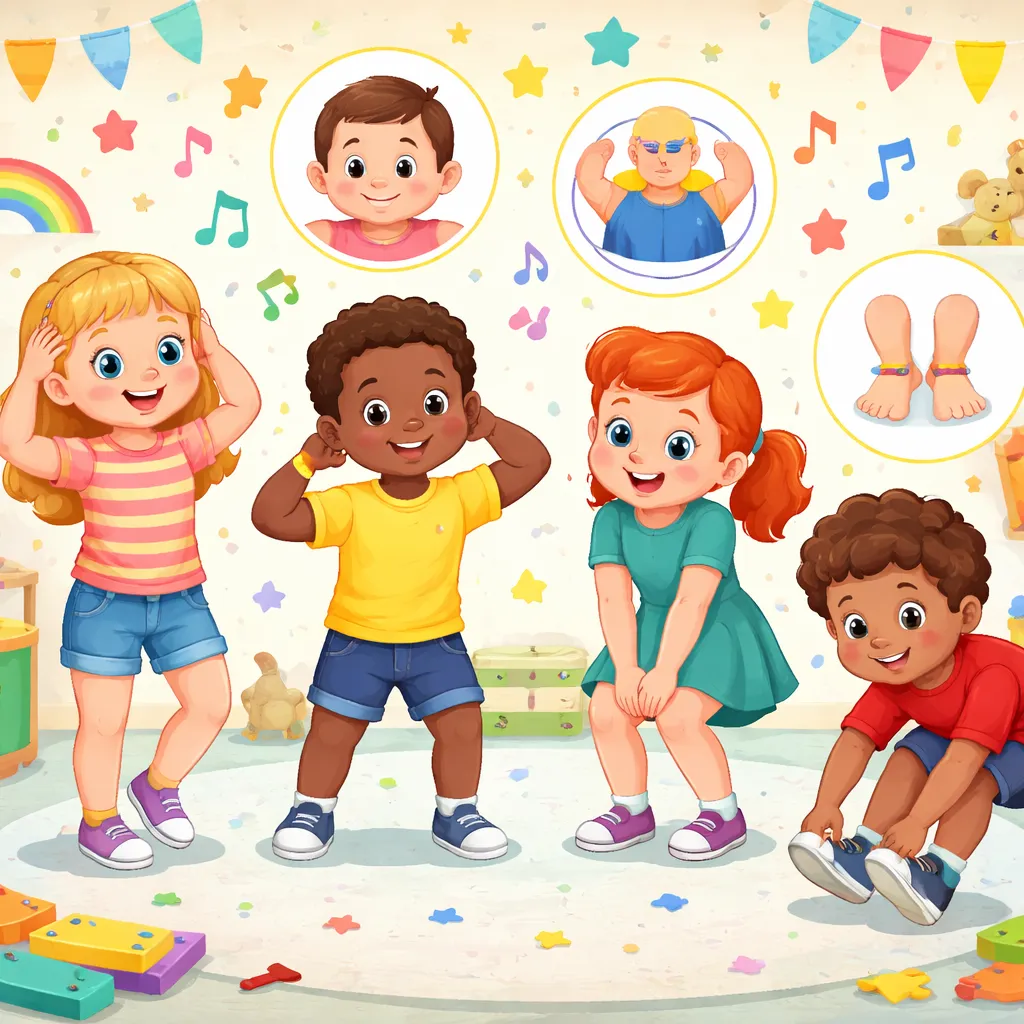

Do you know all the names of the parts of your body? What if you had to point to them, one after another, faster and faster? There is a super fun and energetic French action song that is a race against your own hands. It is a song about naming, touching, and speeding up. Let’s get ready to move and learn the super-speedy song “Head, Shoulders, Knees and Toes (Tête, épaules, genoux et pieds).”
About the Song
Here are the quick and catchy lyrics of the famous French version:
Tête, épaules, genoux et pieds,
Genoux et pieds.
Tête, épaules, genoux et pieds,
Genoux et pieds.
Et les yeux, et les oreilles, et la bouche et le nez!
Tête, épaules, genoux et pieds,
Genoux et pieds!
English Translation:
Head, shoulders, knees and toes,
Knees and toes.
Head, shoulders, knees and toes,
Knees and toes.
And eyes, and ears, and mouth and nose!
Head, shoulders, knees and toes,
Knees and toes!
This is the beloved French-language version of the international body parts action song. The song is a quick-fire list and a physical challenge. “Head, shoulders, knees and toes, knees and toes,” it starts, and you touch each part as you sing it. You repeat the line. Then comes a new, faster part: “And eyes, and ears, and mouth and nose!” where you quickly touch your face. Finally, you return to the main line: “Head, shoulders, knees and toes, knees and toes!” The magic is that you sing it faster each time, making it a hilarious race to keep up.
What the Song is About
The song is a fast-paced game of “touch and name.” Imagine you are standing up ready to play. You sing “Head,” and you touch your head. “Shoulders,” you touch both shoulders. “Knees,” you touch your knees. “And toes,” you bend to touch your toes. Then you quickly say “knees and toes” again, touching them once more.
You do the whole sequence again. Then, the song adds a tricky part. “And eyes,” you point to your eyes. “And ears,” you pull on your ears. “And mouth,” you point to your mouth. “And nose!” you boop your nose. It gets very fast! The whole song is about listening, remembering the order, moving your hands to the right place, and trying not to get mixed up as you go faster and faster. It is a fun test for your brain and your body.
Who Made It & Its Story
“Tête, épaules, genoux et pieds” is the traditional French adaptation of the popular children’s song. Its specific creator is unknown. It is a fundamental song in French early childhood education (“la maternelle”) and at home, used for decades to teach children body part vocabulary in a playful, unforgettable way. The song turns learning into a joyful, physical game, perfectly fitting the “learn by doing” approach.
This energetic, participatory song is loved for three brilliant reasons. First, it is a masterful tool for learning essential French vocabulary for basic body parts (“tête,” “épaules,” “genoux,” “pieds,” “yeux,” “oreilles,” “bouche,” “nez”) through immediate physical action. Second, it has an incredibly catchy, repetitive, and accelerating rhythm that makes it exciting, challenges memory and coordination, and is simply great fun. Third, it is a fantastic exercise in listening, following a sequence, and multi-tasking (singing, listening, touching), which are important skills for young learners.
When to Sing It
This song is perfect for waking up your body and brain. You can sing it as a fun warm-up with your family in the living room, seeing who can keep up without making a mistake. You can sing it with friends during a playdate, making a circle and going faster and faster until everyone is laughing. You can also sing it quietly to yourself when getting dressed, touching each body part as you put on your clothes.
What Children Can Learn
This fast-paced, physical song is a perfect teacher of body part nouns, the concept of listing things, and the use of the connecting word “et” (and).
Vocabulary
The song teaches us clear French words for parts of our body from head to toe. “Head” (Tête). “Shoulders” (épaules). “Knees” (genoux). “And” (et). “Feet/Toes” (pieds). “The” (les/la/le). “Eyes” (yeux). “Ears” (oreilles). “Mouth” (bouche). “Nose” (nez).
Let’s use these words! You can point and say: “Voici ma tête.” (Here is my head.) “Voici mes genoux.” (Here are my knees.) New word: Le ventre. This means “the tummy.” You can add it to your own version of the song: “Tête, épaules, ventre, genoux!” (Head, shoulders, tummy, knees!)
Language Skills
This song is excellent for learning about naming a list of items (nouns) and connecting them with the word “et” (and), as in “Tête, épaules, genoux et pieds” and “Et les yeux, et les oreilles, et la bouche et le nez!”
Concept Definition: We are learning how to list several things one after another. Instead of saying each word alone, we put them together in a series. The word “et” means “and.” It is the glue that sticks the items in our list together. In the song, “et” connects the big body parts and also connects the face parts. It helps us say many things smoothly in one sentence.
Features and Types: When we list items, we often use a special pattern. We say the first items, and for the last two, we use “et” (and). The pattern is: “[Thing 1], [Thing 2], [Thing 3] et [Thing 4].” Notice that for the face parts, the song says “et” before each one for a faster, more rhythmic sound: “Et les yeux, et les oreilles, et la bouche et le nez!” This is a fun, poetic way to make a list sound lively. Most of the time, you use “et” only between the last two items.
How to Spot Them: Here is the “Listing Link” trick. Listen for the word “et.” It is the small link between items. In a list, you will often hear a slight pause or a comma between the first items, and then “et” right before the last one. “Tête, (pause) épaules, (pause) genoux ET pieds.”
How to Use Them: A great way to name a group of things is the “List Maker Formula”. The pattern is: “[Thing 1], [Thing 2], [Thing 3] et [Thing 4].”
Example from the song: “Tête, épaules, genoux et pieds.”
Example you can make: “Dans mon sac, il y a un livre, un crayon, une pomme et un jouet.” (In my bag, there is a book, a pencil, an apple, and a toy.) “Je vois un chat, un oiseau, un arbre et une fleur.” (I see a cat, a bird, a tree, and a flower.)
Sounds & Rhythm Fun
Listen to the bouncy, marching rhythm of the melody. The tune for “Tête, épaules, genoux et pieds” is very simple and repeats exactly, which is why it is so easy to learn. The rhythm matches the actions perfectly—one word, one touch.
The most fun part is the speed! The song is meant to be sung faster each time you repeat it. This makes it a exciting challenge. The line “Et les yeux, et les oreilles, et la bouche et le nez!” is sung on quicker, higher notes, making you touch your face very fast. This change in speed and pitch makes the song exciting and funny. This musical pattern is perfect for creating your own speedy list song. Try an animal parts song: “Museau, oreilles, pattes, queue, Pattes, queue. Museau, oreilles, pattes, queue, Pattes, queue. Et les yeux, et le nez, et les dents et les poils!” (Snout, ears, paws, tail… And eyes, and nose, and teeth and fur!)
Culture & Big Ideas
“Tête, épaules, genoux et pieds” is a perfect example of learning through play (“l’apprentissage par le jeu”) in French education. It is a staple in “les écoles maternelles” (French preschools) where physical activity, song, and language learning are combined. The song reflects the French emphasis on clear articulation and vocabulary building from a young age in a joyful, non-pressured way.
The song conveys three important, active ideas. First, it builds body awareness and vocabulary, directly linking the French word for a body part with the physical sensation of touching it, which is a powerful way to learn. Second, it develops listening skills, memory, and physical coordination as children must remember the sequence, process the words, and perform the correct actions, all at increasing speed. Third, it introduces the fun of a gentle, self-directed challenge—trying to keep up as the song gets faster—which builds focus and a sense of playful accomplishment.
Values & Imagination
Imagine you are in a bright, colorful French preschool classroom. All the children are standing in a circle. The teacher starts to sing slowly. “Tête,” you all touch your heads carefully. “Épaules,” hands go to shoulders. “Genoux et pieds,” you bend down. Everyone is giggling.
You sing it again, a little faster. Then comes the quick part! “Et les yeux, et les oreilles, et la bouche et le nez!” Your fingers fly around your face trying to keep up. By the third or fourth time, the song is so fast that it is a happy, jumbled mess of hands and laughter. Nobody minds if they make a mistake; the fun is in trying. How does it feel to try to move faster than the words? Can you feel each body part as you touch it? Draw a funny, speedy self-portrait. Draw a simple picture of yourself. Draw arrows pointing to your head, shoulders, knees, and toes. Label them in French: “ma tête,” “mes épaules,” “mes genoux,” “mes pieds.” Then draw your face and label “les yeux,” “les oreilles,” “la bouche,” “le nez.” This shows the song’s vocabulary map.
The song encourages us to know and name our own bodies, to enjoy a fun physical and mental challenge, and to laugh and have fun even when we make a mistake because everyone is trying their best. A wonderful activity is the “Docteur des Jouets” (Toy Doctor) game. Take a favorite stuffed animal or doll. Sing the song, but this time, touch the toy’s body parts as you name them in French: “Tête, épaules, genoux et pieds…” This connects the song to caring for others and using the vocabulary in a new way.
So, from your head down to your toes, this song is a joyful race of words and touch. It is a vocabulary lesson for your whole body. It is a language lesson in making lists with “et” (and). It is a music lesson in a catchy, speeding-up tune that tests your coordination. “Head, Shoulders, Knees and Toes (Tête, épaules, genoux et pieds)” teaches us about body awareness, memory, and the joy of a playful challenge.
Your Core Takeaways
You are now an expert on the song “Head, Shoulders, Knees and Toes (Tête, épaules, genoux et pieds).” You know it is a fast-paced French action song where you touch your head, shoulders, knees, toes, eyes, ears, mouth, and nose, singing faster each time. You’ve learned French words like “tête,” “épaules,” “genoux,” “pieds,” “yeux,” “oreilles,” “bouche,” and “nez,” and you’ve practiced connecting words in a list using “et” (and). You’ve felt its catchy, accelerating rhythm perfect for a coordination challenge and created your own list verse. You’ve also discovered the song’s message about body awareness, memory skills, and playful self-challenge.
Your Practice Missions
First, play the “Et… Et… Et…” listing game. Look around your room. Name three or four things you see in a list, using “et” before the last item. Say it in French using the “List Maker Formula.” For example: “Dans ma chambre, il y a un lit, une table, une lampe et une fenêtre.” (In my room, there is a bed, a table, a lamp, and a window.) This mission helps you practice the song’s key language skill of listing items.
Second, have a “Course de Vitesse” (Speed Race) challenge. Sing the French song “Tête, épaules, genoux et pieds” three times in a row. The first time, sing and touch slowly. The second time, do it at medium speed. The third time, go as fast as you can! Can you do it without mixing up the order or the touches? Try it in front of a mirror. This mission lets you experience the song’s core fun of a physical and mental speed challenge.