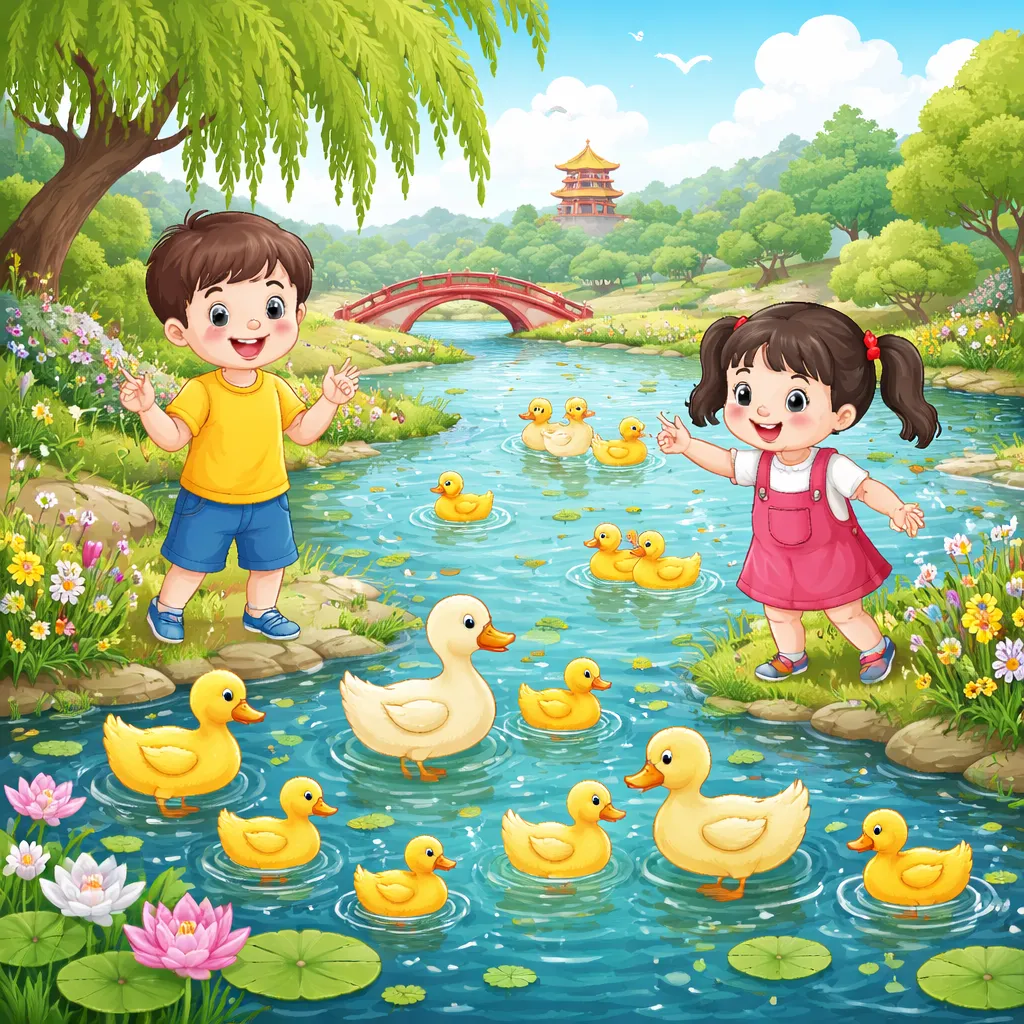

Have you ever tried to count a group of animals that just won’t stay still? Like birds on a wire or fish in a pond? It can be tricky! In China, there is a very cheerful, catchy song about exactly that. It’s a song that turns counting into a fun, musical game with some waddling, quacking friends. Let’s learn the numbers with the playful tune “Counting Ducks” (数鸭子, Shǔ yāzi).
About the Song
Let’s read the counting, quacking words of this popular song.
门前大桥下,游过一群鸭。
快来快来数一数,二四六七八。
嘎嘎嘎嘎,真呀真多呀,
数不清到底多少鸭,
数不清到底多少鸭。
赶鸭老爷爷,胡子白花花,
唱呀唱着家乡戏,还会说笑话。
小孩小孩快快上学校,
别考个鸭蛋抱回家。
English Translation:
Under the big bridge in front of the gate, swam a flock of ducks.
Come quick, come quick and count them, two, four, six, seven, eight.
Quack quack quack quack, oh so many indeed,
Can’t count clearly just how many ducks,
Can’t count clearly just how many ducks.
The old duck-herding grandpa, with a white, flowy beard,
Sings the songs of his hometown, and can tell a joke so weird.
“Little child, little child, hurry up and go to school,
Don’t bring home a big duck egg (a zero) and look like a fool.”
This song is a classic Chinese children’s song from the 1980s. The lyrics were written by Wang Jiazhen (王嘉祯) and the music was composed by Hu Xiaohuan (胡小环). It is a bright, fast-paced song that describes a lively rural scene. The singer sees many ducks swimming under a bridge and tries to count them, skipping numbers in a fun way (“two, four, six, seven, eight”). The ducks quack loudly, and there are so many they become uncountable! The song then introduces a kind, funny old man who herds the ducks. He playfully warns children to study hard so they don’t get a “duck egg” (a zero score) on a test. The song mixes counting, animal sounds, gentle humor, and a bit of advice in a very memorable way.
What the Song is About
The song paints a busy, happy picture of village life. The singer stands near a big bridge over water. Under the bridge, a whole flock of ducks swims by. The singer is excited and invites everyone to count them quickly. But instead of counting “one, two, three,” they count in a jumping pattern: “two, four, six, seven, eight!” This makes it feel like a game.
The ducks quack noisily. There are so many of them moving around that it’s impossible to get the right number! The scene then expands. We see the old grandpa who takes care of the ducks. He has a white beard, sings local songs, and tells jokes. He turns to the listening children and gives them funny, important advice. He tells them to hurry to school and to study hard, so they don’t end up with a “duck egg”—which in Chinese is a funny way of saying a zero on a test. The song is a fun mix of counting, observing nature, and a caring reminder about the importance of learning.
Who Made It & Its Story
“Counting Ducks” was created in the 1980s by lyricist Wang Jiazhen and composer Hu Xiaohuan. It quickly became a nationwide hit and remains one of the most recognizable Chinese children’s songs. The song was crafted during a time when Chinese children’s music was embracing catchy, modern tunes with educational themes. Its primary purpose is to make learning numbers fun and engaging. The character of the wise, humorous old grandpa is a classic figure in Chinese folklore, often used to gently impart wisdom. The song’s incredible catchiness and its combination of simple math, a relatable scene, and a moral lesson have made it a lasting favorite in kindergartens, music classes, and homes for decades.
This song is beloved for three joyful reasons. First, its melody is unbelievably fast, catchy, and energetic, making it impossible not to bounce and sing along. Second, it is a masterful multi-tool for learning—it teaches numbers, animal sounds, observation, and a cultural idiom (“duck egg”), all wrapped in a fun story. Third, it creates a vivid, happy scene that feels both nostalgic and alive, connecting children to a simple, joyful moment in community life.
When to Sing It
This song is perfect for energetic, learning-focused play. You can sing it very quickly while counting any group of objects, like toys or steps, trying to match the fast rhythm. You can chant it at a park or near a pond if you see real ducks or birds, pretending to count them. You can also sing it as a silly reminder to do homework or practice a skill, laughing about not getting a “duck egg.”
What Children Can Learn
This lively, multi-layered song is a fantastic teacher about numbers, language, and culture.
Vocabulary
The song teaches us number, animal, and descriptive words. A “bridge” (大桥, dàqiáo) is a structure built over water for crossing. A “duck” (鸭子, yāzi) is a water bird with a flat beak. A “flock” (一群, yī qún) is a group of birds. To “count” (数, shǔ) means to say numbers in order. “Quack” (嘎嘎, gāgā) is the sound a duck makes. An “old grandpa” (老爷爷, lǎo yéye) is a respectful term for an elderly man. A “joke” (笑话, xiàohuà) is something said to make people laugh. A “duck egg” (鸭蛋, yādàn) is slang for a zero score.
Let’s use these words! You can say, “A large flock of geese flew overhead.” Or, “He told a funny joke that made everyone laugh.” New word: Idiom. This is a phrase whose meaning is different from the literal words. “Duck egg” meaning “zero” is a Chinese idiom.
Language Skills
This song is a brilliant lesson in using numbers and measure words and the imperative for encouragement. The song uses the measure word “群” (qún) for groups: “一群鸭” (a flock of ducks). In Chinese, you need a measure word between a number and a noun.
It uses the imperative to urge action: “快来快来数一数” (Come quick, come quick and count!). The song also practices the result complement “不清” (bù qīng) in “数不清” (cannot count clearly), which is added to a verb to show the action’s result is not achieved. The numbers are presented in a fun, non-sequential way, which is great for pattern recognition.
Sounds & Rhythm Fun
Listen to the incredibly fast, bouncy, and happy rhythm of the melody. The song is in a rapid 2/4 or 4/4 time, which makes it super energetic. The most fun parts are the quick counting “二四六七八” and the onomatopoeic “嘎嘎嘎嘎” for the ducks’ quacking. The rhythm mimics the hurried, excited feeling of trying to count moving animals. The Chinese lyrics have a very clear, driving rhyme: “鸭” (yā) and “八” (bā), “呀” (ya) and “鸭” (yā), “花” (huā) and “话” (huà), “校” (xiào) and “家” (jiā).
The rhythm is peppy and relentless. Try clapping very fast: 门 前 大 桥 下,游 过 一 群 鸭 (mén qián dà qiáo xià, yóu guò yī qún yā). The melody is simple but sung at a breakneck speed, which is part of the challenge and fun. This fast, repetitive, and playful musical pattern is what makes the song so memorable and exciting. You can write your own fast counting song! Use the same energetic rhythm. Try: “On the floor, by the door, rolled a bunch of balls. Quick now, quick now, count them all, one, three, five, six, ten! Roll roll roll roll, oh what a spinning sight, can’t count them as they roll left and right!”
Culture & Big Ideas
“Counting Ducks” offers a charming snapshot of 1980s Chinese rural and educational culture. The bridge and duck pond scene is a classic image of Chinese countryside life. The song connects to the importance of early mathematics education in a fun, stress-free way. The “duck egg” idiom is a classic example of Chinese humorous slang used to encourage children in their studies, reflecting the cultural emphasis on education. The kind but teasing old grandpa is a staple character who represents wisdom passed down from older generations. The song can be associated with the simple joys of everyday life, much like the activities during a spring outing or a visit to a relative’s village. It teaches that learning (counting, observing) can happen anywhere, not just in school, and that community elders are there to guide you.
The song conveys three important ideas. First, it’s about the playful challenge of observation and counting. The world is full of things to count, but sometimes they move too fast, and that’s okay—the fun is in the trying. Second, it expresses the value of wisdom shared with humor. The grandpa doesn’t scold; he jokes and sings, making his advice about studying memorable and kind. Third, it highlights the interconnection of fun and learning. The song itself is a blast to sing, but it secretly teaches numbers, language, and a life lesson, showing that education can be joyful and part of daily play.
Values & Imagination
Imagine you are standing on that big bridge. What does the water below look like? Can you hear the ducks quacking? Now, try to count them as they swim. They dive, they turn, they mix together. Can you keep track? Now, imagine the old grandpa. What does his laugh sound like? How does he wave his arms to herd the ducks? Draw the busy scene. Draw a big bridge. Under it, draw lots and lots of little duck shapes in the water—so many that they’re hard to count! On the riverbank, draw the old grandpa with a big white beard, smiling. In a corner, draw a child with a backpack, running toward a small schoolhouse. This captures all the elements of the song.
The song encourages careful observation, a positive attitude towards learning and school, and respect for the playful wisdom of elders. A great family activity is a “Fast Count Challenge.” Scatter a bunch of small, similar objects (like Lego bricks, coins, or crayons) on a table. Give everyone 5 seconds to look, then cover them. Sing the “快来快来数一数” line, and everyone has to guess how many there are. Reveal and count together. This turns the song’s central game into a real, fast-paced activity.
So, as the last warning about the duck egg fades, think about the joyful energy in this fast-paced tune. It is a vocabulary lesson in animals and numbers. It is a grammar lesson in using measure words and urgent commands. It is a music lesson in a super-fast, happy rhythm. From the first duck under the bridge to the grandpa’s funny advice, it wraps lessons in observation, joyful learning, and community in a melody that makes you want to move, count, and laugh. “Counting Ducks” teaches us that the world is full of things to count, that learning should be fun, and that even a silly warning can come from a place of care.
Your Core Takeaways
You are now an expert on the song “Counting Ducks” (数鸭子). You know it is a fast Chinese song about trying to count a moving duck flock and hearing advice from a duck-herding grandpa. You’ve learned words like “flock,” “quack,” and the idiom “duck egg,” and you’ve practiced counting, using measure words, and urgent phrases. You’ve felt its incredibly bouncy, quick rhythm and created your own counting verse. You’ve also discovered the song’s cultural scene and its messages about playful observation, the importance of studying, and learning through joy.
Your Practice Missions
First, go on a “Counting Quest.” Go to a park, your backyard, or look out a window. Choose something to count that moves or is tricky (birds, cars of a certain color, clouds). Try to count them like in the song. Was it easy or hard? Sing the song about what you saw. This mission connects the song directly to real-world observation.
Second, create a “Silly Advice” poster. The grandpa gives funny advice about not getting a “duck egg.” Think of a silly goal (like “Don’t trip on your shoes!”) and draw a funny “don’t” symbol for it (like a banana peel with a cross through it). Give your poster a funny title. Share it with your family. This activity plays with the song’s theme of humorous, caring advice.