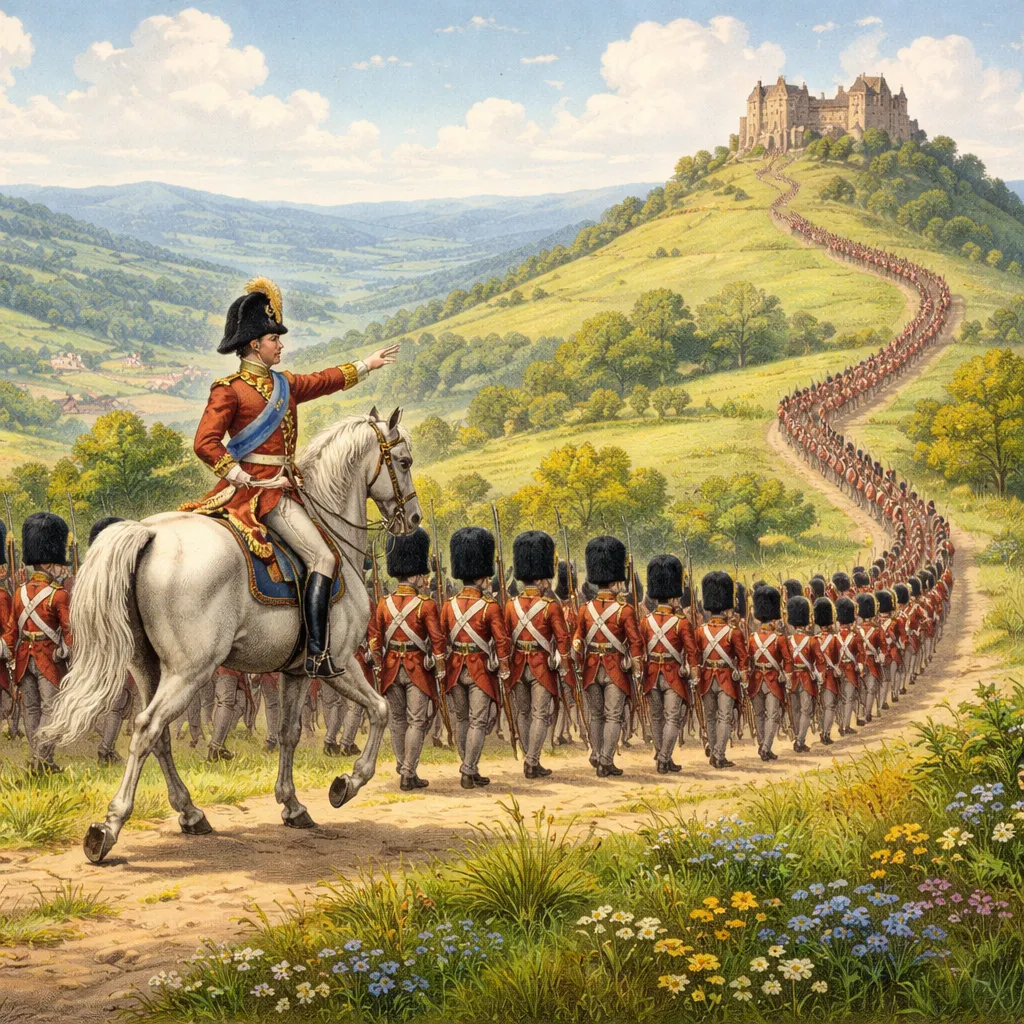

Have you ever played “Follow the Leader”? What if the leader kept changing their mind, making everyone go up, then down, then stop? It would be silly! There is a famous old song about a leader who does just that. It’s a marching song about a very important man and his tired soldiers. Let’s learn about “The Grand Old Duke of York.”
About the Song
Here are the classic words to this marching rhyme.
Oh, the grand old Duke of York,
He had ten thousand men;
He marched them up to the top of the hill,
And he marched them down again.
And when they were up, they were up,
And when they were down, they were down,
And when they were only halfway up,
They were neither up nor down.
This song is a traditional English nursery rhyme and marching chant. It is like a musical joke about following orders that don’t seem to have a point. The song describes a duke, a kind of nobleman, who leads a huge number of soldiers on a very short, repetitive journey up and down a hill. It is a very old rhyme from England. While it is about a “Duke of York,” historians are not sure which real Duke it was. It might be a funny, exaggerated story about a military leader from long ago, poking gentle fun at leaders who give orders just to look busy.
What the Song is About
The song paints a clear and funny picture. First, we meet a very important man: the grand, proud Duke of York. He is in charge of a massive army of ten thousand soldiers. They all stand in neat rows, waiting.
The Duke gives his first order. He shouts, and all ten thousand men start marching. They march in perfect time, all the way up to the very top of a big hill. Once they reach the top, the Duke immediately gives a new order. He turns them around and marches them all the way down the hill again, right back to where they started.
The song then explains the silly situation. It says, quite clearly, that when the soldiers were at the top of the hill, they were “up.” When they were at the bottom, they were “down.” But when they were on the slope, halfway up the hill, they were stuck in the middle—they were not up, and they were not down!
Who Made It & Its Story
Like many nursery rhymes, this is a traditional folk song, so we don’t know a single author. It was sung by soldiers and common people. It first became popular in England hundreds of years ago. Many people think the song is about Prince Frederick, Duke of York, who was a British army officer in the late 1700s. The song might be a playful joke about a time his army moved around but didn’t actually fight a battle.
This marching rhyme has been sung for centuries for three great reasons. First, it has a fantastic, strong marching rhythm that makes you want to stomp your feet. Second, the idea is very funny to children—the thought of ten thousand men just walking up and down a hill for no reason is silly. Third, it is a brilliant tool for teaching the ideas of “up” and “down” and the space in between. The simple, repetitive words make the concepts very clear.
When to Sing It
This song is perfect for action and movement. You can sing it while walking up and down a small hill or a set of stairs, marching in place for each line. You can sing it during a game of pretend with friends, taking turns being the Duke and giving loud marching orders. You can also chant it as a rhythmic clapping game with a partner, clapping on the beat.
What Children Can Learn
This simple marching song is packed with lessons. Let’s line up and discover all the knowledge it has to offer.
Vocabulary
The song teaches us some excellent descriptive and positional words. “Grand” means great, important, and impressive. A “Duke” is a man of very high rank, just below a prince or king. “Ten thousand” is the number 10,000—a lot of people! To “march” is to walk with regular, steady steps, like a soldier. The “top” is the highest point of something. The “bottom” is the lowest point (the song says “down,” meaning at the bottom). “Halfway” means exactly in the middle between two points.
Let’s use these words! You can say, “We saw a grand palace.” Or, “The ants marched in a long line.” You might describe a slide: “I climbed to the top and slid down to the bottom.” New word: Objective. This is a goal or aim. A good leader has a clear objective. The Duke’s objective seemed to be just marching.
Language Skills
This song is a wonderful showcase for the Simple Past Tense and for describing position with prepositions. We use the simple past to talk about completed actions in the past. Look at the verbs: “He had ten thousand men. He marched them up… he marched them down.” These tell us the story of what the Duke did one time.
Even more importantly, the song is a masterclass in the prepositions of place up and down, and the phrase neither… nor. “Up to the top” and “down again” describe direction. The last four lines brilliantly explain opposites: “when they were up, they were up.” It then introduces a third, middle state using “neither up nor down.” “Neither… nor” means “not this one and not that one.” It’s a great way to describe being in between. You can use it too: “I am neither happy nor sad, I am just calm.” “The toy is neither on the table nor under it; it is beside it.”
Sounds & Rhythm Fun
Listen to the powerful beat. The rhyme uses a strong, steady, marching rhythm that matches the soldiers’ feet. The main rhymes are “York” with “men” (a half-rhyme) and the clear, repeated rhyme of “down” with itself. The “up, up, down, down” part is more about repetition than rhyme, which makes it very catchy and easy to shout.
The rhythm is the star here. It goes: OH, the GRAND old DUKE of YORK, he had TEN thousand MEN. You can’t help but stomp your feet to it. The melody is usually very simple, strong, and repetitive, perfect for a group to sing loudly while moving. This powerful rhythm acts like a drum, helping everyone remember the words and march in time. You can write your own marching song! Use the same stomping beat. Try: “Oh, the great big Captain Cork, she had a pirate crew; She sailed them east to find the feast, and then she sailed them west. And when they were east, they were east, and when they were west, they were west, and when they were lost in the middle of the sea, they were neither east nor west!”
Culture & Big Ideas
This song comes from a time in British history when armies and nobles were very prominent. Britain has a long history of famous soldiers and battles. The song gently makes fun of the idea of blind obedience and military pomp, showing that even hundreds of years ago, people could see the humor in leaders who make a big show without much purpose.
The song teaches three interesting ideas. First, it’s about following instructions and obedience. The soldiers do exactly as they are told, immediately. Second, it introduces the concept of pointless action or effort. The march up and down the hill doesn’t achieve anything new, making us think about the purpose of our actions. Third, it’s a great lesson in opposites and intermediate states. It clearly defines “up” and “down” and then cleverly explores the gray area in between (“neither up nor down”), which is a more advanced thinking skill.
Values & Imagination
Let your imagination march with the ten thousand men. What did the hill look like? Was it a soft, green hill or a rocky one? What sounds did the marching make? The “stomp, stomp, stomp” of boots, the jingle of swords? How did the soldiers feel? Were they proud? Were they tired? Were they secretly rolling their eyes at the Duke? Imagine you are the Duke. Why did you march them up and down? Were you practicing? Were you just showing off your big army? Draw a picture from high above, showing a long, snaking line of tiny soldiers going up one side of a hill and down the other.
The song can also get us thinking about good leadership. A good leader has a plan. A simple idea is to play “Helpful Leader.” Next time you are playing with friends and someone needs to decide what game to play, be a leader with an objective. Say, “My objective is for everyone to have fun. Let’s march over to the swing set, then march back to the sandbox!” Your “marching” has a fun purpose, unlike the old Duke of York’s.
So, we have marched all the way through this grand old song. We’ve learned words fit for a duke and practiced the grammar of past adventures. We’ve stomped to its unforgettable beat and even composed our own marching orders. We’ve glimpsed a piece of history where humor was used to comment on authority. The song “The Grand Old Duke of York” is wonderfully silly, but that silliness is the key to its lessons. It teaches opposites through extreme example. It teaches rhythm through mimicry of soldiers’ feet. It teaches us that sometimes, stories about people who do things that seem pointless can help us think more carefully about how we choose to use our own time and energy. Every time you sing it, you are not just telling a joke about a duke; you are exercising your mind, your body, and your funny bone, all in one grand, old, repetitive march.
Your Core Takeaways
You are now an expert on the marching chant “The Grand Old Duke of York.” You know it is a traditional English song that makes fun of pointless orders. You’ve learned vocabulary like “grand,” “march,” and “halfway,” and you can expertly use “neither… nor” to describe an in-between state. You’ve mastered its stomping rhythm and created a new commanding rhyme. You’ve also explored the ideas of obedience, purpose, and the clear definitions of opposites that this song marches into your mind.
Your Practice Missions
First, be the Duke or Duchess of your home. Find a “hill” (a couch cushion, a small step, or a pile of pillows). Gather your “ten thousand men” (your toys, stuffed animals, or family members). Loudly sing the song as you march your troops up to the top of the cushion and down again. Make sure your marching is in perfect time with the song’s rhythm.
Second, have a “Neither-Nor” scavenger hunt. Take the song’s idea of “neither up nor down” and look for three things in your room that are “in-between.” Find something that is neither on the floor nor on the shelf (maybe on a chair?). Something that is neither red nor blue. Something that is neither soft nor hard. Say out loud for each one: “This [object] is neither [this] nor [that].” This practice turns the song’s silly line into a fun game of observation and precise language.