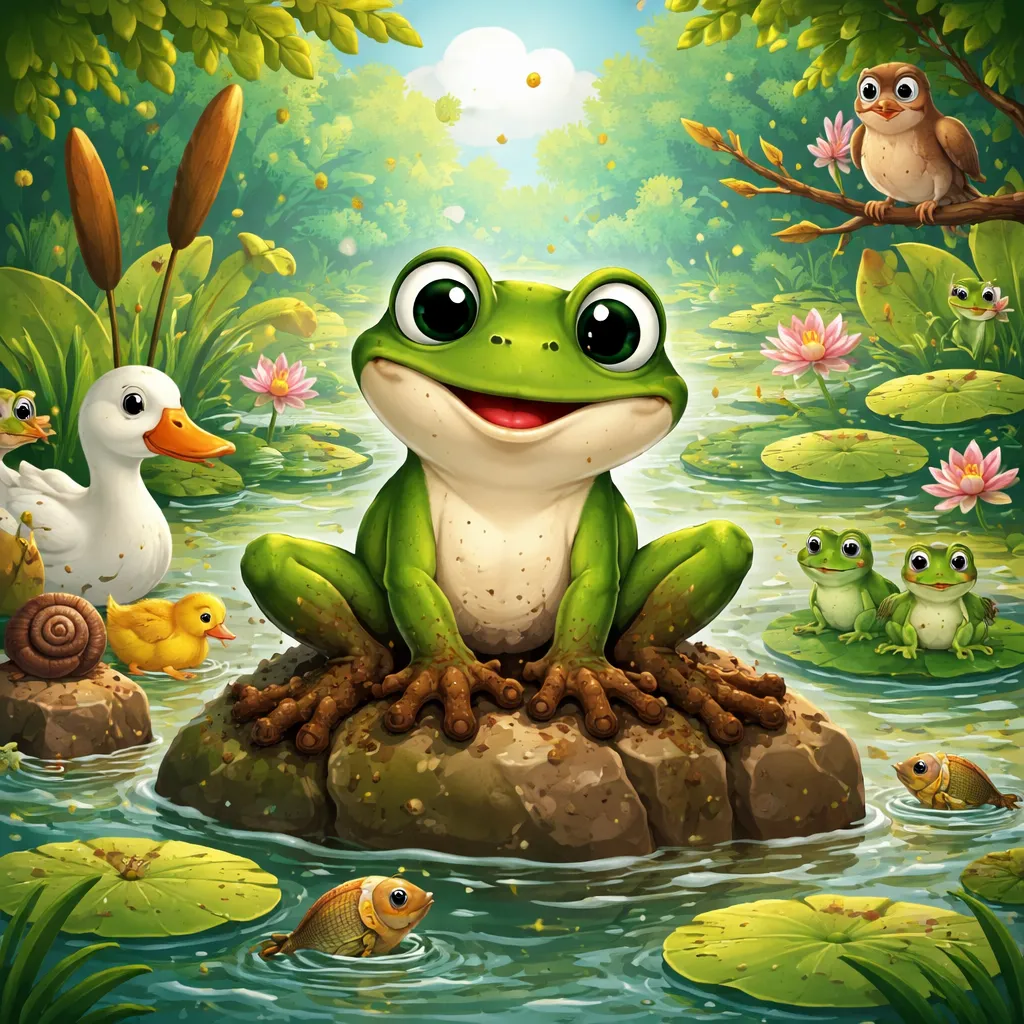

Have you ever seen a frog sitting by a pond or a stream? What do you think it does all day? Does it ever take a bath? In Brazil, there is a very funny and popular song about a very stubborn little frog with a very big opinion about keeping clean. It is a song about a silly argument, a funny habit, and what all the other animals think. Let’s visit the riverbank and learn the catchy, talkative song “The Frog Doesn’t Wash Its Feet (O Sapo Não Lava o Pé).”
About the Song
Here are the playful, conversational lyrics of the traditional Brazilian children’s song. This is the classic, beloved version that starts a fun debate:
O sapo não lava o pé,
Não lava porque não quer.
Ele mora lá na lagoa,
Não lava o pé porque não quer.
Mas que chulé!
— Mas que chulé!
O sapo não lava o pé,
Não lava porque não quer.
English Translation:
The frog doesn’t wash his foot,
He doesn’t wash it because he doesn’t want to.
He lives there in the pond,
He doesn’t wash his foot because he doesn’t want to.
But what a stink!
— But what a stink!
The frog doesn’t wash his foot,
He doesn’t wash it because he doesn’t want to.
This is a classic Portuguese-language children’s call-and-response and game song from Brazil. The song is like a funny news report or a conversation about a famous frog. The word “sapo” means frog. The song states a funny fact: this frog doesn’t wash his feet! It gives the reason twice: because he doesn’t want to (“porque não quer”). It even tells us where he lives: in the pond (“lagoa”). Then, the other animals or singers chime in with the famous line “Mas que chulé!” which is a playful, exaggerated way of saying “But what a stink!” or “Phew, what a smell!” The song is often sung in a group, with one part stating the frog’s habit and everyone else joining in for the “Mas que chulé!” It’s a playful, rhythmic tease.
What the Song is About
The song is a lighthearted, funny story about a frog with a strong will. Imagine a little green frog sitting at the edge of a muddy pond. The song starts by telling us about him: “The frog doesn’t wash his foot.” He has dirty feet from the mud! The song explains, “He doesn’t wash it because he doesn’t want to.” This frog is stubborn. He has made up his mind. He lives in the pond, and he just does not want to wash his feet.
Then, the other creatures around the pond react. They pinch their noses or wave a hand in front of their face. They shout out together: “Mas que chulé!” which means “But what a stink!” or “Wow, what a smell!” They are teasing the frog in a friendly way about his choice. The song repeats the main idea: the frog doesn’t wash his foot because he doesn’t want to. It’s a playful song about a silly, stubborn character and his friends’ funny reaction. It’s not about being mean, but about noticing funny habits and laughing about them together.
Who Made It & Its Story
“O Sapo Não Lava o Pé” is a beloved traditional Brazilian children’s folk song and game, deeply woven into the country’s rich tradition of playful music. Like many folk songs, it was created and shared by many people over time. The song is often used in a game similar to “Tag” or “Pega-Pega,” where the person who is “it” is the “sapo” (frog), and the song is sung while players tease and run away. Brazil’s diverse ecosystems, full of rivers, ponds, and wildlife like frogs, provide a perfect natural setting for this song. It reflects a child’s playful curiosity about animals and a love for silly, imaginative stories about them.
This characterful song is loved for three fun reasons. First, it presents a simple, relatable, and funny character flaw (not washing) in an animal, making it hilarious and memorable for children. Second, it is built on a strong, repetitive, and catchy call-and-response structure that makes it easy for everyone to join in, especially on the loud, playful “Mas que chulé!” line. Third, it sparks imagination and discussion—why won’t the frog wash? Is he just being silly? Is the water too cold? It invites children to think about reasons and consequences in a humorous way.
When to Sing It
This song is perfect for playful, social moments. You can sing it during bath time as a funny reminder to wash up, pretending a rubber ducky is the stubborn frog. You can chant it during a game of tag in the park, where the person who is “it” is the “sapo.” You can also sing it on a walk near a pond or after playing outside, linking it to the idea of cleaning up.
What Children Can Learn
This funny, conversational song is a wonderful teacher about animals, habits, and Portuguese language.
Vocabulary
The song teaches us words for animals, body parts, actions, and reactions in Portuguese. The “frog” (sapo) is a green animal that lives near water. “Doesn’t wash” (não lava) means he does not clean. “The foot” (o pé) is the part of the body you walk on. “Because” (porque) gives a reason. “He doesn’t want to” (não quer) means he has no desire or wish to do it. “He lives” (Ele mora) tells where his home is. “There in the pond” (lá na lagoa) points to a small lake or pool of water. “But” (Mas) introduces a contrasting idea. “What a stink!” (que chulé!) is a funny, exaggerated way to say something smells bad.
Let’s use these words! You can say, “My dog doesn’t like baths because he doesn’t want to get wet.” Or, “I live there in the blue house.” New word: Habit. This is something you do regularly, often without thinking. Washing your feet is a good hygiene habit. The frog has a different habit!
Language Skills
This song is an excellent lesson in using negation—saying “no” or “doesn’t”—in Portuguese with the powerful little word “não” and in using “because” (“porque”) to give a reason for an action or, in this case, a lack of action.
Concept Definition: Negation is how we say something is not happening or is not true. The magic word in Portuguese is “não,” which means “no,” “not,” or “doesn’t.” The song is all about what the frog does NOT do. The word “porque” (because) is the link that gives us the reason why he doesn’t do it.
Features and Types: Look at negation and reasons in the song. The main statement is: “O sapo não lava o pé.” Here, “não” comes right before the action word (verb) “lava” (washes) to tell us the washing is NOT happening. The reason is given right after: “Não lava porque não quer.” The first “não” again negates “lava.” Then “porque” introduces the reason: “não quer” (he doesn’t want to). So we have a double “não” pattern: he does NOT wash because he does NOT want to. It’s a very clear and repeated structure.
How to Spot Them: Here is a simple “no-way detective” trick. Listen for the word “não.” It almost always means a sentence is saying “no” or “not.” Ask: “Is the singer saying that something is not happening?” The word “não” is your clue. To find the reason, listen for the word “porque” (because) right after a statement. It signals that an explanation is coming next.
How to Use Them: A great way to state a funny fact is the “no-action and reason recipe”. The pattern is: [Person/Thing] + [não] + [Action] + [porque] + [Reason].
Example from the song: “O sapo não lava o pé porque não quer.” (The frog doesn’t wash his foot because he doesn’t want to.)
Example you can make: “O gato não bebe leite porque não gosta.” (The cat doesn’t drink milk because it doesn’t like it.)
Sounds & Rhythm Fun
Listen to the bouncy, almost chattering rhythm of the melody. The song has a very steady, marching beat. The repetition of the main line “O sapo não lava o pé” makes it stick in your head immediately. The second line, “Não lava porque não quer,” has a similar rhythm, reinforcing the idea. The most fun part is the call-and-response of “Mas que chulé! — Mas que chulé!” which is usually sung with a funny, exaggerated tone, as if holding your nose. The sounds are playful, with the “o” sounds in “sapo” and “não” and the sharp “pé” and “chulé” at the end of lines.
The rhythm is simple, strong, and perfect for clapping or stomping along. The repetitive, chant-like structure makes the words very easy to learn and remember. This musical pattern is perfect for creating new, silly animal habit songs. You can write your own “doesn’t do” song! Use the same tune. Try: “O cachorro não toma banho, não toma porque tem medo… Mas que sujeira! — Mas que sujeira!” (The dog doesn’t take a bath, he doesn’t take it because he’s afraid… But what a mess! — But what a mess!)
Culture & Big Ideas
“O Sapo Não Lava o Pé” connects to Brazil’s vibrant biodiversity and the common presence of frogs (“sapo” or “rã”) in its many wetlands, rivers, and rainforests. The song also reflects a key part of Brazilian childhood: playful, social games (“brincadeiras”) that often involve singing, teasing, and running around, like the “Pega-Pega do Sapo” (Frog Tag) game. The song’s humor is light and friendly, a way for children to engage in playful debate and silliness together, building social bonds through laughter.
The song conveys three important ideas. First, it playfully introduces the concept of personal habits and hygiene in a way that is funny, not scolding. Second, it explores individual choice and stubbornness—the frog has his own will (“não quer”) and sticks to it, even if others find it funny. Third, it is about social observation and playful group reaction; the community (the other singers) notices a funny habit and comments on it in a lighthearted, choral way, which is a form of social connection and play.
Values & Imagination
Imagine you are the little frog, the “sapo.” You live in a cool, muddy pond. The mud feels nice and squishy between your toes. You like it that way! Your friends, the fish and the turtles, say, “You should wash your feet!” But you just think, “Why? I like the mud. It’s part of my home.” How do you feel? Proud? Stubborn? Happy? Now, imagine you are a bird sitting on a branch above the pond. You hear the other animals singing about the frog. You smell the air and sing out too, “Mas que chulé!” Are you really upset, or are you just joining the funny song? Draw the pond scene. Draw the frog with big, smiling eyes, sitting with dirty feet in the mud. Draw his animal friends around him—a fish popping out of the water, a turtle on a log, a bird on a branch. Give them speech bubbles saying “Mas que chulé!” This shows the song’s playful debate.
The song encourages noticing differences in habits with humor, not meanness. It shows that it’s okay to be different and have your own ways, and it’s also okay for friends to playfully point it out. A wonderful activity is the “Animal Habit Game.” Think of an animal and a funny thing it “doesn’t” do. “The elephant doesn’t use an umbrella in the rain because it likes showers!” or “The butterfly doesn’t wear shoes because it has light feet!” Sing your new line to the tune of “O Sapo.” This sparks creativity and uses the song’s pattern.
So, from the stubborn statement about dirty feet to the laughing, teasing reaction of the pond friends, this song takes you into a funny, musical conversation. It is a vocabulary lesson in animals, body parts, and actions. It is a language lesson in saying “doesn’t” and giving a reason with “because.” It is a music lesson in a catchy, call-and-response chant. “The Frog Doesn’t Wash Its Feet (O Sapo Não Lava o Pé)” teaches us to observe the world with humor, to understand simple choices, and to enjoy being part of a playful, singing community.
Your Core Takeaways
You are now an expert on the song “The Frog Doesn’t Wash Its Feet (O Sapo Não Lava o Pé).” You know it is a traditional Brazilian call-and-response song about a stubborn frog who refuses to wash his feet, and his friends’ funny reaction. You’ve learned Portuguese words like “sapo,” “lavar,” “pé,” “porque,” and the funny phrase “Mas que chulé!” You’ve practiced using “não” to say what something doesn’t do and “porque” to give a reason. You’ve felt its catchy, repetitive rhythm and created your own animal habit verse. You’ve also discovered the song’s message about individual habits, playful observation, and shared, humorous singing.
Your Practice Missions
First, hold a “Pondside Debate.” Grab two toys or draw two animals. One is the Sapo (frog). The other is his friend, the Peixe (fish). Have them talk. The Sapo says, “Não lavo o pé!” (I don’t wash my foot!). The Peixe responds, “Por que não?” (Why not?) and then says, “Mas que chulé!” Try to give a silly reason for the frog. This mission lets you act out the song’s conversation in Portuguese.
Second, become a “Habit Detective.” The song is all about a funny habit. Your mission is to notice a funny or interesting “habit” in your home. Maybe it’s a pet that always sleeps in a weird place or a family member who always hums a tune. Make a simple drawing of it. Then, say or sing one line about it using the song’s “não” pattern. For example, “O gato não dorme na cama, não dorme porque prefere a caixa!” (The cat doesn’t sleep on the bed, it doesn’t sleep because it prefers the box!). This connects the song’s idea to your own funny observations.