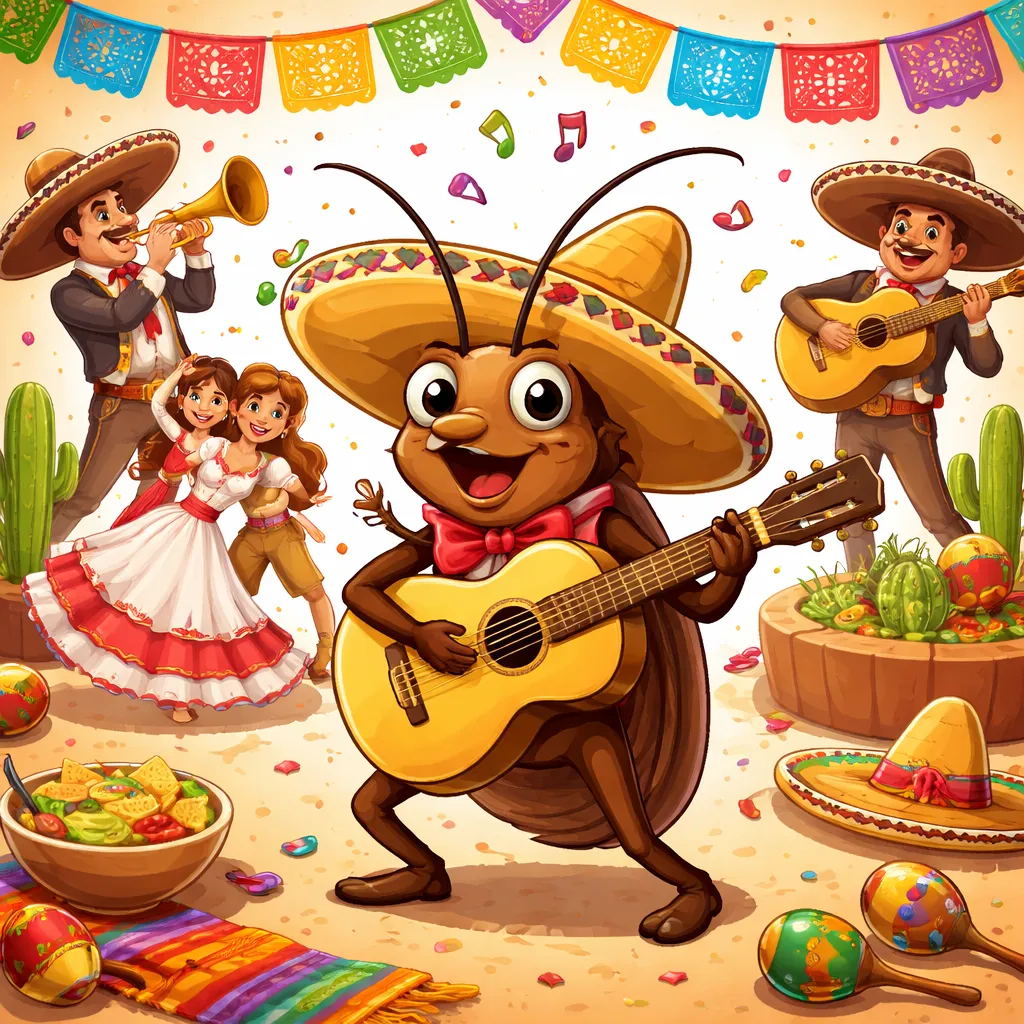

A cockroach cannot walk. It needs something. It is missing a leg. A children’s song can turn that silly problem into a joyful language lesson. Today, we explore a traditional Spanish folk song called “La cucaracha,” which translates to “The Cockroach.” This playful song has been sung for generations. It tells the story of a cockroach that cannot walk because it is missing a leg. We will use this melody as a rhythmic, playful path into English. Together, we will learn new words, explore important sounds, and discover how a simple song can make language learning feel as silly and fun as a cockroach trying to walk. The cockroach cannot walk. Your child can learn English with that same playful, rhythmic energy.
What is the rhyme?
“La cucaracha” is one of the most famous Spanish folk songs. It has been sung for generations across the Spanish-speaking world. The song tells the story of a cockroach that cannot walk because it is missing a leg. The song has a lively, marching rhythm. Children often use hand movements. They pretend to be a cockroach crawling. They count legs. They laugh at the silly story. The song creates a joyful, playful atmosphere. It invites children to sing along, clap, and laugh. When we bring this song to English learning, we keep its playful, rhythmic spirit. We use the familiar melody to introduce English words in a way that feels like singing a silly story.
The lyrics of nursery rhymes
To appreciate this song, we first look at the original Spanish words. Then we see how they translate into English. This shows children that the same silly cockroach song can be told in different languages. You do not need to know Spanish to enjoy the lively, marching rhythm of the words.
Original Version (Spanish)
La cucaracha, la cucaracha
Ya no puede caminar
Porque no tiene, porque le falta
Una pata para andar
English Version
The cockroach, the cockroach
Cannot walk anymore
Because it does not have, because it is missing
One leg to walk
A longer version adds more playful verses:
La cucaracha, la cucaracha
Ya no puede caminar
Porque no tiene, porque le falta
Marihuana que fumar
English Version
The cockroach, the cockroach
Cannot walk anymore
Because it does not have, because it is missing
Marijuana to smoke
As you read these words, notice the lively, marching repetition. The rhythm moves like a marching song. The story is simple and silly. The cockroach cannot walk because it is missing a leg. This narrative invites children to sing, laugh, and march along.
Vocabulary learning
This song offers a wonderful set of words that connect to animals, body parts, and playful problems. We can explore these words through conversation, pictures, and silly play.
Start with the main character: the cockroach. In Spanish, it is cucaracha. In English, we say “cockroach.” Cockroaches are insects that can be found in many places.
Here are the key words to focus on from the song:
Cockroach: An insect. Show pictures of cockroaches.
Cannot: Is not able to. Cannot walk.
Walk: To move on feet. The cockroach cannot walk.
Missing: Not there. It is missing a leg.
Leg: A part of the body used for walking. One leg.
Because: The reason why. Because it is missing a leg.
Use these words in natural moments. When something is not working, say “it cannot.” When something is not there, say “it is missing.” These connections make the vocabulary meaningful.
Phonics points
Phonics helps children understand the sounds that build English words. This song gives us several clear sounds to explore in a lively, rhythmic way.
First, focus on the ‘c’ sound at the beginning of “cockroach.” This is a sharp, unvoiced sound made with the back of the tongue. Say “c c c.” Practice with “cat,” “car,” and “cockroach.” This sound is crisp and clear.
Next, notice the ‘oa’ sound in “roach.” Say “oh” like in “go.” Practice with “boat,” “coat,” and “roach.” This sound is open and marching.
The word “cannot” contains the ‘c’ sound and the short ‘a’ sound. Say “c” like in “cat.” Then add “annot.” Practice with “can,” “can’t,” and “cannot.” This word is a contraction of “can not.”
Finally, look at the ‘l’ sound in “leg.” This is a light sound made with the tongue on the roof of the mouth. Say “l l l.” Practice with “love,” “leaf,” and “leg.” The song also has “because,” which contains the long ‘e’ sound. Say “ee” like in “see.”
Grammar patterns
Even a simple song contains grammar that we can introduce gently. We do not need to use technical terms. Instead, we show how words work together through examples and play.
The song uses the present tense to describe the problem. “Cannot” and “is” describe states now. You can practice by describing problems. “I cannot find my toy.” “It is missing.” This builds present tense.
Notice the repetition of “la cucaracha.” Repetition adds emphasis and rhythm. You can practice repeating for effect. “The cockroach, the cockroach.” “Cannot, cannot.” This adds playful language.
The phrase “because it does not have” shows cause and effect. You can practice with other “because” phrases. “I am sad because I lost my toy.” “She is happy because she played.” This builds understanding of reasons.
Also, look at the word “cannot.” This is a contraction of “can not.” You can practice other contractions. “Don’t” for “do not.” “Isn’t” for “is not.” This builds understanding of contractions.
Learning activities
Activities bring the song into the body and the imagination. They transform listening into active participation. These ideas are simple and require little preparation.
Cockroach Crawl
Play the song and pretend to be a cockroach. Crawl on the floor. When the song says “cannot walk,” try to walk but stumble. When it says “missing a leg,” hop on one leg. This activity builds listening skills and physical play.
Leg Counting
Count your legs. Count the cockroach’s legs. “One, two, three, four, five, six.” The cockroach has six legs. One is missing. Count again. “One, two, three, four, five.” This builds number vocabulary.
Silly Story Game
Make up silly stories about things that are missing. “The dog cannot bark because it is missing its voice.” “The bird cannot fly because it is missing its wing.” This builds creativity and language.
Printable materials
Printable resources offer a quiet way to reinforce the song’s vocabulary. They are perfect for moments when children want to create or focus calmly.
Flashcards
Create a set of flashcards. One card shows a cockroach for “cockroach.” One shows a person walking for “walk.” One shows a leg for “leg.” One shows the word “cannot.” One shows the word “because.” One shows a question mark for “why.” Use these cards for a matching game. Sing a line from the song and ask your child to find the matching card. This builds word recognition.
Coloring Page
Draw a simple cockroach with six legs. Then draw it with only five legs. Children can color both. As they color, talk about the story. “How many legs does it have?” “What is missing?” This keeps the language flowing naturally.
Missing Game
Place several objects on a tray. Let your child look. Cover the tray and remove one object. Ask “what is missing?” This builds observation and vocabulary.
Educational games
Games encourage repetition without boredom. They invite children to use the language in new and creative ways.
Cockroach Says
Play a game similar to “Simon Says.” Give commands using the song’s vocabulary. “The cockroach says walk.” “The cockroach says hop on one leg.” “The cockroach says count your legs.” If you give a command without saying “the cockroach says,” the child does not move. This game builds listening skills.
Missing Game
Hide a toy. Ask “what is missing?” Find it together. Say “I found it!” This builds vocabulary and observation.
Cause and Effect Game
Take turns saying “because” sentences. “I am happy because we played.” “I am tired because I ran.” This builds understanding of reasons.
As you share “La cucaracha” with your child, remember that you are celebrating silliness and rhythm. The cockroach cannot walk because it is missing a leg. It is a silly problem. But the song is joyful. Learning a new language can be silly too. You stumble over words. You miss a sound. But you keep singing. You keep marching. Let the silly cockroach be your guide. Laugh at mistakes. Keep walking. Let the rhythmic spirit of the song remind you both that every missing word is just a leg to find, and every step you take brings you closer to dancing.
本回答由 AI 生成,内容仅供参考,请仔细甄别。