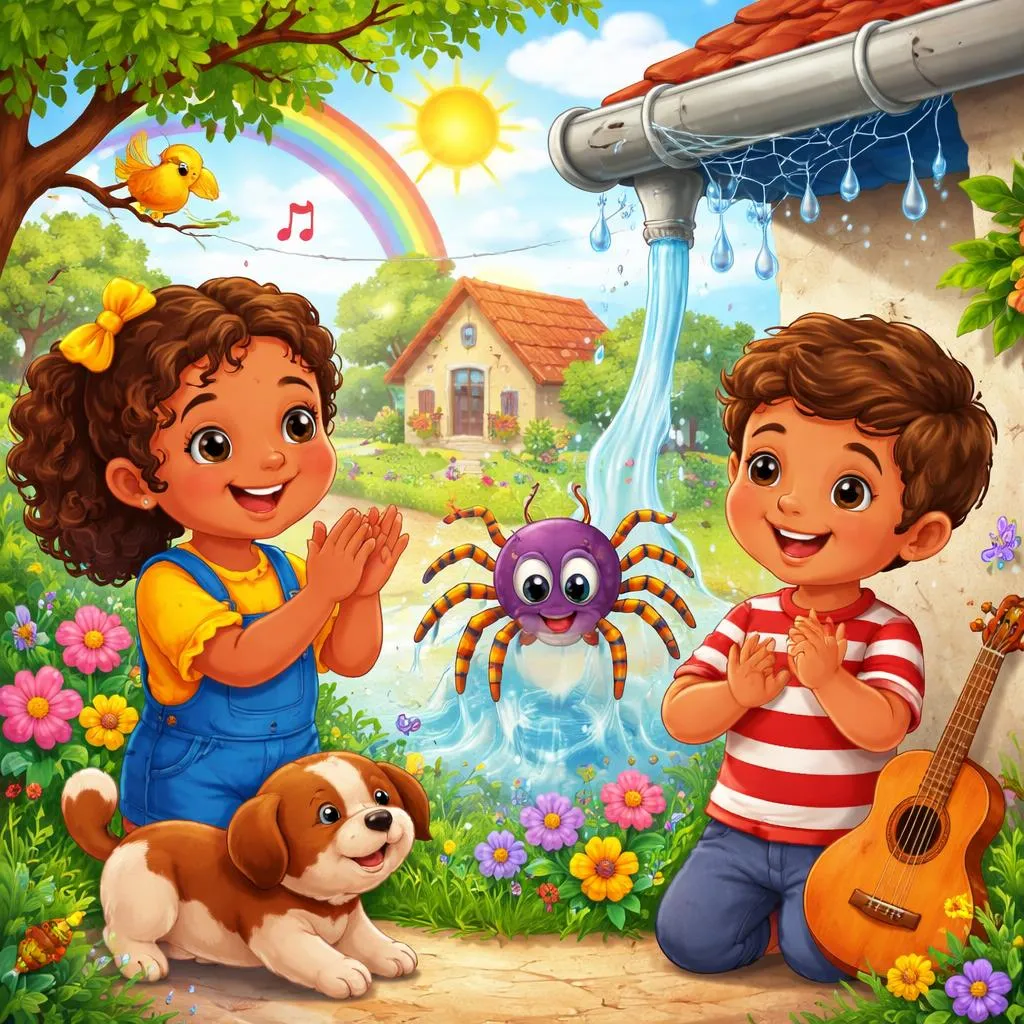

A tiny spider climbs up a waterspout. Rain comes. The spider falls. The sun comes out. The spider climbs again. This little story teaches persistence and resilience. A children’s song can bring that lesson into language learning. Today, we explore a Spanish version of the beloved nursery rhyme “The Itsy Bitsy Spider,” known as “La araña pequeñita.” This gentle song follows a small spider who never gives up. We will use this melody as a persistent, encouraging path into English. Together, we will learn new words, explore important sounds, and discover how a simple song can make language learning feel like climbing up again after every little rain. The spider climbs again and again. Your child can practice English words with that same wonderful persistence.
What is the rhyme?
“The Itsy Bitsy Spider” is one of the most beloved finger-play songs in the English-speaking world. The Spanish version, “La araña pequeñita,” follows the same pattern. The song tells the story of a small spider who climbs up a waterspout. Rain washes the spider down. The sun dries up the rain. The spider climbs up again. The song has a gentle, repetitive rhythm. Children love the finger movements. They make a spider climb with their fingers. They wiggle fingers for rain. They make a sun with their arms. The song creates a comforting, encouraging atmosphere. It teaches that even when you fall, you can try again. When we bring this song to English learning, we keep its persistent, encouraging spirit. We use the familiar melody to introduce English words in a way that feels like cheering on a little spider who never gives up.
The lyrics of nursery rhymes
To appreciate this song, we first look at the original Spanish words. Then we see how they translate into English. This shows children that the same encouraging story about persistence exists in different languages. You do not need to know Spanish to enjoy the gentle, climbing rhythm of the words.
Original Version (Spanish)
La araña pequeñita
Subió, subió, subió
Vino la lluvia
Y se la llevó
Salió el sol
Y todo lo secó
Y la araña pequeñita
Subió, subió, subió
English Version
The itsy bitsy spider
Climbed up, climbed up, climbed up
Down came the rain
And washed her away
Out came the sun
And dried up everything
And the itsy bitsy spider
Climbed up, climbed up, climbed up
As you read these words, notice the gentle repetition. The rhythm moves like a spider climbing. The story is simple and powerful. The spider climbs. Rain comes. The spider falls. The sun comes. The spider climbs again. This narrative invites children to keep trying, no matter what.
Vocabulary learning
This song offers a wonderful set of words that connect to nature, movement, and persistence. We can explore these words through conversation, finger play, and encouraging talk.
Start with the main character: the spider. In Spanish, it is araña. In English, we say “spider.” Spiders are small creatures that spin webs. The spider in this song is very small—itsy bitsy.
Here are the key words to focus on from the song:
Itsy bitsy: Very small. The spider is tiny. Show something very small.
Spider: A small creature with eight legs. Show a picture of a spider.
Climbed: Went up. The spider climbed up.
Waterspout: A pipe that carries rainwater from the roof. Show a picture or point to a downspout.
Came down: Fell. The rain came down.
Rain: Water falling from clouds. Make rain sounds with your fingers.
Washed away: Carried away. The rain washed the spider away.
Came out: Appeared. The sun came out.
Sun: The bright star in the sky. Make a sun with your arms.
Dried up: Made dry. The sun dried up the rain.
Again: One more time. The spider climbed again.
Use these words in natural moments. When it rains, say “the rain is coming down.” When the sun comes out, say “the sun came out and dried up the rain.” When your child tries something again, say “you are trying again, like the itsy bitsy spider!” These connections make the vocabulary meaningful.
Phonics points
Phonics helps children understand the sounds that build English words. This song gives us several clear sounds to explore in a gentle, persistent way.
First, focus on the ‘sp’ blend at the beginning of “spider.” Say “s,” then quickly add “p.” Then add “ider.” Practice with “spoon,” “spot,” and “spider.” This blend is smooth and climbing.
Next, notice the short ‘i’ sound in “itsy” and “bitsy.” Say “i” like in “igloo.” Practice with “sit,” “bit,” and “itsy.” This sound is quick and small, like the spider.
The word “climbed” contains the ‘cl’ blend and the long ‘i’ sound. Say “c,” then quickly add “l.” Then add “imbed.” Practice with “clap,” “cloud,” and “climb.” The ‘b’ in “climbed” is silent. The long ‘i’ is like “eye.”
Finally, look at the ‘r’ sound in “rain” and “dried.” This is a voiced sound made with the tongue. Say “rrrr.” Practice with “run,” “red,” and “rain.” The song also has “washed,” which contains the ‘sh’ sound. Say “sh” like in “ship.”
Grammar patterns
Even a simple song contains grammar that we can introduce gently. We do not need to use technical terms. Instead, we show how words work together through examples and play.
The song uses the past tense to tell the story. “Climbed,” “came,” “washed,” and “dried” describe what already happened. You can practice telling simple stories in the past tense. “The spider climbed. The rain came.” This builds understanding of past tense.
Notice the sequence words. First the spider climbed. Then the rain came. Then the sun came out. Then the spider climbed again. You can practice sequencing with “first,” “then,” “next.” “First it rained. Then the sun came out.” This builds storytelling skills.
The word “again” shows repetition. The spider climbed again. You can practice using “again” to show doing something one more time. “Let us sing again.” “Let us climb again.” This builds vocabulary about repetition.
Also, look at the repetition of “subió, subió, subió” (climbed, climbed, climbed). Repetition adds emphasis and rhythm. You can practice repeating for effect. “Climb, climb, climb.” “Try, try, try.” This adds encouraging language.
Learning activities
Activities bring the song into the body and the imagination. They transform listening into active participation. These ideas are simple and require little preparation.
Finger Play Spider
Play the song and do the finger movements. Make a spider with one hand. Climb it up your other arm (the waterspout). Wiggle your fingers for rain and wash the spider down. Make a sun with your arms. Climb the spider up again. This activity builds fine motor skills and listening.
Persistent Spider Story
Talk about times when you try again. When a tower of blocks falls, you build it again. When you fall while learning to ride a bike, you get up again. Connect these moments to the spider. “You tried again, like the itsy bitsy spider!” This builds emotional vocabulary and resilience.
Water Play
If you have a waterspout or a downspout outside, look at it together. Talk about how the spider climbs up. If it is raining, watch the water come down. If the sun comes out, notice how things dry. This connects the song to the real world.
Printable materials
Printable resources offer a quiet way to reinforce the song’s vocabulary. They are perfect for moments when children want to create or focus calmly.
Flashcards
Create a set of flashcards. One card shows a small spider for “itsy bitsy spider.” One shows a waterspout. One shows rain falling for “came down.” One shows a spider washed away. One shows the sun for “came out.” One shows a spider climbing again for “again.” Use these cards for a matching game. Sing a line from the song and ask your child to find the matching card. This builds word recognition.
Coloring Page
Draw a simple scene from the song. Show a waterspout. Show a tiny spider climbing up. Show raindrops falling. Show the sun in the sky. Children can color the scene. As they color, talk about the story. “What is the spider doing?” “What happens next?” This keeps the language flowing naturally.
Story Sequencing Cards
Create four cards for the story. Spider climbs up. Rain comes and washes spider down. Sun comes out. Spider climbs up again. Your child can put the cards in order. This builds sequencing and storytelling skills.
Educational games
Games encourage repetition without boredom. They invite children to use the language in new and creative ways.
Spider Says
Play a game similar to “Simon Says.” Give commands using the song’s vocabulary. “The spider says climb up the spout.” “The spider says fall down in the rain.” “The spider says climb again.” If you give a command without saying “the spider says,” the child does not move. This game builds listening skills.
Weather Match
Match the weather to what happens. Rain means the spider falls. Sun means the spider climbs. You can use pictures or pretend. This builds understanding of cause and effect.
Try Again Game
Play a game where you try something and sometimes fail. Stack blocks until they fall. Say “the rain came down!” Then try again. Say “the sun came out! I will try again.” This builds resilience and connects to the song.
As you share “La araña pequeñita” with your child, remember that you are teaching persistence. The itsy bitsy spider climbs up the waterspout. Rain comes. The spider falls. But the spider does not give up. When the sun comes out, the spider climbs again. Learning a new language is like that. Some days, the words come easily. Other days, you feel washed down by rain. But the sun always comes out. You can always climb again. Let the persistent spider be your guide. Sing the song when you need encouragement. Let the gentle rhythm remind you both that every fall is just a chance to climb again, and every time you try, you get a little higher.