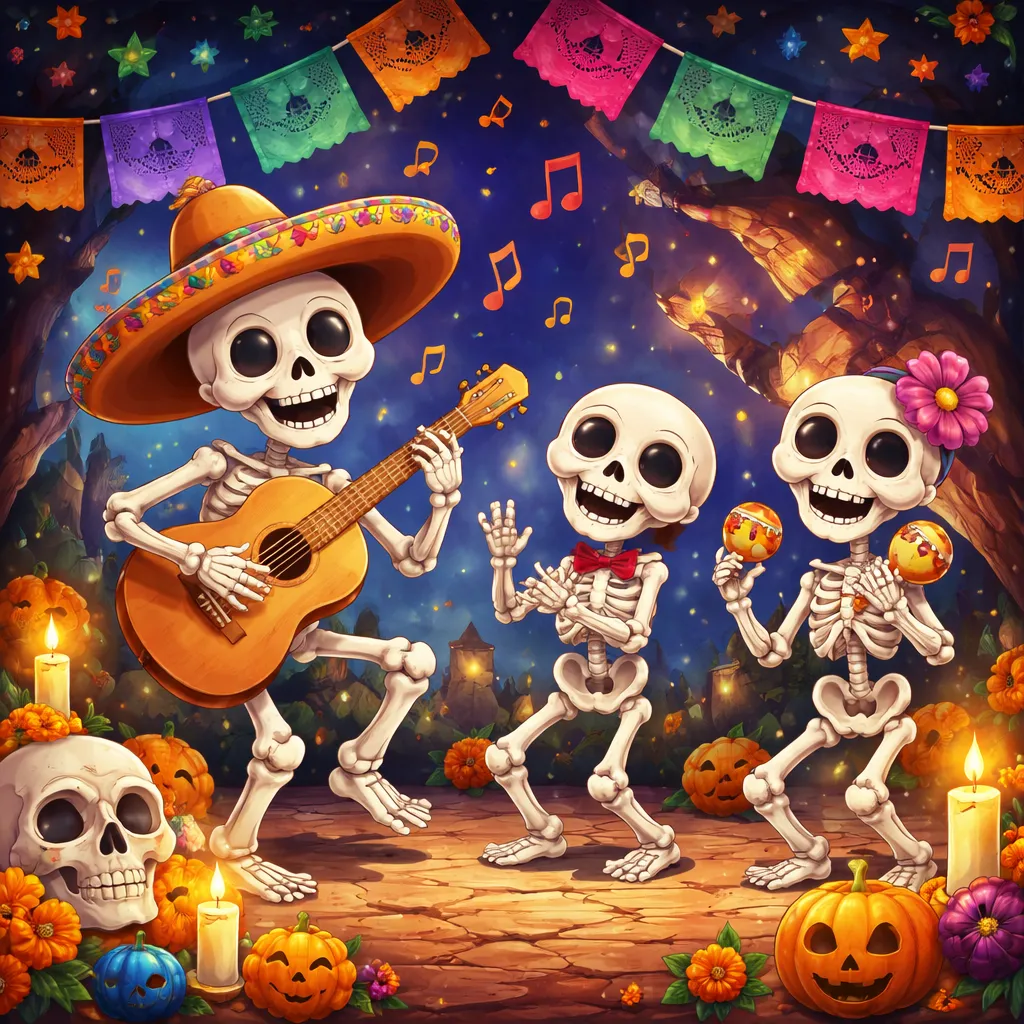

Skeletons dance. Skeletons count. Skeletons tell time. A children’s song can turn numbers and spooky fun into a joyful language lesson. Today, we explore a traditional Spanish children’s song called “Los esqueletos,” which translates to “The Little Skeletons.” This playful song follows skeletons as they come out at different hours of the night. We will use this melody as a rhythmic, counting path into English. Together, we will learn new words, explore important sounds, and discover how a simple song can make language learning feel like a silly dance with friendly skeletons. The skeletons come out at one o’clock. Your child can learn English numbers with that same playful, dancing energy.
What is the rhyme?
“Los esqueletos” is a beloved Spanish children’s song, especially popular around Halloween and Día de los Muertos. It tells the story of skeletons that come out of their graves at different hours of the night. Each verse adds a new hour. The song has a slow, marching rhythm. Children often use hand movements. They wiggle their fingers like skeletons. They march in place. They count the hours. The song creates a playful, slightly spooky atmosphere. It helps children learn numbers in a fun, memorable way. When we bring this song to English learning, we keep its playful, counting spirit. We use the familiar melody to introduce English numbers in a way that feels like dancing with friendly skeletons.
The lyrics of nursery rhymes
To appreciate this song, we first look at the original Spanish words. Then we see how they translate into English. This shows children that the same playful counting song can be told in different languages. You do not need to know Spanish to enjoy the marching, counting rhythm of the words.
Original Version (Spanish)
Cuando el reloj marca la una
Los esqueletos salen de la tumba
Cuando el reloj marca las dos
Los esqueletos comen arroz
Cuando el reloj marca las tres
Los esqueletos se ponen al revés
Cuando el reloj marca las cuatro
Los esqueletos dan un salto
Cuando el reloj marca las cinco
Los esqueletos dan un brinco
Cuando el reloj marca las seis
Los esqueletos tocan el pie
Cuando el reloj marca las siete
Los esqueletos se dan un beso
Cuando el reloj marca las ocho
Los esqueletos tocan el pocho
Cuando el reloj marca las nueve
Los esqueletos bailan un nieve
Cuando el reloj marca las diez
Los esqueletos vuelven otra vez
English Version
When the clock strikes one
The skeletons come out of the tomb
When the clock strikes two
The skeletons eat rice
When the clock strikes three
The skeletons turn upside down
When the clock strikes four
The skeletons take a jump
When the clock strikes five
The skeletons take a leap
When the clock strikes six
The skeletons touch their feet
When the clock strikes seven
The skeletons give a kiss
When the clock strikes eight
The skeletons touch their... (nose, ears, etc.)
When the clock strikes nine
The skeletons do a snow dance
When the clock strikes ten
The skeletons come back again
As you read these words, notice the slow, marching repetition. The rhythm moves like a clock ticking. The song introduces numbers one to ten with fun actions. This narrative invites children to count, move, and laugh.
Vocabulary learning
This song offers a wonderful set of words that connect to numbers, time, and playful actions. We can explore these words through conversation, pictures, and marching play.
Start with the main characters: the skeletons. In Spanish, they are esqueletos. In English, we say “skeletons.” Skeletons are the bones inside our bodies.
Here are the key words to focus on from the song:
Skeleton: The bones inside a body. Show pictures of skeletons.
Clock: A device that tells time. The clock strikes.
Strikes: Makes a sound to mark the hour. The clock strikes one.
Hour: A unit of time. The clock strikes one o’clock.
One, two, three, four, five, six, seven, eight, nine, ten: Numbers 1 to 10.
Tomb: A grave. The skeletons come out of the tomb.
Jump, leap: Actions of moving off the ground.
Touch: To make contact with. Touch their feet.
Kiss: To touch with lips to show love.
Come back again: Return. The skeletons come back again.
Use these words in natural moments. Count things together. “One, two, three.” When you touch your feet, say “touch your feet.” These connections make the vocabulary meaningful.
Phonics points
Phonics helps children understand the sounds that build English words. This song gives us several clear sounds to explore in a playful, counting way.
First, focus on the ‘s’ sound at the beginning of “skeleton.” This is a soft, airy sound. Say “s s s” like a snake. Practice with “sun,” “song,” and “skeleton.” This sound is smooth and sneaky.
Next, notice the ‘k’ sound in “clock” and “strikes.” Say “k k k.” Practice with “cat,” “kite,” and “clock.” This sound is crisp and ticking.
The number words have their own sounds. “One” has the ‘w’ sound. “Two” has the ‘oo’ sound. “Three” has the ‘th’ sound. Practice each number separately.
Finally, look at the ‘j’ sound in “jump.” This is a voiced sound made with the tongue and lips. Say “j j j.” Practice with “joy,” “jelly,” and “jump.” The song also has “touch,” which contains the ‘ch’ sound. Say “ch” like in “cheese.”
Grammar patterns
Even a simple song contains grammar that we can introduce gently. We do not need to use technical terms. Instead, we show how words work together through examples and play.
The song uses the present tense to describe what happens. “Strikes,” “come out,” “eat,” and “jump” describe actions now. You can practice by describing what you do. “I jump.” “I eat.” This builds present tense.
Notice the pattern “when the clock strikes ___.” This shows time. You can practice telling time. “When the clock strikes one.” “When the clock strikes two.” This builds time vocabulary.
The actions in each verse are in the imperative mood. “Jump,” “touch,” “kiss” are commands. You can practice giving gentle commands. “Jump.” “Touch your feet.” “Give a kiss.” This builds understanding of instructions.
Also, look at the repetition of numbers. Repetition helps with memorization. You can practice counting. “One, two, three.” “Four, five, six.” This builds number fluency.
Learning activities
Activities bring the song into the body and the imagination. They transform listening into active participation. These ideas are simple and require little preparation.
Skeleton March
Play the song and pretend to be skeletons. March in place. When the song says “the clock strikes one,” hold up one finger. Do the action for each hour. Jump for four. Touch your feet for six. This activity builds listening skills, counting, and physical play.
Clock Craft
Create a simple clock using a paper plate. Add numbers 1 to 10. Move the hands to different hours while singing. This combines fine motor skills with language practice.
Number Hunt
Go on a number hunt. Find one of something. Two of something. Count together. “One, two, three.” This builds number vocabulary.
Printable materials
Printable resources offer a quiet way to reinforce the song’s vocabulary. They are perfect for moments when children want to create or focus calmly.
Flashcards
Create a set of flashcards. One card shows a clock for “clock.” One shows a skeleton for “skeleton.” One shows numbers 1 to 10. One shows a person jumping for “jump.” One shows a person touching feet for “touch.” One shows a kiss for “kiss.” Use these cards for a matching game. Sing a line from the song and ask your child to find the matching card. This builds word recognition.
Coloring Page
Draw a simple clock with numbers 1 to 10. Draw skeletons dancing around it. Children can color the clock, the numbers, and the skeletons. As they color, count the numbers. “One, two, three.” This keeps the language flowing naturally.
Number Chart
Create a simple number chart from 1 to 10. Your child can decorate each number. Practice counting together. This builds literacy and number recognition.
Educational games
Games encourage repetition without boredom. They invite children to use the language in new and creative ways.
Skeleton Says
Play a game similar to “Simon Says.” Give commands using the song’s vocabulary. “Skeleton says jump four times.” “Skeleton says touch your feet.” “Skeleton says count to five.” If you give a command without saying “skeleton says,” the child does not move. This game builds listening skills.
Clock Game
Make a clock with your arms. Point to one o’clock, two o’clock, etc. Say “when the clock strikes one.” This builds time vocabulary.
Action Dance
Do the actions from the song. Jump. Leap. Touch your feet. Give a kiss. This builds movement and vocabulary.
As you share “Los esqueletos” with your child, remember that you are celebrating numbers, time, and playful movement. The skeletons come out when the clock strikes one, two, three… all the way to ten. They jump, leap, touch, and kiss. Learning a new language can be like a skeleton dance. You count new words. You move to new rhythms. You play with new sounds. Let the dancing skeletons be your guide. Count with joy. Let the playful spirit of the song remind you both that every new number you learn is a step in the dance, and every hour is a chance to learn something new.