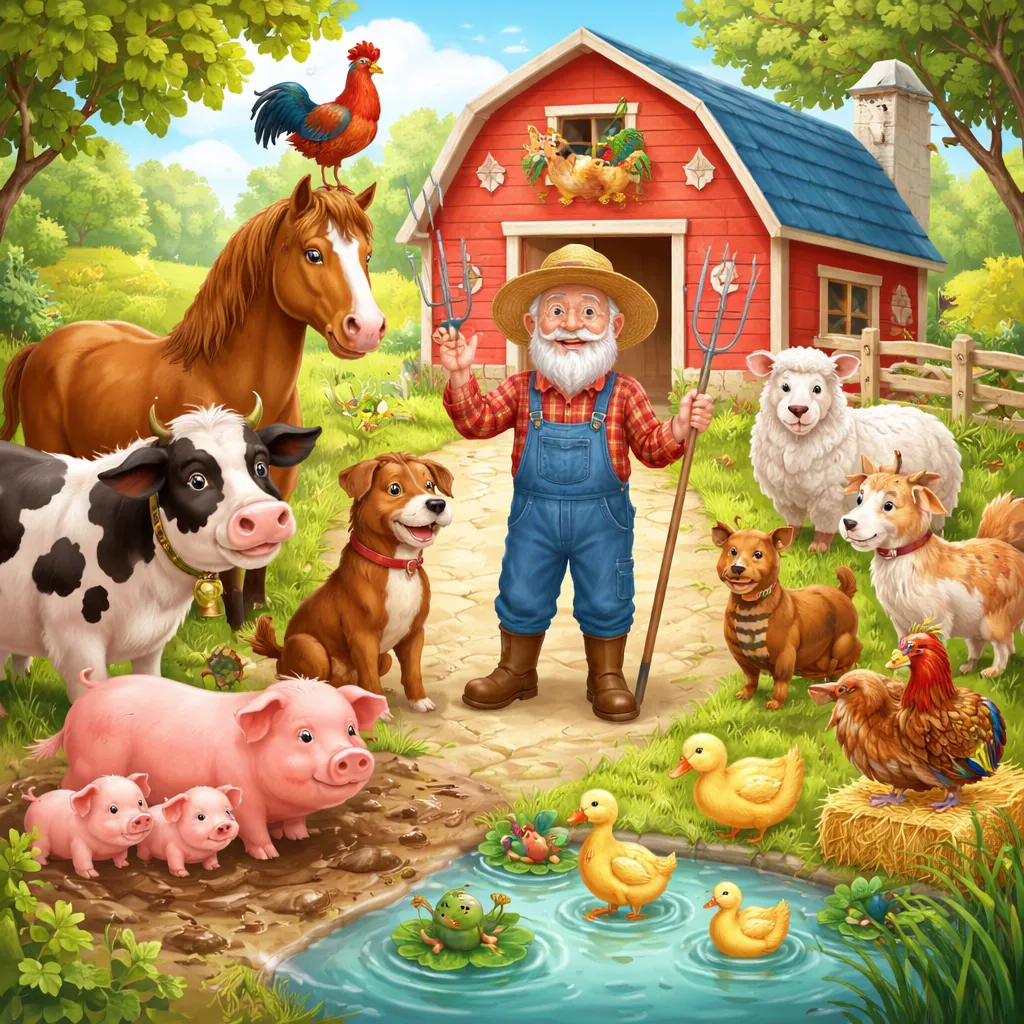

Imagine a big, sunny farm with green fields and red barns. Can you hear the animals? A cow says “Moo,” a pig says “Oink.” But what do the animals say in another language? There is a wonderful song that takes you on a tour of just such a farm, full of friendly creatures and their sounds. Let’s put on our boots and visit the Russian song “Old MacDonald Had a Farm (У старинушки Макдональда была ферма).”
About the Song
Here is a classic verse and chorus of the beloved Russian adaptation of this farmyard favorite:
У старинушки Макдональда была ферма,
О-ей, о-ей, о!
И на той ферме у него была корова,
О-ей, о-ей, о!
С му-му тут, и му-му там,
Тут му-му, там му-му, всюду му-му.
У старинушки Макдональда была ферма,
О-ей, о-ей, о!
English Translation:
At old man MacDonald’s, he had a farm,
Ee-aye, ee-aye, oh!
And on that farm he had a cow,
Ee-aye, ee-aye, oh!
With a moo-moo here, and a moo-moo there,
Here a moo, there a moo, everywhere a moo-moo.
At old man MacDonald’s, he had a farm,
Ee-aye, ee-aye, oh!
This is the beloved Russian-language adaptation of the traditional American folk song “Old MacDonald Had a Farm.” The song introduces a kind old farmer named MacDonald (Макдональд) and invites us to meet all the animals on his land, one by one. For each new animal, the song changes its sound, creating a fun and catchy barnyard chorus. It is a joyful way to learn animal names and their sounds in Russian.
What the Song is About
The song is a musical tour of a very busy farm. The farmer, old man MacDonald, has a farm. That is what we sing about first. Then, we meet the first animal, for example, a cow. The song tells us: “И на той ферме у него была корова.” And on that farm he had a cow.
Now comes the best part! We all get to make the cow’s sound in Russian: “С му-му тут, и му-му там.” With a moo-moo here, and a moo-moo there. We point “here” and “there.” Then we sing faster: “Тут му-му, там му-му, всюду му-му.” Here a moo, there a moo, everywhere a moo-moo! We spread our arms wide for “всюду” (everywhere). Then the song goes back to the main part about the farm, ready to introduce a new animal like a pig (“хрю-хрю”), a chicken (“ко-ко-ко”), or a duck (“кря-кря”).
Who Made It & Its Story
“Old MacDonald Had a Farm” is a traditional folk song with roots in the United Kingdom and the United States. The Russian version, “У старинушки Макдональда,” is a direct and playful translation that became a staple in Russian-speaking childhood. It is loved for three big reasons. First, it is an incredibly effective and fun way to learn animal vocabulary and the wonderful, silly sounds animals make in different languages. Second, it has a simple, repetitive, and cumulative structure that is easy for young children to remember and join in on, building confidence as they sing. Third, it sparks imagination and play, allowing children to act out being different animals and to invent their own verses with other creatures, real or imagined.
When to Sing It
This song is perfect for any playful, imaginative moment. You can sing it on a long car ride, taking turns with your family to choose the next animal and its sound. You can sing it at the park or in the garden, pretending the grass is a field and you are all the different farm animals. You can also sing it as a group game where one person starts as the farmer and points to others to become different animals who must make their sound at the right time.
What Children Can Learn
This cumulative and playful song is a fantastic teacher for learning animal names, sounds, and basic sentence patterns in Russian.
Vocabulary
The song teaches us the names of common farm animals and how Russians hear their sounds. “Old man” (Старинушки / sta-ree-NOOSH-kee – a friendly, folksy way to say “old man”). “Farm” (ферма / FYER-ma). “He had” (была / by-LA – for a ‘she’ noun like farm). “Cow” (корова / ka-RO-va). “Sound: Moo” (му-му / moo-moo). “Here” (тут / toot). “There” (там / tam). “Everywhere” (всюду / VSYU-doo). Other animals: Pig – “свинья” (sveen’-YA), sound “хрю-хрю” (khryu-khryu); Chicken – “курица” (KOO-ree-tsa), sound “ко-ко-ко” (ko-ko-ko); Duck – “утка” (OOT-ka), sound “кря-кря” (krya-krya).
Let’s use these words! You can describe a scene: “На ферме есть корова. Она говорит ‘му-му’.” (On the farm there is a cow. It says ‘moo-moo’.) New word: Животное (zhi-VOT-na-ye). This means “animal.” You can say, “Корова – это животное.” (A cow is an animal.)
Language Skills
This song is excellent for learning the prepositional case to talk about location (“на ферме” – on the farm) and the past tense of the verb “to have” (“у … была” – … had). It also uses the prepositions “тут” (here) and “там” (there) to describe where sounds are heard.
Concept Definition: We are learning about special endings on words to show where something is happening. We are also learning how to say that someone or something had something in the past, using the word “была”.
Features and Types: In Russian, to say something is on or at a place, the word for the place often gets an “-е” ending. “Ферма” (farm) becomes “на ферме” (on the farm). The structure “у … была” tells us about possession in the past. “У старинушки была ферма” means “The old man had a farm.”
Example from the song: Location: “И на той ферме у него была корова.” Possession: “У старинушки Макдональда была ферма.”
How to Spot Them: Here is the “Where is it?” trick. Look for the little word “на” (on) or “в” (in) followed by a word that ends with “-е”. Ask: “Is the singer telling us where something is happening?“ For “had,” look for the word “у” followed by a person and then the word “была”. Ask: “Is the singer talking about what someone owned a long time ago or in the song’s story?“
How to Use Them: A great way to tell a simple story is the “У [Person] была [Thing] на [Place]” formula. It means “[Person] had a [Thing] on/in [Place].”
Example from the song: “У старинушки Макдональда была ферма.“
Example you can make: “У девочки была кошка в доме.“ (The girl had a cat in the house.)
Sounds & Rhythm Fun
The melody of “У старинушки…” is cheerful, bouncy, and incredibly easy to sing. The chorus “О-ей, о-ей, о!” is fun and shouts like a happy farmer. The rhythm is steady and marching, like walking through farm fields.
The best sounds are the animal noises! Each one is short, repetitive, and perfect for the tune. The cow says “му-му,” the pig says “хрю-хрю,” the chicken says “ко-ко-ко,” and the duck says “кря-кря.” The pattern “С [sound] тут, и [sound] там, Тут [sound], там [sound], всюду [sound]-[sound]” is a wonderful tongue-twister that gets faster, making everyone laugh. This pattern is perfect for making new verses. Try a dinosaur verse: “И на той ферме у него был динозавр, С рык-рык тут, и рык-рык там…“ (And on that farm he had a dinosaur, With a roar-roar here…)
Culture & Big Ideas
While the farmer’s name is foreign, the song connects to the long tradition of village and rural life in Russian culture. The image of a kind “старинушка” (old man) with his animals is a warm, familiar figure from folk tales. The song celebrates the everyday life and sounds of the countryside, which is an important part of cultural heritage.
The song conveys three joyful ideas. First, it builds categorization skills by grouping different animals (cow, pig, chicken) under the common setting of a farm, helping children organize the natural world. Second, it teaches the fun concept of onomatopoeia across languages, showing that while a pig might say “oink” in English, it says “хрю-хрю” in Russian, highlighting how languages hear sounds differently. Third, it encourages participation and memory through its cumulative, repetitive structure, where each new animal adds to the chorus, making it a fun group memory challenge.
Values & Imagination
Imagine you are Old MacDonald waking up at sunrise. You put on your big boots and walk out onto your farm. First, you visit the barn. “С му-му тут, и му-му там.” The cows are saying hello! Then you go to the pigpen. “С хрю-хрю тут, и хрю-хрю там.” The pigs are playing in the mud. Next, the chicken coop. “С ко-ко-ко тут…” The chickens are busy laying eggs. Your farm is full of life and sound “всюду” – everywhere! Draw your own dream farm. What animals live there? A rabbit (“кролик”) that goes “прыг-прыг” (jump-jump)? A horse (“лошадь”) that goes “иго-го” (ee-go-go)? Draw them and write their Russian names and sounds. This shows the song’s power to inspire your own animal orchestra.
The song encourages us to appreciate the animals we share our world with, to listen to the different sounds they make, and to use our imagination to create our own joyful, noisy worlds. A wonderful activity is to have a “Ферма Фантазия” (Farm Fantasy) playtime. Use pillows and blankets to build pens for your toy animals. As you place each toy in its pen, sing about it: “И на той ферме у меня был мишка, С рык-рык тут…” (And on that farm I had a bear, With a roar-roar here…).
So, from the cheerful “О-ей, о-ей, о!” to the noisy animal chorus, the Russian song “Old MacDonald Had a Farm (У старинушки Макдональда была ферма)” is a playful trip to the countryside. It is a vocabulary lesson in animals and their sounds. It is a language lesson in talking about location and past possession. It is a music lesson in a cumulative, sing-along tune. It teaches us to listen, to imitate, and to build a song one happy animal at a time.
Your Core Takeaways
You are now an expert on the Russian song “Old MacDonald Had a Farm (У старинушки Макдональда была ферма).” You know it is a cumulative song about a farmer and all the animals on his farm, each with its own Russian sound. You’ve learned Russian words like “ферма,” “корова,” “му-му,” “свинья,” “хрю-хрю,” and the structure “на ферме” and “у … была.” You’ve practiced the fun chorus “О-ей, о-ей, о!” and the pattern for animal sounds. You’ve also discovered the song’s message about the busy life of a farm, the fun of animal sounds in different languages, and the joy of adding your own ideas to a song.
Your Practice Missions
First, play the “Новое Животное” (New Animal) game. Think of an animal not in the original song—maybe a cat, a dog, or a lion. Find out or make up its sound in Russian. Then, insert it into the song. Sing: “И на той ферме у него был кот, С мяу-мяу тут, и мяу-мяу там…” (And on that farm he had a cat, With a meow-meow here…). This mission helps you use the song’s pattern creatively.
Second, host a “Концерт на Ферме” (Farmyard Concert). Gather your family or toys. Each person or toy is a different farm animal from the song. One person is the farmer and starts singing. When your animal is named, you must make its sound loudly at the right time. See if you can all make the animal chorus together without laughing! This mission lets you act out the song and practice the sounds as a fun, noisy group.