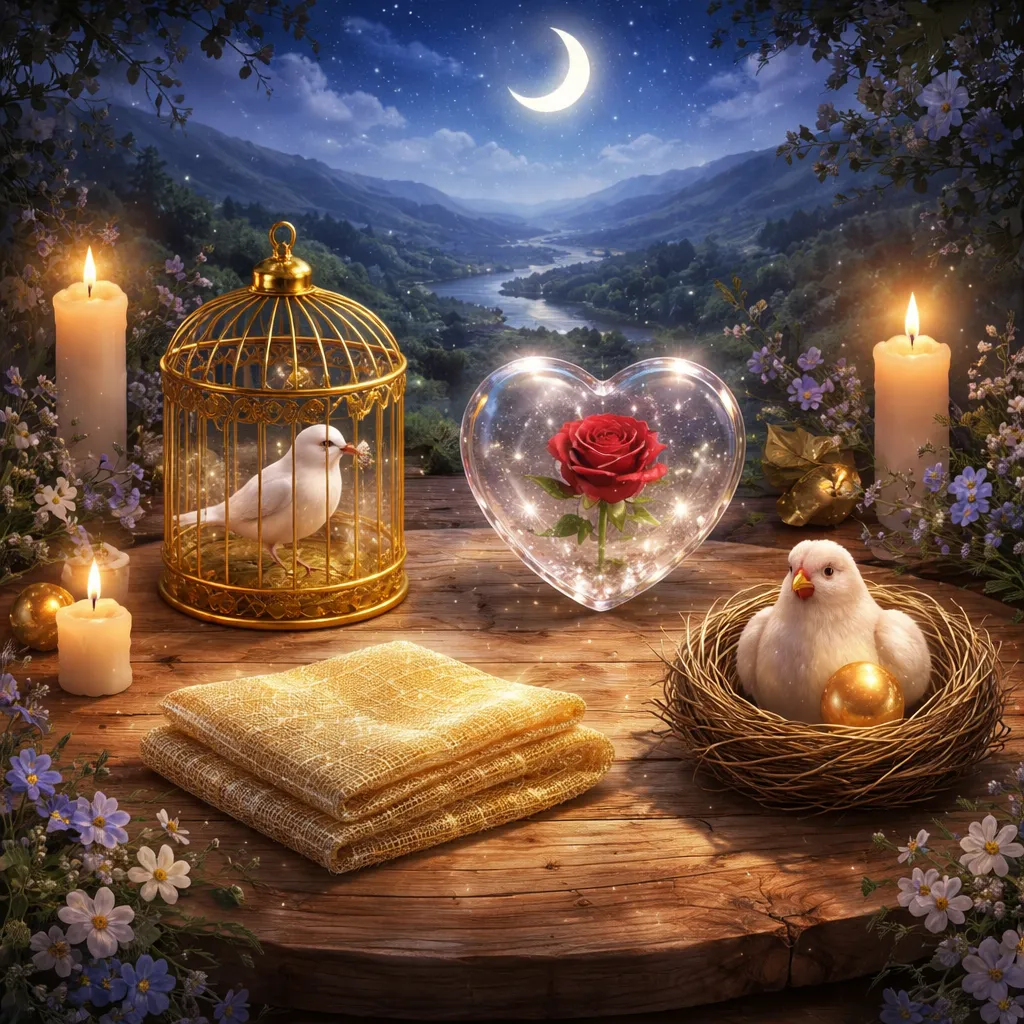

Have you ever tried to give someone a gift that doesn’t exist? Like a square circle or a silent bell? It sounds impossible! But what if the gift is really a beautiful idea hiding in a puzzle? There is a very old, gentle song that is a game of impossible gifts. It’s a song of love, nature, and clever answers. Let’s solve the musical puzzles in “The Riddle Song,” also called “I Gave My Love a Cherry.”
About the Song
Let’s read the puzzling, poetic words of this classic folk song.
I gave my love a cherry that had no stone,
I gave my love a chicken that had no bone,
I told my love a story that had no end,
I gave my love a baby with no cryin’.
How can there be a cherry that has no stone?
How can there be a chicken that has no bone?
How can there be a story that has no end?
How can there be a baby with no cryin’?
A cherry when it’s bloomin’, it has no stone,
A chicken when it’s pippin’, it has no bone,
The story that I love you, it has no end,
A baby when it’s sleepin’, has no cryin’.
This song is a traditional English folk song and riddle ballad. It is structured as a conversation between two people in love. One lover presents four impossible gifts: a cherry without a pit (stone), a chicken without bones, a story without an end, and a baby that doesn’t cry. The other lover then asks how such things are possible. Finally, the first lover provides the beautiful, natural answers: a blooming cherry flower, an egg (a “pipping” chicken inside the egg), the ongoing story of their love, and a sleeping baby. The song uses metaphors from nature to express that true love is a living, growing, and peaceful thing.
What the Song is About
The song paints a picture of a loving conversation. One person is speaking to their beloved, describing the special gifts they have given. But these are not normal gifts; they are riddles. The singer gave a “cherry that had no stone.” In the real world, every cherry has a pit. This makes the listener curious and confused.
Then, the other person asks the logical question: “How can this be?” They are asking for the secret, the solution to the riddle. The first lover then explains. A cherry flower has no stone. A chicken inside the egg (“pippin’” means hatching) has no hard bones yet. The story “I love you” truly has no end. A sleeping baby is not crying. The song is about looking at the world in a different, more poetic way. It shows that love can see the magic in everyday things and express big feelings through small, natural mysteries.
Who Made It & Its Story
“The Riddle Song” is a traditional folk song, so its original author is unknown. It comes from the British folk tradition and is related to other “riddle ballads” where courtship is expressed through puzzles and clever wordplay. The song was brought to America by early settlers and became part of the Appalachian folk tradition. It was collected by folklorists like Cecil Sharp in the early 20th century. The song’s simple, haunting melody and intellectual game made it a favorite in folk music revivals. Artists like Joan Baez helped popularize it in the 1960s, introducing its gentle poetry to a wide audience.
This riddle song has remained beloved for three beautiful reasons. First, it is a charming intellectual game. It engages the mind, inviting the listener to solve the puzzles along with the singer. Second, its answers are rooted in the peaceful cycles of nature (blossoms, eggs, sleep), which makes the metaphors easy to understand and feel. Third, it is a profound yet simple expression of love. It says love is blooming, beginning, endless, and peaceful, all without using complicated words, making it a perfect song for both children and adults.
When to Sing It
This song is perfect for quiet, thoughtful, and loving moments. You can sing it softly as a lullaby, letting the peaceful answers calm the listener. You can sing it as a duet with a family member, taking turns being the riddle-asker and the riddle-answerer. You can also hum it while on a nature walk, looking for blooming flowers or birds, connecting the song’s metaphors to the real world.
What Children Can Learn
This thoughtful, puzzle-like song is a wonderful teacher about language, nature, and thinking. Let’s unwrap its layers.
Vocabulary
The song teaches us specific and poetic words. A “cherry” is a small, round, red fruit with a pit. A “stone” is the hard seed inside a fruit like a cherry or peach. A “chicken” is a young hen or rooster. “Pippin’” is a short form of “pipping,” which means when a baby bird breaks out of its egg. A “story” is a tale or narrative. “Bloomin’” means flowering. “Cryin’” means weeping or shouting loudly.
Let’s use these words! You can say, “The peach had a large stone in the middle.” Or, “We heard the chick pipping inside the egg.” New word: Metaphor. This is when you describe one thing as being another to show they are alike. The song uses a blooming cherry as a metaphor for a gift of love.
Language Skills
This song is a masterful lesson in using the relative clause to describe nouns and forming rhetorical questions. The gifts are described with clauses that start with “that”: “a cherry that had no stone,” “a story that had no end.” This adds specific detail to the noun.
The second part uses questions to challenge the idea: “How can there be a cherry that has no stone?” This is a rhetorical question—a question asked to create dramatic effect, not because the speaker doesn’t know the answer. The song also contrasts the simple past tense (“I gave”) with the present continuous (“when it’s bloomin’”) to show the difference between the gift and its natural state.
Sounds & Rhythm Fun
Listen to the slow, flowing, gentle rhythm of the melody. The song is in a calm 4/4 or 6/8 time, like a slow walk. The structure is clear: a statement, a question, and an answer. The lyrics have a strong, simple rhyme scheme: “stone” and “bone,” “end” and “cryin’,” and then in the answers, “stone” and “bone,” “end” and “cryin’” again.
The rhythm is steady and soothing. Try a slow, even pace: I GAVE my LOVE a CHER-ry THAT had NO STONE. The melody uses a small range of notes and is easy to learn. The repetition of the structure (gift, question, answer) makes the song’s pattern easy to remember. This repetitive, question-and-answer musical pattern is what makes the song so engaging and memorable. You can write your own riddle song! Use the same structure. Try: “I gave my friend a pencil with no lead, I gave my friend a book that no one read. How can there be a pencil with no lead? How can there be a book that no one read? A pencil made of thought, it has no lead, a book of dreams that’s in your head.”
Culture & Big Ideas
“The Riddle Song” is a classic example of the English and Appalachian folk tradition of riddle ballads. In many cultures, riddles are a test of wit and a form of courtship. The song reflects a time when entertainment was homemade and intellectual play was valued. It connects to a worldview that sees deep connections in nature—the life cycle of plants and animals becomes a mirror for human emotions. The song embodies the idea that love is not just a feeling but a way of seeing the world with wonder and creativity.
The song conveys three profound ideas. First, it’s about perception and looking deeper. The surface gift seems impossible, but when you change your perspective (from fruit to flower, from chicken to egg), it becomes not only possible but beautiful. Second, it expresses that true love is a natural, growing process. Like a blossom becoming fruit, an egg becoming a chick, and a story that continues, love is always in a state of beautiful becoming. Third, it highlights communication and shared understanding. The song is a dialogue where both people participate in creating meaning, showing that the best relationships are built on shared puzzles and solutions.
Values & Imagination
Imagine you are giving these impossible gifts. What does the cherry blossom look like? Delicate and white? How do you give someone a story? Do you whisper it? Now, imagine you are receiving the gifts and hearing the answers. Does it feel like a magic trick being explained? A wonderful secret being shared? Draw a picture for each riddle. Split your paper into four squares. In each, draw the “impossible” gift (a cherry with a question mark, a boneless chicken). Then, on a flap of paper over each, draw the answer (a blossom, an egg, the words “I love you,” a sleeping baby). Lifting the flap solves the riddle.
The song encourages us to think creatively, appreciate nature’s cycles, and express love in thoughtful ways. A lovely idea is to have a “Family Riddle Gift” time. Each family member thinks of a simple, natural object (a leaf, a rock, a feather). They give it to another person as a “riddle gift” and must explain why it is special, like “I give you this leaf that never fell from a tree” (because it’s green and still growing). This practices the song’s way of seeing magic in ordinary things.
So, as the last image of the sleeping baby settles in the quiet, think about the gentle wisdom of this puzzle song. It is a vocabulary lesson in nature and poetry. It is a grammar lesson in descriptive clauses and questions. It is a music lesson in a calm, flowing melody. From the first impossible cherry to the final peaceful sleep, it wraps lessons in perception, the growth of love, and shared understanding in a tune that feels like a quiet conversation. “The Riddle Song” teaches us that the best gifts are often ideas, that nature holds the answers to many puzzles, and that true love is a story that really has no end.
Your Core Takeaways
You are now an expert on “The Riddle Song (I Gave My Love a Cherry).” You know it is a traditional English folk song that presents four nature riddles about love. You’ve learned words like “stone,” “pippin’,” and “bloomin’,” and you’ve practiced using descriptive clauses and rhetorical questions. You’ve felt its slow, thoughtful rhythm and created your own riddle verse. You’ve also discovered the song’s place in riddle ballad tradition and its messages about deeper perception, love as a natural process, and the joy of shared understanding.
Your Practice Missions
First, host a “Riddle Song Concert.” Gather your family. Perform the song as a duet. One person sings the gifts, the other sings the questions, and then both sing the answers together. Discuss which riddle is your favorite and why. This helps you internalize the song’s structure and meaning.
Second, create a “Nature Riddle Card.” Go outside and find one small piece of nature—a pinecone, a smooth stone, a dandelion. Create a greeting card. On the front, write a riddle about your object (e.g., “I give you a key that opens no lock”). On the inside, glue the object and write the answer (e.g., “A pinecone that unlocks the smell of the forest”). Give your card to someone. This turns the song’s idea into a tangible, creative gift.