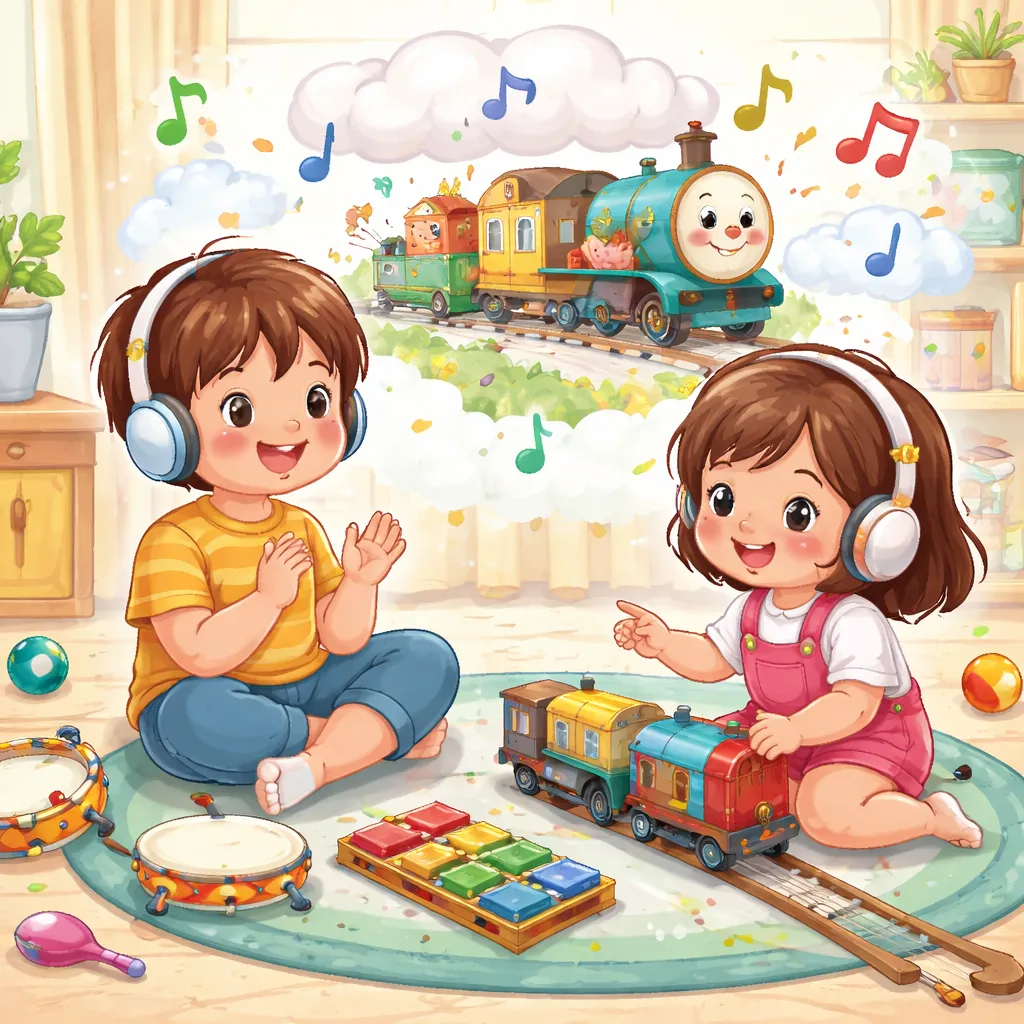

A train chugs along the track. It goes “choo-choo.” It carries passengers. A children’s song can capture that rhythmic journey and bring it into language learning. Today, we explore a traditional Japanese children’s song called “汽車” (Kisha), which translates to “The Train.” This cheerful song follows a train as it travels along the tracks. We will use this melody as a rhythmic, chugging path into English. Together, we will learn new words, explore important sounds, and discover how a simple song can make language learning feel like a train ride through new landscapes. The train chugs along. Your child can learn English with that same steady, rhythmic energy.
What is the rhyme?
“The Train” (汽車) is a beloved Japanese children’s song about a train. It tells the story of a train that travels along the tracks, making its “choo-choo” sound and carrying passengers. The song has a steady, chugging rhythm. Children often use hand movements. They make choo-choo sounds. They move their arms like train wheels. They pretend to be train cars. The song creates a joyful, rhythmic atmosphere. It celebrates the journey of a train as it travels from place to place. When we bring this song to English learning, we keep its rhythmic, chugging spirit. We use the familiar melody to introduce English words in a way that feels like riding on a train through new sounds.
The lyrics of nursery rhymes
To appreciate this song, we first look at the original Japanese words. Then we see how they translate into English. This shows children that the same rhythmic train song can be told in different languages. You do not need to know Japanese to enjoy the steady, chugging rhythm of the words.
Original Version (Japanese)
汽車、汽車、汽車
線路を走る
シュッポッポー
シュッポッポー
汽笛がなるよ
English Version
Train, train, train
Runs on the tracks
Choo-choo, choo-choo
The whistle blows
A longer version adds more detail:
汽車に乗って
どこへ行くの?
山を越えて
町へ行くよ
English Version
Riding the train
Where are you going?
Over the mountains
To the town I go
As you read these words, notice the steady, chugging repetition. The rhythm moves like a train on tracks. The story is simple and joyful. A train runs on the tracks. It goes choo-choo. The whistle blows. Riding the train, where are you going? Over the mountains to the town. This narrative invites children to move and make sounds.
Vocabulary learning
This song offers a wonderful set of words that connect to vehicles, travel, and joyful movement. We can explore these words through conversation, pictures, and chugging play.
Start with the main subject: the train. In Japanese, it is 汽車 (kisha). In English, we say “train.” Trains travel on tracks and carry people.
Here are the key words to focus on from the song:
Train: A vehicle that travels on tracks. Show pictures of trains.
Runs: Moves quickly. The train runs on the tracks.
Tracks: The rails that trains travel on. Point to train tracks.
Choo-choo: The sound a train makes. Say “choo-choo” together.
Whistle: The sound a train makes to signal. The train whistle blows.
Blows: Makes a sound. The whistle blows.
Riding: Traveling on. Riding the train.
Mountains: Large, high landforms. The train goes over mountains.
Town: A place with streets and buildings. The train goes to the town.
Use these words in natural moments. When you see a train, say “look, a train! It goes choo-choo.” When you travel, say “we ride the train.” These connections make the vocabulary meaningful.
Phonics points
Phonics helps children understand the sounds that build English words. This song gives us several clear sounds to explore in a rhythmic, chugging way.
First, focus on the ‘t’ sound at the beginning of “train.” This is a sharp, unvoiced sound. Put your hand in front of your mouth and say “t t t.” You will feel air. Practice with “top,” “toy,” and “train.” This sound is crisp and chugging.
Next, notice the long ‘a’ sound in “train” and “tracks.” Say “ay” like in “day.” Practice with “play,” “say,” and “train.” This sound is bright and open.
The word “choo-choo” contains the ‘ch’ sound and the long ‘oo’ sound. Say “ch” like in “cheese.” Then add “oo.” Practice with “choo-choo,” “choose,” and “choo.” This sound makes the train’s call.
Finally, look at the ‘wh’ sound in “whistle.” This is a breathy sound. Say “w” with air. Practice with “why,” “what,” and “whistle.” The song also has “mountains,” which contains the ‘ow’ sound. Say “ow” like in “cow.”
Grammar patterns
Even a simple song contains grammar that we can introduce gently. We do not need to use technical terms. Instead, we show how words work together through examples and play.
The song uses the present tense to describe what the train does. “Runs,” “blows,” and “goes” describe actions now. You can practice by describing what you do. “I run.” “I ride.” This builds present tense.
Notice the question “where are you going?” This is a question asking about destination. You can practice asking questions. “Where are you going?” “Where is the train going?” This builds questioning skills.
The phrase “over the mountains” shows location. You can practice with other “over” phrases. “Over the hill.” “Over the bridge.” “Over the river.” This teaches spatial language.
Also, look at the sound word “choo-choo.” This is onomatopoeia. It is a word that sounds like the train’s sound. You can practice other sound words. “Beep-beep.” “Vroom-vroom.” “Chug-chug.” This builds sound vocabulary.
Learning activities
Activities bring the song into the body and the imagination. They transform listening into active participation. These ideas are simple and require little preparation.
Train Chug
Play the song and pretend to be a train. Move your arms like train wheels. Chug around the room. When the song says “runs on the tracks,” move in a line. When it says “choo-choo,” make the sound. When it says “over the mountains,” stretch up high. When it says “to the town,” chug to a designated spot. This activity builds listening skills and physical play.
Train Track
Create a train track using tape or string on the floor. Walk along the track like a train. Make choo-choo sounds. Say “I run on the tracks.” This connects the song to movement.
Train Craft
Create a simple train using a cardboard box or paper. Add paper wheels. Decorate it. Line up chairs to be train cars. Use the craft to act out the song. This combines fine motor skills with language practice.
Printable materials
Printable resources offer a quiet way to reinforce the song’s vocabulary. They are perfect for moments when children want to create or focus calmly.
Flashcards
Create a set of flashcards. One card shows a train for “train.” One shows train tracks for “tracks.” One shows the word “choo-choo.” One shows a whistle for “whistle.” One shows mountains. One shows a town. Use these cards for a matching game. Sing a line from the song and ask your child to find the matching card. This builds word recognition.
Coloring Page
Draw a simple train scene. Show a train on tracks. Draw mountains in the background and a town in the distance. Children can color the train bright colors, the tracks gray, and the mountains green. As they color, talk about the scene. “Where is the train going?” “What sound does it make?” This keeps the language flowing naturally.
Train Whistle Craft
Create a simple train whistle using a paper tube. Decorate it. Blow into it to make a whistle sound. This combines fine motor skills with sound practice.
Educational games
Games encourage repetition without boredom. They invite children to use the language in new and creative ways.
Train Says
Play a game similar to “Simon Says.” Give commands using the song’s vocabulary. “The train says run on the tracks.” “The train says choo-choo.” “The train says blow the whistle.” “The train says go over the mountains.” If you give a command without saying “the train says,” the child does not move. This game builds listening skills.
Destination Game
Name a destination. “Let us go to the town!” Chug around the room. When you arrive, say “we have arrived!” This builds imagination and vocabulary.
Whistle Game
Make a whistle sound. See who can make the loudest whistle. See who can make the softest whistle. This builds sound awareness.
As you share “汽車” with your child, remember that you are creating a joyful ride through language. The train runs on the tracks. It goes choo-choo. The whistle blows. It goes over the mountains to the town. Learning a new language can be like that too. You travel along the track of new words. You make new sounds. You go over mountains of difficulty. But you always arrive at new destinations. Let the little train be your guide. Chug along. Make sounds. Let the rhythmic spirit of the train remind you both that language learning is a journey, and every journey is more fun when you make it together.