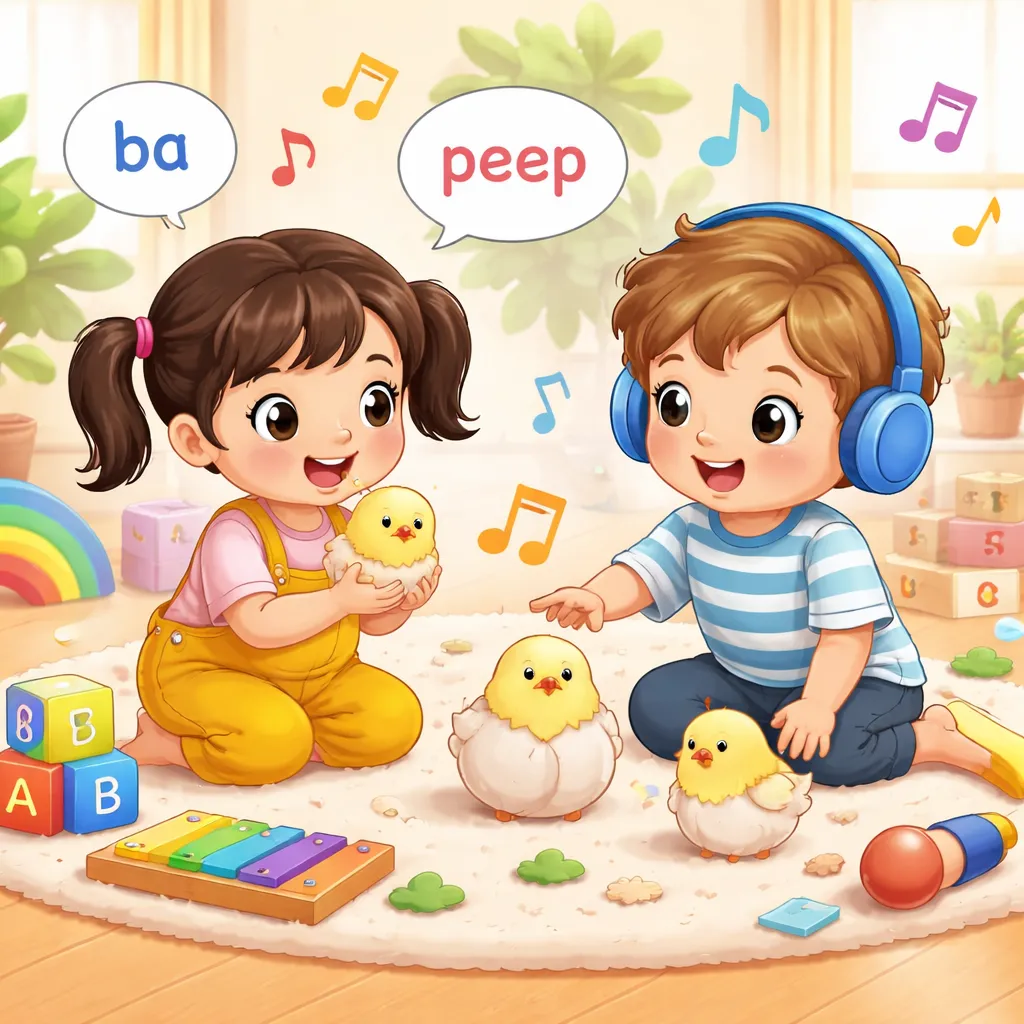

A baby chick pecks at the ground. It is small and yellow. It grows every day. A children’s song can capture that journey of growing and bring it into language learning. Today, we explore a traditional Korean children’s song called “병아리” (Byeongari), which translates to “Baby Chick.” This gentle song follows a small chick as it pecks, chirps, and grows. We will use this melody as a gentle, growing path into English. Together, we will learn new words, explore important sounds, and discover how a simple song can make language learning feel like watching a little chick grow stronger day by day. The baby chick grows. Your child can learn English with that same steady, growing spirit.
What is the rhyme?
“Baby Chick” (병아리) is a sweet Korean children’s song about a baby chick. It tells the story of a small, yellow chick that pecks for food, chirps, and grows. The song has a light, pecking rhythm. Children often use hand movements. They make a small beak with their fingers. They peck at the ground. They make chirping sounds. They pretend to grow. The song creates a calm, nurturing atmosphere. It celebrates the miracle of growing up. When we bring this song to English learning, we keep its gentle, growing spirit. We use the familiar melody to introduce English words in a way that feels like watching something small become something strong.
The lyrics of nursery rhymes
To appreciate this song, we first look at the original Korean words. Then we see how they translate into English. This shows children that the same gentle growing story can be told in different languages. You do not need to know Korean to enjoy the soft, pecking rhythm of the words.
Original Version (Korean)
병아리 병아리
노란 병아리
모이를 쪼아요
삐악삐악
English Version
Baby chick, baby chick
Yellow baby chick
Pecking at the grains
Cheep, cheep, cheep
A longer version adds more detail:
작은 병아리
예쁜 병아리
날개를 퍼덕이며
폴짝폴짝 뛰어요
English Version
Little baby chick
Pretty baby chick
Flapping its little wings
Hop, hop, hopping
As you read these words, notice the gentle, growing repetition. The rhythm moves like a chick pecking and hopping. The story is simple and hopeful. Baby chick pecks at the grains, cheep, cheep, cheep. Little baby chick, pretty baby chick, flapping its little wings, hop, hop, hopping. This narrative invites children to appreciate the journey of growth.
Vocabulary learning
This song offers a wonderful set of words that connect to animals, growth, and daily life. We can explore these words through conversation, pictures, and growing play.
Start with the main character: the baby chick. In Korean, it is 병아리 (byeongari). In English, we say “baby chick.” A chick is a baby chicken.
Here are the key words to focus on from the song:
Baby chick: A baby chicken. Show pictures of chicks.
Little: Small. The little baby chick.
Yellow: The color of the sun. The chick is yellow.
Pecking: Hitting with the beak. The chick is pecking at grains.
Grains: Small seeds. Show grains like rice or corn.
Cheep: The sound a chick makes. Say “cheep” together.
Pretty: Nice to look at. The chick is pretty.
Flapping: Moving up and down. Flapping its little wings.
Wings: The parts birds use to fly. Flapping its wings.
Hop: Jump on one foot or with both feet together. Hop, hop, hopping.
Use these words in natural moments. When you see a baby chick, say “look, a baby chick! It is yellow.” When you eat grains, say “the chick pecks at grains.” These connections make the vocabulary meaningful.
Phonics points
Phonics helps children understand the sounds that build English words. This song gives us several clear sounds to explore in a gentle, growing way.
First, focus on the ‘b’ sound at the beginning of “baby.” This is a voiced sound made with the lips together. Say “b b b.” Practice with “ball,” “big,” and “baby.” This sound is soft and round.
Next, notice the long ‘a’ sound in “baby.” Say “ay” like in “day.” Practice with “may,” “play,” and “baby.” This sound is bright and gentle.
The word “chick” contains the ‘ch’ sound and the short ‘i’ sound. Say “ch” like in “cheese.” Then add “ick.” Practice with “chick,” “chirp,” and “chick.” The short ‘i’ is like “igloo.”
Finally, look at the ‘fl’ blend in “flapping.” Say “f,” then quickly add “l.” Then add “apping.” Practice with “flap,” “flip,” and “flapping.” The song also has “hop,” which contains the short ‘o’ sound. Say “o” like in “hot.”
Grammar patterns
Even a simple song contains grammar that we can introduce gently. We do not need to use technical terms. Instead, we show how words work together through examples and play.
The song uses the present tense to describe what the chick does. “Pecking,” “flapping,” and “hopping” describe actions now. You can practice by describing what you do. “I peck.” “I hop.” This builds present tense.
Notice the repetition of “cheep, cheep, cheep” and “hop, hop, hop.” Repetition adds rhythm and emphasis. You can practice repeating for effect. “Cheep, cheep.” “Hop, hop.” “Flap, flap.” This adds playful language.
The word “pretty” is a descriptive word. You can practice describing things. “A pretty chick.” “A yellow chick.” “A little chick.” This builds descriptive language.
Also, look at the diminutive “baby” shows smallness and affection. You can practice using “baby” with other words. “Baby bird.” “Baby animal.” “Baby you.” This builds affectionate language.
Learning activities
Activities bring the song into the body and the imagination. They transform listening into active participation. These ideas are simple and require little preparation.
Chick Peck
Play the song and pretend to be a baby chick. Make a beak with your fingers. Peck at the ground for grains. When the song says “cheep,” make the sound. When it says “flapping its wings,” flap your arms. When it says “hop,” hop around. This activity builds listening skills and growing play.
Chick Craft
Create a baby chick using a yellow paper circle. Add eyes and a beak. Add paper wings. Glue on yellow feathers or yarn. This combines fine motor skills with language practice.
Growth Chart
Create a growth chart. Mark your child’s height. Say “you grow, like the baby chick!” This connects the song to real growth.
Printable materials
Printable resources offer a quiet way to reinforce the song’s vocabulary. They are perfect for moments when children want to create or focus calmly.
Flashcards
Create a set of flashcards. One card shows a baby chick for “baby chick.” One shows grains for “pecks.” One shows the word “cheep.” One shows flapping wings for “flapping.” One shows hopping for “hop.” One shows the word “yellow.” Use these cards for a matching game. Sing a line from the song and ask your child to find the matching card. This builds word recognition.
Coloring Page
Draw a simple scene. Show a yellow baby chick pecking at grains. Show it flapping its wings and hopping. Children can color the chick yellow, the grains brown, and the grass green. As they color, talk about the story. “What is the chick doing?” “What sound does it make?” This keeps the language flowing naturally.
Chick Mask
Create a simple chick mask using a paper plate. Cut out eye holes. Color it yellow. Add an orange beak. Add paper wings. Wear the mask while pecking and hopping. This combines fine motor skills with language practice.
Educational games
Games encourage repetition without boredom. They invite children to use the language in new and creative ways.
Chick Says
Play a game similar to “Simon Says.” Give commands using the song’s vocabulary. “The chick says peck at the grains.” “The chick says cheep.” “The chick says flap your wings.” “The chick says hop.” If you give a command without saying “the chick says,” the child does not move. This game builds listening skills.
Growth Game
Act out different stages. Start small (curled up). Grow a little (crouch). Grow more (stand). Become a chicken (stand tall and cluck). This builds movement and understanding of growth.
Peck Race
Peck (tap) your finger on the table. See who can peck the fastest. Say “peck, peck, peck!” This builds coordination and vocabulary.
As you share “병아리” with your child, remember that you are celebrating the journey of growth. The baby chick pecks at grains. It flutters its wings. It hops. It grows. Learning a new language is also a journey of growth. You start small, with one word. You peck at new sounds. You hop to new phrases. And one day, you become someone who can speak a whole new language. Let the growing chick be your guide. Be patient. Grow at your own pace. Let the hopeful spirit of the song remind you both that every little step is growth, and every day, you are becoming something beautiful.