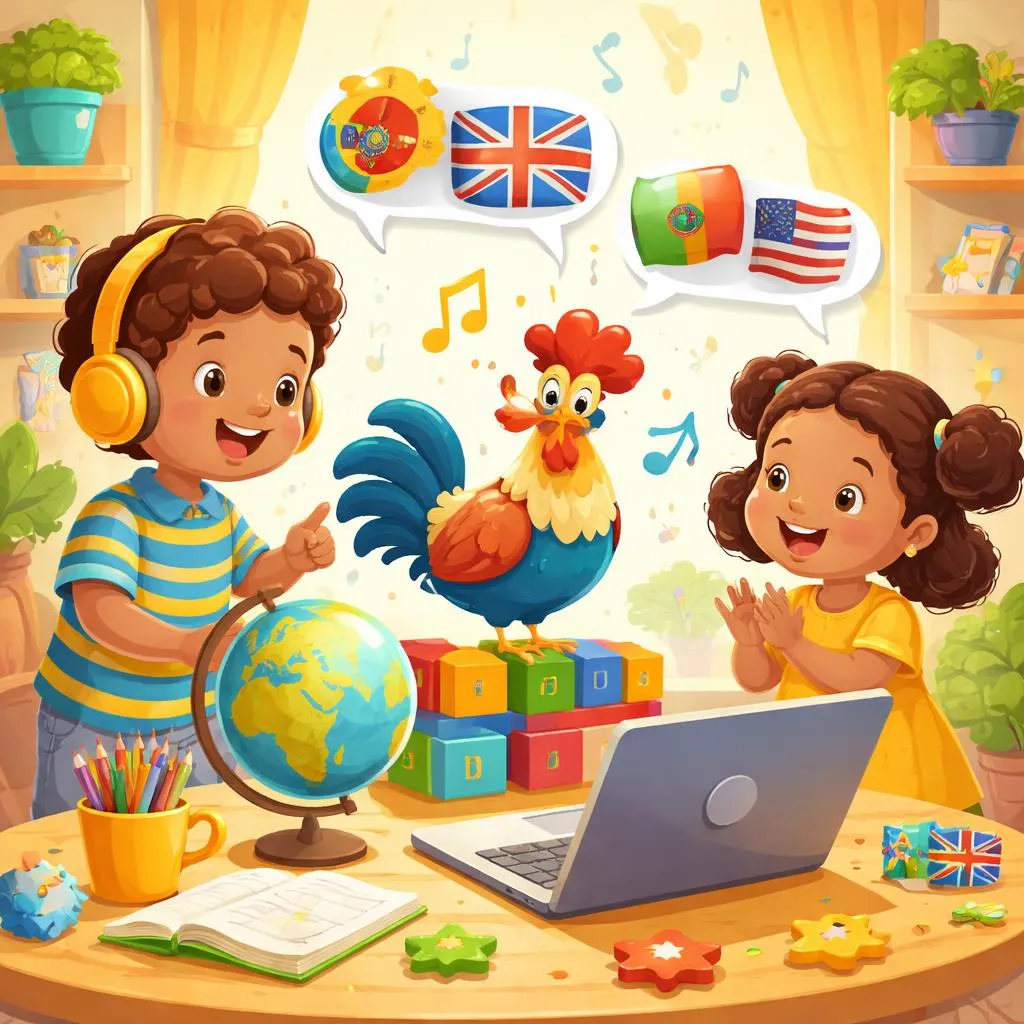

A rooster’s crow greets the morning with confidence. A children’s song can do something similar for language learning. It can wake up curiosity and invite participation. Today, we explore a traditional Portuguese rhyme called “O Galinho,” which means “The Little Rooster.” This cheerful song celebrates the rooster who wakes up the farm. We will use this melody as a joyful way to learn English. Together, we will discover new words, explore sounds, and see how a simple song can build confidence in young learners. The rooster is not shy about singing. Your child can feel that same confidence when exploring English.
What is the rhyme? “O Galinho” is a popular nursery rhyme in Portuguese-speaking cultures. It tells the story of a little rooster who wakes up early each morning. The song has a bright, alert rhythm. It often includes actions. Children stretch their arms like wings. They open their hands like a rooster’s comb. They make crowing sounds. The song celebrates the start of a new day. It invites children to be awake, aware, and ready to join in. When we bring this song to English learning, we keep its energetic spirit. We use the familiar melody to introduce English words in a way that feels like waking up to something new and exciting.
The lyrics of nursery rhymes To appreciate this song fully, we first look at the original Portuguese words. Then we see how they translate into English. This shows children that the same cheerful idea can be expressed in different languages. You do not need to know Portuguese to enjoy the bright rhythm of the words.
Original Version (Portuguese)
O galinho, o galinho Vai cantar, vai cantar Logo cedo, logo cedo Vai acordar, vai acordar
English Version
The little rooster, the little rooster Will sing, will sing Early in the morning, early in the morning Will wake up, will wake up
A second verse often continues the story, showing what happens when the rooster sings.
Original Version (Portuguese)
Acordou, acordou Toda a fazenda, toda a fazenda O sol nasceu, o sol nasceu Bom dia, bom dia
English Version
He woke up, he woke up The whole farm, the whole farm The sun rose, the sun rose Good morning, good morning
As you read these words, notice the building energy. The rooster sings early. He wakes the farm. The sun rises. Everyone says good morning. This simple narrative carries a sense of purpose and joy.
Vocabulary learning This song offers a wonderful set of words that connect to morning routines, nature, and sounds. We can explore these words through conversation, actions, and daily moments.
Start with the main character: the rooster. In Portuguese, it is galinho. In English, we say “little rooster.” The word “little” adds charm. You can look at pictures of roosters together. Notice their bright feathers and the comb on their head. Practice the rooster’s sound. In English, we say “cock-a-doodle-doo.”
Here are the key words to focus on from the song:
Rooster: A male chicken who crows in the morning. Explain that the rooster wakes up the farm.
Sing: What the rooster does. This word is different from human singing. It means making his special call.
Early in the morning: The time when the sun comes up. Point to the morning light. Connect it to your child’s own morning.
Wake up: To become awake. This is a familiar concept. Talk about how you wake up each day.
Farm: A place where animals live. If you have visited a farm, talk about it. Look at pictures of farm animals.
Sun rose: The sun came up. Watch the sunrise together if you can. Or talk about how the sun rises each morning.
Good morning: A greeting. Use this phrase every day to make it familiar.
Use these words in natural moments. In the morning, say “good morning! The sun rose. The little rooster sang.” When your child wakes up, say “you woke up, just like the farm animals.” These connections make the vocabulary meaningful and memorable.
Phonics points Phonics helps children understand the sounds that build English words. This song gives us several clear sounds to explore in a relaxed, energetic way.
First, focus on the ‘r’ sound at the beginning of “rooster.” This is a strong, voiced sound. Make your tongue curl slightly. Say “rrrr” like a rolling sound. Practice with “run,” “red,” and “rooster.” This sound appears in many English words.
Next, notice the long ‘oo’ sound in “rooster” and “soon.” This is a rounded vowel sound. Purse your lips and say “oo oo.” Practice with “moon,” “spoon,” and “rooster.” This is a common sound pattern.
The word “sing” contains the ‘ng’ sound at the end. This is a nasal sound made with the back of the tongue. Say “ing” like in “ring.” Then say “sing.” Practice with “wing,” “king,” and “morning.” This sound appears frequently in English.
Finally, look at the ‘w’ sound in “wake” and “woke.” This is a voiced sound made with rounded lips. Say “w w w” like a soft wind. Then say “wake.” Practice with “water,” “window,” and “wake up.” The song also has “morning,” which contains the ‘or’ sound. Say “more,” “door,” and “morning.” Notice how the mouth opens.
Grammar patterns Even a simple song contains grammar that we can introduce gently. We do not need to use technical terms. Instead, we show how words work together through examples and play.
The song uses the future tense with the word “will.” “Will sing” means the rooster plans to sing. You can explain this simply. “Will” is a helper word that tells us something is going to happen. Practice by talking about morning routines. “You will wake up.” “We will eat breakfast.” This gives children a tool to talk about future events.
The second verse shifts to the past tense. “He woke up” and “the sun rose” describe things that already happened. You can point this out without using the term “past tense.” Say “this is what happened. The rooster sang, and then the sun came up.” Practice by talking about your morning. “You woke up. Then you ate breakfast.”
Notice the repetition of phrases. “The little rooster, the little rooster” repeats the noun. This repetition adds rhythm and emphasis. Children can use this pattern themselves. They might say “the sun, the sun” when pointing to it.
Also, look at the greeting “good morning.” This is a common social phrase. It is a complete expression on its own. Practice using it every day. This teaches children about polite social language in English.
Learning activities Activities bring the song into the body and the imagination. They transform listening into active participation. These ideas are simple and require little preparation.
Morning Rooster Game Play the song in the morning. When the rooster sings, stretch and pretend to wake up. When the verse says “the whole farm woke up,” have your child wake up toy animals. When the sun rises, open the curtains. Say “good morning” together. This connects the song to the daily routine.
Rooster Walk Walk around the room pretending to be the rooster. Stand tall. Flap your wings. When the song says “will sing,” stop and crow loudly, “cock-a-doodle-doo!” When it says “woke up,” pretend to shake off sleep. This activity builds listening skills and physical expression.
Farm Picture Talk Look at a picture of a farm. Point to the rooster, the hens, the chicks, the sun, the barn. Sing the song while pointing to each part. Ask your child to find the rooster. Ask where the sun is. This builds vocabulary and observation skills.
Printable materials Printable resources offer a quiet way to reinforce the song’s vocabulary. They are perfect for moments when children want to create or focus calmly.
Flashcards Create a set of flashcards. One card shows the rooster. One shows a musical note for “sing.” One shows a clock showing early morning. One shows a child waking up. One shows a farm scene. One shows the sun rising. Use these cards for a matching game. Sing a line from the song and ask your child to find the matching card. This builds word recognition.
Coloring Page Draw a simple scene from the song. Show the little rooster on a fence. Show the sun rising behind him. Show a farm with a barn in the background. Children can color while listening to the song. As they color, talk about the scene. “What is the rooster doing?” “Where is the sun?” This keeps the language flowing naturally.
Morning Routine Chart Create a simple chart with pictures. Show waking up, saying good morning, eating breakfast, and going outside. Connect each step to the song. “The rooster wakes up. You wake up.” This builds connections between the song and daily life.
Educational games Games encourage repetition without boredom. They invite children to use the language in new and creative ways.
Rooster Says Play a game similar to “Simon Says.” Give commands using the song’s vocabulary. “The rooster says wake up.” “The rooster says sing like a rooster.” “The rooster says say good morning.” If you give a command without saying “the rooster says,” the child does not move. This game builds listening skills.
Morning Sound Match Make the sounds of different farm animals. The rooster crows. The cow moos. The sheep baas. Ask your child to identify each sound. Then sing the part of the song about the rooster waking the farm. This extends the vocabulary beyond the song.
Sunrise Race Place a yellow circle (the sun) on one side of the room. Place a rooster picture on the other. Take turns moving the sun toward the rooster while singing. When the sun reaches the rooster, everyone says “good morning!” This combines movement with the song’s narrative.
As you share “O Galinho” with your child, remember that you are building a positive association with English. The little rooster sings confidently each morning. He does not worry about being perfect. He simply joins the new day with his voice. Your child can approach language learning with that same confidence. Let the song be a morning companion. Sing it when the day begins. Let the cheerful rooster remind you both that learning English can be as natural and joyful as greeting the sunrise.