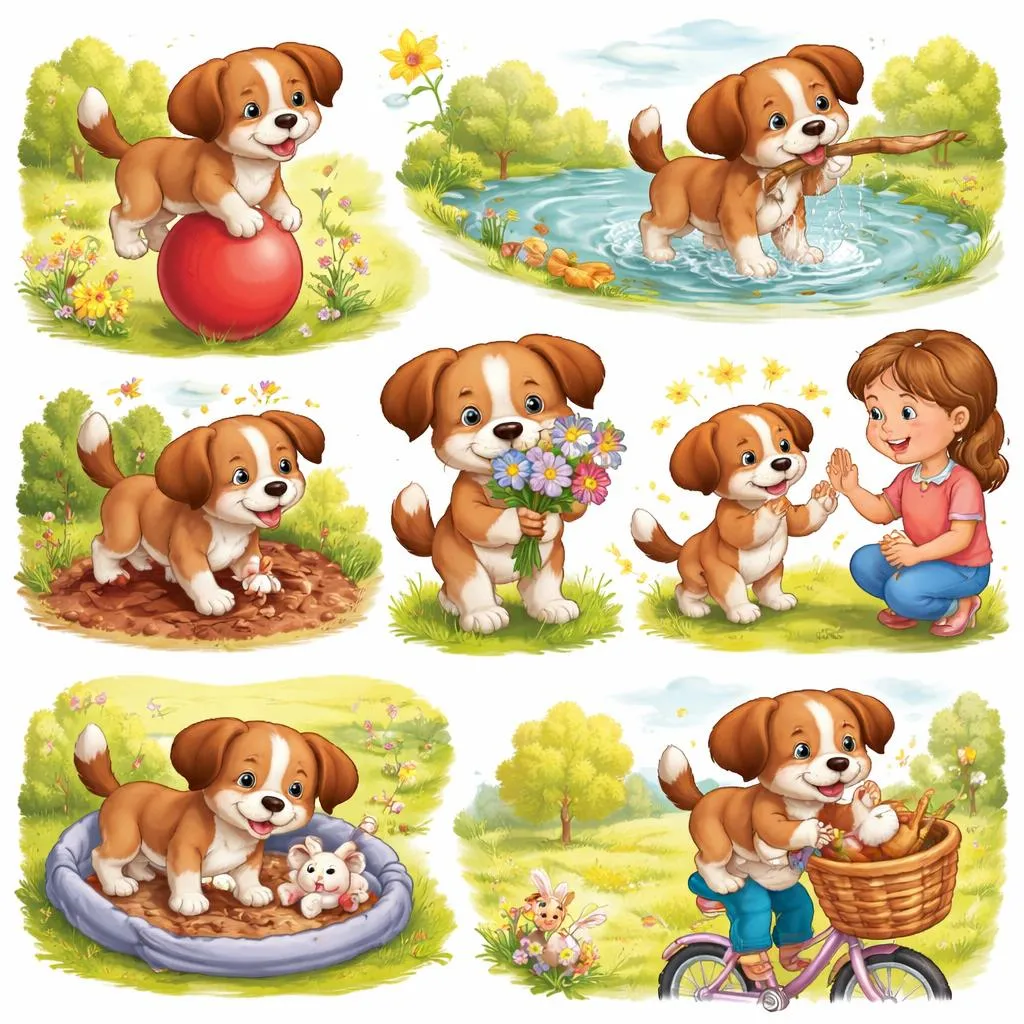

Have you ever played with a happy, wiggly puppy? It might jump, run, and bark with so much excited energy! In Germany, there is a lively, bouncy song all about a little dog and all the fun things it can do. It is a song full of action and sounds. Let’s get ready to move and learn the playful song “The Little Dog (Der kleine Hund).”
About the Song
Here are the energetic, action-packed lyrics of a classic and popular German children’s song:
Der kleine Hund, der kleine Hund,
der kann so bellen, Wau, wau, wau!
Der kleine Hund, der kleine Hund,
der kann so springen, Hopp, hopp, hopp!
Der kleine Hund, der kleine Hund,
der kann so laufen, Lauf, lauf, lauf!
Und wenn er müde, müde ist,
dann schläft er ein, ganz sacht und still.
English Translation:
The little dog, the little dog,
he can bark like this, Woof, woof, woof!
The little dog, the little dog,
he can jump like this, Hop, hop, hop!
The little dog, the little dog,
he can run like this, Run, run, run!
And when he is tired, tired,
then he falls asleep, very softly and quiet.
This is a beloved and energetic German-language action song for children. The song is a celebration of a dog’s playful energy. “The little dog, the little dog, he can bark like this, Woof, woof, woof!” it starts, immediately inviting everyone to make a loud, happy sound. The song lists the dog’s exciting abilities one by one. “He can jump like this! He can run like this!” Each action comes with a fun sound or command word. Finally, after all that playing, the song shows a gentle side. “And when he is tired… then he falls asleep, very softly and quiet.” It is a perfect picture of a playful puppy’s busy day.
What the Song is About
The song is a fun list of a little dog’s favorite activities. Imagine a garden on a sunny day. A brown and white puppy runs into the yard. “The little dog, the little dog, he can bark like this, Woof, woof, woof!” He sees a friend and lets out three happy barks.
He is full of energy! “The little dog, the little dog, he can jump like this, Hop, hop, hop!” He jumps up and down, trying to reach a bouncing ball. Then, he gets the zoomies! “The little dog, the little dog, he can run like this, Run, run, run!” He races in big, fast circles all around the garden. But all that playing makes a puppy very sleepy. “And when he is tired, tired, then he falls asleep, very softly and quiet.” He finds a soft spot in the sun, curls into a ball, and takes a quiet nap. The song is about the joyful energy of play and the peaceful rest that comes after.
Who Made It & Its Story
“Der kleine Hund” is a staple German action and movement song (“Bewegungslied”). Like many traditional children’s songs, its specific creator is unknown, passed down through generations of families, kindergartens, and playgroups. The song is expertly designed for active play, helping children develop gross motor skills by imitating the dog’s actions. It reflects the German cultural appreciation for dogs as common family pets (“Familienhunde”) and the importance of teaching children about animal behavior, energy, and needs in a fun, engaging way.
This energetic song is loved for three fantastic reasons. First, it is a super fun and physical way to learn high-frequency German action verbs like “bellen” (to bark), “springen” (to jump), and “laufen” (to run/ walk). Second, it brilliantly mixes singing with loud sound effects (“Wau, wau, wau!”) and imperative commands (“Lauf, lauf, lauf!”), making language learning a whole-body, shouting, and moving experience. Third, it teaches a simple, relatable narrative about energetic play followed by needed rest, helping children understand the natural cycle of activity and calm.
When to Sing It
This song is perfect for burning off energy and having loud, silly fun. You can sing it as an action game in the living room or garden, jumping and running in place on the commands. You can chant it during a walk with your own dog, matching the actions to what your pet is doing. You can also sing it as a transition from playtime to quiet time, ending by lying down quietly “ganz sacht und still” (very softly and quiet).
What Children Can Learn
This active, joyful song is a wonderful teacher about pets, action words, and the sound of German commands.
Vocabulary
The song teaches us exciting words for animals, actions, sounds, and feelings in German. “The” (Der). “Little” (kleine). “Dog” (Hund). “He” / “it” (er / der). “Can” (kann). “So” (so). “Bark” (bellen). “Woof” (Wau). “Jump” (springen). “Hop” (Hopp). “Run” or walk/run (laufen). “Run!” (as a command: Lauf!). “And” (Und). “When” (wenn). “He” (er). “Is” (ist). “Tired” (müde). “Then” (dann). “Sleeps” (schläft). “He” (er). “In” / “into” (ein, in “schläft ein” meaning falls asleep). “Very” (ganz). “Softly” and quiet (sacht und still).
Let’s use these words! You can describe any active animal or person: “Das Kind kann springen.” (The child can jump.) You can give a friendly command: “Lauf!” (Run!). New word: Ausruhen. This is the German word for “to rest” or “relax,” which is what the tired little dog needs to do.
Language Skills
This song is excellent for learning about action verbs and command forms in German. The key verbs are “bellen” (to bark), “springen” (to jump), and “laufen” (to run). The song also shows us the command form “Lauf!” (Run!).
Concept Definition: An action verb is a doing word. It tells us what someone or something is doing. A command is a word we use to tell someone to do something, like an instruction. In the song, the dog does things: he can bark, jump, run. And the singers tell the dog (or themselves) to do the action with the word “Lauf!”
Features and Types: Action verbs like “bellen,” “springen,” and “laufen” show movement or sound. They are the main event in a sentence. The command form is a special, short way of using the verb. For many verbs, you just use the “stem” of the verb to give a command to one person informally. “Laufen” becomes “Lauf!” (Run!).
How to Spot Them: Here is a simple “what’s happening?” trick. Ask: “What is the subject doing?” The word that answers is often the action verb. In the song: What is the dog doing? He can bark, jump, run. Those are the action verbs. Commands are easy to spot—they often stand alone as a short, strong word, sometimes with an exclamation mark: “Lauf!” “Spring!” (Jump!)
How to Use Them: A great way to talk about abilities or give fun instructions is the “Ability Formula” and the “Command Formula”.
Ability: “[Thing] + kann + [action verb].” Example from the song: “Der Hund kann bellen.” (The dog can bark.)
Command: Just use the verb stem! Example from the song: “Lauf!” (Run!). “Spring!” (Jump!). “Bell!” (Bark!).
Sounds & Rhythm Fun
Listen to the bouncy, energetic rhythm of the melody. The song has a strong, marching beat that makes you want to move. The fantastic sound effect “Wau, wau, wau!” is the classic German dog bark, and it’s so fun to shout out loud! The commands “Hopp, hopp, hopp!” and “Lauf, lauf, lauf!” are repeated three times, creating a powerful, rhythmic chant that’s easy to remember and shout.
The rhythm is perfect for big, energetic actions: making barking sounds, jumping high, and running on the spot. The contrast with the slow, quiet, lullaby-like ending (“ganz sacht und still”) is wonderful for calming down. This musical pattern is perfect for creating your own high-energy animal song. You can write your own “Die kleine Maus” (The Little Mouse) song! Try: “Die kleine Maus, die kleine Maus, die kann so piepsen, Piep, piep, piep! Die kleine Maus, die kleine Maus, die kann so huschen, Husch, husch, husch! …Und wenn sie müde ist, dann schläft sie ein in ihrem Haus.” (The little mouse… can squeak like this… can scurry like this… and when she is tired, she falls asleep in her house.)
Culture & Big Ideas
“Der kleine Hund” connects to the German culture of responsible dog ownership, active outdoor play (“Draußenspiel”), and structured daily rhythms. Dogs are popular family pets in Germany, and it’s common to see well-trained dogs in parks and cities. The song reflects the joy of playing with a dog but also the important understanding that animals (and children!) need both activity and rest. The clear commands (“Lauf!”) mirror the training commands many German dogs learn.
The song conveys three active, important ideas. First, it encourages observation and imitation of animal actions and sounds, building empathy and physical awareness. Second, it celebrates high-energy play as healthy and fun, followed by the necessity and peace of quiet rest. Third, it introduces the concept of following instructions through playful commands, blending obedience with joyful movement.
Values & Imagination
Imagine you are a playful little puppy. You are “der kleine Hund” in a big, green park. “The little dog, the little dog, he can bark like this, Woof, woof, woof!” you think, barking hello to your friends. You are so excited! “The little dog, the little dog, he can jump like this, Hop, hop, hop!” You jump for a stick, your legs full of springs. “The little dog, the little dog, he can run like this, Run, run, run!” You race across the grass as fast as your legs can go. But all that fun is hard work. “And when he is tired, tired, then he falls asleep, very softly and quiet.” You find a cozy blanket, yawn a big yawn, and drift into a soft, quiet sleep. How does the grass feel under your paws? How good does it feel to rest after running? Draw the little dog’s day. Draw three boxes. In the first, draw a barking dog. Write “Wau!” In the second, draw a jumping dog. Write “Hopp!” In the third, draw a running dog. Write “Lauf!”. Then, draw a fourth box with a sleeping dog and write “sacht und still”. This shows the song’s story of play and rest.
The song encourages us to play actively and with all our energy, to listen for and follow fun instructions, and to appreciate the quiet, calm time we need after playing hard. A wonderful activity is the “Hundespiel” (Dog Game) with a friend. One person is the “caller” and shouts the commands from the song: “Bellen!” (Bark!), “Springen!” (Jump!), “Laufen!” (Run!). The other person is the “little dog” and does the action. Then switch! This connects you to the song’s spirit of energetic, instructed play.
So, from the loud “Wau!” to the quiet “sacht und still,” this song is a playful adventure. It is a vocabulary lesson in pets, big actions, and sound words. It is a language lesson in using action verbs like “bellen” and giving commands like “Lauf!”. It is a music lesson in a loud, rhythmic, action-packed melody that ends in a whisper. “The Little Dog (Der kleine Hund)” teaches us to play with energy, to listen to fun commands, and to enjoy a good, quiet rest.
Your Core Takeaways
You are now an expert on the song “The Little Dog (Der kleine Hund).” You know it is a lively German song about a playful dog who barks, jumps, runs, and then sleeps. You’ve learned German words like “Hund,” “bellen,” “Wau,” “springen,” “laufen,” and “müde,” and you’ve practiced using action verbs and command words like “Lauf!”. You’ve felt its energetic, shout-along rhythm and created your own action animal verse. You’ve also discovered the song’s message about active play, following fun instructions, and the importance of rest after activity.
Your Practice Missions
First, play the “Was kannst du?” (What can you do?) game. Do the three actions from the song. As you do each one, say the German sentence: “Ich kann bellen! Wau! Ich kann springen! Hopp! Ich kann laufen! Lauf!”. Then, add your own action: “Ich kann tanzen!” (I can dance!) or “Ich kann singen!” (I can sing!). This mission makes you the star of the song, using the verb “kann” (can) for your own abilities.
Second, be a “Lustiger Trainer” (Funny Trainer). With a friend or a stuffed animal, give the three commands from the song in German. Say “Bellen!” and make barking sounds. Say “Springen!” and jump. Say “Laufen!” and run on the spot. See how fast you can follow the commands. This mission lets you practice the command forms and have energetic fun, just like the song.