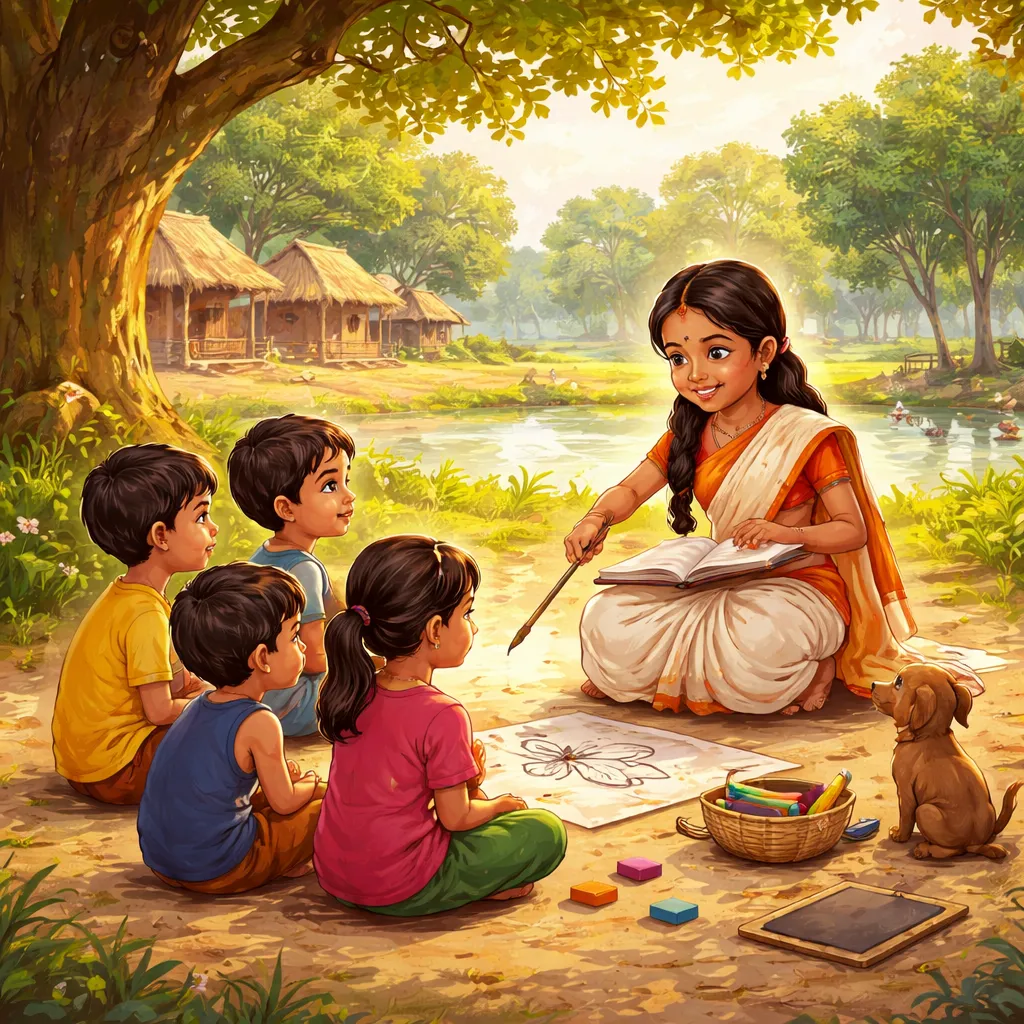

Do you have a favorite teacher? Someone who explains a tricky problem until it makes sense, or who reads stories in a way that makes the characters come alive? A teacher is a guide who helps you discover the world. In Bangladesh and West Bengal, a region that honors learning, there is a song that celebrates this important person. Let’s raise our hands for the Bengali Song: The Little Teacher (শিক্ষক).
About the Song
Here is a verse from this respectful and sweet song in Bengali and English:
শিক্ষক আমার, প্রিয় শিক্ষক
(Shikkhok amar, priyo shikkhok)
My teacher, dear teacher
তোমার কথা শুনে শিখি
(Tomar kotha shune shikhi)
Listening to your words, I learn
তুমি শেখাও ভালো পথ
(Tumi shekhao bhalo path)
You teach the good path
তোমার চেয়ে ভালো কেউ নেই
(Tomar cheye bhalo keu nei)
There is no one better than you
This song’s original name uses the Bengali word “শিক্ষক” (Shikkhok), which means “teacher.” It is a popular and respectful Bengali children’s song. The song is a thankful and admiring message from a student to their teacher. The music is often warm, clear, and full of respect. The Bengali Song: The Little Teacher (শিক্ষক) is a musical thank-you note, expressing gratitude for the guidance and care a teacher provides every day.
What the Song is About
The song is a child’s sincere message to their teacher. First, the child addresses the teacher with affection and respect: “My teacher, dear teacher.” The child explains how learning happens: “Listening to your words, I learn.” This shows the importance of paying attention and the power of a teacher’s voice. The song says the teacher’s job is to “teach the good path.” This means more than school subjects; it’s about how to be a good person. Finally, the child gives the highest praise: “There is no one better than you.” The whole song is about deep respect, the value of listening, and seeing the teacher as a unique and irreplaceable guide in life.
Who Made It & Its Story
This song is a part of the rich tradition of Bengali children’s music that instills respect for educators. While the specific creators aren’t widely listed, the song reflects the immense cultural value placed on teachers, or গুরু (guru), in Indian and Bengali society. A special day that celebrates this is Teachers' Day (শিক্ষক দিবস) in India and Bangladesh, celebrated on different dates, when students honor their teachers. The Bengali Song: The Little Teacher (শিক্ষক) is cherished for three important reasons. First, it helps children articulate feelings of gratitude and respect for their teachers in a simple, beautiful way. Second, it defines a teacher’s role holistically—as an instructor of both knowledge (“words”) and morality (“the good path”). Third, its melody is often heartfelt and easy to sing, making it perfect for school performances or as a personal gesture of thanks.
When to Sing It
You can sing this song softly to yourself while thinking of your teacher, maybe before starting your homework. It’s perfect to chant with your class as a group to welcome your teacher in the morning. You could also sing it when making a thank-you card for your teacher, letting the song guide your words.
The Bengali Song: The Little Teacher (শিক্ষক) teaches us about respect and gratitude. But a good teacher also wants us to learn from everything. This song is a lesson in itself. It introduces us to words for learning and character, shows us how to make comparisons, and shares a core cultural value. Let’s open our notebooks and see what we can learn.
What Children Can Learn
Vocabulary
This song helps us learn words for education, guidance, and values.
Mentor: An experienced and trusted advisor or teacher. A mentor guides you on the right path.
Guidance: Help and advice about how to do something or how to behave. A teacher provides guidance.
Wisdom: The quality of having experience, knowledge, and good judgment. Teachers often share their wisdom.
Integrity: The quality of being honest and having strong moral principles. The “good path” is about living with integrity.
Gratitude: The feeling of being thankful. The song is an expression of gratitude.
Role Model: A person looked to by others as an example to be imitated. A teacher is a role model.
Language Skills
This song is a clear example of making Comparisons using “Better Than.” We use this structure to compare two things and show that one has more of a quality than the other.
What Is It?: Think of “better than” as your comparison tool. It is used to say that one thing is of higher quality or more desirable than another.
Finding the Secret: Look for the phrase “better than” after an adjective (describing word). The thing that is better comes first. Ask: “Is this sentence showing that one thing is superior to another?”
Using It:
◦   Formula: [Thing 1] + is + better than + [Thing 2].

◦   Examples: “Reading is better than watching TV all day.” “My teacher is better than any other.”

◦   In the song: “There is no one better than you.” This is the highest form of praise, comparing the teacher to everyone else.
Sounds & Rhythm Fun
Listen to the respectful rhythm. The Bengali Song: The Little Teacher (শিক্ষক) often has a steady, clear, and dignified beat. It doesn’t bounce or jump; it has the calm, assured pace of someone sharing important knowledge. The melody is often simple and easy to remember, like a lesson well-taught. This clear, steady rhythm makes the message of respect and thanks easy to internalize and remember. You can use this same clear, respectful rhythm to make up a short thank-you song for anyone who helps you.
Culture & Big Ideas
This song connects to the profound Bengali and Indian tradition of revering the teacher, or গুরু. A key figure is Rabindranath Tagore, a Nobel laureate poet and educator who founded a school (Santiniketan) based on holistic, respectful learning. The Bengali Song: The Little Teacher (শিক্ষক) teaches three foundational ideas. First, Teaching as a Noble Calling: A teacher’s work is not just a job; it is a respected and vital service to society. Second, Learning Through Listening: True learning begins with attentive listening, valuing the words and experience of the guide. Third, Education of Character: The ultimate goal of teaching is not just to fill the mind with facts, but to show the “good path” for life.
Values & Imagination
Imagine you are the teacher in the song. What does it feel like to see a student understand something new? How do you choose the “good path” to teach? This song teaches you the value of respecting those who share their knowledge with you. It shows that saying “thank you” is powerful. A simple idea: Think of one thing your teacher taught you this week—a fact, a skill, or a kind way to act. Find a way to tell them you learned it. You can say it, draw it, or write it. This is practicing gratitude.
Your Core Takeaways
The Bengali Song: The Little Teacher (শিক্ষক) is a heartfelt lesson in respect, gratitude, and the true purpose of education. You learned words like “mentor,” “guidance,” and “integrity.” You discovered how to use “better than” to make positive comparisons. You felt the song’s steady, respectful rhythm. You also connected the role of the teacher to cultural giants like Rabindranath Tagore and the celebration of Teachers' Day. Most importantly, the song teaches that teachers deserve our deepest thanks, that learning is an act of listening, and that the best lessons guide us not just in school, but in life.
Your Practice Missions
- Be a “Better Than” Detective. Look around your room. Compare two objects using “better than” in a positive way. Example: “This book is better than that one for bedtime because it has softer pictures.” This practices making kind comparisons.
- Create a “Good Path” Map. Draw a winding path on a piece of paper. Label the start “Me Today.” Label the end “A Wise and Kind Person.” On the path, write or draw three things a teacher (or parent, or book) has taught you that are on the “good path”—like sharing, telling the truth, or being curious. Share your map. This shows how teaching guides our life’s journey.