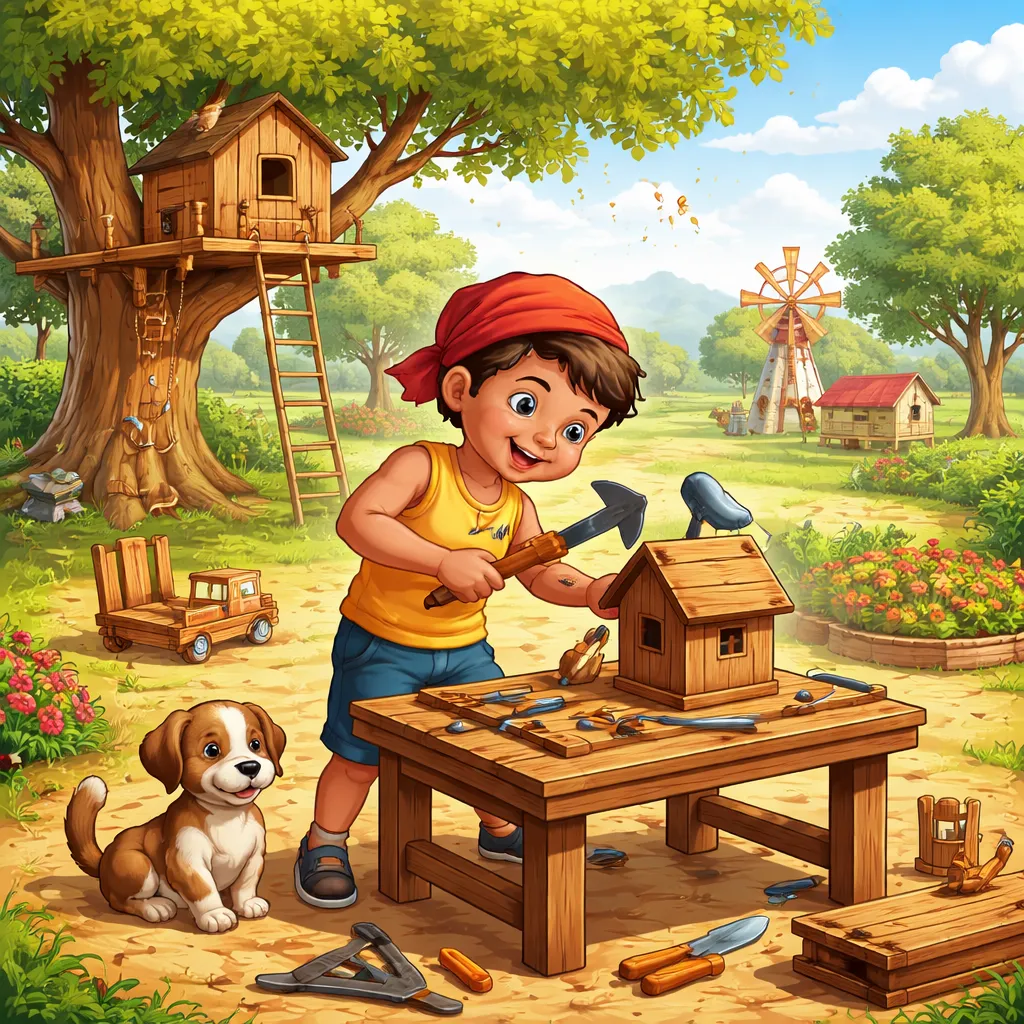

Have you ever taken a block of wood and imagined it could be a speeding car, a tall tower, or a cozy birdhouse? Have you tried to build something and learned that making it straight and strong takes a careful eye and a steady hand? The craft of shaping wood is an ancient and wonderful skill. In India, a land of beautiful woodwork in temples and homes, there’s a song that celebrates this hands-on magic. Let’s pick up our tools and learn with the Hindi Song: The Little Carpenter (बढ़ई).
About the Song Here is a verse from this creative song in Hindi and English: मैं एक छोटा बढ़ई, मेरे औज़ार चमकते (Main ek chhota badhai, mere aujaar chamakte) I am a little carpenter, my tools are shining मैं बनाऊँगा एक प्यारा सा, लकड़ी का खिलौना (Main banaunga ek pyara sa, lakdi ka khilona) I will make a lovely little, wooden toy हथौड़ी से ठोंकूंगा, आरी से काटूंगा (Hathaudi se thonkunga, aari se kaatoonga) With a hammer I will tap, with a saw I will cut यह खिलौना दे दूंगा, अपने छोटे भाई को (Yeh khilona de doonga, apne chhote bhai ko) I will give this toy, to my little brother
This song’s original name uses the Hindi word “बढ़ई” (Badhai), which means “carpenter.” It is a popular modern Indian children’s song. The song is sung from the perspective of a child who is learning the careful, satisfying work of a carpenter. The music often has a steady, rhythmic beat that mimics the sound of tapping and sawing. The Hindi Song: The Little Carpenter (बढ़ई) is a musical workshop that celebrates turning a simple piece of wood into a gift of love through skill and patience.
What the Song is About The song is a step-by-step guide to making something special. First, the little carpenter shows us their clean, shiny tools, ready for work. They have a clear goal: “I will make a lovely little, wooden toy.” The song then takes us through the actions. “With a hammer I will tap, with a saw I will cut.” We can hear the gentle tap-tap-tap and the zeee-zeee sound of the saw, each motion precise and careful. The carpenter isn’t building something big for fame; they are making a small treasure. The best part comes at the end: “I will give this toy, to my little brother.” The whole project, from the first shine of the tools to the final sanding, is an act of love and sharing, creating joy for someone else.
Who Made It & Its Story This song comes from the world of Indian children’s music that honors skilled trades and hands-on work. While specific creators aren’t widely listed, the song connects to India’s rich heritage of woodworking, seen in intricate temple carvings and traditional furniture. A day that honors this craft is Vishwakarma Puja, a festival dedicated to the divine architect and craftsman, Lord Vishwakarma, where workers worship their tools. The Hindi Song: The Little Carpenter (बढ़ई) makes this skill accessible. It is popular for three constructive reasons. First, it encourages children to work with their hands, see a project through, and appreciate the process of making. Second, it highlights safety, care with tools, and the rewarding feeling of creating a physical object. Third, its melody is often rhythmic and workmanlike, easy to sing along to while pretending to build, reinforcing the step-by-step nature of the craft.
When to Sing It You can sing this song while building with blocks or Legos, pretending each block is a piece of wood you’re shaping. It’s perfect to hum while doing a craft project that involves cutting, gluing, or assembling, like making a cardboard castle. You could also sing it as a family when doing a small fix-it job around the house, celebrating the teamwork of creating and repairing.
The Hindi Song: The Little Carpenter (बढ़ई) gives us a blueprint for making things. But to build well, you need to understand the plan. This song is our instruction manual for learning. It teaches us the language of tools and construction, how to describe connected actions, and the cultural value of crafting with care. Let’s read the manual and gather our knowledge tools.
What Children Can Learn
Vocabulary This song helps us build our vocabulary with words for tools, actions, and materials. Blueprint: A detailed plan for building something. A carpenter might have a blueprint for a bookshelf.
Measurement: The size, length, or amount of something, found by using a tool like a ruler. Accurate measurement is key in carpentry.
Saw: A tool with a toothed blade used for cutting wood. You push and pull a saw to cut.
Sand: To make a surface smooth by rubbing it with rough paper (sandpaper). A carpenter sands wood so it doesn’t have splinters.
Assemble: To fit the parts of something together. After cutting, you assemble the pieces to make the toy.
Craftsmanship: Skill in making things with your hands, especially in a craft like woodworking. Good craftsmanship means the item is strong and beautiful.
Language Skills This song is a perfect example of using “And” to Connect Actions in a Sequence. We use “and” to join two or more actions that happen as part of the same process. What Is It?: Think of “and” as your connecting nail or glue. It joins words, phrases, or sentences that are related. In the song, it connects the different steps of the carpenter’s work.
Finding the Secret: Look for the word “and” between two action words (verbs) or two sentences. It shows that these actions are linked and part of a series. Ask: “Are these two actions happening together as part of one job?”
Using It:
◦   Formula: [First action] + and + [second action].

◦   Examples: “I will measure and cut.” “He sands the wood and assembles the pieces.”

◦   In the song, the connected actions are clear: “With a hammer I will tap, and with a saw I will cut.” It shows the two main jobs of the carpenter.
Sounds & Rhythm Fun Listen to the workshop rhythm! The Hindi Song: The Little Carpenter (बढ़ई) often has a clear, strong, and percussive beat. It might sound like the steady tap-tap-tap of a hammer or the back-and-forth swish-swish of a saw. The melody is often straightforward and repetitive, like a work chant that helps keep a steady pace. This rhythmic, action-oriented sound makes it fun to act out the motions and helps you remember the sequence of connected steps in the building process. You can use this same rhythmic, connecting beat to make up a song about any two-step task, like “I will tie my shoes and grab my bag.”
Culture & Big Ideas This song connects to a deep respect for artisans in Indian culture. The festival of Vishwakarma Puja is a key example. On this day, carpenters, factory workers, and craftspeople clean, decorate, and worship their tools, expressing gratitude for their ability to create and build. The Hindi Song: The Little Carpenter (बढ़ई) teaches three foundational ideas. First, Skill Develops with Practice: Becoming good with tools doesn’t happen overnight; it takes patience and practice, just like the little carpenter learning. Second, Measure Twice, Cut Once: This old saying means planning carefully prevents mistakes. The song implies this through its focus on orderly steps. Third, Creating for Community: The best creations are often those made to be useful or joyful for others, strengthening the bonds of family and community.
Values & Imagination Imagine you are the little carpenter. What kind of toy are you making? A spinning top? A little truck? How do you make sure the edges are smooth so it’s safe for your brother? This song teaches you the value of careful, focused work and the importance of safety when using tools (even pretend ones). It shows that making something with your own hands for someone else is a powerful gift. A simple idea: Find a small box or some old cardboard. With safe, child-friendly scissors and tape, try to make a simple gift for someone—a little treasure box, a picture frame, or a nametag for their door. The giving is the final, most important step of your project.
Your Core Takeaways The Hindi Song: The Little Carpenter (बढ़ई) is a hands-on lesson in patience, precision, and generosity. You learned workshop words like “blueprint,” “saw,” and “assemble.” You discovered how to use “and” to connect actions that are part of the same sequence. You moved to the song’s steady, percussive rhythm. You also connected the craft to the cultural celebration of artisans during Vishwakarma Puja. Most importantly, the song teaches that building things requires a plan and patience, that skill grows with practice, and that the greatest satisfaction comes from using your hands to create something kind and useful for others.
Your Practice Missions
- Be a “Connector” Builder. With building blocks or LEGO, create a simple structure. As you build, describe two actions you are doing, connected by “and.” Say, “I am putting on this red block and this blue block.” “I am making a tall tower and a short wall.” This practices linking your actions with words.
- Design a “Gift Blueprint.” Think of a simple gift you could make for someone (a drawing, a folded paper airplane, a decorated rock). On a piece of paper, draw a simple “blueprint” or plan for it. Write two steps for making it, using “and” to connect them. Example: “I will find a smooth rock and paint it with colorful dots.” Then, follow your plan to make your gift.