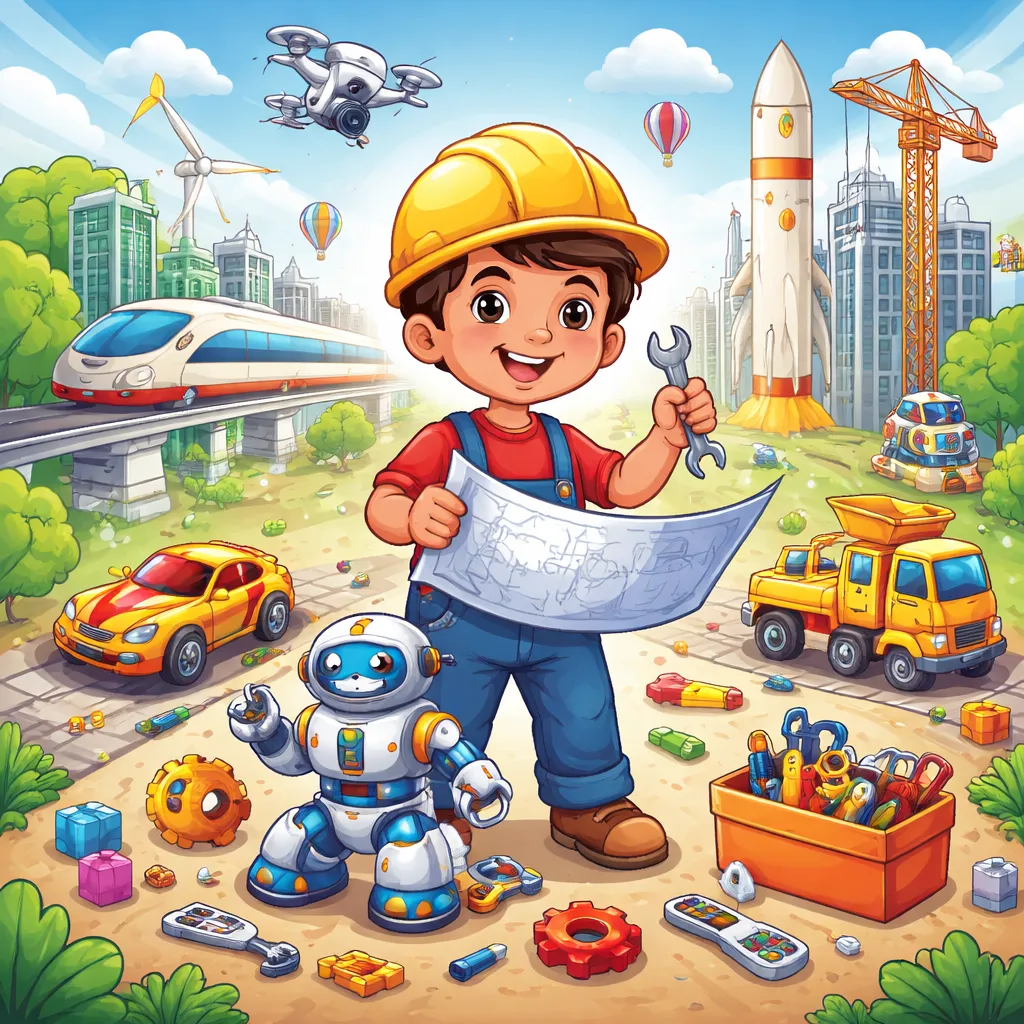

Have you ever looked at a tall building and wondered how it stays up? Or taken apart an old toy just to see how all the pieces fit together inside? The world is full of amazing things that someone had to imagine, plan, and build. In India, a country famous for its ancient temples and modern technology, there’s a song that celebrates the mind of a builder. Let’s put on our thinking caps and learn from the Hindi Song: The Little Engineer (इंजीनियर).
About the Song Here is a creative verse from this popular song in Hindi and English: मैं एक छोटा इंजीनियर, मेरे पास है योजना (Main ek chhota engineer, mere paas hai yojna) I am a little engineer, I have a plan मैं बनाऊँगा एक पुल, नदी के ऊपर (Main banaunga ek pul, nadi ke upar) I will build a bridge, over the river चलो मिलकर काम करें, ताकत है टीम में (Chalo milkar kaam karen, takat hai team mein) Let's work together, strength is in the team बनाएँगे हम दुनिया को, और अच्छी जगह (Banayenge hum duniya ko, aur acchi jagah) We will make the world an even better place
This song’s original name uses the word “इंजीनियर” (Engineer), borrowed from English into Hindi. It is a popular modern Indian children’s song. The song is sung from the point of view of a child who thinks like an engineer. The music often has a steady, building rhythm, with sounds that might make you think of tools or machines working together. The Hindi Song: The Little Engineer (इंजीनियर) is a musical blueprint for creativity, turning the idea of building into a fun puzzle of imagination and teamwork.
What the Song is About The song is a declaration of a big idea. First, the little engineer doesn’t just start hammering. They begin with the most important tool: a plan. “I have a plan,” they say. This shows that engineering starts in the mind. Their first project is a classic challenge: “I will build a bridge, over the river.” The song pictures them drawing the design, choosing strong materials, and figuring out how to make it stand. But an engineer rarely works alone. The song calls for helpers: “Let’s work together, strength is in the team.” Finally, the engineer shares their big dream: the bridge isn’t just for fun; it’s to “make the world an even better place” by connecting people. The song is about solving problems, step by step, with friends.
Who Made It & Its Story This song comes from the genre of modern Indian children’s music that introduces STEM (Science, Technology, Engineering, Math) concepts in a positive, playful way. While specific creators aren’t widely listed, the song reflects a key part of modern India’s identity as a hub of innovation and technology. From software engineers to civil engineers building new cities, the profession is highly respected. The Hindi Song: The Little Engineer (इंजीनियर) taps into that spirit for children. It is popular for three constructive reasons. First, it demystifies engineering, showing it as creative problem-solving that any child can try. Second, it emphasizes planning and teamwork over just making things, teaching valuable process skills. Third, its tune is often upbeat and rhythmic, perfect for singing while building with blocks or Legos, making the learning active and fun.
When to Sing It Sing this song with friends while constructing a massive tower out of blocks or pillows, declaring your building plan at the start. It’s perfect to chant as a family when putting together a piece of furniture or a complex model kit, to remember that “strength is in the team.” You could also sing it in a sandbox, building bridges and canals, and explaining your “plan” to anyone who will listen.
The Hindi Song: The Little Engineer (इंजीनियर) gives us a blueprint for building. But every good engineer needs to read the instructions! This song is also an instruction manual for learning. It teaches us the language of design, how to talk about future projects, and the cultural importance of building a better society. Let’s gather our tools and see what we can construct from this song’s lessons.
What Children Can Learn
Vocabulary This song builds our vocabulary with words for planning, construction, and collaboration. Blueprint: A detailed plan or drawing that shows how something should be built. An engineer draws a blueprint before building a house.
Structure: Something that is built, like a building, bridge, or tower. A strong structure doesn’t fall down easily.
Foundation: The solid base on which a building or structure stands. A strong foundation is the most important part.
Innovation: A new idea, method, or device. Creating a phone that folds is an innovation.
Teamwork: The combined action of a group working together effectively. Building a big project requires good teamwork.
Efficient: Working in a way that gets results without wasting time or energy. A well-designed machine is efficient.
Language Skills This song is a perfect example of using the First Conditional to talk about plans and likely results. We use it to talk about a possible future action and its likely result. What Is It?: Think of the First Conditional as your “If-Then” plan. It’s about a real possibility in the future. “If we work together, then we will build a strong bridge.”
Finding the Secret: Look for two parts in a sentence: the “if” part (condition) and the “will” part (result). The condition is in the simple present tense, and the result uses “will” + base verb. Ask: “Is this sentence talking about a likely future outcome based on a condition?”
Using It:
◦   Formula: If + [present simple], [will + base verb]. OR [Will + base verb] + if + [present simple].

◦   Examples: “If I have a plan, I will build a bridge.” “We will finish faster if we work as a team.” This is the engineer’s logic for project success.
Sounds & Rhythm Fun Listen to the mechanical rhythm. The Hindi Song: The Little Engineer (इंजीनियर) often has a steady, rhythmic, and percussive beat. It might sound like the precise tapping of a hammer or the turning of gears. The melody is often clear and repetitive, like the steps in a set of instructions. This steady, building rhythm mirrors the process of construction—laying one brick, then another. It helps the sequence of ideas (plan, build, team, world) stick in your mind in an organized way. You can use this same rhythmic, step-by-step beat to make up a song about any multi-step process, like baking a cake or planting a garden.
Culture & Big Ideas This song connects to India’s long history of incredible engineering, from the stepwells of Rajasthan to the modern metros and space rockets. A day that celebrates this spirit is Engineers' Day in India (September 15th), the birthday of the legendary engineer Sir M. Visvesvaraya. The day honors the contributions of engineers to society. The Hindi Song: The Little Engineer (इंजीनियर) teaches three foundational ideas. First, Plan Before You Build: Success comes from careful thought and design, not just from starting to build. Second, Collaborative Creation: The biggest, best projects are almost always the result of people sharing ideas and working together. Third, Engineering for Society: The ultimate goal of building things is to solve problems and improve life for people, making the world a better place.
Values & Imagination Imagine you are the little engineer. What problem in your neighborhood would you solve? A wobbly bench? A puddle that needs a bridge? Draw your blueprint. Who will be on your team? This song teaches you the value of patience in planning and the importance of listening to other people’s ideas. It shows that making mistakes is part of the process—you just go back to your plan and try again. A simple idea: Use recyclable materials (cardboard tubes, egg cartons, tape) to build a bridge between two books. Test it. Does it hold? If it falls, what can you change in your “plan”? You are thinking like an engineer.
Your Core Takeaways The Hindi Song: The Little Engineer (इंजीनियर) is a dynamic anthem for creativity, planning, and teamwork. You learned building words like “blueprint,” “structure,” and “foundation.” You discovered how to use the First Conditional (“If… will…”) to make plans and predict outcomes. You moved to the song’s steady, building rhythm. You also connected the song to India’s engineering achievements and the celebration of Engineers' Day. Most importantly, the song teaches that great things start with a good plan, that working together makes us stronger, and that using our minds to build and solve problems is a powerful way to help everyone.
Your Practice Missions
- Be a “First Conditional” Planner. With a grown-up, choose a simple task like building a blanket fort. Say your plan using “if” and “will.” Example: “If we use these chairs, the fort will be tall.” Try your plan and see if your prediction comes true!
- Host a “Better World” Brainstorm. Gather your family or a couple of friends. Each person thinks of one small problem at home or in your community (e.g., a door that squeaks, a messy toy corner). Then, as a team, brainstorm one simple “engineering” solution. Draw a quick “blueprint” for your favorite idea. You’ve just held your first engineering team meeting.