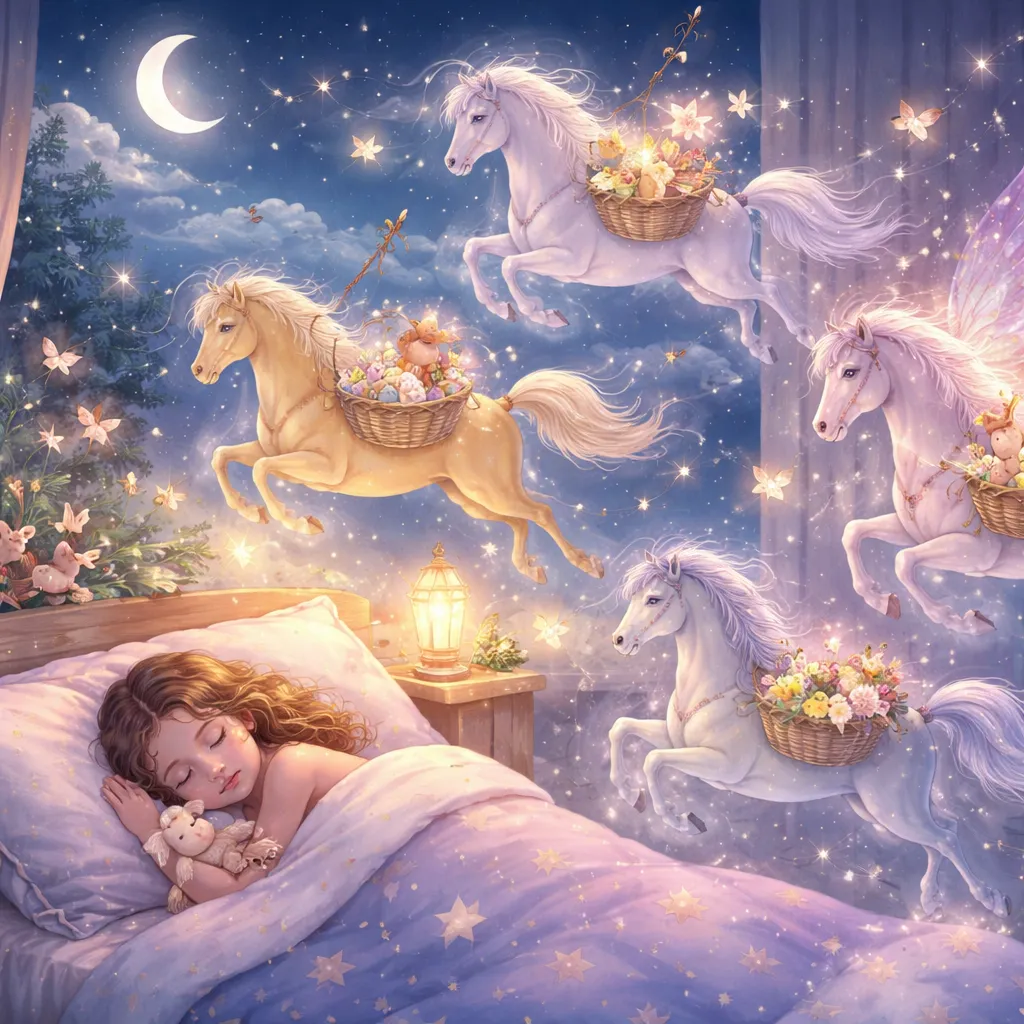

Have you ever had trouble falling asleep? Maybe the world feels too big and noisy. Then, someone you love starts to sing a soft, slow song. The song paints a picture in your mind so peaceful that your eyes get heavy. There is a very old, gentle song that does exactly that. It’s a musical promise of beautiful things to come. Let’s learn about the lullaby “All the Pretty Little Horses.”
About the Song
Let’s read the soft, dreamy words of this classic lullaby.
Hush-a-bye, don’t you cry,
Go to sleep, my little baby.
When you wake, you shall have
All the pretty little horses.
Blacks and bays, dapples and grays,
Coach and six white horses.
Hush-a-bye, don’t you cry,
Go to sleep, my little baby.
This song is a traditional American lullaby, also known as “Hush-a-bye.” It is a slow, soothing melody meant to calm a child and help them drift to sleep. The song’s origins are in the Southern United States, and it is believed to have roots in African American communities of the 19th century. Some believe it was first sung by enslaved African American mothers or caregivers to the children they watched. The song is a loving promise: if the baby stops crying and goes to sleep, they will be rewarded with a wonderful dream of a parade of beautiful, gentle horses in all colors.
What the Song is About
The song paints a quiet, loving scene. A caregiver is holding a restless baby. The baby might be fussing or crying. The caregiver gently rocks the baby and begins to sing. The first words are a direct, soothing command: “Hush-a-bye, don’t you cry.” It’s a request for quiet and peace.
Then comes a promise for the future. The singer tells the baby that after sleep comes—"when you wake"—they will receive a gift. The gift is not a toy, but a vision: “All the pretty little horses.” The singer describes these horses in beautiful detail. There are black horses, reddish-brown “bay” horses, horses with spotted “dappled” coats, and gray horses. And the grandest gift of all: a “coach and six white horses,” which is a fancy carriage pulled by six stunning white horses. The song ends by repeating the gentle command to hush and sleep, wrapping the child in a safe, hopeful promise.
Who Made It & Its Story
“All the Pretty Little Horses” is a traditional folk lullaby, so its original author is unknown. It was passed down orally for generations, first published in 1927 in a collection by folklorist Dorothy Scarborough. The song’s history is deeply tied to the American South. One theory suggests it was sung by enslaved African American “namies” to the white children in their care, a poignant detail that adds layers of meaning to its comforting words. The lullaby traveled from family to family, becoming a standard in American folk music, recorded by artists like Joan Baez and became a symbol of tender, universal care.
This simple lullaby has endured for three beautiful reasons. First, its melody is incredibly slow, soft, and repetitive, which naturally slows a child’s heart rate and breathing, making it the perfect sleep aid. Second, its lyrics are a masterful blend of gentle command (“hush,” “sleep”) and vivid, positive imagination (“pretty little horses”), which distracts and soothes an upset child. Third, it carries a deep emotional weight of care and protection, a feeling that resonates with any parent or child, connecting us to a long line of caregivers through time.
When to Sing It
This song is perfect for calm, winding-down moments. You can sing it very softly at a younger sibling’s bedtime, while gently rocking or patting their back. You can hum it quietly to yourself when you are feeling worried or sad, as a way to self-soothe. You can also sing it slowly while cuddling a favorite stuffed animal, pretending to be the caregiver helping your toy fall asleep.
What Children Can Learn
This gentle, poetic song is a treasure chest of quiet lessons. Let’s tiptoe in and discover them.
Vocabulary
The song teaches us lovely, descriptive words about colors and animals. “Hush-a-bye” is an old, gentle way to say “hush” or “be quiet.” A “lullaby” is a soft song sung to help a child sleep. “Blacks and bays” refers to black horses and bay (reddish-brown) horses. “Dapples” are horses with coats marked with round spots of a different color. “Grays” are horses with gray coats. A “coach” is a large, enclosed horse-drawn carriage. “Six white horses” means six white horses, which would be a very grand and impressive sight.
Let’s use these words! You can say, “The dapple-gray pony stood in the field.” Or, “In the old painting, a golden coach waited.” New word: Soothing. This means having a gently calming effect. The lullaby is very soothing.
Language Skills
This song is a wonderful lesson in using the future tense to make a promise and the imperative mood for gentle commands. The future tense shows what will happen: “When you wake, you shall have all the pretty little horses.” “Shall” is a formal, old-fashioned word for “will,” often used in promises.
The song starts with imperative verbs for gentle direction: “Hush-a-bye, don’t you cry, Go to sleep.” These are soft commands meant to guide behavior. The song also uses the simple present tense to describe the horses that exist (“you shall have the horses”), which are presented as a guaranteed future fact.
Sounds & Rhythm Fun
Listen to the slow, swaying, rocking rhythm of the melody. The song uses repetition to create a hypnotic, calming effect. The first two lines are repeated at the end, like a peaceful circle. The lyrics have a gentle, near-rhyme: “cry” and “baby,” “have” and “horses,” “bays” and “grays,” “horses” and “horses.”
The rhythm is a slow, steady 6/8 time, which feels like the rocking of a cradle or a chair. Try a slow, gentle sway: HUSH-a-BYE, DON’T you CRY. The melody uses a small range of notes and moves up and down smoothly, like a gentle wave. This slow, repetitive, and predictable musical pattern is what makes the song so effective for lulling someone to sleep—it gives the mind a simple, beautiful focus. You can write your own lullaby! Use the same swaying rhythm. Try: “Hush now, close your eyes so tight, go to sleep, my dear tonight. When you wake, you’ll see a sight, all the twinkling stars so bright. Reds and golds, and silver moons, dancing to the night’s sweet tunes.”
Culture & Big Ideas
“All the Pretty Little Horses” is a classic piece of American folk culture, specifically from the lullaby tradition. It reflects the universal human practice of using song to connect, comfort, and guide children from wakefulness to sleep. Its suspected origins in the complex relationships of the pre-Civil War South add a layer of historical significance, showing how music can provide a space for tenderness even in difficult circumstances. The song is a testament to the enduring power of a caregiver’s love.
The song conveys three profound ideas. First, it’s about comfort through promise and imagination. Instead of just saying “stop crying,” it offers a beautiful dream to look forward to, teaching that positive imagination can ease distress. Second, it’s about ritual and transition. The song acts as a bridge from the busy day to the quiet night, a ritual that signals safety and rest. Third, it speaks to nurturing and protection. The singer’s voice becomes a safe space, promising that the child is watched over and that good things await, building a sense of security.
Values & Imagination
Imagine you are the child hearing this song. What does the caregiver’s voice sound like? Warm and low? What does the room look like? Is it lit by a small lamp? Now, imagine the promised dream. Picture the field where the pretty little horses are. What do their coats feel like? Silky? How do they move? Gracefully? Imagine the “coach and six white horses.” Is it made of glass? Gold? Who is inside? Draw a picture of the dream. Don’t draw the child sleeping; draw what the child is dreaming about. Show all the different colored horses and the magnificent coach, all under a twilight or morning sky.
The song inspires us to be comforting and to use our imagination for good. A lovely idea is to create a “Dream Promise” ritual. With your family, at bedtime, instead of singing, you can take turns describing a peaceful, happy “dream promise” to each other. It doesn’t have to be about horses. It could be about flying, exploring a friendly forest, or finding a field of giant flowers. This builds a habit of positive thinking and caring for each other’s feelings.
So, as the last “my little baby” whispers into silence, think about the quiet power of this old song. It is a vocabulary lesson in color and grandeur. It is a grammar lesson in future promises and gentle commands. It is a music lesson in a slow, swaying rhythm. From the first “hush” to the final image of white horses, it wraps a lesson in comfort, imagination, and protective love in a melody that feels like a soft blanket for the soul. “All the Pretty Little Horses” teaches us that words can be a gentle guide, that dreams are gifts we can give, and that the simplest songs often hold the deepest love.
Your Core Takeaways
You are now an expert on the lullaby “All the Pretty Little Horses.” You know it is a traditional American song, likely from the South, used to soothe babies to sleep with a promise of beautiful dreams. You’ve learned horse color words like “bay” and “dapple,” and you’ve practiced using the future tense for promises (“shall have”) and gentle commands. You’ve felt its slow, rocking rhythm and created your own lullaby verse. You’ve also discovered the song’s role in caregiving rituals and its messages about using imagination for comfort, creating safe transitions, and the nurturing power of love.
Your Practice Missions
First, be a “Lullaby Leader” for a night. Choose a stuffed animal, a pet, or a younger sibling. At a quiet time, hold them gently and sing “All the Pretty Little Horses” very softly. Rock slowly as you sing. Pay attention to how the slow song makes you both feel. This lets you practice being the comforter.
Second, design a “Dream Coach.” The song promises a “coach and six white horses.” Design your own fantastic dream vehicle. What would it be? A cloud chariot? A submarine pulled by dolphins? A rocket sled? Draw it in detail. What is it made of? Who rides in it? Where does it go? Present your dream coach to your family and explain the dream journey it would take you on. This activity lets you expand on the song’s central promise with your own creativity.