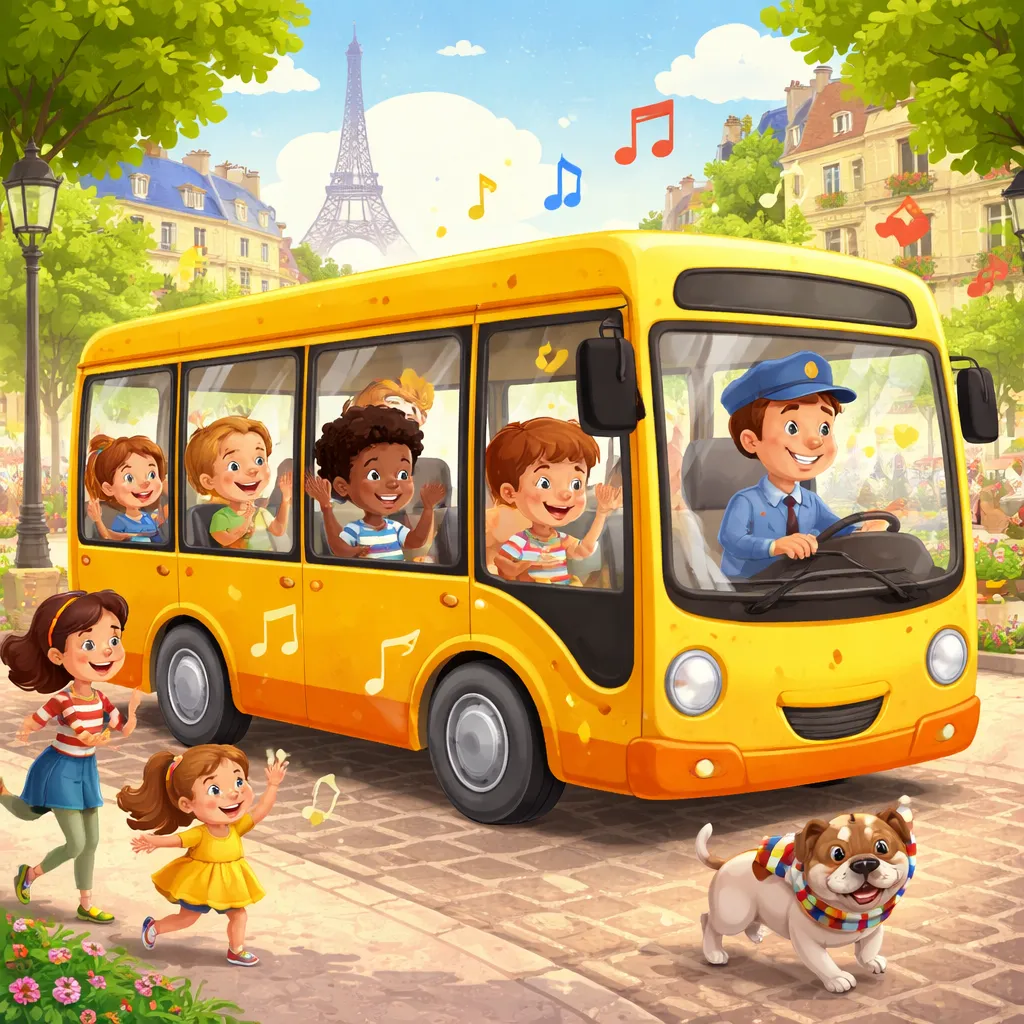

Have you ever ridden on a big, noisy bus? The wheels go round, the wipers go swish, and the horn goes beep! There is a super fun French action song that turns all the parts of a bus and its passengers into a musical adventure. It is a song about movement, sounds, and the busy life of a city bus. Let’s climb aboard and learn the playful, noisy song “The Wheels on the Bus (Les roues du bus).”
About the Song
Here are the lively, cumulative lyrics of the classic French version:
Les roues du bus tournent et tournent,
Tournent et tournent, tournent et tournent.
Les roues du bus tournent et tournent,
Sur le chemin.
Les essuie-glaces font shh shh shh...
Le chauffeur dit "Billet s'il vous plaît!"...
Les bébés du bus font ouin ouin ouin...
Les parents du bus font chut chut chut...
English Translation:
The wheels on the bus go round and round,
Round and round, round and round.
The wheels on the bus go round and round,
All along the road.
The wipers on the bus go swish swish swish...
The driver on the bus says "Ticket please!"...
The babies on the bus go wah wah wah...
The parents on the bus go shh shh shh...
This is the popular French-language version of the international children’s classic. The song is a playful tour of a bus and its sounds. “The wheels on the bus go round and round, round and round, round and round. The wheels on the bus go round and round, all along the road,” it starts with the most important movement. Then, each verse adds a new character or part. “The wipers on the bus go swish swish swish…” “The driver on the bus says ‘Ticket please!'” “The babies on the bus go wah wah wah…” “The parents on the bus go shh shh shh…” The song collects all the funny sounds and actions of a bus trip.
What the Song is About
The song takes us on a fun, noisy bus ride through the city. Imagine you are sitting on a big, red bus. Outside, the city moves by. “The wheels on the bus go round and round,” the big black wheels spin fast on the road. The bus moves “all along the road,” passing houses and shops.
Then it starts to rain! “The wipers on the bus go swish swish swh,” the two wiper arms swing left and right, clearing the windshield. The driver is busy. “The driver on the bus says ‘Ticket please!'” he asks each person for their ticket. Some babies are crying. “The babies on the bus go wah wah wah,” they are not happy about the ride. The parents try to calm them. “The parents on the bus go shh shh shh,” they make a gentle quieting sound. The song shows us a whole little world moving and making sounds together.
Who Made It & Its Story
“Les roues du bus” is the beloved French adaptation of the American folk song “The Wheels on the Bus,” which became popular in the mid-20th century. Its specific creator is unknown. It is now a staple in French kindergartens (“l'école maternelle”) and homes. The song fits perfectly with a common sight in French cities: the public bus (“le bus” or “l’autobus”), an essential part of daily life for many families. The French version includes culturally specific elements like the driver asking for a “billet” (ticket).
This energetic, interactive song is loved for three brilliant reasons. First, it teaches fantastic, everyday French vocabulary for vehicle parts and people (“roues,” “essuie-glaces,” “chauffeur,” “bébés”) alongside fun sound words (“shh,” “ouin”). Second, it has an incredibly catchy, repetitive, and cumulative structure that makes it easy to learn, remember, and add new verses to. Third, it is a fantastic action song that connects words with specific movements (turning hands, swishing arms), making it perfect for learning through play and burning off energy.
When to Sing It
This song is perfect for active play and learning about vehicles. You can sing it loudly on a real bus or car trip, doing the actions for everything you see outside. You can perform it with friends at playtime, making a pretend bus with chairs and acting out all the verses. You can also sing it during bath time with toy buses, making the wheels “tournent” in the water and the wipers “swish” on the side of the tub.
What Children Can Learn
This joyful, action-packed song is a wonderful teacher of practical French nouns, fun sounds (onomatopoeia), and the useful phrase “qui + verb” (that/who + verb) to describe things.
Vocabulary
The song teaches us clear French words for bus parts, people, and their sounds. “The” (Les). “Wheels” (roues). “Of the/on the” (du). “Bus” (bus). “Go/Turn” (tournent). “And” (et). “On the/Along the” (Sur le). “Road/Path” (chemin). “Wipers” (essuie-glaces). “Do/Go” (font). “Swish sound” (shh shh shh). “Driver” (chauffeur). “Says” (dit). “Ticket please” (Billet s'il vous plaît). “Babies” (bébés). “Wah sound” (ouin ouin ouin). “Parents” (parents). “Shh sound” (chut chut chut).
Let’s use these words! You can describe a bus: “Les roues du bus sont grandes.” (The wheels of the bus are big.) New word: Le klaxon. This means “the horn,” which you can add to your song: “Le klaxon du bus fait beep beep beep!”
Language Skills
This song is excellent for learning about describing what things do using “qui” (that/who) + a verb, like in the classic English structure “The wheels that go round.” In French, it’s implied: “Les roues du bus tournent” (The wheels of the bus [that] go round).
Concept Definition: We are learning how to describe an action that belongs to a specific person or thing. In the song, we don’t just say “wheels.” We say “the wheels of the bus” and then we say what they do: “tournent” (go round). The phrase “du bus” tells us which wheels. The verb “tournent” tells us what those specific wheels do. This is a very common and useful way to talk about the world.
Features and Types: This structure often appears as: “Les/Le/La [Thing 1] + de/d’/du/des [Thing 2] + [Action Verb].” Here, “Thing 1” is the part (the wheels), “de/d’/du/des” connects it to the owner (the bus), and the verb is the action (go round). Other examples: “Le chien de mon voisin aboie.” (My neighbor’s dog [The dog of my neighbor] barks.) “La couleur de ma voiture est bleue.” (The color of my car is blue.)
How to Spot Them: Here is the “Whose? Does what?” trick. Find a thing. Ask: “Whose thing is it?” The answer uses “de/d’/du/des” (of). Then ask: “What does this thing do?” The answer is the verb. Whose wheels? The wheels of the bus. What do they do? They go round.
How to Use Them: A great way to describe the world is the “Part-Owner-Action Formula”. The pattern is: “Les/Le/La [Part] + de/d’/du/des [Owner] + [Verb].”
Example from the song: “Les roues du bus tournent.” (The wheels of the bus go round.)
Example you can make: “Le klaxon de la voiture fait beep!” (The horn of the car goes beep!) “La queue du chat bouge.” (The tail of the cat moves.) “Les ailes de l’avion volent.” (The wings of the plane fly.)
Sounds & Rhythm Fun
Listen to the bouncy, rolling rhythm of the melody. The tune for “Les roues du bus tournent et tournent” has a circular, spinning feeling, just like wheels! The repetition of “tournent et tournent” three times is super fun to sing and easy to remember.
The melody repeats exactly the same for every new verse. You just change the subject and the sound! “Font shh shh shh” and “Font ouin ouin ouin” use the same tune, making it a perfect template. The sound words (“shh,” “ouin,” “chut”) are the star of each verse. This musical pattern is perfect for creating your own “Bus” verses. What about the doors? Try: “Les portes du bus s’ouvrent et ferment, S’ouvrent et ferment, s’ouvrent et ferment, Les portes du bus s’ouvrent et ferment, Sur le chemin!” (The doors on the bus open and close…)
Culture & Big Ideas
“Les roues du bus” connects to everyday city life and public transportation in French-speaking places. Taking the “bus” or “autobus” is a common way for families to travel. The song includes the driver asking for a “billet” (ticket), a real part of the bus experience. It reflects the lively, communal atmosphere of public transport.
The song conveys three wonderful, active ideas. First, it is a celebration of observation, noticing the different parts of a vehicle (wheels, wipers) and the people inside (driver, babies, parents). Second, it encourages symbolic play and connecting words with physical actions (turning hands for wheels, swishing arms for wipers), which helps with learning and coordination. Third, it shows a mini-community in action on the bus, with each person and part having a role and a sound, reflecting how a community works together.
Values & Imagination
Imagine you are on a bright yellow French bus in Paris. The engine rumbles. “The wheels on the bus go round and round,” you sing, making your hands go in circles as you watch the city pass by the window. “All along the road,” maybe the road is along the River Seine.
Suddenly, rain dots the window. “The wipers on the bus go swish swish swh,” you move your arms like wipers, clearing the pretend rain. The friendly driver smiles. “The driver on the bus says ‘Ticket please!'” you say in a deep, polite voice. A baby coos. “The babies on the bus go wah wah wah,” you pretend to cry. “The parents on the bus go shh shh shh,” you put a finger to your lips. What other sounds can you hear on this busy, musical bus? Draw your own bus adventure. Draw a big bus with round wheels. Draw wipers on the windshield. Draw a driver at the front. Draw babies and parents inside the windows. Add your own new part, like “Les phares du bus font clignote clignote!” (The headlights on the bus go blink blink blink!). This shows the song’s fun observation.
The song encourages us to be curious observers of the world around us, to find music and fun in everyday sounds, and to see how everyone (and every part!) in a community, like a bus, has a job to do. A wonderful activity is the “Bus Imaginaire” (Imaginary Bus) game. Line up chairs like a bus. One person is the driver. Others are passengers. Sing the song, and for each verse, everyone does the action and makes the sound together. This connects you to the song’s core spirit of playful, communal action.
So, from the spinning wheels to the shushing parents, this song is a moving, noisy, happy world. It is a vocabulary lesson in transportation and sounds. It is a language lesson in describing what parts of things do (“Les roues du bus tournent”). It is a music lesson in a repetitive, energetic tune perfect for making up new verses. “The Wheels on the Bus (Les roues du bus)” teaches us about observation, playful imitation, and the busy life of a community vehicle.
Your Core Takeaways
You are now an expert on the song “The Wheels on the Bus (Les roues du bus).” You know it is a lively French action song about all the parts and people on a bus making their own sounds, from wheels that go round and round to parents who go shh shh shh. You’ve learned French words like “roues,” “bus,” “tournent,” “essuie-glaces,” “chauffeur,” “billet,” “bébés,” and “parents,” and you’ve practiced describing what things do using the “Part-Owner-Action” pattern. You’ve felt its catchy, repeating rhythm perfect for actions and created your own new verse. You’ve also discovered the song’s message about observation, playful imitation, and community.
Your Practice Missions
First, play the “Les [Part] de la [Chose] font…” game. Look at a vehicle or a toy. Pick a part and say what it does in French. Use the formula: “Les/Le/La [Part] de/d’/du/des [Thing] [Verb].” For example, for a toy car, say “Les phares de la voiture brillent.” (The headlights of the car shine.) Or for yourself, “Les mains de [Your Name] applaudissent!” ([Your Name]’s hands clap!). This mission helps you practice the song’s key language skill.
Second, have a “Concert de Bus” (Bus Concert). The next time you are on a bus or in the car, be a sound detective. Listen to the real sounds. Can you make up a new French verse for what you hear? Maybe “Le moteur de la voiture fait vroom vroom vroom…” (The car’s engine goes vroom…) or “Les gens dans le métro lisent lisent lisent…” (The people on the subway read read read…). Sing it softly to the tune of “Les roues du bus.” This mission lets you apply the song’s pattern to your own world.