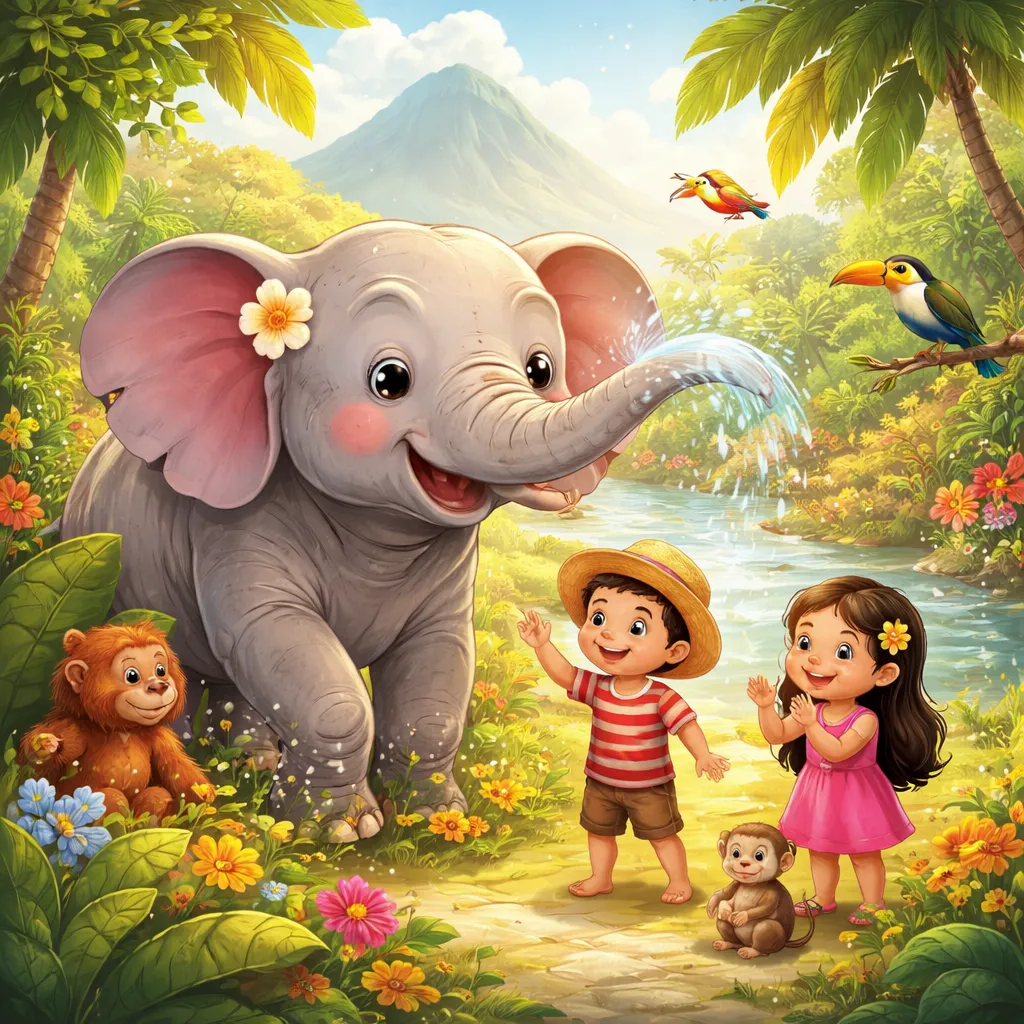

Have you ever seen an elephant? They are big, gentle animals with amazing parts: long trunks, huge flappy ears, and strong legs. How do you say hello to an elephant? In Indonesia, there is a famous and happy song that asks an elephant about all its wonderful body parts. It is a song about curiosity and friendly greetings. Let’s say hello to “The Elephant (Gajah).”
About the Song
Here are the cheerful and curious lyrics of the beloved Indonesian children’s song “Gajah”:
Gajah, gajah!
Belalainya panjang sekali.
Telinganya lebar,
Kaki yang besar.
Di mana belalai?
Ini belalai!
Di mana telinga?
Ini telinga!
Di mana kaki?
Ini kaki!
Halo, Gajah!
Apa kabar? Baik-baik saja!
English Translation:
Elephant, elephant!
Its trunk is very long.
Its ears are wide,
Its feet that are big.
Where is the trunk?
Here is the trunk!
Where is the ear?
Here is the ear!
Where is the foot?
Here is the foot!
Hello, Elephant!
How are you? Very good!
This is a classic and interactive Indonesian action song for children. Originally an Indonesian folk song, it is a staple in kindergartens and playgroups across the country. The song is a happy chat with a friendly elephant. First, we describe the elephant: its very long trunk (“belalainya panjang sekali”), its wide ears, and its big feet. Then, we play a question-and-answer game, pointing to each part: “Where is the trunk? Here it is!” Finally, we greet the elephant and ask how it is. It is a song about noticing, naming, and being friendly to animals.
What the Song is About
The song is a fun game of pointing and learning with a big elephant friend. First, you see the elephant. You say hello: “Gajah, gajah!” You look closely at its amazing body. You see its long, long trunk. It can pick up leaves and spray water. You see its wide, flappy ears that look like big fans. You see its big, round feet that walk quietly.
Now you play a game. You ask the elephant a question, “Di mana belalai?” (Where is the trunk?). Then, you point right to the trunk and say, “Ini belalai!” (Here is the trunk!). You do the same for its wide ears and its big feet. You are learning the elephant’s parts by asking and showing.
After the game, you are polite. You say, “Halo, Gajah! Apa kabar?” (Hello, Elephant! How are you?). And in your mind, the happy elephant answers, “Baik-baik saja!” (Very good!). It is a fun way to learn about an animal and be its friend.
When to Sing It
This song is perfect for active play and learning about animals. You can sing it at the zoo or when looking at a picture of an elephant, pointing to your own head, ears, and feet as you sing. You can sing it during playgroup as a movement game, where one child points to a body part on a drawing and everyone shouts “Ini!” (Here it is!). You can also sing it as a fun way to start the day, greeting friends with “Halo! Apa kabar?” just like you greet the elephant.
What Children Can Learn
This joyful, interactive song is a fantastic teacher of animal body parts, simple questions, and friendly greetings in Indonesian.
Vocabulary
The song teaches us clear Indonesian words for animals, body parts, and greetings. “Elephant” (Gajah). “Trunk” (belalai). “Very long” (panjang sekali). “Ears” (telinga). “Wide” (lebar). “Feet/Legs” (kaki). “Big” (besar). “Where?” (Di mana?). “Here it is!/This is…!” (Ini!). “Hello” (Halo). “How are you?” (Apa kabar?). “Very good/OK” (Baik-baik saja).
Let’s use these words! You can point to your own nose and say, “Ini hidung!” (Here is my nose!). New word: Hidung. This means “nose.” You can ask a friend, “Di mana hidung?” (Where is your nose?) and they can point and say, “Ini!”
Language Skills
This song is a perfect introduction to asking and answering simple “where” questions in Indonesian. It uses the important question word “Di mana?” (Where?) and the answering word “Ini” (Here/This).
Concept Definition: We are learning about asking where something is located and how to point it out. “Di mana?” is like a detective’s word—it helps you find things. “Ini” is the word you use when you have found it and want to show everyone. It’s like a pointing word.
Features and Types: The question pattern is very simple: “Di mana + [thing you are looking for]?” The answer is even simpler: “Ini + [the thing]!” or often just “Ini!” (Here it is!). The song shows this clearly: “Di mana belalai?” (Where is the trunk?) / “Ini belalai!” (Here is the trunk!). The thing you are looking for (belalai, telinga, kaki) is a noun.
How to Spot Them: Here is the “Finding Game” trick. Listen for the words “Di mana” at the start of a sentence. This is always a question about location. Ask yourself: “Is this sentence asking me to look for or point to something?” If yes, it’s a “Di mana?” question. The answer will almost always have “Ini” to point to the thing.
How to Use Them: A great way to play a finding game is the “Di mana? Ini!” formula. The pattern is: “Di mana [object]?” (Question) / “Ini [object]!” or just “Ini!” (Answer).
Example from the song: “Di mana telinga?” / “Ini telinga!”
Example you can make: “Di mana bukuku?” (Where is my book?) / “Ini!” (Here it is!)
Sounds & Rhythm Fun
Listen to the bouncy, playful rhythm of the melody. The tune for “Gajah” is simple, catchy, and full of energy, perfect for moving around. The song has two clear parts. The first part describes the elephant, and the melody is smooth. The second part is the question-and-answer game, and the rhythm becomes more like a chant: “Di mana X? Ini X!”
The repetition of the “Di mana…? Ini…!” pattern makes it super easy to remember and shout out. The “a” sound in “gajah,” “mana,” and “kabar” is a bright, open sound. The rhythm is steady and march-like, like an elephant walking. This musical pattern is perfect for creating your own animal quiz songs. Try a bird song: “Burung, burung! Paruhnya kecil sekali. Sayapnya lebar… Di mana paruh? Ini paruh!” (Bird, bird! Its beak is very small. Its wings are wide… Where is the beak? Here is the beak!)
Culture & Big Ideas
“Gajah” connects to the warm, communal style of Indonesian early childhood education, where learning is often group-oriented, playful, and full of music and movement. The call-and-response style of the song encourages participation from every child, reflecting the social and collaborative nature of Indonesian culture.
The song conveys three wonderful and simple ideas. First, it encourages close observation and naming of the physical world, teaching children to look carefully at an animal’s features and learn the specific words for them, which builds vocabulary and scientific curiosity. Second, it fosters social interaction and turn-taking through the musical Q&A format, where one can ask the question and another can give the answer, building conversational skills in a fun, low-pressure way. Third, it models friendly, polite interaction with the natural world, as the song ends with greeting the elephant and asking about its well-being (“Apa kabar?”), teaching respect and empathy for living creatures.
Values & Imagination
Imagine you are standing right in front of a real, gentle elephant. It is grey and very tall. You look up and say, “Gajah, gajah!” The elephant swings its trunk slowly. You look closely. “Belalainya panjang sekali,” you think. Its trunk is so long, like a giant hose. You see its ears flap. “Telinganya lebar,” like two big fans. You look at its feet. “Kaki yang besar,” they are as big as buckets!
Now you play your game. You ask, “Di mana belalai?” You step forward and gently touch the tip of its trunk. “Ini belalai!” you say. The elephant makes a soft sound. You ask, “Di mana telinga?” You point to its huge, flappy ear. “Ini telinga!” How does it feel to be so close to such a big, friendly animal? Draw your elephant friend. Draw a big elephant. Label its parts in Indonesian: “belalai” on the trunk, “telinga” on the ears, “kaki” on the feet. Draw a little version of yourself next to it, waving and saying “Halo, Gajah!” This shows the song’s friendly curiosity.
The song encourages us to be curious about animals, to learn the names of their body parts, and to be polite and friendly to all creatures, big and small. A wonderful activity is the “Di mana? Game” with a teddy bear. Take a teddy bear and ask a friend, “Di mana hidung beruang?” (Where is the bear’s nose?). Your friend points and says, “Ini hidung!” You can do this for eyes (“mata”), mouth (“mulut”), and paws (“kaki”). This connects the song’s core Q&A pattern to a fun, everyday game.
So, from describing the elephant to playing the pointing game and saying hello, this song is a friendly lesson. It is a vocabulary lesson in animal body parts and greetings. It is a language lesson in asking “Di mana?” (Where?) and answering “Ini!” (Here!). It is a music lesson in a bouncy, call-and-response chant. “The Elephant (Gajah)” teaches us about observation, friendly questions, and kindness to animals.
Your Core Takeaways
You are now an expert on the Indonesian song “The Elephant (Gajah).” You know it is a fun, interactive song where you describe an elephant’s long trunk, wide ears, and big feet, then play a pointing game asking “Where is it?” and answering “Here it is!” before greeting the elephant politely. You’ve learned Indonesian words like “gajah,” “belalai,” “telinga,” “kaki,” “di mana,” and “ini,” and you’ve mastered the simple question “Di mana…?” and the pointing answer “Ini…!”. You’ve felt its bouncy, playful rhythm and imagined meeting a real elephant. You’ve also discovered the song’s message about curious observation, friendly games, and being polite to animals.
Your Practice Missions
First, play “Gajah Says” (like “Simon Says”). One person is the leader and gives commands using the elephant’s body parts. Say, “Gajah says, sentuh belalai!” (Elephant says, touch your trunk/arm as a trunk!). Or “Di mana telinga?” and everyone must point to their ears and shout “Ini!” This mission helps you connect the Indonesian words to your own body movements.
Second, be a “Penjelajah Hewan” (Animal Explorer). Pick another animal you like, like a lion (“singa”) or a monkey (“monyet”). Draw it and label three of its body parts in Indonesian. Then, make up a little song or chant for it using the “Gajah” pattern: “[Animal], [animal]! … Di mana [body part]? Ini [body part]!” Sing it to a friend. This mission lets you use the song’s structure to learn about any animal.