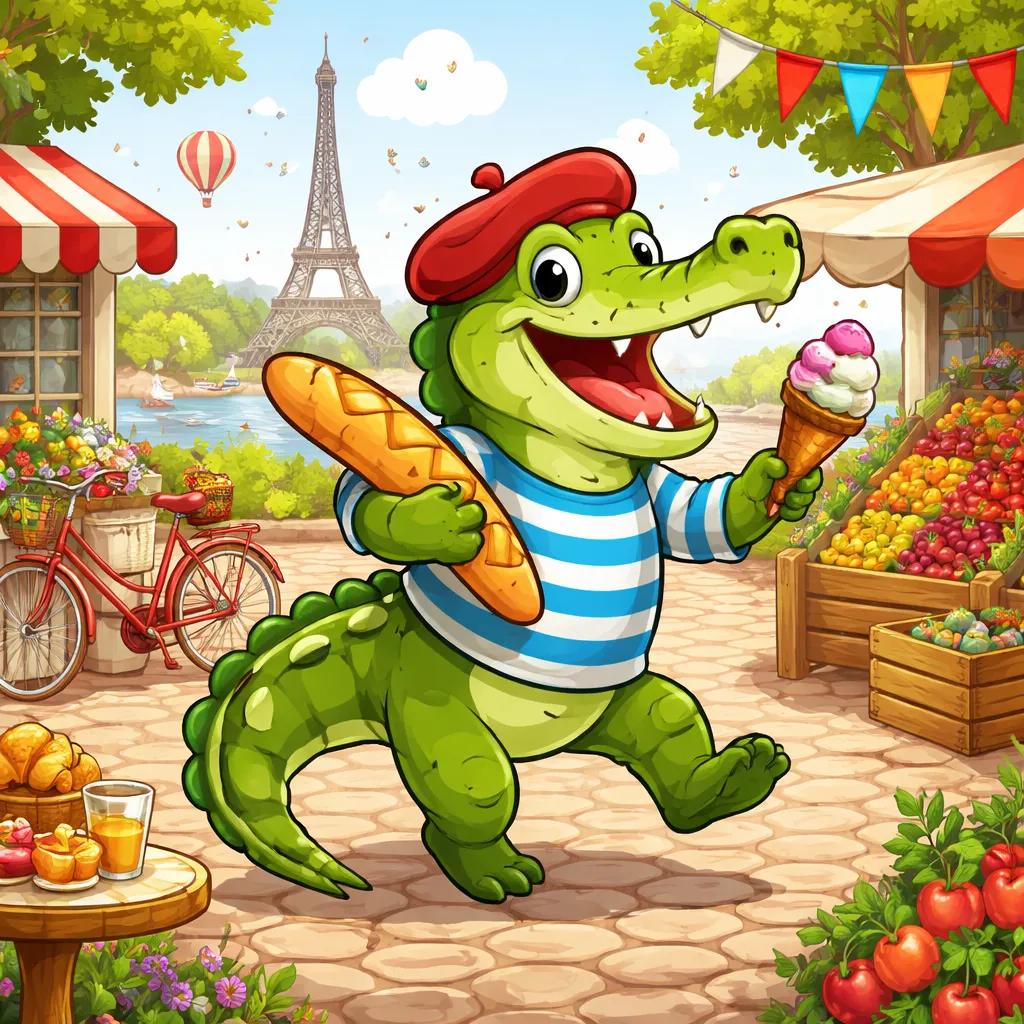

Have you ever seen a crocodile at the zoo or in a book? It looks big, with a long snout and lots of teeth. What if a little crocodile wanted to be funny and make faces? There is a playful and very famous French song about just that. It is a song full of silly actions and a surprising splash. Let’s get ready to move and learn the funny song “The Little Crocodile (Un petit crocodile).”
About the Song
Here are the playful and interactive lyrics of this classic French action song:
Un petit crocodile
Sortit de la rivière
Pour aller de l'autre côté.
Il s'avança dans l'herbe verte
Et marcha, marcha, marcha.
Il ouvrit une grande gueule
Et tira une grande langue
Aux mouches du voisinage.
Il agita son petit corps
Et remua, remua, remua.
Il fit des grimaces
Très, très effrayantes
Et puis il s'en retourna
Dans l'eau, plouf!
English Translation:
A little crocodile
Came out of the river
To go to the other side.
He moved forward in the green grass
And walked, walked, walked.
He opened a big mouth
And stuck out a big tongue
At the flies in the neighborhood.
He wiggled his little body
And shook, shook, shook.
He made faces
Very, very scary faces
And then he went back
Into the water, splash!
This is a very popular and active French children’s song and fingerplay. The song tells the story of a little crocodile’s short, funny adventure on land. “Un petit crocodile sortit de la rivière,” it begins. The crocodile comes out of the water, walks through the grass, and then does a series of silly, slightly naughty things. He opens his big mouth, sticks out his long tongue, wiggles his body, and makes scary faces. Finally, with a big “plouf!” he jumps back into the water. It is a song full of big gestures and playful sounds.
What the Song is About
The song is a short, funny cartoon about a crocodile’s walk. Picture a sunny riverbank. A little crocodile pokes his head out of the water. He decides to cross to the other side. He climbs out onto the green, green grass. “Il marcha, marcha, marcha.” He walks with a funny, waddling walk.
Then, he decides to have some fun. He sees some flies buzzing around. What does he do? He opens his huge mouth very wide. “Il ouvrit une grande gueule.” He sticks out his very long, pink tongue as far as it can go, trying to scare or maybe catch the flies. Next, he starts to dance! He wiggles his whole body from side to side. “Il agita son petit corps.” He shakes and shakes.
He makes the silliest, most terrifying faces he can think of. He scrunches his nose and rolls his eyes. He wants to look very scary, but he is just a little crocodile, so it is probably more funny than scary. After his performance, he is done. He turns around and runs back to the river. He jumps in with a giant, happy “PLOUF!” The water splashes everywhere.
Who Made It & Its Story
“Un petit crocodile” is a traditional French children’s song. Its specific creator is unknown. It is a cornerstone of French preschools and family music, beloved as a “comptine avec gestes” (nursery rhyme with gestures). Children sing it while acting out all the parts: walking with their arms, opening a big mouth, sticking out their tongue, wiggling their hips, making faces, and finally jumping for the “plouf!” It turns music time into a fun, physical game.
This energetic and hilarious song is loved for three fantastic reasons. First, it is a brilliant full-body action song that engages children physically, connecting specific French verbs (marcher, ouvrir, tirer, agiter) with clear, fun movements, which helps memory and understanding. Second, it has a wonderful element of silly, playful humor and surprise, especially with the exaggerated faces and the final big splash (“plouf!”), which makes children laugh and want to participate again and again. Third, it uses a simple, sequential narrative structure (“first he did this, then he did that”) with repetitive actions (“marcha, marcha, marcha”), making the story easy to follow and the French words easy to remember and chant.
When to Sing It
This song is perfect for burning energy and being silly. You can sing it during a playdate with friends, all acting out the crocodile’s walk, wiggles, and funny faces together, ending with everyone jumping for the “plouf!”. You can sing it outside in the garden, pretending the grass is the riverbank and a blanket or a mat is the water for the final splash. You can also sing it during bath time, making your bath toy crocodile act out the song before it goes “plouf!” into the real water.
What Children Can Learn
This hilarious action song is a wonderful teacher of body parts, action verbs, and simple storytelling in the past tense.
Vocabulary
The song teaches us fun French words for animals, places, body parts, and actions. “A” (Un). “Little” (petit). “Crocodile” (crocodile). “Came out of” (Sortit de). “The river” (la rivière). “Green grass” (l’herbe verte). “Walked” (marcha). “Opened” (ouvrit). “Big mouth” (grande gueule). “Stuck out” (tira). “Big tongue” (grande langue). “Flies” (mouches). “Wiggled/Shook” (agita). “His little body” (son petit corps). “Shook” (remua). “Made” (fit). “Faces” (grimaces). “Very scary” (très effrayantes). “Went back” (s’en retourna). “In the water” (dans l’eau). “Splash!” (plouf!).
Let’s use these words! You can describe actions: “Le chien ouvre sa bouche.” (The dog opens its mouth.) “Je tire la langue!” (I stick out my tongue!) New word: Sauter. This means “to jump.” You can say, “Le crocodile saute dans l’eau! Plouf!” (The crocodile jumps in the water! Splash!)
Language Skills
This song is great for noticing and learning about telling a simple story that already happened, using the past tense. The song uses a specific past tense form called the “passé simple” for storytelling, like “sortit” (came out) and “marcha” (walked). While children this age don’t need to conjugate it, they can learn to recognize it as the “storytelling” form.
Concept Definition: We are learning about special word endings that tell us a story is about something that already finished. In songs and old stories, French often uses a special “storybook” past tense. In our song, the crocodile’s adventure is a finished little story. Words like “sortit” (came out), “marcha” (walked), and “ouvrit” (opened) have a “-it” or “-a” sound at the end. This is a clue that we are hearing a tale about what the crocodile did.
Features and Types: This “storybook” past tense is used a lot in fairy tales, fables, and songs like this one. It makes the story sound like an event that happened once upon a time. You will often see it with “Il” (he/it) or “Elle” (she/it). The pattern often ends with “-a” for many verbs (marcha, tira, agita, remua) or “-it” for others (sortit, ouvrit). The common pattern is: “[Il/Elle] + [verb with a special ‘story’ ending] + [the rest of the sentence].”
How to Spot Them: Here is the “Storytime Signal” trick. In a song or story, listen for action words that end with a strong “-a” (like march-a) or “-it” (like sort-it), especially after “il” or “elle.” Ask yourself: “Is this telling me what someone did one time in the past?” If yes, it might be this storytelling past tense. It gives the song a “once upon a time” feeling.
How to Use Them: While you will learn to speak in other past tenses first, you can enjoy recognizing this tense in stories. Think of it as the “Storyteller’s Formula”. When you tell a made-up story about an animal, you can try the pattern: “Il était une fois… [animal]… il/elle [verb-a/it]…” (Once upon a time… [animal]… he/she [verb]…).
Example from the song: “Un petit crocodile… il marcha, marcha, marcha.” (A little crocodile… he walked, walked, walked.)
Example you can recognize: In a story: “Le lion rugit.” (The lion roared.) “La princesse chanta.” (The princess sang.)
Sounds & Rhythm Fun
Listen to the bouncy, marching rhythm of the melody. The tune for “Un petit crocodile” is catchy and has a steady beat that matches the crocodile’s walk. The repetition of words like “marcha, marcha, marcha” and “remua, remua, remua” makes those parts fun to sing and act out.
The song has wonderful sound effects! The word “plouf!” is the sound of a big splash. It is a classic French onomatopoeia, a word that sounds like the noise it describes. The “ou” sound in “gueule” (mouth) and the “an” sound in “langue” (tongue) are fun French sounds to make. The melody rises and falls in a playful way, especially on the funny parts about making faces. This musical pattern is perfect for creating your own animal adventure song. Try a monkey song: “Un petit singe grimpa, grimpa, grimpa… Il fit des singeries… Et puis sauta, plouf! dans les feuilles!” (A little monkey climbed, climbed, climbed… He acted like a monkey… And then jumped, splash! into the leaves!).
Culture & Big Ideas
“Un petit crocodile” fits right into the French tradition of “chansons gestuelles” (action songs) that are a key part of early childhood education (“maternelle”). These songs develop motor skills, coordination, and group participation. The crocodile, while exotic, is treated with a playful, non-scary humor that is typical of many French children’s animal characters, making the unfamiliar familiar and funny.
The song conveys three playful and important ideas. First, it encourages physical coordination and symbolic play, as children use their own bodies to represent the animal’s actions (walking, opening mouth, wiggling), building the connection between language and movement. Second, it explores humor and playful exaggeration (making “very, very scary” faces), allowing children to play with the concept of being “scary” in a safe and silly context. Third, it presents a complete, simple narrative with a clear beginning (coming out of the river), middle (the series of actions), and end (jumping back in), teaching basic story structure in a fun, embodied way.
Values & Imagination
Imagine you are the little crocodile. The river water is cool. You see the sunny, green grass on the other side. You pull yourself out. Your feet sink a little into the soft mud. You start your walk. “Je marche, marche, marche.” You feel the sun on your scaly back.
You see some shiny flies buzzing. You stop. You have an idea. You open your jaw as wide as it can go—so wide a big ball could fit inside! You stick your tongue way, way out. You waggle your whole body like a wiggly noodle. Then you make the craziest, scrunchiest, silliest face you can. You want to make the flies laugh! After your funny show, you are tired. The river looks cool and inviting. You take a little run and JUMP! “PLOUF!” The water feels amazing. How does it feel to be a silly crocodile? Is it fun to make funny faces? Draw the crocodile’s adventure. Draw three pictures. First, draw him walking in the grass. Second, draw him with a huge open mouth and a wiggly body. Third, draw a big splash (“PLOUF!”) in the water. This tells the song’s story.
The song encourages us to use our whole body to tell a story, to be playful and silly, and to see animals as characters with their own funny adventures. A wonderful activity is the “Concert des Grimaces” (Funny Faces Concert). Play the song. Every time you sing the part about making “grimaces très effrayantes,” have a contest with a friend or in the mirror: who can make the funniest, silliest, most “scary” face? This connects to the song’s core theme of playful expression and humor.
So, from the first step on the grass to the final big splash, this song is a mini comedy starring a crocodile. It is a vocabulary lesson in body parts and big actions. It is a language lesson in hearing the “storybook” past tense. It is a music lesson in a bouncy tune with a great sound effect. “The Little Crocodile (Un petit crocodile)” teaches us about playful movement, storytelling, and the joy of being silly.
Your Core Takeaways
You are now an expert on the song “The Little Crocodile (Un petit crocodile).” You know it is a funny French action song about a crocodile who walks on grass, sticks out his tongue, wiggles, makes faces, and jumps back into the water with a “plouf!”. You’ve learned French words like “crocodile,” “rivière,” “marcha,” “langue,” “grimaces,” and “plouf,” and you’ve noticed the special “storybook” past tense endings like “-a” and “-it” that tell a finished tale. You’ve felt its bouncy, marching rhythm perfect for acting out and created your own animal adventure verse. You’ve also discovered the song’s message about playful movement, humor, and clear storytelling.
Your Practice Missions
First, play the “Et puis…” (And then…) story game. Tell a short, silly story about an animal using the “Storyteller’s Formula.” Start with “Un petit [animal]…” (A little [animal]…). Say what it did using a few action words, and end with “Et puis… plouf!” or another funny ending. For example: “Un petit chat grimpa, grimpa, grimpa sur l’arbre. Il regarda les oiseaux. Et puis… il descendit vite!” (A little cat climbed, climbed, climbed the tree. He looked at the birds. And then… he came down fast!). This mission helps you play with the song’s narrative style.
Second, have a “Parade des Animaux Rigolos” (Funny Animal Parade). Choose three different animals. For each one, think of two funny actions they could do, like the crocodile. Act them out with your body and say the actions in French. For example, for an elephant: “Il bouge ses grandes oreilles.” (He moves his big ears.) “Il barrit (fait le bruit de l’éléphant)!” (He trumpets!). This mission lets you use the song’s core idea of playful, physical animal storytelling.