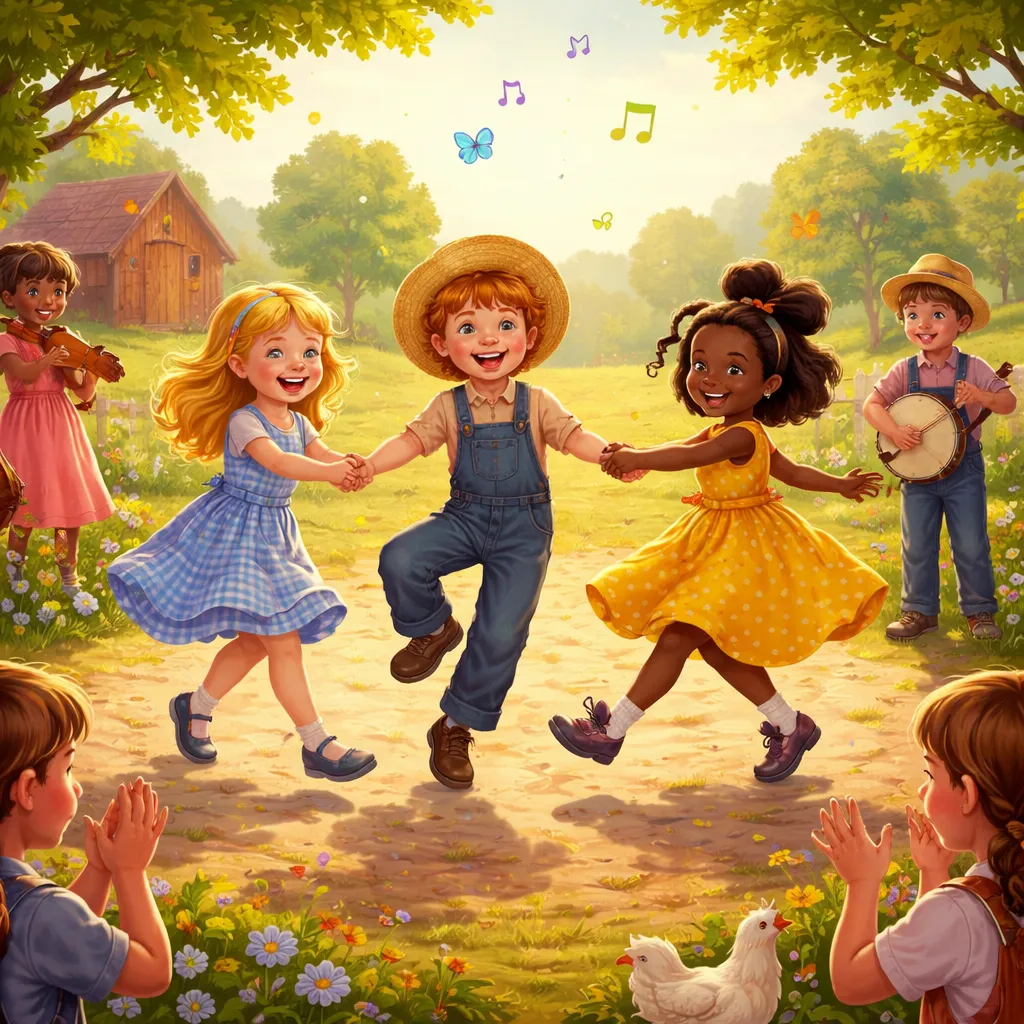

Do you have a favorite way to move when you’re happy? Do you jump? Do you dance? Long ago, at big parties in small towns, people had a special song for moving and choosing partners. It’s a song that’s also a game, and it has a funny word in its title. Let’s learn about the playful song and dance “Skip to My Lou.”
About the Song
Let’s read the fun, repeating words of this classic play-party song.
Lost my partner, what’ll I do?
Lost my partner, what’ll I do?
Lost my partner, what’ll I do?
Skip to my Lou, my darling.
Lou, Lou, skip to my Lou,
Lou, Lou, skip to my Lou,
Lou, Lou, skip to my Lou,
Skip to my Lou, my darling.
Fly’s in the buttermilk, shoo, fly, shoo!
Fly’s in the buttermilk, shoo, fly, shoo!
Fly’s in the buttermilk, shoo, fly, shoo!
Skip to my Lou, my darling.
This song is a traditional American play-party song and singing game from the 19th century. It is a lively, repetitive tune used for a group dance. The word “Lou” is thought to be a short, folksy version of the word “love.” So, “Skip to My Lou” means something like “Skip to my love” or “Skip to my sweetheart.” The song was sung at community gatherings, especially in places where instrumental music and dancing were sometimes frowned upon. Singing the music made it an acceptable “play-party” game. The lyrics change in different versions, often featuring silly, everyday problems like losing a partner or a fly in the buttermilk.
What the Song is About
The song paints a picture of a fun, slightly silly party game. A group of people form a circle. In the middle, one person is alone—they have “lost” their dancing partner. They sing out their problem three times: “Lost my partner, what’ll I do?”
The answer is in the chorus: “Skip to my Lou!” This means they should skip across the circle to choose a new partner (their “Lou”). Everyone sings “Lou, Lou, skip to my Lou” as the person skips happily to pick someone new. Then, the game continues. Other silly verses are added, like “Fly’s in the buttermilk, shoo, fly, shoo!” where everyone might pretend to shoo away a fly. The whole song is about moving, solving a funny problem, and making sure everyone has a partner to dance with. It’s a game about inclusion and cheerful action.
Who Made It & Its Story
“Skip to My Lou” is a traditional American folk song, so its original creator is unknown. It comes from the “play-party” tradition of the 1800s, particularly in rural American communities, especially in the South and Midwest. In some religious communities, fiddle music and dancing were seen as improper. To get around this, young people invented “play-parties,” which were group dances accompanied only by singing and clapping. “Skip to My Lou” was one of the most popular. The song was passed down orally and collected by folklorists in the early 20th century. Its simple, adaptable structure made it a favorite in schoolyards and summer camps for generations.
This song has remained a favorite for three playful reasons. First, its melody is incredibly catchy, simple, and perfect for skipping. Second, it is an action song. You can’t just sit and sing it; you have to move, making it a perfect game for burning off energy. Third, it is wonderfully silly and adaptable. New verses can be invented about anything (“Cat’s in the cream jar, meow, meow, meow!”), encouraging creativity and laughter.
When to Sing It
This song is perfect for active, group play. You can sing and dance to it during a family game night, making up your own silly verses. You can sing it on a walk, skipping instead of walking whenever you sing the chorus. You can also sing it with friends at the park, forming a circle and playing the traditional partner-choosing game.
What Children Can Learn
This energetic game-song is a playground of learning. Let’s skip through all the lessons.
Vocabulary
The song teaches us casual, old-fashioned words. To “skip” is to move by hopping on one foot and then the other, in a light, bouncy way. “Lou” is a nickname for “love” or “sweetheart.” “Partner” is a person you do an activity with, like dancing. “What’ll” is a contraction of “what will.” “Darling” is a term of affection. “Buttermilk” is the liquid left after churning butter, a common farm product. “Shoo” is a word said to scare away an animal.
Let’s use these words! You can say, “Let’s skip to the end of the path.” Or, “Shoo, fly, you’re on the picnic blanket!” New word: Contraction. This is a short form of two words, like “what’ll” for “what will.”
Language Skills
This song is a fantastic lesson in using contractions and the imperative mood. Contractions are short forms of words. The song uses “what’ll” (what will) and the implied “I’ll” (I will) in the answer to the question. Using contractions makes the language sound casual and natural, like everyday speech.
The song also uses the imperative mood for giving cheerful commands: “Skip to my Lou!” and “Shoo, fly, shoo!” The imperative is the form of the verb used for orders or instructions, and here it’s used to direct the game’s action. The repeated question “what’ll I do?” is a great example of asking for advice or expressing a problem.
Sounds & Rhythm Fun
Listen to the bouncy, skipping rhythm of the melody. The song uses heavy repetition, which is key for a group game—it’s easy to remember and join in. The chorus has a strong, chanted feel: “Lou, Lou, skip to my Lou.” The verses have a clear rhyme: “do” and “Lou,” “shoo” and “Lou.”
The rhythm is a bright, jaunty 2/4 or 4/4 time, perfectly matching the light, quick steps of a skip. Try clapping twice for each line: LOST my PART-ner, WHAT’ll I DO? The melody is simple, based on just a few notes, and is incredibly easy to learn. This clear, repetitive, and energetic musical pattern is what makes the song so perfect for active play. You can write your own action game song! Use the same bouncy rhythm. Try: “Lost my pencil, what’ll I do? Lost my pencil, what’ll I do? Lost my pencil, what’ll I do? Grab a new one, yes it’s true! New one, new one, grab a new one! New one, new one, grab a new one! Grab a new one, yes it’s true!”
Culture & Big Ideas
“Skip to My Lou” is a prime example of 19th-century American “play-party” culture. It shows how communities created their own fun within social rules, using singing and simple movements for entertainment and courtship. The song reflects values of community, inclusion (finding a new partner so no one is left out), and making the best of simple things. It is a living piece of social history from a time before recorded music and television.
The song communicates three joyful ideas. First, it’s about problem-solving with a positive attitude. The response to losing a partner isn’t to cry; it’s to skip and find a new one! Second, it emphasizes inclusion and social connection. The game ensures everyone gets a turn and a partner, reinforcing group cohesion. Third, it celebrates silliness and improvisation. The verses are often nonsensical (“flies in the buttermilk”), showing that fun doesn’t have to be serious and encouraging creative thinking.
Values & Imagination
Imagine you are at a play-party in a barn or a big farmhouse kitchen. What are people wearing? Simple, old-fashioned clothes? Is the room lit by lanterns? Can you hear the sound of many feet skipping on a wooden floor? Now, imagine you are the one who “lost my partner.” Who do you skip to? A friend? A sibling? A parent? What silly new verse could you invent? “Dog’s in the fireplace, woof, woof, woof!”? Draw a picture of the dance. Show the circle of people, one person skipping to the center, and the “Lou” they are choosing. Show the smiles on their faces.
The song inspires us to be active, inclusive, and creative. A wonderful idea is to host a “Family Skip to My Lou” game. Clear some space. Teach the simple song to your family. Form a circle, choose one person to start in the middle, and play! Make up your own family verses about household things. This creates laughter, movement, and a shared tradition.
So, as the last “skip to my Lou, my darling” is sung, think about the simple joy this game brings. It is a vocabulary lesson in playful, old-time words. It is a grammar lesson in contractions and commands. It is a music lesson in bouncy, communal rhythm. From the first call of “lost my partner” to the final skip, it wraps up the spirit of community play, creative problem-solving, and pure, uncomplicated fun in a tune that makes your feet want to move. “Skip to My Lou” teaches us that games can bring us together, that a little silliness is wonderful, and that sometimes, the answer to a problem is simply to skip.
Your Core Takeaways
You are now an expert on the song “Skip to My Lou.” You know it is a 19th-century American play-party song and game. You’ve learned that “Lou” is a folksy word for “love,” and you’ve practiced contractions like “what’ll” and imperative verbs like “skip.” You’ve felt its bouncy, skipping rhythm and created your own action verse. You’ve also discovered the song’s role in community gatherings, its messages about positive problem-solving, inclusion, and the value of silly, creative fun.
Your Practice Missions
First, host a “Skip to My Lou” dance-off. Teach the song to at least one other person. Play the game together. Take turns being the one who “loses” their partner. Invent at least one brand new, silly verse about something in your home (like “Dad’s in the armchair, snore, snore, snore!”). This puts the song into immediate, active practice.
Second, create a “Modern Play-Party” comic. The song comes from a time of community parties. Imagine what a “play-party” for your friends would look like today. Draw a comic strip of 3-4 panels showing you and your friends playing a modern version of “Skip to My Lou.” Where are you? (The park? A basement?) What are you wearing? What silly modern problem is in a verse? (“Phone’s in the sofa, buzz, buzz, buzz!”) Share your comic with your family.