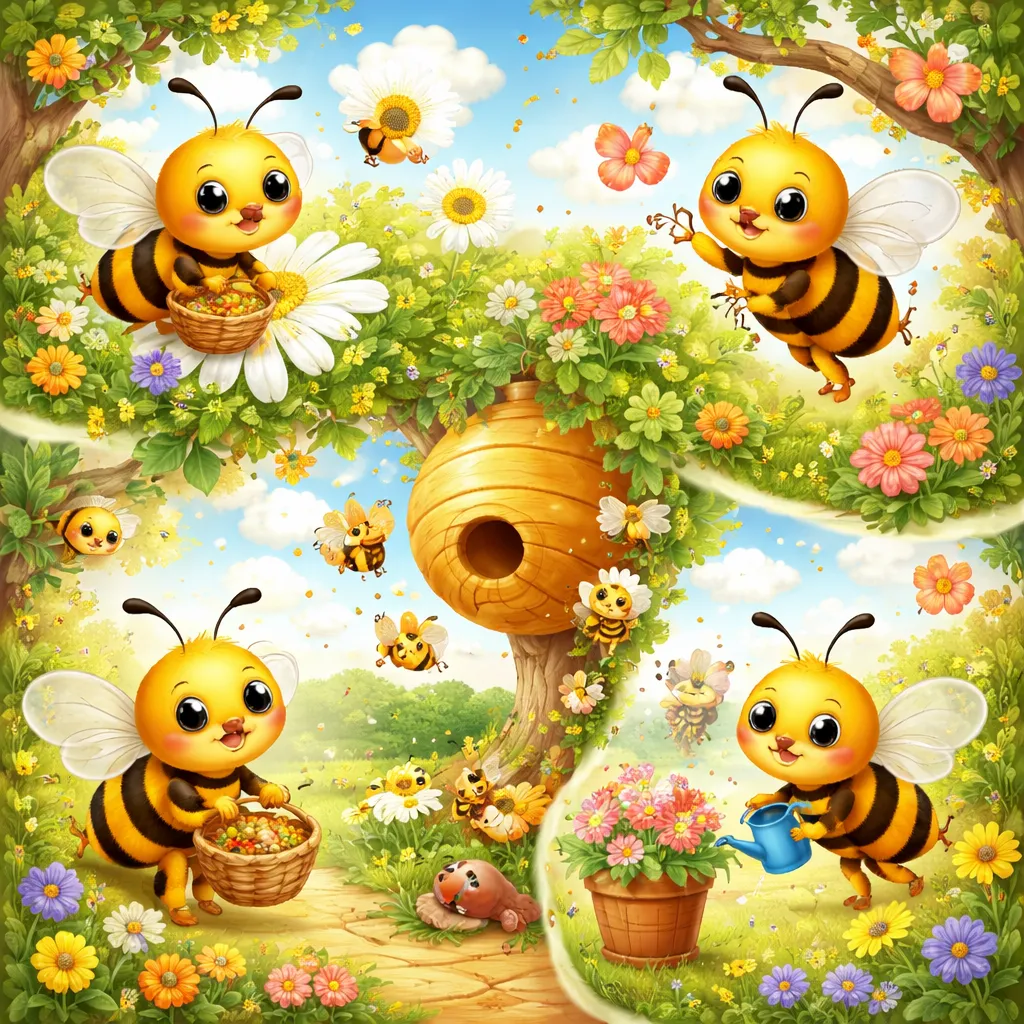

Have you ever watched a bee in a garden? It zooms from flower to flower, never stopping, its wings making a tiny buzzing sound. In Germany, there is a cheerful song about this hardworking little insect. It is a song that buzzes with energy and action. Let’s follow its flight and learn the busy song “The Little Bee (Die kleine Biene).”
About the Song
Here are the lively, action-packed lyrics of a popular traditional German children’s song:
Die kleine Biene, summ, summ, summ,
fliegt hin und her, summ, summ, summ.
Die kleine Biene, summ, summ, summ,
arbeitet schwer, summ, summ, summ.
English Translation:
The little bee, buzz, buzz, buzz,
flies here and there, buzz, buzz, buzz.
The little bee, buzz, buzz, buzz,
works hard, buzz, buzz, buzz.
This is a delightful German-language children’s song from Germany. The song is a celebration of a tiny creature’s busy day. “The little bee, buzz, buzz, buzz,” it starts, immediately filling the air with the sound of bee wings. This little bee is always on the move! “Flies here and there, buzz, buzz, buzz,” the song tells us, painting a picture of fast, zigzagging flight between bright flowers. But the bee is not just playing; it has a very important job. “The little bee, buzz, buzz, buzz, works hard, buzz, buzz, buzz.” The song is a simple, loving look at the life of a bee, full of movement, sound, and purpose.
What the Song is About
The song is a snapshot of a bee’s busy workday. Imagine a sunny garden full of colorful flowers. A small, striped bee with delicate wings appears. “The little bee, buzz, buzz, buzz.” You can almost hear its busy sound.
It does not stay still for a second. “Flies here and there, buzz, buzz, buzz.” It zips to a red rose, then quickly to a yellow sunflower, then over to a purple lavender plant. It is constantly moving, collecting what it needs. This movement has a very important reason. The bee is not just flying around; it is working. “The little bee, buzz, buzz, buzz, works hard, buzz, buzz, buzz.” It is gathering pollen and nectar to help make honey and to help the flowers grow. The song shows us a creature that is always active, always helpful, and always makes a cheerful buzzing sound.
Who Made It & Its Story
“Die kleine Biene” is a classic German folk song, deeply rooted in the country’s appreciation for nature and its tiny, important creatures. Its specific creator is unknown, as it has been sung for many years in kindergartens and homes. The song reflects a cultural value placed on diligence, nature observation, and the interconnectedness of the natural world. In Germany, bees are highly respected for their role in the environment. The song connects to this respect, presenting the bee not as something to fear, but as a small, admirable worker.
This energetic song is loved for three wonderful reasons. First, it is a perfect, catchy way to learn common German verbs for movement and action, like “fliegt” (flies) and “arbeitet” (works). Third, it pairs these verbs with a fun, onomatopoeic sound (“summ”) and a clear adverb (“schwer”), building a rich vocabulary in just a few lines. Third, it celebrates a positive value—hard work and purpose—in a way that is joyful and connected to the natural world, teaching children to appreciate the busy bees around them.
When to Sing It
This song is perfect for active, energetic moments. You can sing it happily while walking through a park or garden, pretending to fly like a bee from one spot to another. You can chant it as a fun action song with friends, everyone buzzing and “flying” around the room. You can also hum it while working on a small task, like tidying your toys, to feel as productive and cheerful as the little bee.
What Children Can Learn
This action-packed song is a wonderful teacher about insects, verbs, and the value of work in German.
Vocabulary
The song teaches us key words for animals, actions, sounds, and descriptions in German. “The” (Die). “Little” (kleine). “Bee” (Biene). “Buzz” (summ). “Flies” (fliegt). “Here and there” (hin und her). “Works” (arbeitet). “Hard” (schwer).
Let’s use these words! You can describe any flying insect: “Der Vogel fliegt.” (The bird flies.) You can talk about work: “Ich arbeite.” (I work.) New word: Bestäubung (pollination). This is the amazing job the bee is doing while it “flies here and there” and “works hard.” It carries pollen from flower to flower, helping plants make fruits and seeds.
Language Skills
This song is excellent for learning about verbs in the present tense, specifically how they are used with “he,” “she,” or “it” in German. Words like “fliegt” (flies) and “arbeitet” (works) are action words that tell us what the bee (she/it) is doing right now.
Concept Definition: A verb is an action word. It tells us what someone or something does. In the song, the little bee is doing two main things. First, it moves: “fliegt” (flies). Second, it is active: “arbeitet” (works). These verbs show the bee’s busy life.
Features and Types: Verbs can show different kinds of actions. “Fliegt” is a movement action (from one place to another). “Arbeitet” is an activity action (doing a job). In German, when the subject is “he,” “she,” or “it” (like “die Biene”), we often add a “-t” to the verb stem. From “fliegen” we get “fliegt.” From “arbeiten” we get “arbeitet.”
How to Spot Them: Here is a simple “what’s happening?” trick. Ask yourself: “What is happening in this sentence? What is the subject doing?” The word that answers that question is the verb. In the song: What is the bee doing? It is flying (“fliegt”). It is working (“arbeitet”). Those are our verbs.
How to Use Them: A great way to talk about what someone or something does is the “Who/What Does What” formula. The pattern is: “[The person or thing] + [Verb with -t for he/she/it].”
Example from the song: “Die kleine Biene fliegt.” (The little bee flies.) “Die kleine Biene arbeitet.” (The little bee works.)
Example you can make: “Der Hund läuft.” (The dog runs.) “Die Sonne scheint.” (The sun shines.)
Sounds & Rhythm Fun
Listen to the busy, buzzy rhythm of the melody. The song often has a lively, steady tune that mimics the constant humming of bee wings. The wonderful onomatopoeia “summ, summ, summ” is repeated like a catchy chorus, making it super fun to sing and easy to remember. The words “Biene” (bee) and “schwer” (hard) don’t rhyme perfectly, but the strong, repeated “summ” sound ties everything together beautifully. The phrase “hin und her” (here and there) has a flowing, back-and-forth sound that feels like flying.
The rhythm is bouncy and energetic, perfect for flapping your “bee wings” (your hands) quickly. The repetition of the whole first line and the constant “summ” sounds make the song stick in your head like a happy little earworm. This musical pattern is perfect for creating your own song about a busy animal. You can write your own “Die kleine Ameise” (The Little Ant) song! Try: “Die kleine Ameise, tipp, tapp, tipp, läuft hin und her, tipp, tapp, tipp. Die kleine Ameise, tipp, tapp, tipp, arbeitet schwer, tipp, tapp, tipp.” (The little ant, tip, tap, tip, runs here and there, tip, tap, tip. The little ant, tip, tap, tip, works hard, tip, tap, tip.)
Culture & Big Ideas
“Die kleine Biene” connects to the German cultural values of diligence (“Fleiß”), order, and a deep respect for nature (“Naturverbundenheit”). Bees are seen as ideal workers—organized, tireless, and essential for the environment. The song reflects this admiration. It also ties into the German tradition of “Kinderlieder” (children’s songs) that teach about the natural world and positive behaviors in a simple, memorable way.
The song conveys three important, joyful ideas. First, it encourages careful observation of nature and its small creatures, appreciating their constant activity. Second, it positively frames the concept of hard work (“arbeitet schwer”) as something natural, joyful, and worthwhile, just like the bee’s flight. Third, it introduces the idea of interdependence in nature—the bee works hard, and in doing so, it helps the flowers and our world, showing that even small actions have big purposes.
Values & Imagination
Imagine you are as small as a bee. You are the “kleine Biene” on a very important mission. Your wings hum, “summ, summ, summ.” You look at a huge field of flowers like a colorful city. “The little bee, buzz, buzz, buzz, flies here and there, buzz, buzz, buzz.” You zip to a blue flower, then a pink one, then a white one. Your tiny legs get covered in yellow pollen. It is a big job, but you are strong and happy. “The little bee, buzz, buzz, buzz, works hard, buzz, buzz, buzz.” You are helping the garden grow! How does the pollen feel? How sweet does the nectar smell? Draw the little bee’s world. Draw a busy bee with lots of movement lines around it. Draw many different flowers. Draw a thought bubble from the bee with the word “SUMM!” inside. Write the words “fliegt hin und her” and “arbeitet schwer” on your picture. This shows the song’s energy and purpose.
The song encourages us to be observant, to appreciate hard work, and to see the important jobs that even the smallest creatures do. A wonderful activity is the “Helpful Bee” mission. Choose a small, helpful job you can do, like setting the table or watering a plant. While you do it, hum the tune of “Die kleine Biene” or say “summ, summ, summ.” This connects you to the song’s spirit of cheerful, purposeful activity.
So, from its buzzing flight to its hard work, this song is a celebration of a tiny powerhouse. It is a vocabulary lesson in insects, actions, and sounds. It is a language lesson in using present tense verbs like “fliegt” and “arbeitet.” It is a music lesson in a lively, repetitive, buzzing melody. “The Little Bee (Die kleine Biene)” teaches us to watch nature closely, to value hard work, and to find joy in being busy and helpful.
Your Core Takeaways
You are now an expert on the song “The Little Bee (Die kleine Biene).” You know it is a German song about a bee that buzzes, flies everywhere, and works hard. You’ve learned German words like “Biene,” “summ,” “fliegt,” “hin und her,” “arbeitet,” and “schwer,” and you’ve practiced using action verbs for “he/she/it.” You’ve felt its energetic, buzzing rhythm and created your own busy animal verse. You’ve also discovered the song’s message about observing nature, appreciating hard work, and understanding how small creatures help our world.
Your Practice Missions
First, play the “Was macht es?” (What is it doing?) game. Look at an animal or a thing outside. Describe what it is doing in German using a verb that ends in “-t.” For example, “Der Vogel fliegt.” (The bird flies.) “Die Blume wächst.” (The flower grows.) “Das Auto fährt.” (The car drives.) See how many “-t” action sentences you can make. This mission helps you master the verb pattern from the song.
Second, be a “Summ, Summ” helper. Find one small task to do to help at home, like putting your toys in a box. As you do the task, move quickly and busily from one spot to another, just like the bee “flies here and there.” Hum the “summ, summ, summ” tune while you work. When you finish, say “Ich arbeite schwer, summ, summ, summ!” (I work hard, buzz, buzz, buzz!). This mission lets you act out the song’s meaning of cheerful, hard work.