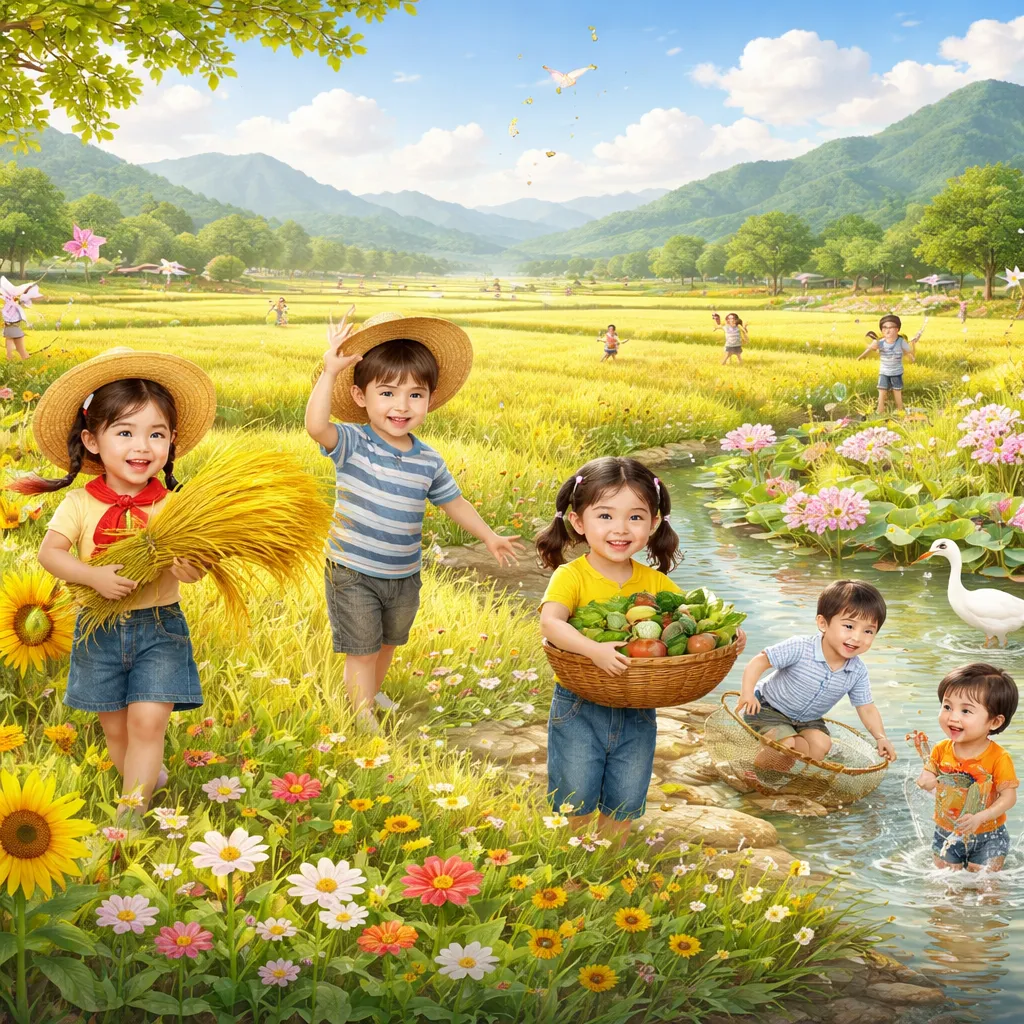

Imagine standing at the edge of a vast, open space. As far as you can see, there are golden fields, winding rivers, and distant blue mountains. It feels peaceful, beautiful, and full of life. A long time ago in China, someone tried to capture that exact feeling in a song. It’s a musical painting that makes you feel proud and calm. Let’s explore the lyrical song “Our Field Is a Garden” (我们的田野, Wǒmen de tiányě).
About the Song
Let’s read the first verse of this descriptive, beautiful song.
我们的田野,美丽的田野,
碧绿的河水,流过无边的稻田。
无边的稻田,好像起伏的海面。
English Translation:
Our field, beautiful field,
Green rivers flow past boundless rice paddies.
The boundless rice paddies, like a rolling sea.
This song is a Chinese children’s song from the 1950s. The lyrics were written by Zhang Zhidong (张之洞) and the music was composed by Zhang Wenjiao (张文纲). It is a slow, expansive, and poetic song that describes the natural landscape of the Chinese countryside with great love and detail. The song doesn’t tell a story with characters and action. Instead, it acts like a camera slowly panning across a scene, pointing out the green rivers, the endless rice fields that look like a sea, the lotus flowers, the forests, and the distant blue mountains. The song expresses a deep appreciation for the beauty and abundance of the homeland. It is a standard in Chinese music education, loved for its beautiful melody and its ability to evoke a sense of peace and national pride.
What the Song is About
The song paints a series of grand, peaceful pictures of the land. The singer calls the land “our field,” which immediately makes it feel shared and beloved. They describe it as beautiful. Then, they focus on specific parts of the scene.
First, they see green rivers flowing next to endless rice paddies. The paddies are so big and wave in the wind that they look like a rolling sea. The song might go on to describe other parts of the landscape: lakes with lotus flowers, forests where workers are cutting wood, and blue mountains in the distance where animals live and treasures are hidden. Each image is calm, abundant, and full of life. The song is about looking at the wide world around you, noticing its beauty in detail, and feeling a strong sense of belonging and gratitude for that land. It’s a song that makes you want to be an explorer and a painter at the same time.
Who Made It & Its Story
“Our Field Is a Garden” was created in 1953 by lyricist Zhang Zhidong and composer Zhang Wenjiao. The song was written during a period in China when there was a strong emphasis on building a new society and appreciating the motherland’s natural resources and beauty. The song was intended for children to help them develop an aesthetic appreciation for their country’s landscape and to foster a sense of pride and responsibility towards it. The song’s serene and majestic tone set it apart from more militant children’s songs of the era. It became a classic in school music textbooks and is often performed by children’s choirs. Its enduring popularity is a testament to the universal appeal of its peaceful, nature-centered imagery.
This lyrical song has remained a classic for three beautiful reasons. First, its melody is sweeping, gentle, and majestic, perfectly matching the expansive scenery it describes. Second, the lyrics are a masterpiece of simple, vivid imagery that allows any child to visualize a beautiful, idealized countryside. Third, it evokes a deep, calm feeling of connection to nature and place, which is a feeling that transcends time and politics, appealing to the basic human love for beautiful landscapes.
When to Sing It
This song is perfect for calm, observant moments. You can sing it softly on a long car ride through the countryside, matching the words to what you see out the window. You can hum it while looking at a large, beautiful landscape painting or photograph, letting the music deepen the feeling. You can also sing it in a group, like a choir, allowing the harmonious melody to create a feeling of shared appreciation for beauty.
What Children Can Learn
This descriptive, poetic song is a rich field of lessons about language, observation, and art.
Vocabulary
The song teaches us rich descriptive and geographical words. A “field” (田野, tiányě) is an open area of land, often used for farming. “Beautiful” (美丽, měilì) means very pretty. “Green” (碧绿, bìlǜ) is a color like grass or leaves. A “river” (河水, héshuǐ) is a large natural flow of water. “Boundless” (无边, wúbiān) means having no limits or edges. “Rice paddies” (稻田, dàotián) are flooded fields where rice is grown. “Rolling sea” (起伏的海面, qǐfú de hǎimiàn) means the surface of the ocean with waves going up and down.
Let’s use these words! You can say, “We flew over the boundless desert.” Or, “The rolling sea was calm today.” New word: Landscape. This means all the visible features of an area of land. The song describes a landscape.
Language Skills
This song is a masterful lesson in using descriptive adjectives and the simile for comparison. The song uses adjectives before nouns to create a clear picture: “beautiful field,” “green rivers,” “boundless rice paddies.” This is how we build detailed descriptions.
The song uses a classic simile with “好像” (hǎoxiàng, like): “The rice paddies are like a rolling sea.” This compares two different things (fields and the sea) to help the listener imagine the scene better. The song also uses the present simple tense to describe the scene as it is: rivers “flow,” fields “are.” This tense is for general truths and states.
Sounds & Rhythm Fun
Listen to the slow, flowing, expansive rhythm of the melody. The song is in a gentle 4/4 time, but it feels broad and open. The melody has long, sustained notes that rise and fall, mimicking the rolling hills and wide vistas it describes. The Chinese lyrics have a soft, poetic rhyme: “野” (yě) and “野” (yě), “田” (tián) and “面” (miàn).
The rhythm is steady and grand, not fast. Try singing with a full, calm voice: 我 们 的 田 野,美 丽 的 田 野 (wǒmen de tiányě, měilì de tiányě). The melody is more complex than a simple nursery rhyme, which makes it a wonderful introduction to more formal singing. This sweeping, lyrical, and serene musical pattern is what makes the song feel like a piece of classical landscape art. You can write your own descriptive song! Use the same lyrical style. Try: “Our park, the quiet park, the tall trees stand against the sky. The tall trees, like friendly giants, watching the people go by.”
Culture & Big Ideas
“Our Field Is a Garden” is a product of mid-20th century Chinese patriotic art, but one focused on natural beauty rather than political struggle. It connects to the ancient Chinese artistic tradition of “shanshui” (山水, mountain-water) painting and poetry, which focuses on the harmony and grandeur of the natural world. The song reflects the value of finding beauty and pride in one’s homeland. It can be connected to the Qingming Festival (Tomb-Sweeping Day), a time when people go outdoors to remember ancestors and appreciate spring, often in rural settings. The song teaches that loving one’s country can be about cherishing its rivers, mountains, and fields, and seeing them as a shared garden to be appreciated and protected.
The song conveys three profound ideas. First, it’s about detailed observation and appreciation of nature. The song trains the eye and the mind to look closely and find poetry in the landscape. Second, it expresses a sense of collective ownership and pride. The land is “our field,” suggesting it belongs to everyone and is a source of shared identity and beauty. Third, it highlights the artist’s role as a translator of beauty. The song turns a physical landscape into an emotional and musical experience, teaching that we can use our voices and words to share the way we see the world.
Values & Imagination
Imagine you are the singer, standing on a small hill. What do you see first? The river? The fields? How far can you see? Now, imagine the “rolling sea” of rice paddies. Can you see the wind making waves? Can you hear it? Now, imagine what is beyond the mountains. What treasures are hidden there? Draw a panoramic picture of the song’s view. Don’t draw just one thing. Draw a long, horizontal picture showing all the layers: the green river in the foreground, then the golden rice fields, then the blue mountains in the back. Label each part with a word from the song. This captures the song’s layered, sweeping perspective.
The song encourages close observation of nature, a sense of shared stewardship for the environment, and the use of creative language to express beauty. A lovely idea is to have a “Panorama of My Home” activity. With your family, look out the biggest window in your home or go to a local park. Together, describe what you see in layers (what’s close, what’s in the middle, what’s far away). Use descriptive words. One person can be the scribe and write a short, three-line “song” based on your view. This applies the song’s technique to your own world.
So, as the last note about the rolling fields fades, think about the wide-angle lens of this song. It is a vocabulary lesson in describing landscapes. It is a grammar lesson in using adjectives and similes. It is a music lesson in a sweeping, serene melody. From the first claim of “our field” to the final image of distant treasures, it wraps lessons in observation, shared pride, and artistic expression in a tune that feels as wide and hopeful as the horizon. “Our Field Is a Garden” teaches us to see the world as a beautiful, connected picture, to feel that we are part of that picture, and that we can sing the world into being even more beautiful.
Your Core Takeaways
You are now an expert on the song “Our Field Is a Garden” (我们的田野). You know it is a 1950s Chinese children’s song that paints a lyrical picture of the countryside. You’ve learned words like “boundless,” “rice paddies,” and “rolling sea,” and you’ve practiced using descriptive adjectives and similes. You’ve felt its expansive, flowing rhythm and created your own descriptive verse. You’ve also discovered the song’s cultural background and its messages about observing nature, collective pride in the homeland, and translating beauty into art.
Your Practice Missions
First, be a “Landscape Composer.” Find a picture of a beautiful landscape (in a book, online, or a photo you took). Play the song “Our Field Is a Garden” softly in the background as you look at the picture. Then, write three sentences describing the picture, trying to use the song’s style (e.g., “The blue lake, like a giant mirror…”). Share your composed description. This connects the song directly to the act of viewing art.
Second, create a “Soundscape Map.” The song describes a scene with different parts (river, fields, mountains). On a large piece of paper, draw a simple map of an imaginary beautiful land. Label the different areas. Then, for each area, choose a simple sound or a short melody (hummed) that represents it. Perform your “soundscape” for your family by pointing to the area on the map and making its sound. This activity combines geography, music, and imagination, inspired by the song’s structure.