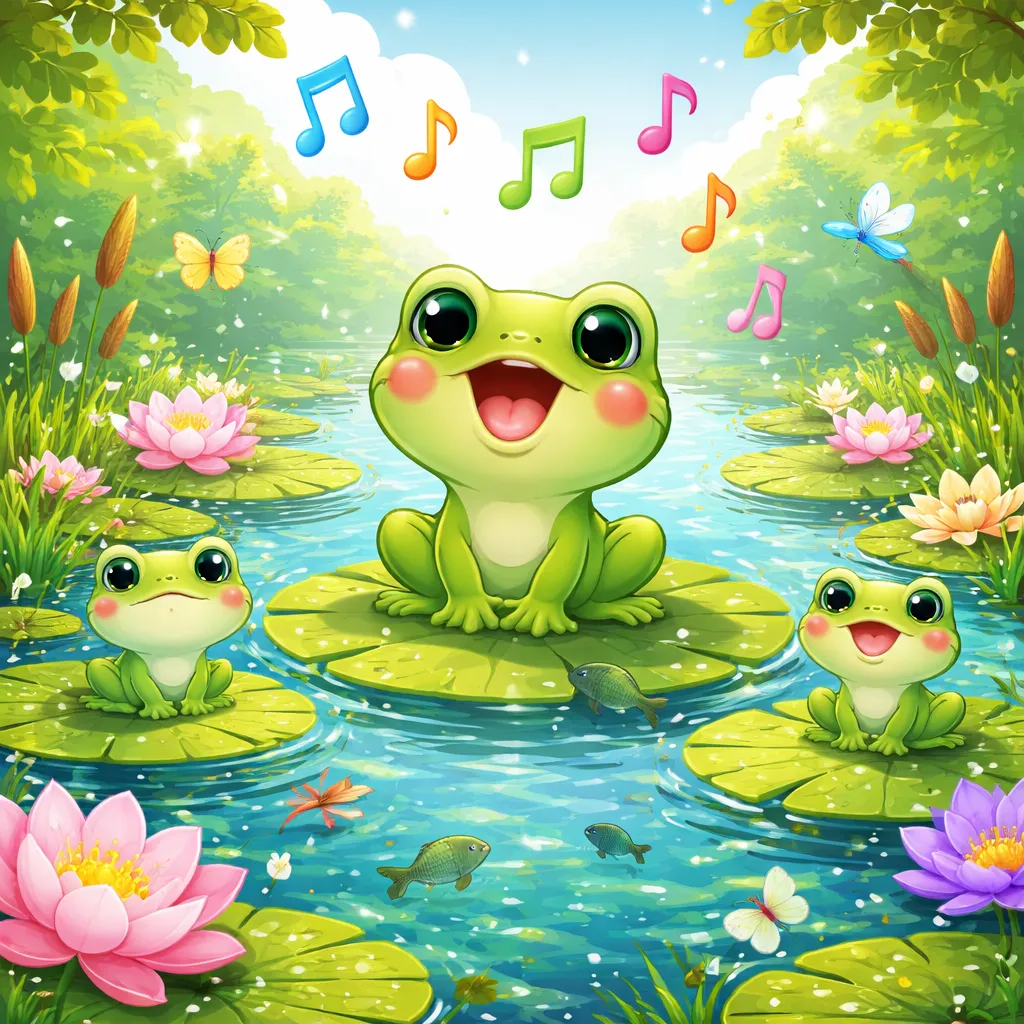

Have you ever been near a pond on a warm evening and heard a chorus of cheerful, croaking sounds? Ribbit, ribbit! Those are frogs, singing their songs to each other. In Korea, a country with beautiful mountains and clear streams, there is a playful song that imitates this funny sound. Let’s hop along with the Korean Song: The Little Frog (개구리).
About the Song
Here is a classic verse from this beloved song in Korean and English:
개구리 개구리 노래하자
(Gaegu-ri gaegu-ri noraehaja)
Little frog, little frog, let's sing
개굴개굴 개굴개굴
(Gaegul gaegul gaegul gaegul)
Ribbit ribbit, ribbit ribbit
우물가에 앉아서
(Umul-ga-e anjaseo)
Sitting by the well
즐거운 노래 부르자
(Jeulgeoun norae bureuja)
Let's sing a happy song
This song’s original name is “개구리” (Gaeguri), the Korean word for “frog.” It is a very popular traditional Korean children’s song. The song is a cheerful invitation from a little frog to sing together. The music is bouncy, simple, and full of the funny croaking sound “개굴개굴.” The Korean Song: The Little Frog (개구리) is a musical game, celebrating the unique sound of frogs and the joy of making music with friends, even if they are green and live in the water!
What the Song is About
The song is a happy chat with a frog. First, the singer calls out: “Little frog, little frog, let's sing.” The frog answers with its special sound: “Ribbit ribbit, ribbit ribbit.” We learn where the frog is: “Sitting by the well.” We can picture it on a cool, stone edge. Finally, the singer makes a plan: “Let's sing a happy song.” The frog’s croak and the child’s voice become a duet. The whole song is about friendship with nature, enjoying simple sounds, and creating a happy, shared moment.
Who Made It & Its Story
This song is a traditional Korean folk song, shared by generations of children. The original creator is unknown, as it comes from the people’s love for nature and playful sounds. Frogs are common in Korea’s rural and mountainous areas. The Korean Song: The Little Frog (개구리) is adored for three jumpy reasons. First, it is incredibly fun to sing because you get to make silly sounds. Second, it teaches children to listen to and appreciate the sounds of nature. Third, its melody is very simple, repetitive, and catchy, making it easy to learn and perfect for group singing.
When to Sing It
You can sing this song on a rainy day, hopping around and croaking like a frog. It’s perfect to chant while playing near water, like a bathtub or a sink, pretending it’s a pond. You could also sing it with friends, taking turns being the frog and the singer.
The Korean Song: The Little Frog (개구리) gets us listening and making sounds. But there’s more to learn from this amphibian friend. This song is a pond of knowledge. It teaches us new words, how language can imitate sounds, and a bit about Korean nature. Let’s take a leap into learning.
What Children Can Learn
Vocabulary
This song helps us learn words for animals, sounds, and places.
Amphibian: An animal that can live both in water and on land. Frogs and toads are amphibians.
Chorus: A group of singers or sounds made together. A chorus of frogs can be very loud.
Habitat: The natural home of an animal. A pond is a frog’s habitat.
Vocalize: To produce sound with the voice. Frogs vocalize to communicate.
Echo: A sound that is reflected and heard again. A frog’s croak might create an echo.
Well: A deep hole dug to reach water. In the song, the frog sits by a well.
Language Skills
This song is a perfect example of Onomatopoeia, which are words that imitate the sound they describe.
What Is It?: Think of onomatopoeia as “sound words.” They sound like the noise they are naming. “Buzz” sounds like a bee. “Bang” sounds like a drum.
Finding the Secret: Listen to the word. Does it sound like a noise you hear in real life? If yes, it might be onomatopoeia.
Using It:
◦   In the song, “개굴개굴” (gaegul gaegul) is the Korean onomatopoeia for a frog’s croak, just like “ribbit” in English.

◦   Other examples: “Splash” for water, “meow” for a cat, “boom” for thunder.
Sounds & Rhythm Fun
Listen to the croaking rhythm! The Korean Song: The Little Frog (개구리) has a bouncy, jumpy beat. The “개굴개굴” part is repeated and fun to say, mimicking the frog’s call. This simple, repetitive rhythm makes the song easy to remember and turns singing into a playful game. You can use this same bouncy, repetitive rhythm to make up a song using other sound words, like “drip drop” for rain or “tick tock” for a clock.
Culture & Big Ideas
This song connects to Korea’s appreciation for nature. Frogs are often seen in Korean folk tales and are sometimes considered lucky. A time when people enjoy the outdoors is during the Dano festival (spring festival), which celebrates the season when nature is full of life. The Korean Song: The Little Frog (개구리) teaches three simple ideas. First, Nature’s Music: The sounds of animals are a form of natural music that we can enjoy and even join. Second, Communication: Animals “talk” to each other using sounds, just like we do with words. Third, Shared Joy: Happiness grows when shared, even if you’re just singing a silly song with a make-believe frog.
Values & Imagination
Imagine you are the little frog by the well. What do you see in the water? What are you singing about? This song teaches you to be a good listener and to find joy in simple, funny moments. It encourages you to be curious about the animals around you. A simple idea: Sit very quietly for one minute and listen. How many different sounds can you hear? A car, a bird, the wind? You are discovering the world’s song.
Your Core Takeaways
The Korean Song: The Little Frog (개구리) is a jumpy, joyful lesson in nature, sound, and fun. You learned words like “amphibian,” “habitat,” and “onomatopoeia.” You discovered how words can imitate sounds. You moved to the song’s bouncy, croaking rhythm. You also connected the frog to Korean appreciation for nature. Most importantly, the song teaches that nature is full of music, that making silly sounds is fun, and that sharing a song—even with a frog—makes everyone happy.
Your Practice Missions
- Be a “Sound Detective.” Go on a short walk or listen from a window. Write down or remember three sounds you hear. Then, try to make up an onomatopoeic word for each sound (e.g., rustle for leaves, beep for a car). Share your sound words with someone.
- Host a “Pond Concert.” Gather a few family members or toys. Choose one person to be the conductor. The conductor points, and everyone makes a “개굴개굴” sound. Try making the sound fast, slow, loud, and soft. This playful game practices listening and following rhythm, just like the frogs in the chorus.














