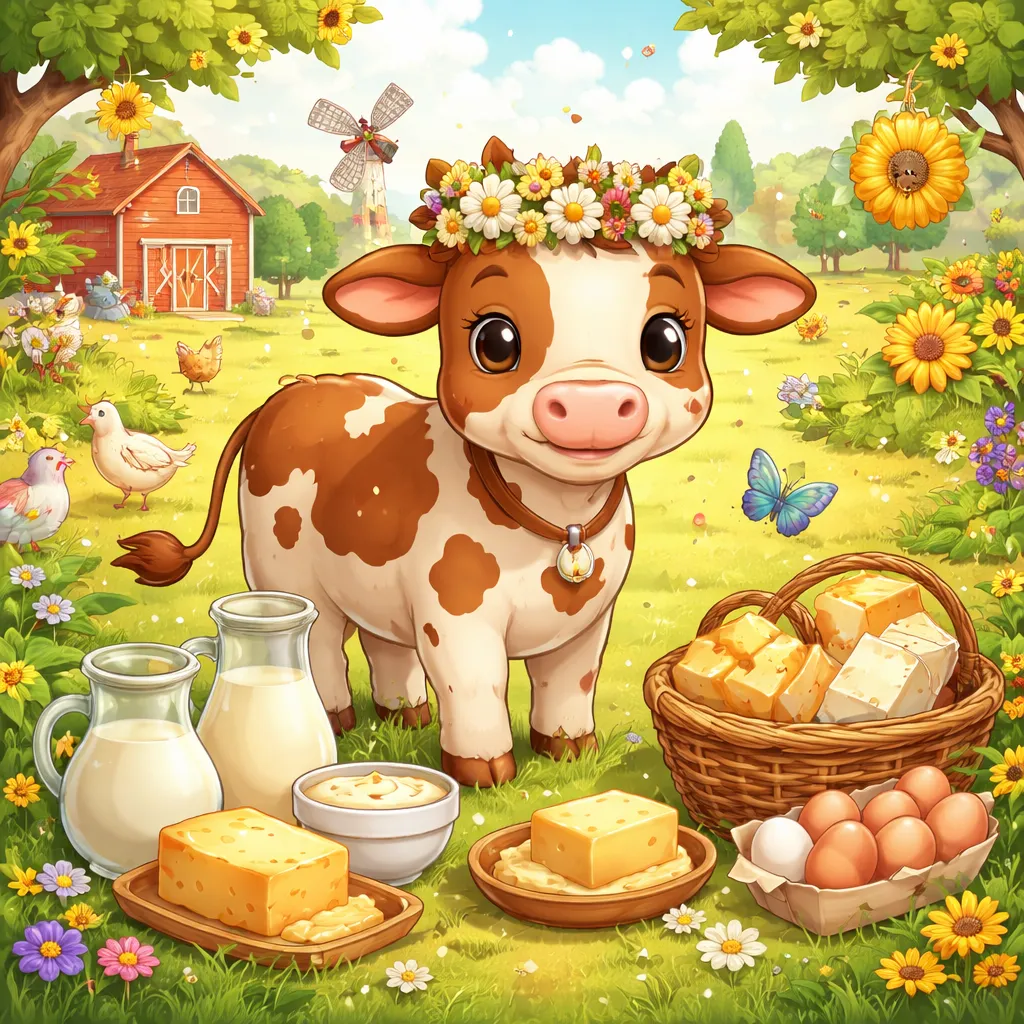

Have you ever poured cold, white milk on your cereal or eaten a delicious piece of cheese? These good things often start with a friendly farm animal. In Germany, there is a simple, happy song all about a little cow and the wonderful gift she gives every day. It is a song of thanks and daily routine. Let’s say thank you and learn the gentle song “The Little Cow (Die kleine Kuh).”
About the Song
Here are the warm, repetitive lyrics of a beloved traditional German children’s song:
Die kleine Kuh, die kleine Kuh,
die gibt uns Milch, so weiß und gut.
Die kleine Kuh, die kleine Kuh,
die gibt uns Milch, und das ist gut.
Aus Milch macht man Butter,
aus Milch macht man Käse.
Die kleine Kuh, die kleine Kuh,
die gibt uns Milch, und das ist gut.
English Translation:
The little cow, the little cow,
she gives us milk, so white and good.
The little cow, the little cow,
she gives us milk, and that is good.
From milk you make butter,
from milk you make cheese.
The little cow, the little cow,
she gives us milk, and that is good.
This is a classic German-language folk and farm song for children. The song is a celebration of the cow’s gift. “The little cow, the little cow, she gives us milk, so white and good,” it sings warmly. The song repeats this thankful line, letting the goodness of the gift sink in. “And that is good,” it reminds us. Then, the song teaches us what comes from this gift. “From milk you make butter, from milk you make cheese.” It shows the simple journey from farm to table. Finally, it thanks the cow again. The song is about gratitude, learning where food comes from, and the simple, good cycle of nature.
What the Song is About
The song is a thankful look at a cow’s daily gift. Imagine a peaceful farm in the morning. A gentle brown and white cow stands in her stall. “The little cow, the little cow, she gives us milk, so white and good.” A farmer gently milks the cow, and warm, white milk fills a shiny pail.
The milk is fresh and perfect. “The little cow, the little cow, she gives us milk, and that is good.” This milk is the start of many delicious things. “From milk you make butter, from milk you make cheese.” In a kitchen, someone shakes cream to make golden butter. In another place, milk is left to become yummy cheese. The song reminds us that one kind animal gives us the start for many meals. “And that is good.” The song is about being grateful for the animals that help feed us.
When to Sing It
This song is perfect for thankful, everyday moments. You can sing it happily at breakfast or snack time when you enjoy milk, butter on bread, or a piece of cheese. You can chant it while playing with farm animal toys, pretending to “give” milk to your toys. You can also sing it as a gentle “thank you” song after visiting a farm or reading a book about farm life.
What Children Can Learn
This grateful, simple song is a wonderful teacher about farm animals, food sources, and the verb “to give” in German.
Vocabulary
The song teaches us clear words for animals, food, actions, and descriptions in German. “The” (Die). “Little” (kleine). “Cow” (Kuh). “She” / “it” (die / sie). “Gives” (gibt). “Us” (uns). “Milk” (Milch). “So” (so). “White” (weiß). “And” (und). “Good” (gut). “That” (das). “Is” (ist). “From” / out of (Aus). “Makes” / one makes (macht man). “Butter” (Butter). “Cheese” (Käse).
Let’s use these words! You can talk about gifts: “Mama gibt mir ein Buch.” (Mama gives me a book.) You can describe food: “Die Milch ist kalt.” (The milk is cold.) New word: Bauernhof. This is the German word for “farm,” the home of “die kleine Kuh.”
Language Skills
This song is excellent for learning about giving and receiving, using the verb “geben” (to give). The key sentence pattern is “Die kleine Kuh gibt uns Milch.” (The little cow gives us milk.) It also introduces the useful phrase “Aus … macht man…” (From … you make …).
Concept Definition: The verb “geben” means to give. It tells us that someone is handing something to someone else. In the song, the cow gives milk to us. “Geben” is a very important verb for sharing and receiving.
Features and Types: “Geben” is an irregular verb. Its form changes with the subject. For “she/it” (die Kuh), we use “gibt”. For “I,” we use “gebe.” For “you,” we use “gibst.” For “we/they,” we use “geben.” The song uses “gibt” because the cow (she) is doing the giving. The word “uns” means “to us,” showing who receives the gift.
How to Spot Them: Here is a simple “gift check” trick. Ask: “Who is giving what to whom?” The word for the action of giving is “geben” or one of its forms like “gibt.” In the song: Who gives? The cow. What does she give? Milk. To whom? To us (“uns”). The word “gibt” is the key action.
How to Use Them: A great way to talk about sharing is the “Giving Formula”. The pattern is: “[Giver] + gibt + [Receiver] + [Thing given].”
Example from the song: “Die Kuh gibt uns Milch.” (The cow gives us milk.)
Example you can make: “Der Lehrer gibt dem Kind ein Blatt.” (The teacher gives the child a paper.) “Ich gebe dir das Spielzeug.” (I give you the toy.)
Sounds & Rhythm Fun
Listen to the steady, comforting rhythm of the melody. The song often has a simple, swaying tune that feels calm and thankful. The beautiful repetition of the line “Die kleine Kuh” and the phrase “die gibt uns Milch” makes the song very easy to learn and sing together. The words “gut” (good) and “Butter” (butter) have a similar “u” sound, and the song’s rhythm is as steady and reliable as the cow’s daily gift.
The rhythm is not too fast, perfect for gentle rocking or pretend milking motions. The middle part, “Aus Milch macht man Butter, aus Milch macht man Käse,” has a lovely, listing quality that teaches like a simple rhyme. This musical pattern is perfect for creating your own “giving” song. You can write your own “Der Apfelbaum” (The Apple Tree) song! Try: “Der Apfelbaum, der Apfelbaum, der gibt uns Äpfel, rot und gut. Der Apfelbaum, der Apfelbaum, der gibt uns Äpfel, und das ist gut. Aus Äpfeln macht man Saft, aus Äpfeln macht man Mus. Der Apfelbaum, der Apfelbaum, der gibt uns Äpfel, und das ist gut.” (The apple tree… gives us apples, red and good… from apples you make juice, from apples you make sauce…)
Culture & Big Ideas
“Die kleine Kuh” connects deeply to German agricultural traditions, regional food culture, and the value of knowing where food comes from (“Herkunft der Lebensmittel”). Germany has many rural areas with dairy farms, and fresh milk, butter (“Butter”), and a huge variety of cheeses (“Käse”) are important parts of daily meals. The song reflects a straightforward appreciation for the source of everyday foods, a concept often taught early in German kindergartens and schools.
The song conveys three fundamental, nourishing ideas. First, it fosters gratitude and connection to the natural world, directly linking the animal to the food on the child’s table. Second, it teaches basic food origins and transformation, showing a simple chain (cow -> milk -> butter/cheese) in an easy-to-understand way. Third, it celebrates the value of routine, dependable gifts from nature, and the community (“uns” – us) that benefits from them.
Values & Imagination
Imagine you are on a sunny farm. You see a gentle “kleine Kuh” in the meadow. In the early morning, the farmer comes. “The little cow, the little cow, she gives us milk, so white and good,” you think. You watch the fresh milk flow. It is a gift. Later, in a bright kitchen, someone takes the milk. “From milk you make butter, from milk you make cheese.” You see yellow butter forming and smell the cheese as it ages. All of this starts with the cow’s gift. “And that is good.” How does the cool milk taste? How does the creamy butter feel on bread? Draw the little cow’s gift journey. Draw the cow in the middle. Draw an arrow to a bottle of milk. From the milk, draw two more arrows: one to a pat of butter, one to a piece of cheese. Write the words “gibt uns Milch” and “Aus Milch macht man…” on the arrows. This shows the song’s story of giving and making.
The song encourages us to think about where our food comes from, to feel thankful for the animals and farmers, and to appreciate simple, good things. A wonderful activity is the “Was gibt es?” (What does it give?) game. Think of things in nature that give us something. Say: “Der Apfelbaum gibt uns Äpfel.” (The apple tree gives us apples.) “Die Biene gibt uns Honig.” (The bee gives us honey.) This connects you to the song’s spirit of gratitude for nature’s gifts.
So, from the white milk to the yummy cheese, this song is a lesson in gratitude. It is a vocabulary lesson in farm animals, dairy foods, and the act of giving. It is a language lesson in using “gibt” (gives) and the “aus … macht man” (from … you make) pattern. It is a music lesson in a steady, thankful, repetitive melody. “The Little Cow (Die kleine Kuh)” teaches us to say thank you, to understand simple beginnings, and to enjoy the good things we are given.
Your Core Takeaways
You are now an expert on the song “The Little Cow (Die kleine Kuh).” You know it is a thankful German song about a cow giving us milk, which becomes butter and cheese. You’ve learned German words like “Kuh,” “Milch,” “gibt,” “uns,” “Butter,” and “Käse,” and you’ve practiced using the verb “gibt” (gives) to talk about sharing and the pattern “Aus … macht man…” to explain how something is made. You’ve felt its steady, grateful rhythm and created your own giving verse. You’ve also discovered the song’s message about gratitude, learning where food comes from, and appreciating simple, good gifts.
Your Practice Missions
First, play the “Was gibt…?” (What gives…?) game. Look at your breakfast or snack. See milk, butter, or cheese. Point to it and say the German sentence: “Die kleine Kuh gibt uns Milch.” (The little cow gives us milk.) Then, thank the cow in your mind or out loud: “Danke, kleine Kuh!” (Thank you, little cow!). This mission makes you mindful of the song’s main idea of gratitude.
Second, be a “Dankbarkeit sagen” (Say Thank You) detective. Find one more thing that nature or an animal gives us. It could be “Der Himmel gibt uns Regen.” (The sky gives us rain.) or “Die Henne gibt uns Eier.” (The hen gives us eggs.). Say your sentence out loud using the “gibt” formula. This mission lets you use the song’s most important language skill to explore and be thankful for many gifts.