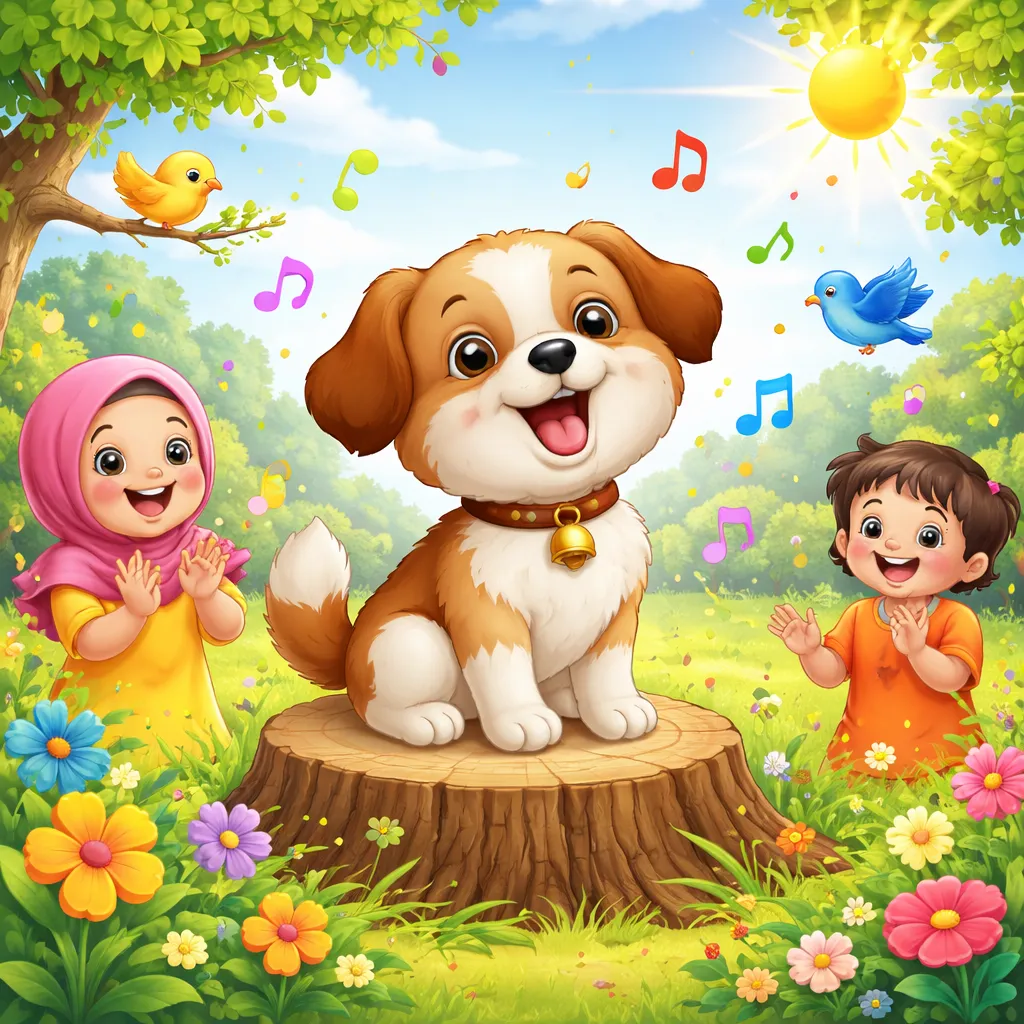

Do you know a friendly little dog? Maybe it lives next door or in your home. Dogs are happy friends. They wag their tails, bark a cheerful “woof!”, and love to play. In Indonesia, dogs are common pets and friends, and there is a playful song about a little dog that wants to say hello. It is a song about cheerful greetings. Let’s listen to “The Little Dog (Anjing Kecil).”
About the Song
Here are the lively and friendly lyrics of a popular traditional Indonesian children’s song about a little dog:
Anjing kecil, anjing kecil,
Warna coklat, ekor panjang.
Melihat aku pulang,
Ekornya bergoyang.
Guk-guk, guk-guk!
Anjing kecil, apa katamu?
Guk-guk, guk-guk!
Aku menyapa, “Halo!”
Mari, anjing kecil, masuklah!
Ayo kita bermain.
Kamu teman yang setia,
Selalu gembira.
English Translation:
Little dog, little dog,
Brown color, long tail.
Seeing me come home,
Its tail is wagging.
Woof-woof, woof-woof!
Little dog, what do you say?
Woof-woof, woof-woof!
I am greeting, “Hello!”
Come, little dog, come in!
Let’s play.
You are a loyal friend,
Always joyful.
This is a cheerful and welcoming Indonesian folk song for children. The song describes a happy reunion with a pet dog. First, we see the dog. It is small, brown, and has a long tail. It sees its friend coming home and wags its tail. Then, the dog barks! We ask it, “What are you saying?” The dog’s friendly bark is its way of saying “Hello!” Finally, we invite the dog inside to play, calling it a loyal and always happy friend. It is a song about friendship, understanding pets, and daily greetings.
What the Song is About
The song is about the happy moment you come home to a furry friend. You walk towards your house. You see a little dog. It is an “anjing kecil.” It is brown (“warna coklat”) and has a “ekor panjang” (long tail). The dog sees you! “Melihat aku pulang.” It is so happy you are home. Its tail wags back and forth fast. “Ekor nya bergoyang.”
Then the dog makes a sound. “Guk-guk, guk-guk!” That is the Indonesian word for “woof-woof!” You smile and ask, “Anjing kecil, apa katamu?” (Little dog, what are you saying?). The dog barks again, “Guk-guk, guk-guk!” as if to answer. The song tells us the bark is a greeting. The dog is “menyapa,” saying “Halo!” (Hello!).
You are so happy to see your friend. You say, “Mari, anjing kecil, masuklah!” (Come, little dog, come in!). You want to play. “Ayo kita bermain.” (Let’s play.). You think about your dog. It is a “teman yang setia” (loyal friend) and always “selalu gembira” (always joyful). The song celebrates this happy friendship.
When to Sing It
This song is perfect for cheerful, welcoming moments. You can sing it happily when you come home from school and greet your own pet dog or a friendly neighbor’s dog, wagging an imaginary tail. You can sing it during playtime with a stuffed animal dog, pretending to have a barking conversation and then inviting it to play. You can also sing it as a friendly “hello” song with friends, taking turns being the person and the happy, barking dog.
What Children Can Learn
This friendly, interactive song is a wonderful teacher of descriptive words, question words, and common verbs for daily life and pet care in Indonesian.
Vocabulary
The song teaches us useful Indonesian words for describing animals, actions, and friendship. “Dog” (Anjing). “Small/little” (kecil). “Color” (warna). “Brown” (coklat). “Tail” (ekor). “Long” (panjang). “To see” (melihat). “I/me” (aku). “To go home/come home” (pulang). “Its” (-nya). “Is wagging” (bergoyang). “Woof” (Guk-guk!). “What” (apa). “Your word/saying” (katamu). “Am greeting” (menyapa). “Hello” (Halo!). “Come” (Mari). “To enter/come in” (masuk). “Let’s” (Ayo). “We” (kita). “To play” (bermain). “You” (kamu). “Friend” (teman). “Loyal” (setia). “Always” (selalu). “Joyful/happy” (gembira).
Let’s use these words! You can describe a pet: “Anjing saya warna coklat.” (My dog is brown.) “Ekor kucing pendek.” (The cat’s tail is short.) New word: Tulang. This means “bone.” You can say, “Anjing suka tulang.” (Dogs like bones.)
Language Skills
This song is excellent for learning how to describe how something looks and for asking about what someone (or a dog!) is saying. It uses descriptive phrases and the important question word “Apa?” (What?).
Concept Definition: We are learning about describing things by telling their color and shape, like “brown” and “long tail.” We also learn to ask about words or sounds using “Apa?” which means “What?”. “Apa katamu?” literally means “What your word?” or “What are you saying?”
Features and Types: Descriptions often follow the thing they describe. The pattern is: “[Thing] + [description].” In the song, it’s “Anjing kecil, warna coklat, ekor panjang.” (Little dog, brown color, long tail.). The question “Apa?” is a very useful word. It can ask about things (“Apa ini?” – What is this?) or, as in the song, about speech/sound (“Apa katamu?” – What are you saying?).
How to Spot Them: Here is the “Description Detective” trick. Look for words that tell you about color (“coklat”), size (“kecil,” “panjang”), or action (“bergoyang”). They help you picture the dog. For the question, listen for the word “Apa” at the start. Ask yourself: “Is this question asking for information or the meaning of something?” If yes, it’s an “Apa?” question.
How to Use Them: A great way to describe a pet and ask about it is the “Describe and Ask” formula. The pattern is: “Describe: [Animal] [color], [body part] [size]. Ask: [Animal], apa katamu?”
Example from the song: “Anjing kecil, warna coklat, ekor panjang… Anjing kecil, apa katamu?”
Example you can make: “Kucing putih, ekor pendek. Kucing, apa katamu?” (White cat, short tail. Cat, what do you say? [Answer: “Meong!”]).
Sounds & Rhythm Fun
Listen to the bouncy, cheerful melody of the song. The tune for “Anjing Kecil” is often lively and has a rhythm that feels like a happy dog hopping or a tail wagging. The part that sounds like the dog barking, “Guk-guk, guk-guk!”, is repeated and fun to sing. It is the Indonesian onomatopoeia for a dog’s bark!
The words have a fun, bouncy sound. The “k” sound in “kecil,” “coklat,” and “katamu” is crisp. The repeated “guk-guk” is playful and easy to remember, just like a real bark. The rhythm is steady and march-like, perfect for stomping feet like happy paws. This energetic rhythm is perfect for creating your own animal greeting song. Try a duck song: “Bebek kecil, warna kuning, kaki berselaput… Kwek-kwek, kwek-kwek!…” (Little duck, yellow color, webbed feet… Quack-quack, quack-quack!…).
Culture & Big Ideas
“Anjing Kecil” reflects the common role of dogs as loyal companions and watchful friends in many Indonesian households, especially in more rural or suburban areas. The scene of a dog joyfully greeting someone coming home is a familiar and heartwarming part of daily life, and the song captures this simple moment of return and welcome.
The song conveys three warm and important ideas. First, it encourages careful observation of animals, noting their physical features (color, tail) and their body language (wagging tail), which is the first step in understanding and caring for them. Second, it playfully explores communication between humans and animals, suggesting that we can “ask” what an animal’s sounds mean and interpret them as friendly greetings, building empathy and connection. Third, it celebrates the pure, loyal, and joyful friendship offered by pets, highlighting qualities like loyalty (“setia”) and constant happiness (“selalu gembira”) that make them special friends.
Values & Imagination
Imagine you are the little dog. You are a small, brown dog with a long, fluffy tail. You are sitting by the door. You hear familiar footsteps. “Melihat aku pulang,” you see your best friend coming home! You are so excited. Your tail starts to wag fast by itself. “Ekor nya bergoyang!” You can’t help it.
You run to the gate. “Guk-guk, guk-guk!” you bark happily. Your friend smiles and asks, “Anjing kecil, apa katamu?” You bark again, “Guk-guk!” You are trying to say, “Hello! I missed you! I’m so happy you’re home!” Then, you hear the best words: “Mari, anjing kecil, masuklah! Ayo kita bermain.” The door opens, and you run inside to play. How does it feel to be such a happy and loyal friend? Draw the happy scene. Draw a house and a path. Draw yourself coming home. Draw a little brown dog with a long tail near the door, its tail as a blur because it’s wagging so fast. Draw a speech bubble that says “Guk-guk!” and “Halo!”. This shows the song’s joyful greeting.
The song encourages us to observe our pets with love, to greet them warmly, to see their barks and wags as a language of friendship, and to be a loyal, playful friend in return. A wonderful activity is the “Percakapan dengan Anjing” (Conversation with the Dog) game. With a friend, one person is the human coming home, and the other is the dog. The human describes the dog (“Anjing kecil, warna coklat…”) and asks, “Apa katamu?” The “dog” answers with a happy “Guk-guk!” and a wagging arm. Then switch roles! This connects the song’s dialogue to imaginative play.
So, from describing the happy dog to understanding its friendly bark, this song is a celebration of a pet’s welcome. It is a vocabulary lesson in describing animals and greetings. It is a language lesson in using descriptive phrases and asking “Apa?” (What?). It is a music lesson in a bouncy, cheerful tune with a fun barking sound. “The Little Dog (Anjing Kecil)” teaches us about observation, joyful greetings, and loyal friendship.
Your Core Takeaways
You are now an expert on the Indonesian song “The Little Dog (Anjing Kecil).” You know it is a happy song about a brown dog with a long tail that wags when it sees its friend come home, barks a friendly “Guk-guk!”, and is invited inside to play as a loyal friend. You’ve learned Indonesian words like “anjing,” “warna,” “coklat,” “ekor,” “panjang,” “guk-guk,” “apa,” and “teman,” and you’ve practiced describing animals and asking “Apa katamu?” (What are you saying?). You’ve felt its cheerful, bouncy rhythm and learned the Indonesian dog sound “guk-guk.” You’ve also discovered the song’s message about observing pets, understanding their greetings, and valuing loyal friendship.
Your Practice Missions
First, play the “Deskripsikan Teman” (Describe a Friend) game. Pick a stuffed animal or a picture of an animal. Describe it in Indonesian like the song does. Say, “[Animal] [color], [body part] [size].” For example, “Kelinci putih, telinga panjang.” (White rabbit, long ears.) Then ask it, “[Animal], apa katamu?” and make its sound! This mission helps you practice descriptive phrases and the “Apa?” question.
Second, make a “Kartu Sapa Anjing Kecil” (Little Dog Greeting Card). Fold a piece of paper to make a card. On the front, draw the happy brown dog with a wagging tail. Inside, write a friendly message from the dog. You can write “Halo! Aku anjing kecil. Guk-guk! Aku senang bertemu dengan kamu.” (Hello! I am a little dog. Woof-woof! I am happy to meet you.) Give your card to a friend or family member as a friendly greeting. This mission lets you use the song’s greeting words to make someone happy.