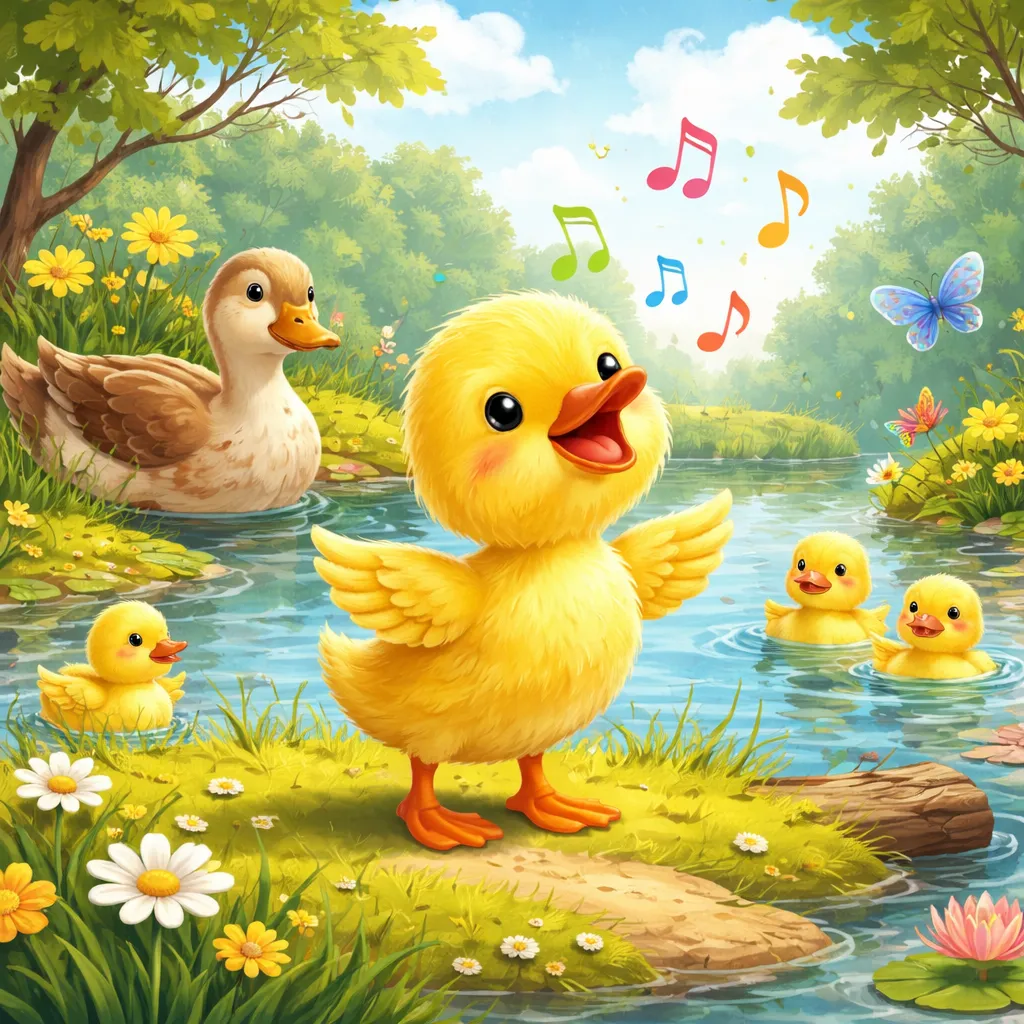

Have you ever visited a farm or a pond and seen a family of ducks? The little ones, called ducklings, waddle and swim and make cute sounds. In Indonesia, the word for duck is “bebek,” and there is a cheerful, playful song about a little duck. It is a song about its family, its sounds, and its fun day. Let’s waddle along with “The Little Duck (Bebek Kecil).”
About the Song
Here are the happy and descriptive lyrics of a popular traditional Indonesian children’s song about a little duck:
Bebek kecil, bebek kecil,
Berenang di air.
Jalannya lucu, satu-dua,
Di atas lumpur kotor.
Katak katak, wek wek wek,
Punya keluarga besar.
Bapak bebek, ibu bebek,
Semua sayang padamu.
English Translation:
Little duck, little duck,
Swimming in the water.
Its walk is funny, one-two,
On the dirty mud.
Quack quack, wek wek wek,
Has a big family.
Father duck, mother duck,
All love you.
This is a classic and joyful Indonesian folk song for children. The song is a celebration of a duck’s happy life. The singer talks to the “bebek kecil.” First, we see it swimming, “berenang di air.” Then, we see it walking on land. Its walk is funny and cute, “jalannya lucu,” as it goes “satu-dua” (one-two) on the “lumpur kotor,” the dirty mud. Next, we hear its sound, but in Indonesian, a duck says “wek wek wek” instead of “quack quack”! The song tells us the duck has a “keluarga besar,” a big family, with a “bapak bebek” and an “ibu bebek,” and they all love the little duck. It is a song about family love and simple joys.
What the Song is About
The song shows us a day in the life of a happy little duck. You are at the edge of a pond. You see a “bebek kecil.” It is “berenang di air,” swimming happily in the water. It dives and splashes.
Then, the duck gets out of the water. It walks on the ground. “Jalannya lucu, satu-dua.” Its walk is funny, a little waddle, one step, two steps. It walks “di atas lumpur kotor,” on top of the squishy, dirty mud near the water. It doesn’t mind the mud at all!
Now you hear it. The duck opens its beak. “Katak katak, wek wek wek!” It makes its funny sound. The song tells you this duck is not alone. It has a “keluarga besar,” a big family. There is a “bapak bebek” and an “ibu bebek.” And all of them, “semua sayang padamu,” all of them love the little duck. The song paints a picture of a playful, loved little creature.
When to Sing It
This song is perfect for playful, active moments. You can sing it while splashing in the bathtub, pretending to be a duck swimming. You can sing it during a walk to a park with a pond, waddling like a duck on the path. You can also sing it as a family song, pointing to different family members when you sing “bapak bebek, ibu bebek.”
What Children Can Learn
This fun, family-focused song is a great teacher for learning about animals, their actions, and talking about family members in Indonesian.
Vocabulary
The song teaches us useful Indonesian words for animals, actions, places, and family. “Duck” (Bebek). “Small/little” (kecil). “To swim” (berenang). “In” (di). “Water” (air). “Walk/Gait” (jalan). “Funny/cute” (lucu). “One” (satu). “Two” (dua). “On top of” (di atas). “Mud” (lumpur). “Dirty” (kotor). “Quack (sound)” (katak). “Duck sound” (wek wek wek). “To have” (punya). “Family” (keluarga). “Big” (besar). “Father” (bapak). “Mother” (ibu). “All” (semua). “To love” (sayang). “To you” (padamu).
Let’s use these words! You can describe other animals: “Anjing jalan cepat.” (The dog walks fast.) “Kucing tidur di atas kursi.” (The cat sleeps on the chair.) New word: Saudara. This means “sibling.” You can say, “Bebek kecil punya saudara.” (The little duck has siblings.)
Language Skills
This song is excellent for learning to use the suffix “-nya” to mean “its” or “his/her” and for using simple “to be” sentences with “adalah” (is/am/are) to describe something.
Concept Definition: We are learning about using the ending “-nya” to show something belongs to someone or something we are talking about, like “its walk” (“jalannya”). We are also learning to describe someone or something with the word “adalah” (is/am/are) in sentences like “Its walk is funny” (“Jalannya lucu”).
Features and Types: The suffix “-nya” is added to the end of a noun. The pattern is: “[Noun] + -nya.” In the song, it’s “jalan” (walk) becomes “jalannya” (its walk). The word “adalah” is often used to link a subject with a description, but in simple spoken Indonesian, it is sometimes left out! The pattern can be: “[Subject] + (adalah) + [Description].” In the song, it’s “Jalannya lucu” (Its walk is funny), where “adalah” is understood.
How to Spot Them: Here is the “Belonging Finder” trick. Look for a noun that ends with “-nya.” Ask yourself: “Does this word mean ‘his’, ‘her’, or ‘its’ [something]?” For descriptions, look for a sentence where a thing is directly followed by a describing word. Ask: “Is the first part telling me what and the second part telling me how it is?”
How to Use Them: A great way to describe an animal is the “Its and Is” formula. Belonging: “[Noun]-nya.” Description: “[Thing] + (adalah) + [Description].”
Example from the song: Belonging: “Jalannya lucu.” (Its walk is funny.) Description: “Keluarganya besar.” (Its family is big.)
Example you can make: “Bulumu halus.” (Its/Your feathers are soft.) “Rumahnya merah.” (His/Her/Its house is red.)
Sounds & Rhythm Fun
Listen to the playful, waddling melody of the song. The tune for “Bebek Kecil” is often bouncy and fun, with a rhythm that mimics the “satu-dua” waddle of a duck. The “wek wek wek” part is especially fun to sing and sounds just like a duck’s quack in Indonesian!
The words are very catchy. Repeating “bebek kecil” at the start is friendly. The phrase “jalannya lucu, satu-dua” has a bouncy rhythm perfect for walking with a waddle. The duck sound “katak katak, wek wek wek” is super fun to say and easy to remember. Words for family like “bapak” and “ibu” sound warm and familiar. This bouncy rhythm is perfect for creating your own farm animal song. Try a chick song: “Anak ayam, anak ayam, Berjalan satu-dua… Cicit cicit, cicit cicit… Punya keluarga besar…” (Little chick, little chick, Walking one-two… Peep peep, peep peep… Has a big family…).
Culture & Big Ideas
“Bebek Kecil” reflects the common sight of ducks in Indonesia, especially in rural and farm settings, and the importance of family (“keluarga”). Ducks are often kept in villages, and seeing them swim or waddle is a familiar, happy scene. The song highlights the close family unit, which is central to Indonesian culture.
The song conveys three warm and important ideas. First, it celebrates the simple, playful actions of animals, like swimming and a funny waddle (“jalannya lucu”), encouraging children to observe and enjoy the natural world with joy and humor. Second, it introduces the concept of animal sounds in a different language (“wek wek wek”), showing that different cultures hear and represent animal sounds in their own unique ways. Third, it strongly emphasizes family love and belonging, showing the little duck as part of a loving “keluarga besar” where “semua sayang padamu” (all love you), reinforcing the value of family bonds.
Values & Imagination
Imagine you are the little duck. You are a “bebek kecil.” Your favorite thing is to “berenang di air.” You love to splash and dive in the cool pond. When you get out, you walk on the mud. “Jalannya lucu, satu-dua.” You waddle in a funny way that makes everyone smile.
You are happy, so you call out. “Katak katak, wek wek wek!” You hear an answer. It’s your “bapak bebek” and your “ibu bebek.” You have a “keluarga besar,” a big family of ducks. They all waddle over to you. You know that “semua sayang padamu.” They all love you. How does it feel to be part of a big, loving family that is always there for you? Draw the duck’s happy day. Draw a pond (“air”). Draw a duck swimming. On the land, draw a duck walking on mud (“lumpur kotor”). Around it, draw a big “bapak bebek,” an “ibu bebek,” and other ducklings. Write “wek wek wek!” in a speech bubble. This shows the song’s story of fun and family.
The song encourages us to find joy in simple animal behaviors, to learn about different languages through fun sounds, and to appreciate the love and security of our own families. A wonderful activity is the “Suara Keluarga” (Family Sounds) game. With your family, pretend to be different animals. One person is the “bebek kecil” and says “wek wek wek.” Another is the “bapak bebek” and says a deep “wek wek.” Another is the “ibu bebek” and says a gentle “wek wek.” Walk around waddling and making your duck sounds together! This connects the song’s vocabulary to playful family interaction.
So, from the duck’s swim and waddle to its family’s love, this song is a lesson in joy and belonging. It is a vocabulary lesson in animals, actions, and family. It is a language lesson in using “-nya” for “its” and making simple descriptions. It is a music lesson in a bouncy, quacking tune. “The Little Duck (Bebek Kecil)” teaches us about playfulness, different animal sounds, and family love.
Your Core Takeaways
You are now an expert on the Indonesian song “The Little Duck (Bebek Kecil).” You know it is a happy song about a little duck that swims in water, walks with a funny waddle on dirty mud, says “wek wek wek,” and has a big family of father and mother ducks who all love it. You’ve learned Indonesian words like “bebek,” “berenang,” “air,” “jalan,” “lucu,” “lumpur,” “wek wek,” “keluarga,” “bapak,” and “ibu,” and you’ve practiced the “-nya” ending for “its” (like “jalannya”) and how to make simple descriptions. You’ve felt its bouncy, waddling rhythm. You’ve also discovered the song’s message about enjoying simple fun, learning animal sounds in a new language, and the importance of family love.
Your Practice Missions
First, play the “Aku Bebek Kecil” (I am a Little Duck) game. In your room or garden, act out the duck’s day. First, pretend to swim (“berenang”). Then, waddle like a duck and say “satu-dua” with each step. Finally, say “wek wek wek!” and give a big hug to your “bapak” or “ibu” (your own parent!). This mission helps you act out the song’s key actions and words.
Second, have a “Keluarga Hewan” (Animal Family) drawing. Draw your favorite animal and its family. It could be a cat family, a dog family, or a bird family. Label them in Indonesian: “bapak [animal]” (father…), “ibu [animal]” (mother…), and “[animal] kecil” (little…). Show your drawing and say, “Ini keluarga besar [animal].” (This is the big [animal] family.). This mission lets you use the song’s family words and the “-nya” concept in a creative way.