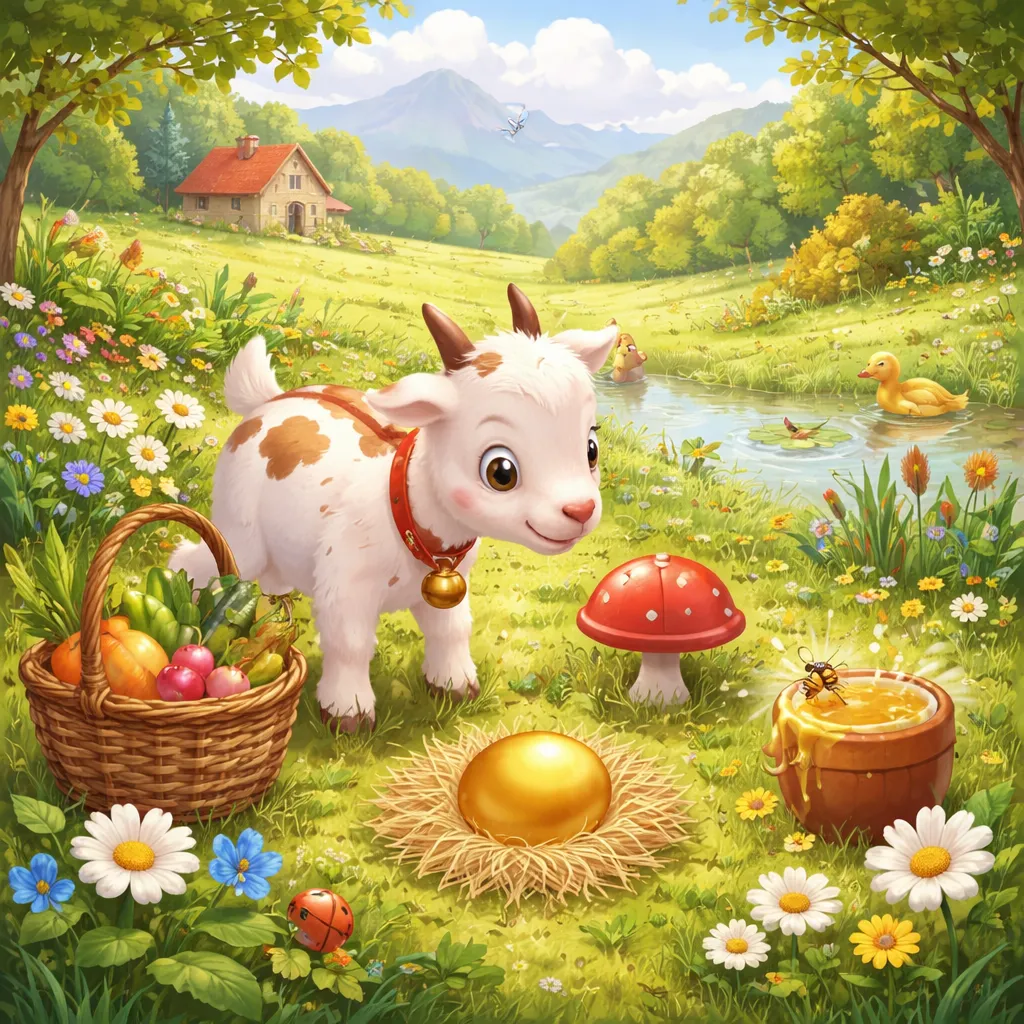

Have you ever climbed on a big rock or explored a new path in a park? Some animals are born explorers! In Germany, there is a curious and adventurous song all about a little goat who loves to wander. It is a song about discovering the world. Let’s put on our exploring shoes and learn the wandering song “The Little Goat (Die kleine Ziege).”
About the Song
Here are the wandering, playful lyrics of a beloved traditional German children’s song:
Die kleine Ziege, die kleine Ziege,
die geht ins Holz, ins Holz, ins Holz.
Die kleine Ziege, die kleine Ziege,
die geht allein, allein, allein.
Sie klettert auf den steilen Stein,
und frisst das kleine Blätt'relein.
Die kleine Ziege, die kleine Ziege,
die ist so munter, munter, munt.
English Translation:
The little goat, the little goat,
she goes into the woods, the woods, the woods.
The little goat, the little goat,
she goes all alone, alone, alone.
She climbs onto the steep stone,
and eats the little small leaf.
The little goat, the little goat,
she is so lively, lively, lively.
This is a charming and adventurous German-language song for children. The song tells a simple story of a goat’s independent walk. “The little goat, the little goat, she goes into the woods, the woods, the woods,” it begins, setting off on a journey. This goat is brave. “The little goat, the little goat, she goes all alone, alone, alone,” it continues, showing her independence. Her adventure has two fun parts. “She climbs onto the steep stone, and eats the little small leaf,” the song tells us. She explores and finds a snack. The song ends by describing her cheerful spirit. “The little goat, the little goat, she is so lively, lively, lively.” The song is a celebration of a small animal’s big adventure in nature.
What the Song is About
The song is a short adventure story of a brave little goat. Imagine the edge of a green forest. A little goat with clever eyes and small horns looks at the path. “The little goat, the little goat, she goes into the woods, the woods, the woods.” She bravely walks into the forest, leaving the familiar farm behind.
She is not with her friends or her mother. “The little goat, the little goat, she goes all alone, alone, alone.” She is on a solo adventure. In the woods, she finds a challenge. “She climbs onto the steep stone,” using her strong little hooves to scramble up a big, rocky hill. At the top, she finds her reward. “And eats the little small leaf,” enjoying a tasty green leaf from a bush. The song paints a picture of a goat who is curious, capable, and full of energy. “She is so lively, lively, lively.” The song is about the joy of exploring, the confidence of doing something alone, and the simple pleasures of nature.
Who Made It & Its Story
“Die kleine Ziege” is a traditional German folk song that fits into a rich tradition of nature and animal songs for children. Its specific creator, like many folk songs, is not known, as it has been sung for many years. The song reflects the common sight of goats in the German countryside, especially in mountainous regions like the Alps, where goats are known for their climbing skills. It connects to a cultural appreciation for walks in nature (“Wandern”) and the independence of exploring the natural world, even on a small scale.
This gentle adventure song is loved for three wonderful reasons. First, it is a perfect way to learn descriptive German verbs and nouns about movement and nature, like “geht” (goes), “klettert” (climbs), “Holz” (woods), and “Stein” (stone). Second, it uses beautiful, poetic repetition (“ins Holz, ins Holz, ins Holz”) and the lovely old-fashioned word “munter” (lively), creating a rhythmic and charming sound. Third, it portrays a positive message of gentle bravery, independence, and finding joy in small, natural discoveries, which resonates deeply with young children.
When to Sing It
This song is perfect for gentle adventures and outdoor exploration. You can sing it while taking a walk in a park or forest, pretending you are the little goat exploring the “woods.” You can chant it while climbing on playground equipment, imagining you are climbing the “steep stone.” You can also hum it as a quiet, happy song about feeling good and “lively” on a bright, energetic morning.
What Children Can Learn
This gentle, exploratory song is a wonderful teacher about nature, simple actions, and describing feelings in German.
Vocabulary
The song teaches us clear words for animals, places, actions, and feelings in German. “The” (Die). “Little” (kleine). “Goat” (Ziege). “She” (sie). “Goes” (geht). “Into the” (ins). “Woods” (Holz). “Alone” (allein). “Climbs” (klettert). “Onto the” (auf den). “Steep” (steilen). “Stone” (Stein). “And” (und). “Eats” (frisst). “The” (das). “Small” (kleine). “Leaf” (Blätt'relein – a sweet, old form for a tiny leaf). “Is” (ist). “So” (so). “Lively” (munter).
Let’s use these words! You can talk about going somewhere: “Ich gehe in den Park.” (I go into the park.) You can describe an animal: “Der Hund ist munter.” (The dog is lively.) New word: Abenteuer. This is the German word for “adventure,” just like the little goat’s trip into the woods.
Language Skills
This song is excellent for learning about describing where someone goes and what they are like. The key structures are “geht ins…” (goes into the…) and “ist so…” (is so…). It shows us how to talk about location and character.
Concept Definition: Words like “ins Holz” (into the woods) or “auf den Stein” (onto the stone) tell us location – where something is or where it is going. Words like “munter” (lively) or “klein” (little) tell us description – what something or someone is like. In the song, we learn where the goat goes and what she is like.
Features and Types: Location words often start with little words like “in” (into), “auf” (on/onto), “unter” (under). Description words often come after “ist” (is) or a similar word. In the song, we have location: “ins Holz” (into the woods) and “auf den Stein” (onto the stone). We have description: “so munter” (so lively) and “kleine Ziege” (little goat).
How to Spot Them: Here is a simple “where and how” trick. Ask two questions about the sentence. Question 1: “Wo?” or “Wohin?” This means “Where?” or “To where?”. The answer is often a location phrase, like “ins Holz.” Question 2: “Wie?” This means “How?” or “What is it like?”. The answer is often a description word, like “munter.”
How to Use Them: A great way to tell a mini-story is the “Go-Describe Formula”. The pattern is: “[Person/Animal] geht [Location]. [Person/Animal] ist [Description].”
Example from the song: “Die Ziege geht ins Holz. Die Ziege ist munter.”
Example you can make: “Das Kind geht in den Garten. Das Kind ist fröhlich.” (The child goes into the garden. The child is happy.)
Sounds & Rhythm Fun
Listen to the gentle, walking rhythm of the melody. The song has a steady, calm tune that sounds like the goat walking step by step. The beautiful repetitions “ins Holz, ins Holz, ins Holz” and “allein, allein, allein” sound like an echo in the forest and make the song easy to remember. The sweet, old word “Blätt’relein” for a tiny leaf and the lovely word “munter, munter, munt” are wonderful to say.
The rhythm is not fast or jumpy, but steady and calm, perfect for walking or gently swaying. The repeated line “Die kleine Ziege” starts each new part of her adventure. This musical pattern is perfect for creating your own gentle adventure song. You can write your own “Die kleine Ente” (The Little Duck) song! Try: “Die kleine Ente, die kleine Ente, die geht zum See, zum See, zum See. Die kleine Ente, die kleine Ente, die schwimmt allein, allein, allein…” (The little duck… goes to the lake… swims alone…)
Culture & Big Ideas
“Die kleine Ziege” connects to the German love for hiking (“Wandern”), exploring forests (“Wälder”), and a deep appreciation for the countryside and its animals. Goats are common in German rural and alpine areas, valued for their milk and cheese. The song reflects a child’s-eye view of the natural world as a place for small, safe adventures, mirroring the cultural importance of independent play and exploration in nature.
The song conveys three gentle, important ideas. First, it encourages a sense of gentle bravery and independence, showing that it is okay and even wonderful to explore on your own sometimes. Second, it fosters a connection with and observation of nature, noticing details like a “steep stone” or a “small leaf.” Third, it celebrates a cheerful, energetic spirit (“munter sein”) and the simple satisfaction of a small journey, finding happiness in a walk, a climb, and a little snack.
Values & Imagination
Imagine you are the curious “kleine Ziege.” You stand at the edge of the sunny farm, looking at the dark, green line of trees. “The little goat, the little goat, she goes into the woods, the woods, the woods,” you decide. You step onto the soft path. “The little goat, the little goat, she goes all alone, alone, alone.” You are not scared; you are excited. You see a big grey rock. “She climbs onto the steep stone,” you think, using your strong legs to hop up. At the top, you see a perfect, green leaf. “And eats the little small leaf.” It tastes fresh and good. You feel the sun on your back and the breeze in your fur. “She is so lively, lively, lively.” How does the moss feel under your feet? What sounds do you hear in the woods? Draw the little goat’s adventure map. Draw a path from a farmhouse to a forest. Draw the goat climbing a big stone. Draw a little leaf with a bite taken out. At the end, draw a happy goat with a smile. This shows the song’s journey of exploration.
The song encourages us to be brave in small ways, to enjoy our own company, and to find wonder in simple things like a walk, a climb, or a single leaf. A wonderful activity is the “Muntermacher-Spaziergang” (Lively-Maker Walk). Go for a short walk, outside if you can, or just around your home. Be like the little goat. Notice one thing you can climb onto (like a step or a couch cushion). Notice one small, interesting thing you can “find” (like a pretty pebble or a specific toy). After, say “Ich bin munter!” (I am lively!). This connects you to the song’s spirit of gentle exploration and feeling good.
So, from the deep woods to the tasty leaf, this song is a small adventure. It is a vocabulary lesson in nature, movement, and feelings. It is a language lesson in saying where you go (“geht ins…”) and how you feel (“ist so…”). It is a music lesson in a steady, walking melody with beautiful echoes. “The Little Goat (Die kleine Ziege)” teaches us to be curious explorers, to enjoy little journeys, and to feel lively and happy in our own skin.
Your Core Takeaways
You are now an expert on the song “The Little Goat (Die kleine Ziege).” You know it is a gentle German adventure song about a goat who explores the woods alone, climbs a stone, eats a leaf, and feels lively. You’ve learned German words like “Ziege,” “Holz,” “geht,” “allein,” “klettert,” “Stein,” and “munter,” and you’ve practiced talking about where someone goes (“geht ins Holz”) and how they are (“ist so munter”). You’ve felt its steady, wandering rhythm and created your own exploration verse. You’ve also discovered the song’s message about gentle bravery, enjoying nature, and feeling cheerful and energetic.
Your Practice Missions
First, play the “Wo gehst du?” (Where do you go?) game. Pretend to be the little goat. Walk around the room. When someone asks “Wo gehst du, kleine Ziege?” (Where are you going, little goat?), point and say in German: “Ich gehe ins Holz!” (I’m going into the woods!) or “Ich gehe zum Stein!” (I’m going to the stone!). This mission makes you use the song’s location words in a fun way.
Second, have a “Muntermacher” (Lively-Maker) moment. Do one small thing that makes you feel good and energetic, like stretching high like a goat on a stone, jumping three times, or taking five big breaths. After, describe yourself like the goat: say “Ich bin munter!” (I am lively!) with a smile. This mission lets you connect the song’s feeling to your own experience.