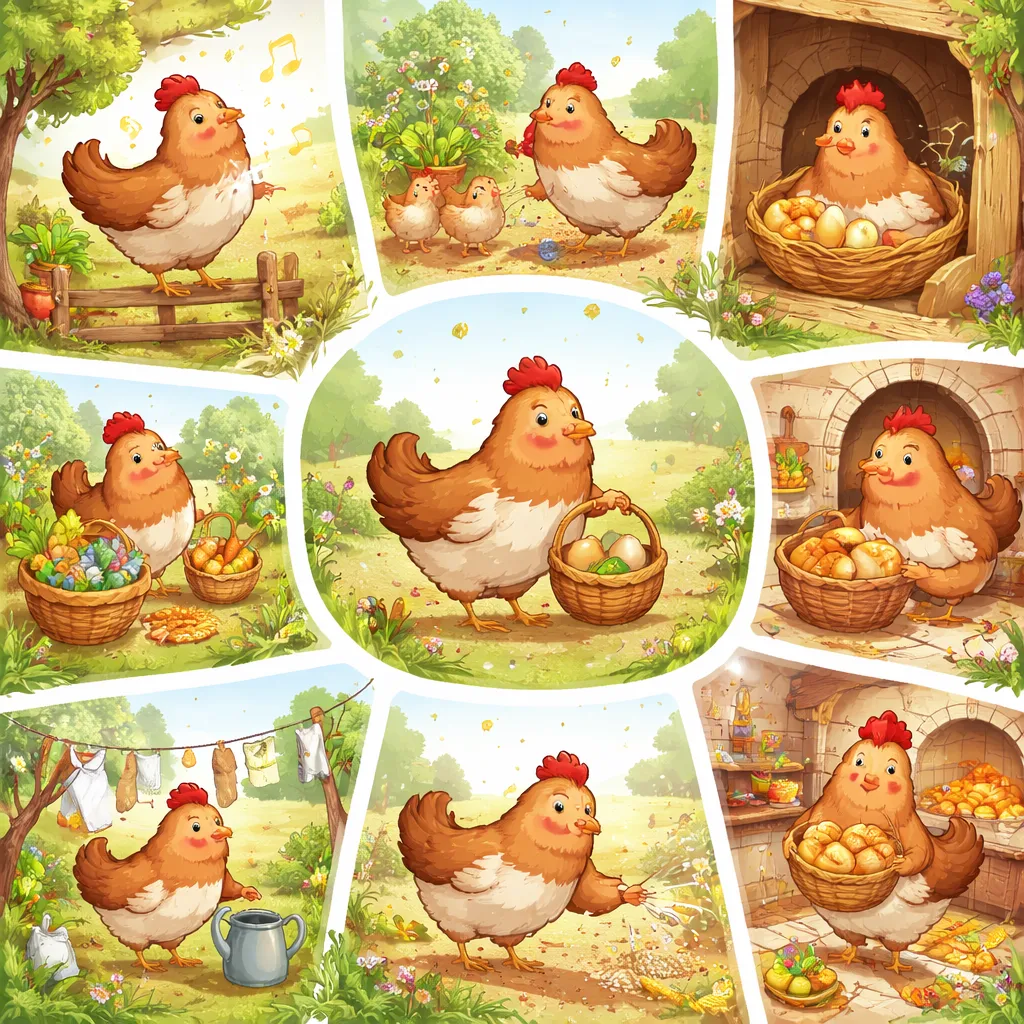

What is the first thing you do when you wake up? Do you eat breakfast or get ready for school? Animals have their own important daily jobs too. In Germany, there is a gentle, busy song all about a little hen and her very special daily task. It is a song about a quiet, useful routine. Let’s visit the cozy chicken coop and learn the song “The Little Hen (Das kleine Huhn).”
About the Song
Here are the gentle, repetitive lyrics of a beloved traditional German children’s song:
Das kleine Huhn, das kleine Huhn,
das läuft im Garten hin und her.
Das kleine Huhn, das kleine Huhn,
das pickt die Körner, mehr und mehr.
Es legt ein Ei, ein Ei, ein Ei,
das tut es, und dann ruht es sich.
Das kleine Huhn, das kleine Huhn,
das ist so fleißig, staunt doch her.
English Translation:
The little hen, the little hen,
she runs in the garden here and there.
The little hen, the little hen,
she pecks the grains, more and more.
She lays an egg, an egg, an egg,
she does that, and then she rests.
The little hen, the little hen,
she is so hardworking, just marvel here.
This is a classic and cozy German-language song for children. The song shows us a simple day in the life of a busy hen. “The little hen, the little hen, she runs in the garden here and there,” it begins, painting a picture of her moving about. Her day is full of small jobs. “The little hen, the little hen, she pecks the grains, more and more,” showing her finding her food. Then comes her most important task. “She lays an egg, an egg, an egg,” the song tells us, repeating the special word. After her work, she takes a break. “She does that, and then she rests.” The song ends by praising her. “The little hen, the little hen, she is so hardworking, just marvel here.” The song is a celebration of gentle, daily effort and the quiet miracle of an egg.
What the Song is About
The song is a snapshot of a hen’s productive and peaceful day. Imagine a sunny garden near a small, red chicken coop. A little brown hen with soft feathers steps out. “The little hen, the little hen, she runs in the garden here and there.” She walks busily around the grass, looking for things.
She stops and pecks at the ground. “The little hen, the little hen, she pecks the grains, more and more.” She finds little seeds and grains to eat, one by one. After eating, she goes to her quiet, cozy nest. “She lays an egg, an egg, an egg.” She works quietly and carefully to make a smooth, warm, white egg. Her important job is done. “She does that, and then she rests.” She settles down, maybe closing her eyes for a while. The song shows us that her day, while simple, is full of purpose. “She is so hardworking, just marvel here.” The song invites us to look closely and appreciate her quiet effort.
Who Made It & Its Story
“Das kleine Huhn” is a traditional German folk song that belongs to the world of farm and animal songs for young children. Its specific creator is not known, as it comes from oral tradition. The song reflects the close connection to farm life and the wonder of where food comes from, a common theme in German kindergarten education. The hen laying an egg is a fascinating, everyday miracle for children, and this song captures that gentle wonder. It connects to cultural values of diligence (“Fleiß”) and appreciating the small, productive routines of nature.
This gentle, rhythmic song is loved for three wonderful reasons. First, it is a perfect, simple way to learn common German verbs for daily actions and farm life, like “läuft” (runs), “pickt” (pecks), and the key verb “legt” (lays). Second, it has a calm, repetitive melody and the satisfying triple repeat of “ein Ei, ein Ei, ein Ei,” which is easy to remember and soothing to sing. Third, it teaches appreciation for animals, their work, and the simple, satisfying cycle of a daily routine, fostering a sense of care and observation.
When to Sing It
This song is perfect for calm, focused moments and learning about routines. You can sing it softly in the morning while having breakfast, especially if you’re eating an egg, thinking about the hen’s work. You can hum it during a quiet playtime with toy animals, acting out the hen’s day of pecking and resting. You can also chant it as a gentle activity song, walking “here and there” like the hen, then crouching down to “lay an egg” and rest.
What Children Can Learn
This peaceful, routine-based song is a wonderful teacher about animals, daily tasks, and describing work in German.
Vocabulary
The song teaches us clear words for animals, actions, objects, and descriptions in German. “The” (Das). “Little” (kleine). “Hen” (Huhn). “She” (das / es). “Runs” (läuft). “In the” (im). “Garden” (Garten). “Here and there” (hin und her). “Pecks” (pickt). “The” (die). “Grains” (Körner). “More and more” (mehr und mehr). “Lays” (legt). “An” (ein). “Egg” (Ei). “That” (das). “Does” (tut). “It” (es). “And then” (und dann). “Rests itself” (ruht sich). “Is” (ist). “So” (so). “Hardworking” (fleißig). “Marvel” (staunt). “Here” (doch her – an expression meaning “just look!”).
Let’s use these words! You can describe an action: “Die Ente läuft.” (The duck runs.) You can talk about food: “Das ist ein Ei.” (That is an egg.) New word: Täglich. This means “daily” or “every day,” just like the little hen’s routine.
Language Skills
This song is excellent for learning about talking about regular, daily actions using verbs in the present tense. The key pattern is the third-person “he/she/it” form of verbs, which often adds a -t: “sie läuft” (she runs), “sie pickt” (she pecks), “sie legt” (she lays).
Concept Definition: Verbs are action words. When we talk about what one person, animal, or thing (he, she, it) does regularly, we often change the verb. In German, for many verbs, you take the basic form (like “laufen” – to run) and add a -t for he/she/it: “er/sie/es läuft”. This is like adding an -s in English: “he runs.” The song is full of these: “das Huhn läuft,” “das Huhn pickt,” “es legt.”
Features and Types: Many common German verbs follow this “add -t” rule for he/she/it. For example: spielen (to play) -> er spielt; machen (to do) -> sie macht; essen (to eat) -> es isst. The song shows us “laufen -> sie läuft”, “picken -> sie pickt”, “legen -> es legt”.
How to Spot Them: Here is a simple “who does it?” trick. Look at the subject of the sentence (who or what is doing the action). If it is “er” (he), “sie” (she), or “es” (it), or a word like “das Huhn” (the hen), then the action word often gets a -t at the end. Ask: “Is one person/animal/thing doing this?” If yes, look for the -t.
How to Use Them: A great way to describe daily routines is the “Daily Action Formula”. The pattern is: “[One person/animal/thing] + [Verb with -t] + [The rest].”
Example from the song: “Das Huhn pickt die Körner.” (The hen pecks the grains.)
Example you can make: “Der Hund spielt im Garten.” (The dog plays in the garden.) “Mein Bruder malt ein Bild.” (My brother paints a picture.)
Sounds & Rhythm Fun
Listen to the steady, pecking rhythm of the melody. The song has a gentle, walking pace that sounds like a hen pecking at the ground. The repeated line “Das kleine Huhn” starts each new part of her day. The triple repeat “ein Ei, ein Ei, ein Ei” is the musical highlight, fun to say and easy to remember, like a little drumroll for the egg.
The rhythm is not fast, but calm and purposeful. The sounds are gentle, with soft “ch” sounds in “Huhn” and rolling “r” sounds in “Garten” and “Körner.” The final line “das ist so fleißig, staunt doch her” has a proud, admiring tone. This musical pattern is perfect for creating your own daily routine song. You can write your own “Die kleine Biene” (The Little Bee) song! Try: “Die kleine Biene, die kleine Biene, die fliegt von Blume zu Blu-me. Die kleine Biene, die kleine Biene, die sammelt süßen Ho-nig. Sie summt dabei, bei, bei, das tut sie, und dann fliegt sie heim…” (The little bee… flies from flower to flower… collects sweet honey… she buzzes while doing it, be, be, she does that, and then flies home…)
Culture & Big Ideas
“Das kleine Huhn” connects to the German appreciation for orderly routines, diligence (“Fleiß”), and a close connection to farm-fresh food. The image of a hen laying an egg is a classic symbol of natural, simple production. The song also gently introduces the farm-to-table concept, showing children where eggs come from in a sweet, non-threatening way. It reflects the value placed on quiet, consistent work.
The song conveys three gentle, important ideas. First, it teaches about animal care and the natural source of our food, fostering respect for the creatures that provide it. Second, it models a positive work ethic and the satisfaction of completing a task, showing a sequence: activity (pecking), productive work (laying an egg), and well-earned rest. Third, it encourages careful observation and appreciation for the small, everyday wonders of nature, like watching a hen in a garden.
Values & Imagination
Imagine you are the busy “kleine Huhn.” You wake up in your soft, straw nest. The sun is warm. “The little hen, the little hen, she runs in the garden here and there,” you think, as you step out into the green grass. You scratch and look down. “The little hen, the little hen, she pecks the grains, more and more.” You find tasty little seeds and eat them one by one.
Then, you feel it’s time for your important job. You go back to your quiet nest. “She lays an egg, an egg, an egg.” You work quietly until a smooth, warm egg is there in the straw. It is your special gift for the day. Your work is done. “She does that, and then she rests.” You settle down, feeling calm and useful. Someone might look at you and think, “She is so hardworking, just marvel here.” How does the straw feel? How does it feel to finish an important job? Draw the little hen’s day. Draw three boxes like a comic strip. In the first, draw the hen walking in a garden. In the second, draw her pecking at little dots on the ground. In the third, draw her sitting on a nest with a big egg. This shows the song’s simple routine.
The song encourages us to notice and appreciate the quiet work of animals, to find joy in simple, productive routines, and to understand where our food comes from. A wonderful activity is the “Fleißig wie ein Huhn” (Hardworking like a Hen) game. Choose a small, simple task, like putting toys in a box. Do it step-by-step: first walk to the toys (like the hen runs), then pick them up one by one (like the hen pecks), then place them all in the box (like the hen lays the egg), and finally sit down and say “Fertig!” (Done!). This connects you to the song’s spirit of gentle, productive work.
So, from the garden run to the final rest, this song is a day in a life. It is a vocabulary lesson in farm animals, actions, and food. It is a language lesson in using verbs with -t for he/she/it, like “läuft” and “legt.” It is a music lesson in a gentle, pecking rhythm with a fun, repeating highlight. “The Little Hen (Das kleine Huhn)” teaches us about animal routines, the value of quiet work, and the wonder of a simple, perfect egg.
Your Core Takeaways
You are now an expert on the song “The Little Hen (Das kleine Huhn).” You know it is a gentle German song about a hen’s daily routine: running in the garden, pecking grains, laying an egg, and then resting. You’ve learned German words like “Huhn,” “Ei,” “läuft,” “pickt,” “legt,” and “fleißig,” and you’ve practiced how to say what one animal or person does regularly (using verbs like “läuft” and “legt”). You’ve felt its calm, pecking rhythm and created your own daily routine verse. You’ve also discovered the song’s message about appreciating animals, understanding daily work, and finding wonder in simple things like an egg.
Your Practice Missions
First, play the “Was tut es?” (What does it do?) game. Look at an animal, a person, or even a toy. Describe one thing it does using the “-t” verb rule from the song. For example, point to a cat and say “Die Katze schläft.” (The cat sleeps.) Point to a clock and say “Die Uhr tickt.” (The clock ticks.) This mission makes you a grammar detective, spotting and using the song’s key language pattern.
Second, have an “Ei-er-Tag” (Egg Day). At breakfast or another meal, if you have an egg, look at it and think of the little hen. Say the song’s special line: “Es legt ein Ei, ein Ei, ein Ei.” You can even say “Danke, kleines Huhn!” (Thank you, little hen!). This mission helps you connect the song to the real world and appreciate the simple gift it describes.