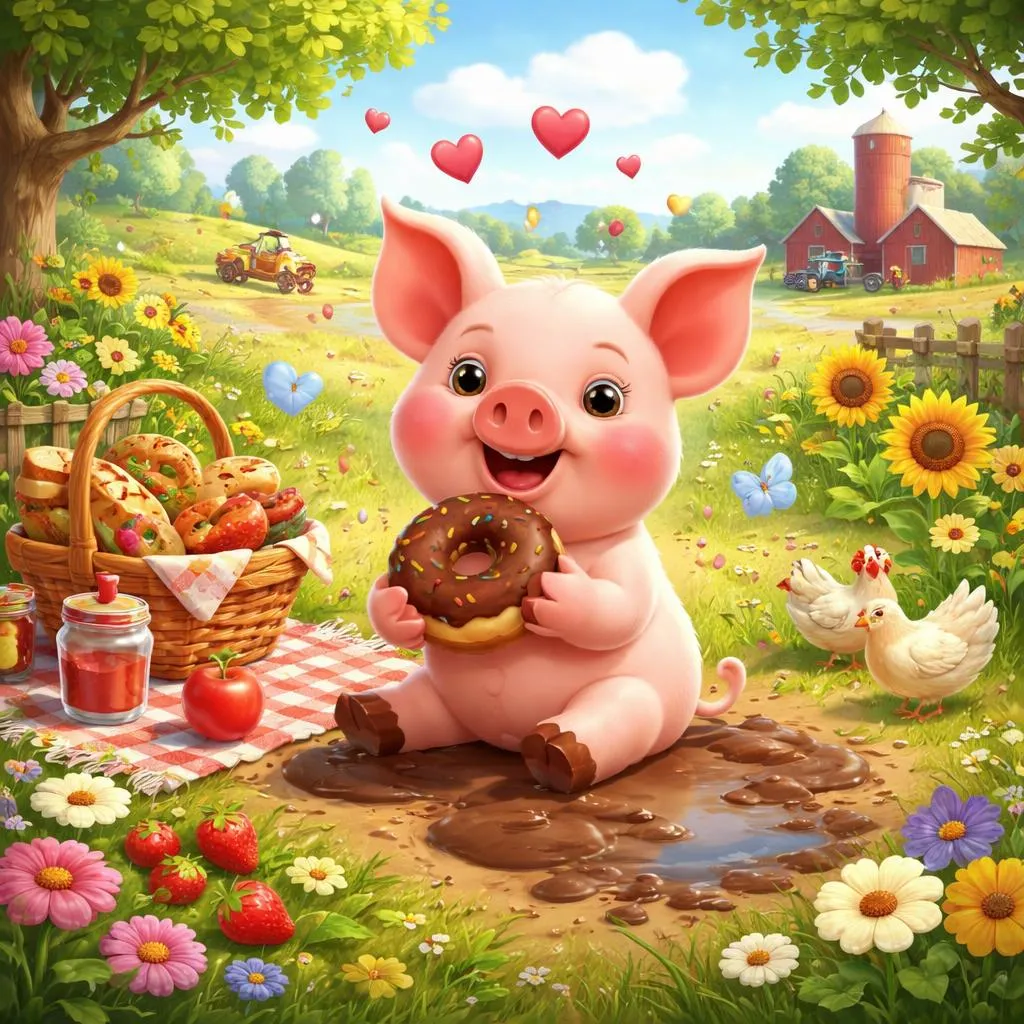

Have you ever jumped in a puddle after the rain? Have you ever felt the squishy mud between your toes? Some animals find that to be the most wonderful thing in the world! In Germany, there is a happy, messy song all about a little pig who loves to play in the mud. It is a song about simple, dirty joy. Let’s get ready to get a little messy and learn the fun song “The Little Pig (Das kleine Schwein).”
About the Song
Here are the cheerful, playful lyrics of a beloved traditional German children’s song:
Das kleine Schwein, das kleine Schwein,
das nimmt ein Bad im Matsch, juchhe!
Das kleine Schwein, das kleine Schwein,
das badet sich im Dreck, ja, ja, ja!
Es grunzt und quiekt vor lauter Glück,
im Matsch, im Dreck, das ist sein Schmuck.
Drum freut sich das Schweinchen, o wie fein,
das kleine, dreckige Schwein.
English Translation:
The little pig, the little pig,
it takes a bath in the mud, hooray!
The little pig, the little pig,
it bathes itself in the dirt, yes, yes, yes!
It grunts and squeaks with pure happiness,
in the mud, in the dirt, that is its decoration.
So the little piggy is happy, oh how fine,
the little, dirty pig.
This is a classic and joyful German-language song for children that celebrates playful messiness. The song is all about a pig’s favorite activity. “The little pig, the little pig, it takes a bath in the mud, hooray!” it starts with excitement. This is not a normal bath. It is a mud bath! The song repeats the happy idea. “The little pig, the little pig, it bathes itself in the dirt, yes, yes, yes!” The pig is not just dirty; it is having the best time. “It grunts and squeaks with pure happiness, in the mud, in the dirt, that is its decoration.” For the pig, the mud is like beautiful jewelry. The song ends by telling us the pig is very, very happy to be a little, dirty pig. The song finds joy in something that might seem messy to us.
What the Song is About
The song is a celebration of a pig’s perfect, muddy day. Imagine a farm on a warm, sunny day after some rain. A little pink pig with a curly tail looks at a big, brown, wet mud puddle. “The little pig, the little pig, it takes a bath in the mud, hooray!” It runs and jumps right into the middle of the soft, squishy mud.
It rolls and splashes. “The little pig, the little pig, it bathes itself in the dirt, yes, yes, yes!” It covers itself from head to toe in the cool, wet earth. The pig is so happy. “It grunts and squeaks with pure happiness, in the mud, in the dirt, that is its decoration.” Its happy “oink” and “squeal” sounds fill the air. The mud is not dirt to the pig; it is like wearing a wonderful, muddy coat. “So the little piggy is happy, oh how fine, the little, dirty pig.” The song is about finding your own kind of fun and being perfectly happy just the way you are.
Who Made It & Its Story
“Das kleine Schwein” is a traditional German folk song that belongs to the large and beloved collection of animal songs for children. Its specific writer, like many folk songs, is unknown, as it has been passed down through generations of families, kindergartens, and playgrounds. The song connects to a child’s innate love for sensory play—like playing with mud, sand, or water—and applies it to a farm animal known for this very behavior. In German culture, pigs are also symbols of good luck (“Glücksschwein”), and the song captures their playful, contented nature.
This messy, joyful song is loved for three wonderful reasons. First, it is a fantastic, playful way to learn vivid German action verbs and nouns related to play and dirt, like “badet” (bathes), “Matsch” (mud), and “Dreck” (dirt). Second, it features fun onomatopoeia (“grunzt,” “quiekt”) and a cheerful, repetitive chorus (“ja, ja, ja!”), making it incredibly fun to sing and act out. Third, it carries a subtle but powerful message of self-acceptance and finding joy in simple, natural pleasures, even if they seem messy to others.
When to Sing It
This song is perfect for playful, messy, or bath-time fun. You can sing it with big, happy actions while playing with modeling clay, slime, or in a sandbox, pretending it is mud. You can chant it joyfully during bath time, splashing in the water like the pig splashes in mud. You can also sing it on a rainy day when you see puddles, celebrating the pig’s favorite kind of weather.
What Children Can Learn
This joyful, sensory song is a wonderful teacher about animals, their unique joys, and expressing happiness in German.
Vocabulary
The song teaches us fun words for animals, actions, places, and feelings in German. “The” (Das). “Little” (kleine). “Pig” (Schwein). “It” (das / es). “Takes” (nimmt). “A” (ein). “Bath” (Bad). “In the” (im). “Mud” (Matsch). “Hooray!” (juchhe!). “Bathes itself” (badet sich). “Dirt” (Dreck). “Yes” (ja). “Grunts” (grunzt). “And” (und). “Squeaks” (quiekt). “With” (vor). “Pure” (lauter). “Happiness” (Glück). “That” (das). “Is” (ist). “Its” (sein). “Decoration” (Schmuck). “Therefore/so” (Drum). “Is happy” (freut sich). “Oh” (o). “How” (wie). “Fine/nice” (fein). “Dirty” (dreckige).
Let’s use these words! You can talk about happiness: “Ich habe Glück.” (I have luck/happiness.) You can describe an action: “Das Kind badet sich.” (The child bathes itself.) New word: Spaß. This is the German word for “fun,” which the little pig is definitely having!
Language Skills
This song is excellent for learning about actions that someone does for themselves, using the word “sich” (oneself). The key phrase is “das badet sich” (it bathes itself). It also introduces the verb “freut sich” (is happy/rejoices), which is another action you do for yourself.
Concept Definition: The word “sich” is a special word that means yourself, himself, herself, itself, or themselves. It shows that the subject is doing the action to their own self. In the song, the pig is not bathing someone else; it is bathing itself. When you say “I wash myself,” you are using a word like “sich” in German.
Features and Types: “Sich” changes a little depending on who is doing the action. For “I wash myself,” it’s “ich wasche mich.” For “you wash yourself,” it’s “du wäschst dich.” For “he/she/it” like the pig, it’s “es badet sich.” For “we wash ourselves,” it’s “wir waschen uns.” The song uses “sich” with the pig (“es”).
How to Spot Them: Here is a simple “self-check” trick. Ask: “Is the person or animal doing the action to their own self?” If the answer is yes, you often need a word like “sich.” In the song, the pig is bathing. Who is getting bathed? The pig itself! So we use “badet sich.”
How to Use Them: A great way to talk about self-care or personal actions is the “Self-Action Formula”. The pattern is: “[Person/Animal] + [Action Verb] + sich.”
Example from the song: “Das Schwein badet sich.” (The pig bathes itself.)
Example you can make: “Das Kind wäscht sich.” (The child washes itself.) “Ich freue mich.” (I am happy. Literally: I rejoice myself.)
Sounds & Rhythm Fun
Listen to the bouncy, happy rhythm of the melody. The song has a joyful, almost marching tune that makes you want to stomp in pretend mud. The repeated line “Das kleine Schwein” starts each happy thought. The cheerful shout “juchhe!” (hooray!) and the happy “ja, ja, ja!” are so fun to sing out loud. The pig sounds “grunzt und quiekt” (grunts and squeaks) are perfect for funny voice acting.
The rhythm is steady and playful, ideal for doing actions: pretending to be a pig, rolling in “mud,” and making grunting sounds. The words “Matsch, Matsch, Matsch!” (if you say it slowly) or the feel of “im Dreck” (in the dirt) sound squishy and fun to say. This musical pattern is perfect for creating your own “messy fun” song. You can write your own “Der kleine Bär” (The Little Bear) song! Try: “Der kleine Bär, der kleine Bär, der wälzt sich im Laub, juchhe! Der kleine Bär, der kleine Bär, der klettert auf Bäume, ja, ja, ja!…” (The little bear… rolls itself in the leaves, hooray!… climbs trees, yes, yes, yes!)
Culture & Big Ideas
“Das kleine Schwein” connects to the German appreciation for nature, animals, and the simple pleasures of life, as well as the cultural symbol of the pig as a bringer of good luck (“Glücksbringer”). A small marzipan or chocolate pig is a common New Year’s gift for good luck. The song also touches on a child-friendly view of farm life and animal behavior, accepting that getting dirty can be a natural, happy part of play.
The song conveys three important, joyful ideas. First, it promotes empathy and understanding of animal behaviors and preferences, showing that what seems messy to us (a mud bath) is delightful and natural for a pig. Second, it celebrates uncomplicated happiness and self-acceptance, as the pig is utterly joyful and proud to be its dirty self. Third, it encourages finding delight in sensory experiences and simple activities, a key part of childhood play and well-being.
Values & Imagination
Imagine you are a playful “kleines Schwein” on a warm day. You see a big, wonderful, wet mud puddle. “The little pig, the little pig, it takes a bath in the mud, hooray!” you think, and you run and slide right into the cool, soft mud. It feels amazing on your skin. “The little pig, the little pig, it bathes itself in the dirt, yes, yes, yes!” You roll and splash, covering your whole body. You are so full of joy that happy sounds just bubble out. “It grunts and squeaks with pure happiness, in the mud, in the dirt, that is its decoration.” The mud is your favorite thing. It makes you feel wonderful. “So the little piggy is happy, oh how fine, the little, dirty pig.” You are perfectly, completely happy just being you. How does the cool mud feel? What does it smell like? Draw the little pig’s happy place. Draw a big, brown mud puddle. Draw a very happy, dirty pig in the middle, with a big smile. Draw little music notes with “Grunz!” and “Quiek!” coming from it. This shows the song’s feeling of messy joy.
The song encourages us to see the world from another creature’s perspective, to find our own simple sources of happiness, and to not be afraid of a little mess if it means having fun. A wonderful activity is the “Schweineglück” (Pig Happiness) game. Find something that makes you as happy as mud makes the pig. It could be jumping on a bed, hugging a pet, or eating your favorite fruit. Do that action and say “Ja, ja, ja!” with a big smile, just like the pig. This connects you to the song’s spirit of pure, simple joy.
So, from the squishy mud to the happy squeals, this song is a celebration of simple fun. It is a vocabulary lesson in animals, mess, and feelings. It is a language lesson in using “sich” (oneself) with verbs like “sich freuen” (to be happy). It is a music lesson in a bouncy, joyful melody full of fun sounds. “The Little Pig (Das kleine Schwein)” teaches us to understand others, to embrace what makes us happy, and to say “ja, ja, ja!” to life’s simple pleasures.
Your Core Takeaways
You are now an expert on the song “The Little Pig (Das kleine Schwein).” You know it is a joyful German song about a pig who loves taking mud baths and is very happy about it. You’ve learned German words like “Schwein,” “Matsch,” “Dreck,” “badet sich,” “grunzt,” and “Glück,” and you’ve practiced using “sich” to talk about actions you do to yourself, like being happy (“ich freue mich”). You’ve felt its bouncy, playful rhythm and created your own joyful animal verse. You’ve also discovered the song’s message about empathy for animals, self-acceptance, and finding happiness in simple things.
Your Practice Missions
First, play the “Schwein im Matsch” (Pig in the Mud) game. Find a soft rug or a pillow. This is your “mud.” Pretend to be the little pig. Act out the song: take a “bath” on your rug, roll around, and make happy grunting and squeaking sounds (“Grunz! Quiek!”). Say “Ja, ja, ja!” while you do it. This mission lets you feel the pig’s joyful fun.
Second, have a “Freu-dich-Moment” (Be-Happy Moment). Think of one thing that makes you very happy, like seeing a friend or eating ice cream. Say a German sentence about it using the “sich freuen” pattern: “Ich freue mich auf…” (I am happy about/looking forward to…) or simply “Ich freue mich!” (I am happy!). This mission lets you use the song’s language skill to talk about your own happiness, just like the little pig.