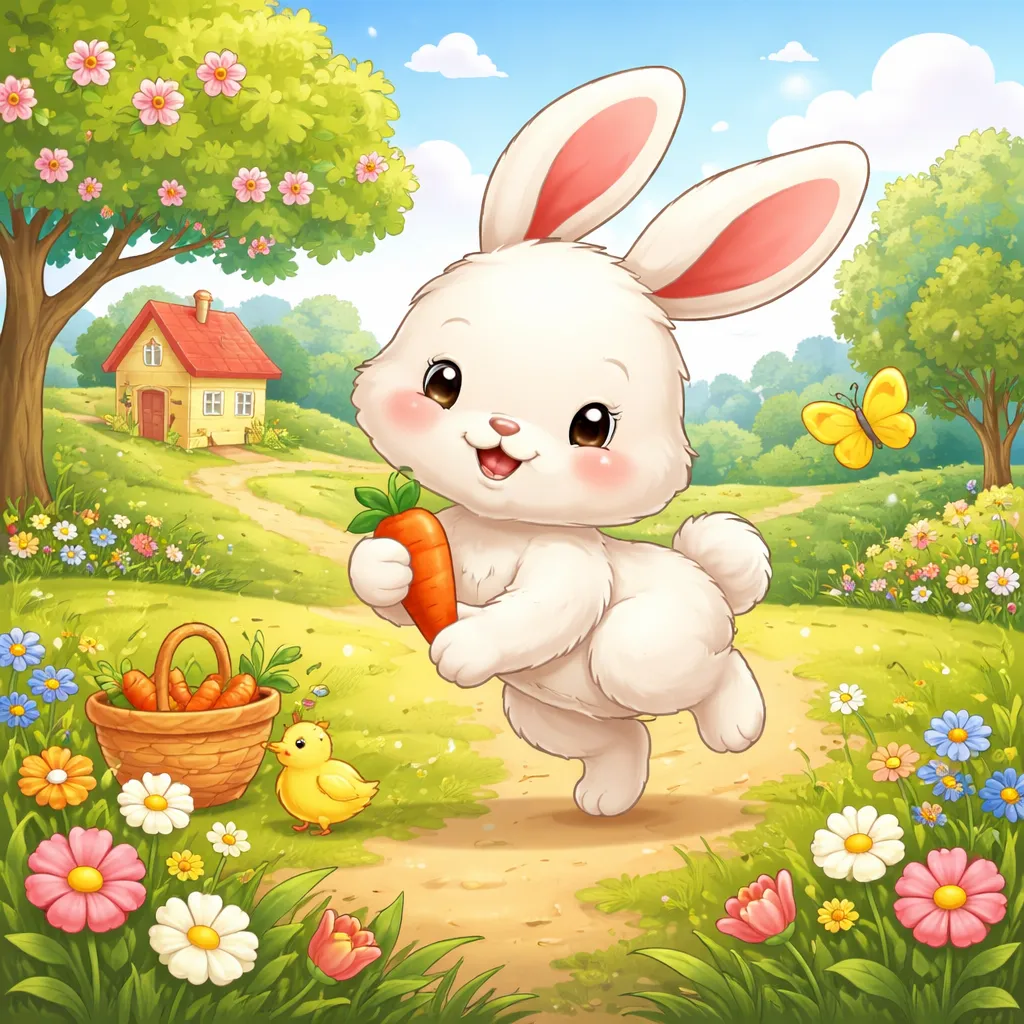

Have you ever seen a rabbit in a garden, nibbling on a carrot with its twitchy nose? Or watched one hop across the grass with its big, strong back legs? Rabbits are playful and gentle garden friends. In Portugal, there is a joyful, active song that imagines the adventures of a little rabbit. Let’s tiptoe into the vegetable patch and learn the bouncy song “The Little Rabbit (O Coelhinho).”
About the Song
Here are the lively, descriptive lyrics of a beloved traditional Portuguese children’s song. This version follows the rabbit’s activities:
O coelhinho, o coelhinho
Vive no jardim, vive no jardim.
O coelhinho, o coelhinho
Corre na relva, corre na relva.
O coelhinho, o coelhinho
Come a cenoura, come a cenoura.
O coelhinho, o coelhinho
Salta, salta, com alegria, com alegria!
English Translation:
The little rabbit, the little rabbit
Lives in the garden, lives in the garden.
The little rabbit, the little rabbit
Runs on the grass, runs on the grass.
The little rabbit, the little rabbit
Eats the carrot, eats the carrot.
The little rabbit, the little rabbit
Jumps, jumps, with happiness, with happiness!
This is a classic Portuguese-language children’s song from Portugal that paints a picture of a rabbit’s happy life. The word “coelhinho” is a sweet, affectionate way to say “little rabbit” or “bunny.” The song is a celebration of simple joys. It introduces us to a little rabbit and its home. Where is its home? In the garden! The song shows us what the rabbit does all day. It lives among the plants, it runs fast on the soft green grass, it enjoys a crunchy carrot, and most of all, it jumps for joy! The song helps us imagine the rabbit’s active, happy day.
What the Song is About
The song is a sunny portrait of a rabbit’s favorite things. Imagine a soft, fluffy rabbit with long ears. Its home is a cozy burrow or a hidden spot under the bushes in a green garden. “The little rabbit lives in the garden, lives in the garden,” the song says. This is its whole world.
The rabbit loves to move. It stretches its legs and dashes across the open, green lawn. “The little rabbit runs on the grass, runs on the grass.” After running, it gets hungry. It finds a bright orange carrot growing in the soil or given by a friend. “The little rabbit eats the carrot, eats the carrot.” With a full belly and happy heart, the rabbit feels a burst of energy. It hops up and down, bouncing with pure joy. “The little rabbit jumps, jumps, with happiness, with happiness!” The song shows us a rabbit that is active, well-fed, and full of joy.
Who Made It & Its Story
“O Coelhinho” is a traditional Portuguese folk song, part of a rich collection of tunes that depict animals in familiar, everyday settings like gardens and countryside. Its specific creator is unknown, as it has been sung in Portuguese homes, schools, and playgrounds for many years. The song reflects a common sight in Portuguese towns and villages: small gardens and family vegetable patches where animals like rabbits might be seen or kept. It connects to a culture that values home-grown food, outdoor life, and finding delight in simple, natural things. The song is a staple for teaching young children about common animals, action words, and the concept of happiness found in everyday activities.
This cheerful song is loved for three clear reasons. First, it is a fantastic, energetic introduction to several common and useful verbs in Portuguese that describe basic actions: living, running, eating, and jumping. Second, its melody is typically bright, bouncy, and full of energy, perfectly matching the rabbit’s actions and making it irresistible to sing and move along to. Third, it connects actions with positive emotions by ending with the rabbit jumping “with happiness” (“com alegria”), teaching that physical activity and simple pleasures are a wonderful source of joy.
When to Sing It
This song is perfect for active play and happy moments. You can sing it while hopping like a rabbit around the living room or garden. You can chant it at snack time while eating crunchy carrot sticks, pretending to be the little rabbit. You can also hum it during a walk in a park, keeping an eye out for movement in the grass and imagining a little rabbit’s home.
What Children Can Learn
This energetic song is a wonderful teacher about animals, action words, and expressing feelings in Portuguese.
Vocabulary
The song teaches us words for animals, places, actions, and feelings in Portuguese. “The little rabbit” (O coelhinho). “Lives” (Vive). “In the garden” (no jardim). “Runs” (Corre). “On the grass” (na relva). “Eats” (Come). “The carrot” (a cenoura). “Jumps” (Salta). “With happiness” (com alegria).
Let’s use these words! You can say, “O coelho come.” (The rabbit eats.) Or, “Eu salto com alegria!” (I jump with happiness!) New word: Habitat. This is the natural home of an animal, like the garden (“o jardim”) is a habitat for the rabbit. It provides food, shelter, and space to run.
Language Skills
This song clearly teaches the use of common action words (verbs) in the simple present tense to talk about what someone or something does regularly. It also beautifully shows how to use the phrase “com” (with) to connect an action to a feeling or manner.
Concept Definition: Action words (verbs) tell us what someone or something does. The song is full of them! The word “com” is a preposition that means “with.” It links an action to another idea, like how the action is done or what accompanies it.
Features and Types: Look at all the things the rabbit does: it “vive” (lives), “corre” (runs), “come” (eats), and “salta” (jumps). These are all different action words describing its daily life. The last action, “jumps,” is done in a special way: “com alegria” (with happiness). Here, “com” links the jumping to the feeling of joy, telling us the rabbit’s emotion.
How to Spot Them: Here is a simple “action detective” trick. Ask yourself: “What is happening? What is the subject doing?” The word that answers is usually an action word. In the song, ask: “What does the rabbit do?” It lives, runs, eats, jumps! To find “com,” look for it before a noun that tells you more about the action, like “happiness” or “a friend.”
How to Use Them: A great way to talk about daily routines and feelings is the “Daily Action and Feeling Formula”. The patterns are: “[Who/What] + [Action Word] + [Where/What].” and “[Who/What] + [Action Word] + com + [Feeling/Thing].”
Example from the song: “O coelhinho vive no jardim.” (The little rabbit lives in the garden.) “O coelhinho salta com alegria.” (The little rabbit jumps with happiness.)
Example you can make: “O pássaro voa no céu.” (The bird flies in the sky.) “Eu brinco com meu amigo.” (I play with my friend.)
Sounds & Rhythm Fun
Listen to the happy, bouncy rhythm of the melody. The song often has a lively, skipping pace that makes you think of a rabbit hopping. The repetition of each location and action, like “vive no jardim, vive no jardim,” sounds like the steady, happy beats of a rabbit’s heart or its quick footsteps. The final line, “com alegria, com alegria!” is often sung with a rising, joyful tune. The word “alegria” (happiness) itself sounds light and musical.
The rhythm is energetic and perfect for hopping or clapping along. The repeating lines make the words stick in your mind easily. The joyful feeling of the melody helps you remember the happy theme. This musical pattern is perfect for creating your own garden animal song. You can write your own “A Joaninha” (The Ladybug) song! Use the same tune. Try: “A joaninha, a joaninha, voa na flor, voa na flor. A joaninha, a joaninha, tem pintas vermelhas, com amor…” (The ladybug, the ladybug, flies on the flower, flies on the flower. The ladybug, the ladybug, has red spots, with love…)
Culture & Big Ideas
“O Coelhinho” connects to the importance of home gardens (“hortas” or “jardins”) in Portuguese culture, which are often spaces for growing vegetables like carrots, relaxing, and being close to nature. The rabbit, while sometimes a garden visitor, is a familiar and generally beloved animal in stories and songs. The song also connects to the universal idea of finding simple, pure happiness in basic things like a home, food, and play.
The song conveys three lovely, positive ideas. First, it teaches about the basic needs and behaviors of an animal—where it lives, what it eats, and how it moves—in a simple, engaging way. Second, it associates physical activity (running, jumping) with positive emotion (happiness), promoting a healthy and joyful connection to movement. Third, it presents the garden as a complete and happy world for the rabbit, fostering an appreciation for nature and the outdoors as a place of abundance and joy.
Values & Imagination
Imagine you are the “coelhinho.” You are a soft, furry rabbit in your safe, green garden home. You sniff the air, smelling the soil and the plants. “I live in the garden, live in the garden,” you think happily. You see an open patch of soft, green grass. You can’t resist! You dash forward, your feet a blur. “I run on the grass, run on the grass,” you think, the wind in your ears. Then you smell something delicious and crunchy. You find a bright orange carrot. You nibble and munch. “I eat the carrot, eat the carrot.” It tastes so good! You feel a bubble of pure joy rise up from your paws to your ears. You have to jump! You hop up and down, twisting in the air. “I jump, jump, with happiness, with happiness!” How does the grass feel under your feet? How does the carrot taste? Draw the little rabbit’s world. Draw a garden with plants and grass. Draw the rabbit doing all four actions: in its burrow (living), running, eating a carrot, and jumping for joy. Write the word “ALEGRIA” in big, happy letters in the sky. This shows the song’s happy ending.
The song encourages us to appreciate simple pleasures, to be active and playful, and to see our own homes and gardens as places of happiness. A wonderful activity is a “Happy Jump Mission.” Think of one thing that makes you happy right now—a person, a pet, a favorite toy. Say it out loud: “I feel happiness because of [my friend/my dog/my book].” Then, do three big jumps, saying with each jump: “Com alegria!” (With happiness!). This connects you to the rabbit’s joyful action.
So, from its garden home to its joyful jumps, this song paints a picture of a happy, active life. It is a vocabulary lesson in animals, places, and actions. It is a language lesson in using common verbs and connecting actions to feelings with “com.” It is a music lesson in a bouncy, repetitive, joyful melody. “The Little Rabbit (O Coelhinho)” teaches us about animal life, connects activity with happiness, and celebrates the simple joys found in our own backyard.
Your Core Takeaways
You are now an expert on the song “The Little Rabbit (O Coelhinho).” You know it is a Portuguese song about a rabbit that lives in the garden, runs on the grass, eats a carrot, and jumps with happiness. You’ve learned Portuguese words like “coelhinho,” “jardim,” “relva,” “come,” “salta,” and “alegria,” and you’ve practiced using action verbs and the connecting word “com.” You’ve felt its bouncy, happy rhythm and created your own garden animal verse. You’ve also discovered the song’s message about animal habitats, the joy of movement and simple things, and expressing happiness through action.
Your Practice Missions
First, play “Rabbit Says” (like “Simon Says”). Be the leader. Give commands in Portuguese based on the song’s actions: “Corre!” (Run!), “Salta!” (Jump!), “Come!” (Eat—pretend to munch!). Add “com alegria” (with happiness) to the end. Everyone must do the action in a happy way. This mission gets you moving and using the action words and phrases.
Second, do a “Com Detective” search. Look around you or think of your day. Find three actions you do with someone or something. Say a simple Portuguese sentence for each using “com.” For example, “Eu leio com a mamãe.” (I read with Mom.) or “Eu como a maçã com felicidade.” (I eat the apple with happiness.) This mission helps you practice using “com” to link actions with companions or feelings, just like the rabbit jumps with happiness.