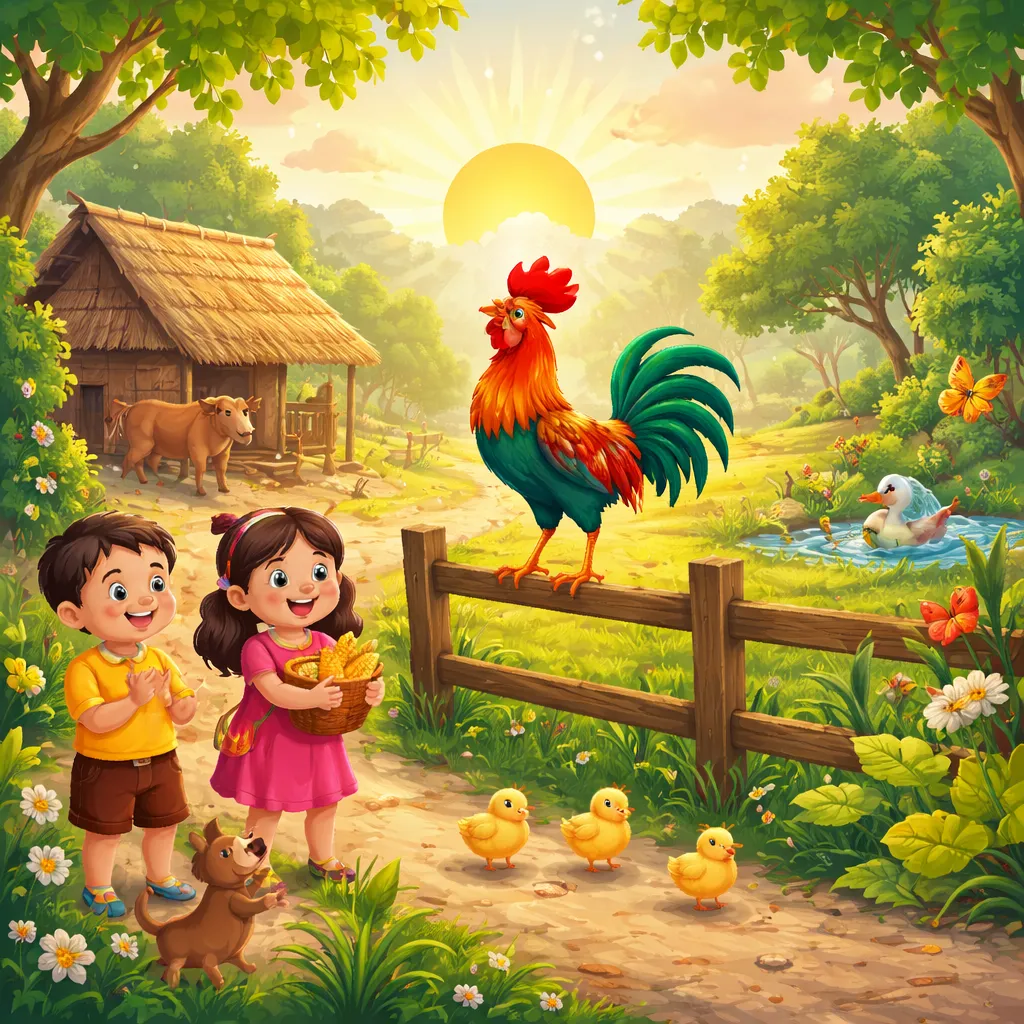

Have you ever heard a rooster crow in the morning? That loud “cock-a-doodle-doo” is a sound that wakes up the whole world. In Indonesia, the word for a rooster is “ayam jago,” and there is a famous, energetic song about a little rooster. It is a song about his important morning job. Let’s meet the star of the morning in “The Little Rooster (Ayam Jago Kecil).”
About the Song
Here are the proud and clear lyrics of a beloved traditional Indonesian children’s song about a little rooster:
Ayam jago kecil,
Bersayap dua.
Kalau berkokok,
Kukuruyuk…kuk!
Pagi-pagi bangun,
Naik ke pagar.
Kukuruyuk…kuk!
Ayo bangun semua!
English Translation:
Little rooster,
Has two wings.
When he crows,
Cock-a-doodle-doo… doo!
Wakes up very early in the morning,
Goes up to the fence.
Cock-a-doodle-doo… doo!
Come on, everyone wake up!
This is a classic and cheerful Indonesian folk song for children. The song is a celebration of the rooster’s role as the morning alarm clock. It describes the “ayam jago kecil.” First, we see what he has: “Bersayap dua,” he has two wings. Then, we learn what he does: “Kalau berkokok, Kukuruyuk…kuk!” When he crows, he says “Kukuruyuk…kuk!” which is the Indonesian sound for a rooster’s crow. The song tells us his routine. He wakes up “pagi-pagi,” very early in the morning. He climbs up “ke pagar,” onto the fence. From his high spot, he crows loudly: “Kukuruyuk…kuk!” His message is clear: “Ayo bangun semua!” which means “Come on, everyone wake up!” It is a song about starting the day with energy and purpose.
What the Song is About
The song shows us the important job of a little rooster. The “ayam jago kecil” is a handsome bird. He has two strong wings, “bersayap dua.” He uses his voice for a special task. “Kalau berkokok,” whenever he crows, he makes his famous sound: “Kukuruyuk…kuk!”
His day starts when it is still dark. He “pagi-pagi bangun,” wakes up very early. He doesn’t stay on the ground. He flies or hops up high. He goes “naik ke pagar,” up onto the fence. This is his stage. From this high place, he takes a deep breath and crows as loud as he can. “Kukuruyuk…kuk!” His crow is not just a sound. It is a call. It is a message for the whole village. “Ayo bangun semua!” He is telling the sun, the people, the animals: “Come on, everyone wake up!” The song paints a picture of a responsible little character who starts the day for everyone.
When to Sing It
This song is perfect for morning routines and energetic moments. You can sing it loudly when you wake up, stretching your arms like wings and pretending to crow. You can sing it while playing outside, climbing onto a low wall or step to be the “rooster on the fence.” You can also sing it as a call to gather friends or family, just like the rooster calls everyone to wake up.
What Children Can Learn
This action-packed song is a wonderful teacher for learning about animal features, daily routines, and using the word “kalau” (when/if) to talk about what happens.
Vocabulary
The song teaches us useful Indonesian words for animals, body parts, actions, time, and places. “Rooster” (Ayam jago). “Small/little” (kecil). “To have wings/with wings” (bersayap). “Two” (dua). “When/if” (kalau). “To crow” (berkokok). “Rooster crow sound” (kukuruyuk…kuk!). “Morning” (pagi). “To wake up” (bangun). “To climb/go up” (naik). “To/towards” (ke). “Fence” (pagar). “Come on” (ayo). “All/everyone” (semua).
Let’s use these words! You can describe other animals: “Burung bersayap dua.” (The bird has two wings.) “Anjing bangun pagi.” (The dog wakes up early.) New word: Berkaki. This means “to have legs/with legs.” You can say, “Ayam jago berkaki dua.” (The rooster has two legs.)
Language Skills
This song is excellent for learning to use the word “kalau” (when/if) to connect an action with what happens next. It also shows us how to describe a permanent feature with “ber-” (like “bersayap” – having wings) and a habitual action with “ber-” (like “berkokok” – to crow).
Concept Definition: We are learning about using “kalau” to mean “when” or “if” something happens, followed by what occurs as a result. It’s like saying “When this happens, then that happens.” We are also learning about verbs that start with “ber-” which can mean “to have” a feature or “to do” an action regularly.
Features and Types: The pattern with “kalau” is: “Kalau + [Action/Condition], + [What Happens].” In the song, it’s “Kalau berkokok, Kukuruyuk…kuk!” (When he crows, Cock-a-doodle-doo!). Verbs with “ber-” can show a state (“bersayap” – having wings) or an action (“berkokok” – to crow, “bangun” – to wake up is also a “ber-” type verb).
How to Spot Them: Here is the “When-Then Finder” trick. Look for a sentence that starts with the word “Kalau.” The very next part is the condition, and the part after the comma is the result. Ask: “Is this sentence telling me what happens when something else occurs?” For “ber-” verbs, look for words starting with “ber-”. Ask: “Is this word describing having something or doing an action?”
How to Use Them: A great way to talk about routines is the “When-Do” formula. Condition: “Kalau + [action].“ Result: “[what happens].“ Feature/Action: “[Subject] + ber[something].”
Example from the song: “Kalau berkokok, Kukuruyuk…kuk!“ (When he crows, Cock-a-doodle-doo!). Feature: “Bersayap dua.“ (Has two wings.)
Example you can make: “Kalau hujan, aku di dalam rumah.“ (When it rains, I am inside the house.) “Aku berkaki dua.“ (I have two legs.)
Sounds & Rhythm Fun
Listen to the strong, crowing melody of the song. The tune for “Ayam Jago Kecil” is often bold and clear, with a rhythm that mimics the proud strut of a rooster. The best part is the crowing sound “Kukuruyuk…kuk!” which is fun to shout out loud, just like a real rooster.
The words are strong and rhythmic. Saying “ayam jago kecil” feels important. The word “bersayap dua” has a steady beat. The most fun part is definitely making the rooster sound: “Kukuruyuk…kuk!” It is the loudest, proudest part of the song. Phrases like “pagi-pagi bangun” and “ayo bangun semua” are like strong commands that get everyone moving. This bold rhythm is perfect for creating your own morning animal song. Try a dog song: “Anjing kecil, berekor satu. Kalau menggonggong, Guk guk guk!…“ (Little dog, has one tail. When he barks, Woof woof woof!…).
Culture & Big Ideas
“Ayam Jago Kecil” reflects the important role of roosters in rural Indonesian life as natural alarm clocks. Their early morning crow is a familiar sound in villages, signaling the start of a new day. The song captures this daily rhythm and the rooster’s proud, responsible character.
The song conveys three clear and important ideas. First, it teaches about having a purpose and a job, as the rooster’s important job is to wake everyone up, showing that everyone, even a little rooster, can have a meaningful role. Second, it promotes the value of good daily habits, like waking up early (“pagi-pagi bangun”), and encourages a positive, energetic start to the day for “semua” (everyone). Third, it showcases leadership and using your voice, as the rooster climbs to a high place (“naik ke pagar”) and uses his call to lead and gather the community, encouraging others to act.
Values & Imagination
Imagine you are the little rooster. You are an “ayam jago kecil” with a very important job. You have two strong wings, “bersayap dua.” You know that “kalau berkokok,” when you crow, you must do it loudly and clearly: “Kukuruyuk…kuk!”
Your work starts when it is still dark. You “pagi-pagi bangun,” wake up very early. You stretch your wings and fly up. You go “naik ke pagar,” up onto the highest fence post. From there, you can see the whole sleeping world. You take a big breath and let out your call. “Kukuruyuk…kuk!” You shout it again. Your message is for everyone: “Ayo bangun semua!” Come on, sun, rise! Come on, people, wake up! Come on, world, a new day is here! How does it feel to have a job that helps everyone start their day? Draw the rooster’s morning. Draw the fence (“pagar”). Draw the rooster standing proudly on top, his beak open. Draw a shining sun coming up. Below, draw a house with a light turning on. Write “Kukuruyuk…kuk!” and “Ayo bangun semua!” in big letters. This shows the song’s story of a new beginning.
The song encourages us to find our own “important job,” to be responsible and start our day with good energy, and to use our voices to encourage and help others. A wonderful activity is the “Panggilan Pagi” (Morning Call) game. In the morning, take turns being the “ayam jago.” Stand on a small step or stool (your “fence”). Stretch your arms like wings, take a deep breath, and sing the song loudly, especially the “Kukuruyuk…kuk!” part. Then say “Ayo bangun semua!” to your family. This connects the song’s vocabulary to a fun, positive morning routine.
So, from the rooster’s crow to his call for everyone to wake up, this song is a lesson in responsibility and energy. It is a vocabulary lesson in body parts, actions, and time. It is a language lesson in using “kalau” for “when” and “ber-” verbs. It is a music lesson in a strong, crowing tune. “The Little Rooster (Ayam Jago Kecil)” teaches us about having a purpose, starting the day right, and leading with your voice.
Your Core Takeaways
You are now an expert on the Indonesian song “The Little Rooster (Ayam Jago Kecil).” You know it is a song about a little rooster with two wings who, when he crows, says “Kukuruyuk…kuk!”, who wakes up early, climbs the fence, and calls for everyone to wake up. You’ve learned Indonesian words like “ayam jago,” “bersayap,” “kalau,” “berkokok,” “kukuruyuk,” “pagi,” “bangun,” “naik ke,” and “ayo,” and you’ve practiced using “kalau” to connect actions and “ber-” verbs. You’ve felt its bold, crowing rhythm. You’ve also discovered the song’s message about having an important job, the value of waking up early, and using your voice to lead and help others.
Your Practice Missions
First, do the “Kalau Aku…” (When I…) game. Think of an animal and what it does. Say a sentence using “Kalau” like in the song. For example, “Kalau aku kucing, aku mengeong. Meong!” (When I am a cat, I meow. Meow!) or “Kalau aku lapar, aku makan.” (When I am hungry, I eat.). This mission helps you master the “Kalau + [action], [result]” pattern.
Second, have a “Penyiar Pagi” (Morning Announcer) routine. Tomorrow morning, be like the rooster. Do one thing very early, like making your bed or brushing your teeth. After you do it, stand up tall and say proudly: “Aku pagi-pagi bangun. Aku [action]!” (I woke up early. I [made my bed]!). This mission lets you use the song’s phrase for waking up early and connect it to a positive, responsible action.