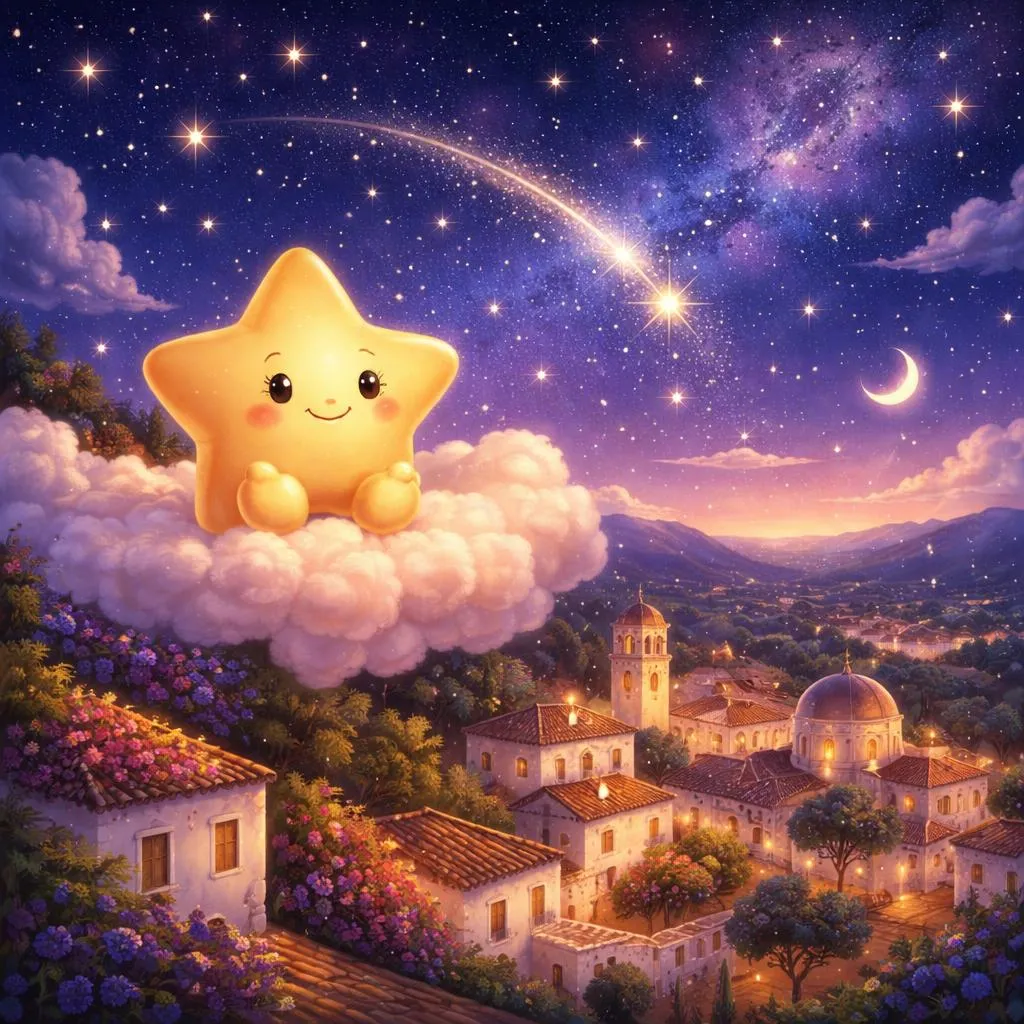

Have you ever looked up at the night sky, found the first bright star, and made a secret wish? In the Spanish-speaking world, there is a gentle, famous song that does just that. It is a quiet conversation with a twinkling star, full of wonder and hope. Let’s look up and learn the beautiful lullaby “The Little Star (Estrellita).”
About the Song
Here are the poetic, dreamy words of this beloved Spanish song.
Estrellita, ¿dónde estás?
Me pregunto qué serás.
En el cielo y en el mar,
un diamante de verdad.
Estrellita, ¿dónde estás?
Me pregunto qué serás.
English Translation:
Little star, where are you?
I wonder what you are.
In the sky and in the sea,
a true diamond.
Little star, where are you?
I wonder what you are.
This is a classic Spanish lullaby and children’s song. Its music was famously composed by the Mexican musician Manuel M. Ponce in 1912. He wrote the gentle melody, and the simple, wondering words became the perfect match. The song is a beautiful, slow melody that feels like a musical hug. It is a child’s curious and loving talk with a distant star. The singer looks at the tiny, shining point of light and asks two big questions: “Where are you?” and “What are you?” The song compares the star to a diamond in the sky and also reflected in the sea, making it seem both far away and magically close. It is a song of wonder, a peaceful way to end the day by connecting with the beautiful mystery of the night.
What the Song is About
The song paints a quiet, thoughtful picture of a child gazing at the evening sky. Imagine a calm, dark blue night. One by one, stars begin to appear. A child sits by a window or outside, looking up. Their eyes find one special, twinkling star. The child feels a question bubble up inside and sings it softly to the star: “Little star, where are you?” The child is not just asking for a location, but wondering about the star’s faraway home in the vast, deep universe.
The child keeps wondering, singing, “I wonder what you are.” Is the star a distant sun? A magical light? Then, the child imagines the star’s light shining in two places at once. It sparkles high up in the night sky, and that same sparkle is reflected down below on the calm, dark surface of the sea, like a glittering diamond. The star is so bright and precious, it is like a “true diamond.” The song repeats the two big questions, leaving the mystery open. There is no answer, just the peaceful feeling of asking and wondering. The song is about curiosity, beauty, and feeling a connection to something vast and wonderful.
Who Made It & Its Story
The beautiful melody of “Estrellita” was composed by the renowned Mexican pianist and composer Manuel M. Ponce in 1912. While the simple, poetic lyrics are traditional, Ponce’s tender and slightly sad melody made the song famous all over the world. It became one of Mexico’s most beloved musical pieces. Ponce is often called the “father of Mexican classical music,” and he loved using folk tunes in his work. “Estrellita” sounds like a folk song, but it is actually his own composition that feels timeless and traditional. The song captures a feeling of nostalgic love and wonder that speaks to everyone, making it a global classic.
This lullaby is loved for three deep reasons. First, its melody is incredibly tender, simple, and hauntingly beautiful, easy to remember and hum, creating an instant feeling of calm and wonder. Second, it gives voice to the universal childhood feeling of curiosity about the night sky, putting big, philosophical questions into a simple, singable form. Third, it connects the singer to something vast and beautiful, offering comfort and a sense of magic that makes the night feel friendly and full of possibility.
When to Sing It
This song is perfect for quiet, thoughtful moments. You can sing it softly as a lullaby at bedtime, while looking out a window at the first stars appearing. You can hum it during a calm car ride at night, watching the sky and the reflections of lights. You can also whisper it on a quiet beach evening, looking at the real stars above and their reflections on the wet sand or calm water.
What Children Can Learn
This gentle, wondering song is a wonderful teacher about the cosmos, Spanish language, and big feelings.
Vocabulary
The song teaches us words for celestial objects, questions, and beautiful things in Spanish. A “little star” (estrellita) is a tiny, shining point of light in the night sky. The “sky” (cielo) is the blue or black space above us with the sun, moon, and stars. The “sea” (mar) is the big, salty ocean. A “diamond” (diamante) is a very hard, shiny, and precious jewel. “Where” (dónde) is a word we use to ask about a place or location. “What” (qué) is a word we use to ask about a thing or an idea. “True” or “real” (verdad) means something that is authentic and not pretend.
Let’s use these words! You can say, “I see a bright star in the dark sky.” Or, “The treasure chest held a sparkling diamond.” New word: Celestial. This is a fancy word for things that belong to the sky or outer space, like stars, planets, and moons—just like the estrellita in the song.
Language Skills
This song is a lovely lesson in asking questions using question words and using the verb “to be” in different ways.
Concept Definition: A question word is a special word we use at the beginning of a sentence to ask for information. It is like a key that unlocks an answer. In the song, the child uses these keys to ask the star things. Think of them as “curiosity keys.” We also use the verb “to be” (ser/estar) to talk about what things are or where they are.
Features and Types: In Spanish, there are different “curiosity keys.” The song uses two very important ones: “¿Dónde?” which means “Where?” and asks about a place. And “¿Qué?” which means “What?” and asks about a thing or idea. The song also shows the verb “ser” in “¿qué serás?” meaning “what will you be?” which is about the essence or future of something.
How to Spot Them: Here is a simple “finding secret.” In Spanish, questions often have two special marks: an upside-down question mark at the beginning (¿) and a normal one at the end (?). When you see “¿” at the start of a sentence, look right after it! The next word is often a curiosity key like “dónde” or “qué.” Also, ask yourself: “Is this sentence trying to find out information?” If yes, it’s a question.
How to Use Them: A great way to ask questions is with a “question recipe”. The pattern is: [Question Word] + [Verb] + [Rest of Question]?
Example from the song: “¿Dónde estás?” (Where are you?) Question Word=Dónde, Verb=estás.
Example from the song: “¿Qué serás?” (What will you be?) Question Word=Qué, Verb=serás.
You can make your own questions! “Where is my toy?” or “What is that sound?” In Spanish, that could be “¿Dónde está mi juguete?” or “¿Qué es ese sonido?” Just use the recipe: Curiosity Key + Verb + what you want to know.
Sounds & Rhythm Fun
Listen to the slow, flowing, and gentle rhythm of the melody. The song has a lullaby’s smooth, rocking feel, like waves on the sea it mentions. The beautiful repetition of the two main lines “Estrellita, ¿dónde estás? Me pregunto qué serás” makes the song easy to remember and deeply soothing. The melody rises and falls gently, like a soft sigh or a curious look up at the sky. The Spanish words have a musical, poetic sound. “Está” rhymes with “mar” and “verdad,” creating a peaceful, resolved feeling. The “s” sounds in “estás,” “serás,” “cielo,” and “mar” give the song a soft, whispering quality, perfect for a quiet night.
The rhythm is slow and steady. Try swaying gently side to side with the beat: Es-tre-lli-ta, ¿dón-de es-tás? Me pre-gun-to qué se-rás. The melody is simple but full of feeling, which helps you remember not just the words, but the calm, wondering mood. This smooth, repetitive, and gentle musical pattern is perfect for expressing wonder. You can write your own “wonder song”! Use the same slow, flowing melody. Try: “Luna llena, ¿qué ves tú? Me pregunto en la altitud. En la noche, tan brillante, un farol resplandeciente.” (Full moon, what do you see? I wonder, up so high. In the night, so very bright, a shining lantern light.)
Culture & Big Ideas
“Estrellita” connects deeply to the romantic and poetic tradition in Mexican and Latin American music. Stars are common symbols in art and songs, representing love, guidance, dreams, and mystery. This song turns stargazing into a personal, musical conversation. It reflects a cultural appreciation for beauty, poetry, and the big questions in life, even in simple children’s songs. The image of the star as a diamond in the sky and the sea shows a love for beautiful comparisons, a style used often in poetry. The song is a gentle introduction to seeing the world with a poet’s eyes.
The song conveys three profound ideas. First, it’s about the beauty of curiosity and asking questions. Wondering “where?” and “what?” is the first step in learning and imagining. Second, it expresses a sense of connection and reflection. The star is both high in the sky and deep in the sea, showing how beauty can be in two places at once, connecting heaven and earth. Third, it highlights finding value and magic in simple things. A tiny, distant point of light is compared to a precious diamond, teaching us to see wonder in everyday miracles.
Values & Imagination
Imagine you are the child singing to the star. The air is cool and quiet. You look up and see one star shining brighter than the others. How does its light seem to flicker? Like a friendly, silent wink. You sing your question to it. Do you imagine the star can hear you? What would its voice sound like if it answered? A tiny, musical chime? Now, imagine you are the little star. You are very, very far away, shining your ancient light. You see a child on the blue planet far below, looking right at you. You hear their quiet song. What message would you send back with your twinkling light? A message of hello? A message of peace? Draw the scene. Draw yourself on a hill or at a window, looking up. Draw the night sky with one special, big star. Then, draw a line of light or sparkles from that star all the way down to you, and another line from the star down to a calm sea where its reflection shines like a diamond. This shows the connection the song describes.
The song encourages curiosity about the universe, appreciation for quiet beauty, and the joy of wondering. A wonderful activity is a “Star Conversation” journal. On a clear night, find a star. Ask it a question like in the song: “Little star, what is your favorite planet?” or “Little star, what do you see on Earth?” Write or draw your question and then imagine the star’s answer. This turns the song into a creative writing and dreaming exercise.
So, as the last gentle note of wonder fades, think about the journey in this timeless tune. It is a vocabulary lesson in the sky, the sea, and questions. It is a language lesson in asking “where” and “what” in Spanish. It is a music lesson in a slow, flowing melody that feels like a dream. From the first call to the “estrellita” to the final comparison to a diamond, it wraps lessons in curiosity, beauty, and connection in a melody that feels like a secret shared with the universe. “The Little Star (Estrellita)” teaches us that it is good to ask questions, that beauty is everywhere if we look, and that even the smallest light can inspire the biggest dreams.
Your Core Takeaways
You are now an expert on the song “The Little Star (Estrellita).” You know it is a famous Mexican lullaby by Manuel M. Ponce, about a child wondering about a star in the sky and sea. You’ve learned Spanish words like “estrellita,” “cielo,” and “diamante,” and you’ve practiced using question words like “¿dónde?” and “¿qué?” to ask about places and things. You’ve felt its slow, gentle rhythm and created your own wondering verse. You’ve also discovered the song’s connection to poetic traditions and its messages about being curious, seeing connections in beauty, and finding value in simple wonders.
Your Practice Missions
First, have a “Night Sky Conversation.” Tonight or on a clear night, go outside or look out your window. Find the first star you see. Sing “Estrellita” to it softly. Then, ask it your own new question in Spanish or English, like “¿Estrellita, cómo estás?” (Little star, how are you?). Just spend a quiet minute wondering about it. This mission turns the song into a real, personal moment of stargazing.
Second, create a “Diamond in the Sea” art piece. The song says the star is like a diamond in the sky and the sea. On a dark piece of paper, use a white crayon or chalk to draw a starry sky. At the bottom, paint or color a calm, dark blue sea. Use glue and glitter or a shiny sticker to place one special “diamond” star in the sky, and then make its shimmering reflection in the water below. This activity helps you visualize the beautiful, connected image from the song.