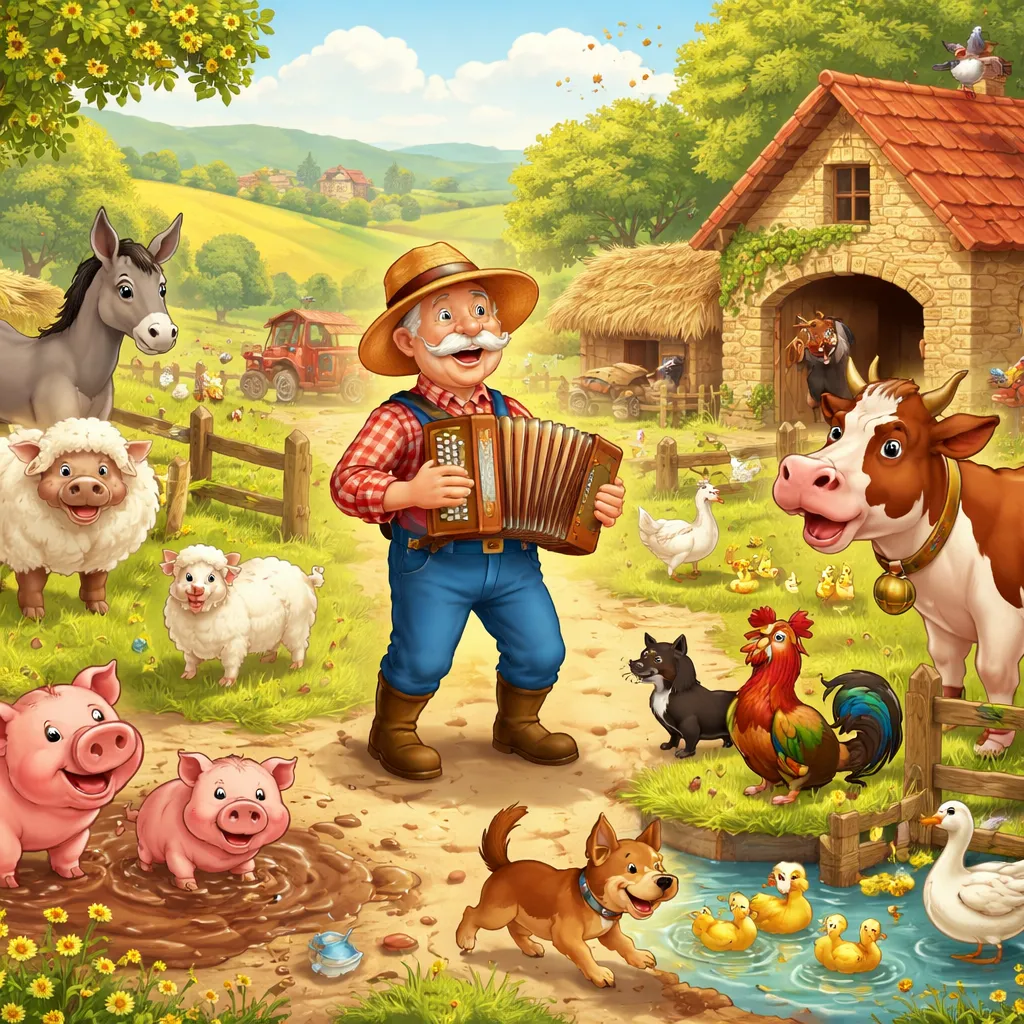

Have you ever visited a real farm? It is a busy, noisy place full of amazing animals, each with its own special sound. There is a super fun French song that takes you on a musical tour of just such a farm. It is a song about a friendly farmer, all his wonderful animals, and the silly sounds they make. Let’s put on our boots and learn the classic, noisy song “Old MacDonald Had a Farm (Le vieux MacDonald avait une ferme).”
About the Song
Here are the lively, cumulative lyrics of the beloved French version:
Le vieux MacDonald avait une ferme,
I-a-i-a-o!
Et dans sa ferme il avait un canard,
I-a-i-a-o!
Avec un coin-coin par-ci, un coin-coin par-là,
Ici coin-coin, là coin-coin, partout coin-coin!
Le vieux MacDonald avait une ferme,
I-a-i-a-o!
(The song continues, changing the animal and its sound each verse: a pig/“un cochon” says “groin-groin,” a cow/“une vache” says “meuh,” a sheep/“un mouton” says “bêê,” etc.)
English Translation:
Old MacDonald had a farm,
E-I-E-I-O!
And on his farm he had a duck,
E-I-E-I-O!
With a quack-quack here, a quack-quack there,
Here a quack, there a quack, everywhere a quack-quack!
Old MacDonald had a farm,
E-I-E-I-O!
This is the classic French-language version of the traditional farm song. The song introduces us to a kind farmer named “le vieux MacDonald” (old MacDonald). “Le vieux MacDonald avait une ferme, I-a-i-a-o!” it starts. Then, for each verse, we meet a new animal living on his farm. “And on his farm he had a duck, I-a-i-a-o!” The best part comes next: the animal’s sound! “With a quack-quack here, a quack-quack there, Here a quack, there a quack, everywhere a quack-quack!” The song fills the farm with more and more animal noises, creating a joyful, funny chorus.
What the Song is About
The song is a playful visit to a bustling, noisy farm. Imagine you are walking with Vieux MacDonald. He points to a pond. “And on his farm he had a duck,” he says. Then, from all around, you hear the duck’s sound: “Coin-coin here, coin-coin there!” You look here and there, and the quacking seems to be everywhere.
You walk to the pigpen. “And on his farm he had a pig.” Suddenly, you hear “Groin-groin here, groin-groin there!” The pigs are happy and loud. Next, you visit the field with the cow. “And on his farm he had a cow.” A gentle “Meuh here, meuh there!” fills the air. Each animal adds its own sound to the farm’s music. The song builds a picture of a farm full of life, with each creature contributing its unique voice to the cheerful noise.
Who Made It & Its Story
“Le vieux MacDonald avait une ferme” is the traditional French adaptation of the well-known American folk song. Its specific creator is unknown. It has become a fundamental song in French-speaking homes, schools, and libraries, used to teach children about farm animals and their French names and sounds. The song connects to the important role of agriculture (“l’agriculture”) in French culture and countryside life.
This cumulative, noisy song is loved for three wonderful reasons. First, it is a joyful and memorable way to learn essential French vocabulary for common farm animals (“canard,” “cochon,” “vache,” “mouton”) and the wonderfully unique sounds they make in French (“coin-coin,” “groin-groin,” “meuh,” “bêê”). Second, it has a super catchy, repetitive, and building structure—the “I-a-i-a-o” refrain and the “here-there-everywhere” pattern—that makes it easy for everyone to sing along and remember. Third, it sparks imagination and play, inviting children to impersonate animals, make silly sounds, and visualize a lively farm scene, blending music with dramatic play.
When to Sing It
This song is perfect for imaginative play and learning about animals. You can sing it loudly on a car trip through the countryside, pointing out real animals and making their French sounds. You can sing it during playtime with toy farm animals, picking up a duck toy for the “coin-coin” verse and a cow for the “meuh” verse. You can also sing it as a silly group game with friends, each person taking turns being a different animal on the farm.
What Children Can Learn
This fun, imaginative song is a fantastic teacher of animal vocabulary, onomatopoeia (sound words), and the useful verb “avoir” (to have) to talk about possession.
Vocabulary
The song teaches us clear French words for the farmer, the farm, animals, and their unique sounds. “The” (Le). “Old” (vieux). “MacDonald” (MacDonald). “Had” (avait). “A” (une). “Farm” (ferme). “I-a-i-a-o!” (E-I-E-I-O!). “And” (Et). “In/On” (dans). “His” (sa). “He had” (il avait). “A duck” (un canard). “With” (Avec). “A quack” (un coin-coin). “Here” (par-ci/ici). “There” (par-là/là). “Everywhere” (partout).
Let’s use these words! You can talk about animals: “Le canard fait 'coin-coin'.” (The duck says 'quack'.) New word: Le coq. This means “the rooster.” You can add a new verse: “Et dans sa ferme il avait un coq, I-a-i-a-o! Avec un cocorico par-ci...” (And on his farm he had a rooster... With a cock-a-doodle-doo here...)
Language Skills
This song is perfect for learning about talking about what someone or something owns or has, using the very important verb “avoir” (to have), as in “Le vieux MacDonald avait une ferme” and “il avait un canard.”
Concept Definition: We are learning about a special word that means “to have” or “to own.” In French, this word is “avoir.” In the song, we use “avait,” which is the way to say “he had” or “she had” in the past. It tells us what Old MacDonald possessed. He had a farm. On that farm, he had a duck. It is a simple way to connect a person with the things that belong to them.
Features and Types: The verb “avoir” is used in many ways. In this song, we see it used for possession: owning things (a farm) or having relationships with people or animals (a duck, a cow). The pattern is: “[Person or Thing] + form of avoir + [Thing they have].” For “il” (he) or “elle” (she) in the past, we use “avait.” For “je” (I), it’s “j’avais.” For “tu” (you), it’s “tu avais.”
How to Spot Them: Here is the “Has/Have/Had” trick. Look for the word “avait” (or “j’avais,” “tu avais”). This word is the key. Ask yourself: “Who had something?” The word before “avait” is the owner. “What did they have?” The words after “avait” tell you the thing. “Le vieux MacDonald (who) avait (had) une ferme (what).”
How to Use Them: A great way to talk about what you or others have is the “Ownership Formula”. The pattern is: “[Owner] + avait/avais/avait + [Thing].”
Example from the song: “Le vieux MacDonald avait une ferme.” (Old MacDonald had a farm.)
Example you can make: “J’avais un gros gâteau.” (I had a big cake.) “Ma sœur avait un vélo rouge.” (My sister had a red bicycle.) “Le chien avait un os.” (The dog had a bone.)
Sounds & Rhythm Fun
Listen to the bouncy, folk-song rhythm of the melody. The tune for “Le vieux MacDonald avait une ferme, I-a-i-a-o!” is cheerful and easy to hum. The nonsense refrain “I-a-i-a-o!” is super fun to shout and acts like the farm’s theme song.
The best part is the animal sound chorus! The pattern “Avec un [sound] par-ci, un [sound] par-là, Ici [sound], là [sound], partout [sound]-[sound]!” is repeated for each animal. This repetition makes the sounds unforgettable. Singing “coin-coin” or “groin-groin” here, there, and everywhere is silly and helps you remember the French words for the noises. This musical pattern is perfect for creating your own animal verses. Try a jungle version: “Le vieux MacDonald avait un zoo, I-a-i-a-o! Et dans son zoo il avait un lion, I-a-i-a-o! Avec un rugissement par-ci...” (Old MacDonald had a zoo... he had a lion... With a roar here...)
Culture & Big Ideas
“Le vieux MacDonald avait une ferme” connects to the deep roots of French rural and agricultural life. France has a strong tradition of farming, producing famous cheeses, breads, and other foods. The song reflects the familiar sight of mixed farms (“fermes”) with various animals, a common part of the countryside (“la campagne”) and its cultural heritage.
The song conveys three playful yet important ideas. First, it teaches observation and categorization of animals, connecting each creature with its name, its distinct French sound, and its place in a farm setting. Second, it introduces the concept of a cumulative narrative, where each verse adds a new element (a new animal and sound) to the growing scene, building memory and anticipation. Third, it celebrates diversity and community, showing how a farm (or any community) is made up of many different members, each contributing their own unique “voice” to create a lively whole.
Values & Imagination
Imagine you are standing at the fence of Vieux MacDonald’s farm in the French countryside. The sun is warm. You hear the first “I-a-i-a-o!” You see the duck swimming in the pond. “Coin-coin here, coin-coin there!” it seems to say hello.
You walk further and see pink pigs rolling in the mud. “Groin-groin here, groin-groin there!” they snort happily. In the green field, a big brown cow chews grass. “Meuh here, meuh there!” she calls softly. A flock of fluffy white sheep graze. “Bêê here, bêê there!” The whole farm is a beautiful, noisy, happy symphony of animal sounds. Can you hear all the different voices? Can you smell the hay and the earth? Draw the noisy farm. Draw a big farmhouse. Draw different areas for each animal: a pond for the duck, a pen for the pig, a field for the cow and sheep. Write their French sounds in speech bubbles: “Coin-coin!” “Groin-groin!” “Meuh!” “Bêê!”. This shows the song’s joyful chaos.
The song encourages us to appreciate farm animals and the hard work of farmers who care for them, to enjoy the fun of making silly sounds, and to see how many different parts (animals) come together to make a whole (the farm). A wonderful activity is the “Ferme des Amis” (Friends’ Farm) game. With a group of friends or toys, each person chooses a different farm animal. Sing the song, and when your animal’s verse comes, make its sound and action. This connects the song to teamwork and taking turns.
So, from the quacking duck to the bleating sheep, this song is a tour of a happy, noisy animal home. It is a vocabulary lesson in French farm animals and their sounds. It is a language lesson in using “avoir” (to have) to talk about what someone owns. It is a music lesson in a cumulative, catchy tune perfect for making up new verses. “Old MacDonald Had a Farm (Le vieux MacDonald avait une ferme)” teaches us about animals, observation, and the joy of a growing, noisy chorus.
Your Core Takeaways
You are now an expert on the song “Old MacDonald Had a Farm (Le vieux MacDonald avait une ferme).” You know it is a classic French cumulative song about a farmer who has a farm full of animals, each making its own silly sound in French. You’ve learned French words like “vieux,” “ferme,” “canard,” “cochon,” “vache,” “mouton,” and their sounds “coin-coin,” “groin-groin,” “meuh,” “bêê,” and you’ve practiced using the verb “avait” (had) to talk about what someone owns. You’ve felt its catchy, repetitive rhythm perfect for animal sounds and created your own animal verse. You’ve also discovered the song’s message about animal diversity, cumulative storytelling, and the lively community of a farm.
Your Practice Missions
First, play the “Il avait…” (He had…) game. Look at a picture in a book or a scene outside your window. Describe what you see using the “Ownership Formula.” For example, for a picture of a garden: “La femme avait un jardin. Dans son jardin, elle avait une fleur jaune.” (The woman had a garden. In her garden, she had a yellow flower.) This mission helps you practice the song’s key language skill.
Second, host a “Concert de la Ferme” (Farm Concert). Gather your toy animals or draw pictures of animals. Sing the French song, and for each animal you have, make up a new verse! What sound does your toy dinosaur make? “Avec un GRAAOU par-ci!” What about a toy car? “Avec un vroum-vroum par-là!” This mission lets you use the song’s fun structure to be creative with any “animals” you have.