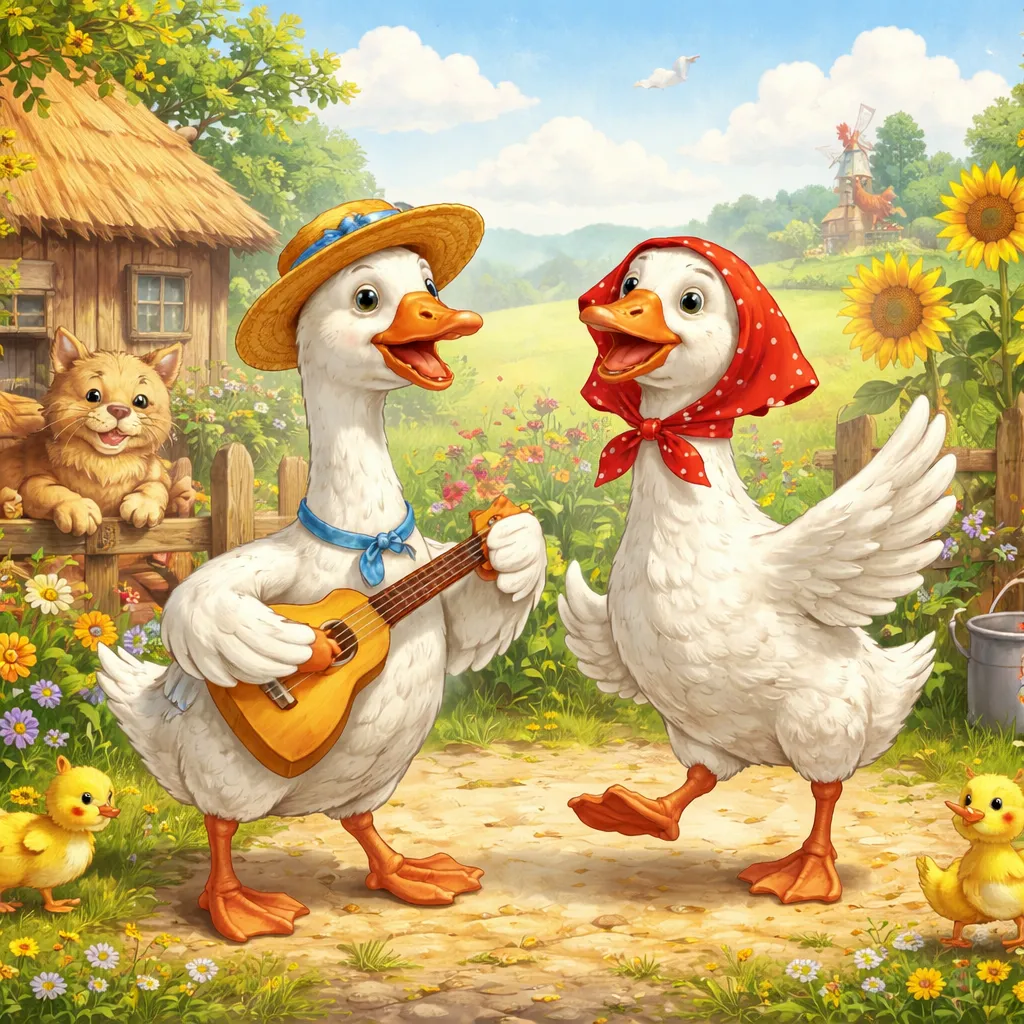

Have you ever seen geese walking together? They sometimes walk in a line, making funny sounds. In Russia, the word for goose is “гусь” (goos’), and there is a very famous, silly song about a pair of them. It is a song about two geese who live with their grandma and get into a funny situation. Let’s meet the characters in the Russian song “Two Cheerful Geese (Два весёлых гуся).”
About the Song
Here are the playful and repetitive lyrics of the classic Russian children’s song “Two Cheerful Geese”:
Жили-были у бабуси
Два весёлых гуся.
Один – серый, другой – белый,
Два весёлых гуся.
Вытянули шеи,
У кого длинней.
Один – серый, другой – белый,
Два весёлых гуся.
Мыли гуси лапки
В луже у канавы.
Один – серый, другой – белый,
Два весёлых гуся.
Прятали лапки
В той же самой луже.
Один – серый, другой – белый,
Два весёлых гуся.
Кричала бабуся:
«Ой, пропали гуси!
Один – серый, другой – белый –
Гуси мои!»
Отвечали гуси:
«Бабуся, ты, бабуся,
Не кричи так, бабуся,
Мы вернулись к тебе!»
English Translation:
Once upon a time, grandma had
Two cheerful geese.
One was grey, the other was white,
Two cheerful geese.
They stretched their necks,
To see whose was longer.
One was grey, the other was white,
Two cheerful geese.
The geese washed their feet
In a puddle by the ditch.
One was grey, the other was white,
Two cheerful geese.
They hid their feet
In that very same puddle.
One was grey, the other was white,
Two cheerful geese.
Grandma shouted:
“Oh, the geese are lost!
One grey, the other white –
My geese!”
The geese answered:
“Granny, you, granny,
Don’t shout so, granny,
We came back to you!”
This is a traditional and hugely popular Russian folk song for children. The song tells a simple, funny story about “два весёлых гуся” (two cheerful geese) who belong to a grandma (“бабуся”). The song describes their colors, their silly actions like stretching their necks and washing their feet in a puddle, and a playful moment where they hide and grandma thinks they are lost. The geese then talk back to her! It is a song full of humor, repetition, and a little conversation.
What the Song is About
The song is a short, funny story about two goose friends. First, we meet them. They live with their grandma. “Два весёлых гуся.” One goose is grey, and the other goose is white.
These geese are playful. They stretch their long necks. “Вытянули шеи.” They are having a contest to see whose neck is longer! Then, they find a muddy puddle. “Мыли гуси лапки в луже.” They wash their feet in the puddle. But then, they do something silly. “Прятали лапки в той же самой луже.” They hide their feet in that same puddle!
Grandma cannot see their feet. She gets worried and shouts, “Oh, пропали гуси!” She thinks her geese are lost! But the geese are right there. They answer her, “Не кричи так, бабуся!” They tell her not to shout because they have come back. It was just a funny trick.
When to Sing It
This song is perfect for playful and silly times. You can sing it while playing with toy animals, acting out the geese stretching and washing. You can sing it on a walk, especially if you see birds or puddles. You can also sing it as a fun call-and-response song with a friend or sibling, one being the grandma and the other being the geese.
What Children Can Learn
This humorous song is a wonderful teacher for learning about counting, describing, and simple past actions in Russian.
Vocabulary
The song teaches us clear Russian words for family, animals, colors, numbers, body parts, and actions. “Lived (once upon a time)” (Жили-были / Zhili-byli). “By/at grandma’s” (у бабуси / u babusi). “Two” (два / dva). “Cheerful” (весёлых / vesyolykh). “Geese” (гуся / gusya – here in a special form). “One” (один / odin). “Grey” (серый / seryy). “Other” (другой / drugoy). “White” (белый / belyy). “Stretched” (Вытянули / Vytianuli). “Necks” (шеи / shei). “Washed” (Мыли / Myli). “Feet/paws” (лапки / lapki). “In a puddle” (в луже / v luzhe). “Hid” (Прятали / Pryatali). “Shouted” (Кричала / Krichala). “Lost” (пропали / propali). “Answered” (Отвечали / Otvechali). “Don’t shout” (Не кричи / Ne krichi). “We returned” (Мы вернулись / My vernulis’).
Let’s use these words! You can describe things: “Один мяч, другой кубик.” (One ball, another cube.) New word: Цвет (tsvet). This means “color.” You can say, “Серый и белый – это цвета.” (Grey and white are colors.)
Language Skills
This song is excellent for learning about plural nouns like “гуси” (geese) and the number “два” (two) used with them. It also introduces us to verbs in the past tense, like “мыли” (washed) and “прятали” (hid), which tell us what happened before.
Concept Definition: We are learning about words for more than one thing (plural nouns). We are also learning about action words that tell us what someone did in the past (past tense verbs).
Features and Types: In Russian, the word for the thing often changes when there is more than one. “Гусь” (one goose) becomes “гуси” (geese). The number “два” (two) is often used with a special form, like “два гуся”. For past actions, many verbs change their ending. “Мыть” (to wash) becomes “мыли” (washed) for “they.” “Прятать” (to hide) becomes “прятали” (hid).
How to Spot Them: Here is the “More-Than-One Finder” trick. Look for numbers like “два” (two) or “три” (three) before a thing. The word for the thing will often look different than for one. Ask: “Is this talking about one or more than one?“ For past actions, many verbs in stories end with “-ли” or “-ла”. Ask: “Is this word telling me what someone did (an action that already finished)?“
How to Use Them: A great way to tell a simple story is the “Once-There-Were-Did” formula. Once: “Жили-были…“ (Once upon a time there were…) There were: “два [thing in special form].“ (two [things].) Did: “Они [past tense verb].“ (They [did something].)
Example from the song: “Жили-были… два весёлых гуся. Они мыли лапки.“
Example you can make: “Жили-были два маленьких кота. Они играли.“ (Once upon a time there were two small cats. They played.)
Sounds & Rhythm Fun
Listen to the bouncy, chanting melody of the song. The tune for “Два весёлых гуся” is very catchy and repetitive, almost like a nursery rhyme you can clap to. The rhythm is steady and fun.
The words have a great rhythmic pattern. The repeated line “Один – серый, другой – белый, Два весёлых гуся” acts like a chorus, easy to remember and sing together. Words like “вытянули” (stretched) and “прятали” (hid) are fun to say. The conversation part is dramatic: Grandma’s worried “Ой, пропали гуси!” and the geese’s playful reply “Не кричи так, бабуся!” make the song like a tiny play. This chanting rhythm is perfect for creating your own animal pair song. Try a rabbit song: “Жили-были у дедуси Два весёлых зайца…“ (Once upon a time, grandpa had Two cheerful hares…).
Culture & Big Ideas
“Two Cheerful Geese” is a staple of Russian childhood, much like “Old MacDonald” in English. It reflects a traditional rural or village setting where a “бабуся” (granny) might keep geese, which are common farm animals. The song turns everyday farm life into a silly, relatable story for children.
The song conveys three playful and important ideas. First, it teaches about pairs, opposites, and descriptions through the two distinct geese—“один серый, другой белый” (one grey, the other white)—helping with basic comparison and color learning. Second, it celebrates gentle mischief and humor, as the geese play a little trick by hiding their feet, causing grandma to worry, but it all ends happily with their return, showing that playful scares can be fun. Third, it highlights a caring relationship between the grandma and her geese, showing her concern for them and their affectionate response, reflecting themes of care and belonging.
Values & Imagination
Imagine you are in a little village house. “У бабуси” – at grandma’s house. In her yard, you see “два весёлых гуся.” One is all grey, and the other is pure white. They are best friends. They stretch their long, long necks up to the sky. Maybe they are trying to see who is taller!
Then, they waddle to a puddle. They splash their feet in the water, washing them. “Мыли гуси лапки.” But then, they think it’s funny to put their feet down and make them disappear in the muddy water. “Прятали лапки.” Grandma looks out the window and can’t see their feet! She thinks they are gone and cries out. But the geese pop up and say, “We’re right here!” How would you feel if you played a little trick like that? Draw the funny scene. Draw the grandma looking out the window. Draw the two geese, one grey and one white. Draw the puddle where they hide their feet. Draw a speech bubble for grandma and one for the geese. This shows the song’s story of playful fun and care.
The song encourages us to see the fun in everyday animals, to enjoy silly stories, and to understand the loving worry of caregivers. A wonderful activity is the “Один – Другой” (One – The Other) game. With a friend, point to two similar but different things, like two pencils. Say, “Один – красный, другой – синий.” (One is red, the other is blue.) This uses the song’s comparing language.
So, from the two geese stretching and washing to hiding and talking to grandma, this song is a lesson in playful storytelling. It is a vocabulary lesson in numbers, colors, and actions. It is a language lesson in talking about more than one thing and past actions. It is a music lesson in a catchy, chanting tune. “Two Cheerful Geese (Два весёлых гуся)” teaches us to describe, to enjoy gentle humor, and to see the stories in everyday life.
Your Core Takeaways
You are now an expert on the Russian song “Two Cheerful Geese (Два весёлых гуся).” You know it is a funny story about a grandma’s two geese, one grey and one white, who stretch their necks, wash and hide their feet in a puddle, scare their grandma, and then tell her they are back. You’ve learned Russian words like “гуси,” “бабуся,” “два,” “один,” “серый,” “другой,” “белый,” “мыли,” and “прятали,” and you’ve practiced talking about pairs with “два” and past actions with verbs like “мыли.” You’ve felt its catchy, repetitive rhythm. You’ve also discovered the song’s message about describing differences, playful tricks, and caring relationships.
Your Practice Missions
First, play the “Два Весёлых…” (Two Cheerful…) game. Look around for pairs of things, like two shoes, two spoons, or two toys. Say, “Жили-были два весёлых…” and add the word, like “два весёлых ботинка” (two cheerful shoes). Describe them: “Один – большой, другой – маленький” (One is big, the other is small). This mission helps you master the “два” + plural pattern from the song.
Second, act out the “Гусиный День” (Goose Day) story. With a friend or family member, pretend to be the geese. Do the actions: stretch your “шеи” (necks), wash your “лапки” (hands/feet), hide them, and then say the geese’s line: “Не кричи так, бабуся!” Another person can be the “бабуся” and say her line. This mission lets you use the song’s verbs and dialogue in a fun, physical way.