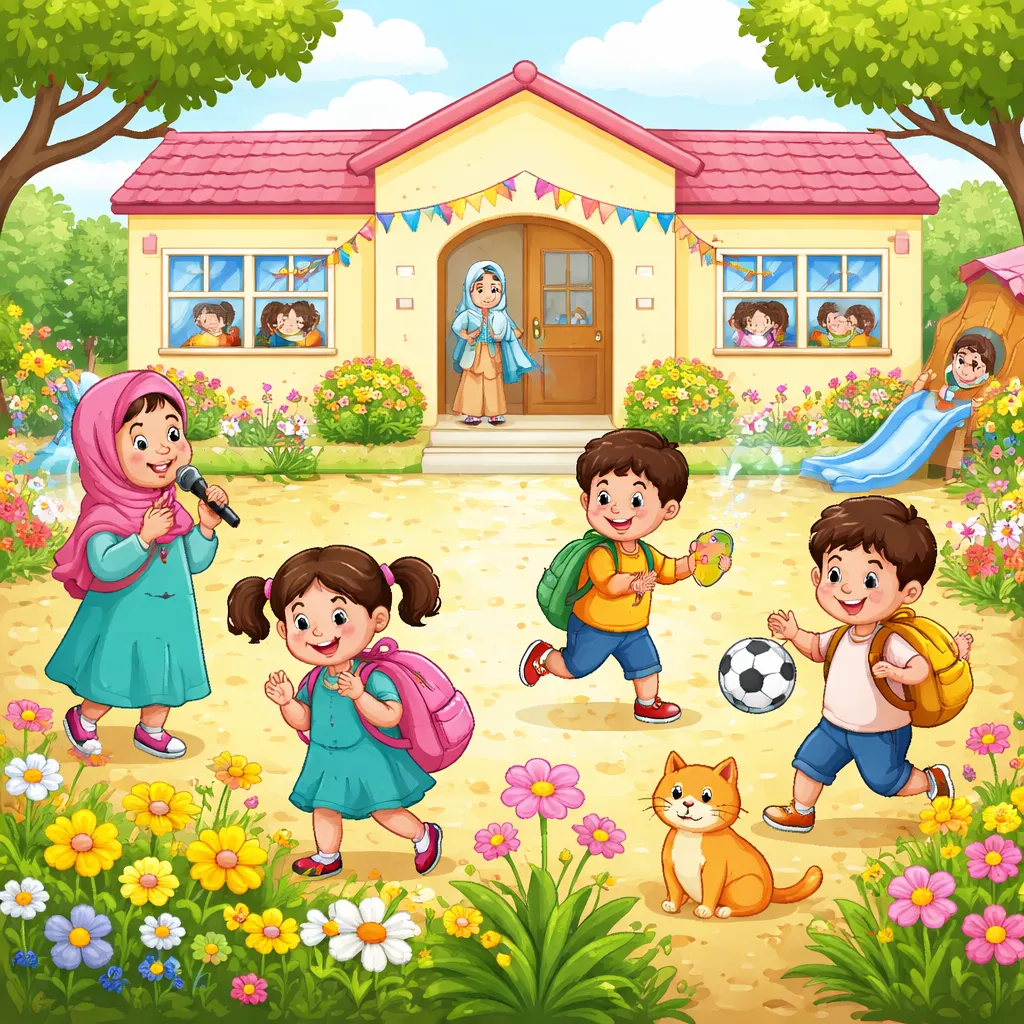

Do you remember your first day at a new school or classroom? Everything felt new and a little exciting. The building, the teacher, the other children—it was a whole new little world. There is a happy, familiar song that takes us right into that world, a place of learning and friendship. Let’s walk through the door and learn the Arabic song “The Little School (المدرسة الصغيرة).”
About the Song
Here is a cheerful and common verse from this beloved Arabic children’s song:
المدرسة الصغيرة، فيها أولاد جميلة
نلعب ونتعلم، مع المعلمة الفاضلة
في المدرسة الصغيرة، نغني جميع الأغاني
ونرسم ونكتب الحروف، في كل يوم وأواني
English Translation:
The little school, in it are wonderful children
We play and we learn, with the kind teacher
In the little school, we all sing songs
And we draw and write letters, every day and time
This is a popular traditional Arabic children’s song, sung widely across the Arab world to welcome children to the school environment. Like “The Little Garden,” its specific composer is part of a shared cultural tradition. The song is sung from the perspective of children happily at school. It is a song about the daily routine of a classroom, celebrating the activities of learning, playing, and being together with a kind teacher. It makes the school feel like a friendly, small community.
What the Song is About
The song is a happy tour of a school day. First, the children look at their school and see themselves: “wonderful children” inside it. Then, they describe what they do there. They have two main jobs: to play and to learn. They do this with the help of their “kind teacher.”
The song lists the fun activities. They all sing songs together. They draw colorful pictures. They write their letters, learning the shapes of the Arabic alphabet. They do this “every day and time,” meaning it’s their regular, happy routine. The whole song paints a picture of school as a busy, joyful, and safe little world.
Who Made It & Its Story
As a traditional song, “Al Madrasah Al Sagheerah” was created to help young children feel positive and excited about going to school. In Arab culture, education is highly valued, and this song reflects the importance of a good, welcoming start to a child’s learning journey. It is a classroom staple for three wonderful reasons. First, its melody is typically bright, simple, and repetitive, with a clear, marching rhythm that mimics the orderly and cheerful routine of a school day, making it easy for groups to sing together. Second, it presents school in a purely positive and fun light, focusing on play, singing, and creative activities (drawing, writing) to build a child’s excitement and reduce any anxiety about this new environment. Third, it emphasizes community and guidance, highlighting the group (“we all”) and the supportive role of the kind teacher, framing school as a place of collective friendship and growth.
When to Sing It
This song is perfect for moments connected to school and learning. You can sing it on the walk or drive to school in the morning, to get ready for the day. You can sing it during playtime when you are pretending to have a classroom with your toys or friends. You can also hum it while you are doing your homework or practicing writing your letters, to make it more fun.
What Children Can Learn
This structured and joyful song is a great teacher for learning basic verbs for daily activities and the essential preposition for location, “في” (in).
Vocabulary
The song teaches us important words about the school day. “The school” (المدرسة / al-ma-dra-sah). “Small / Little” (الصغيرة / as-sa-ghee-rah). “In it” (فيها / fee-ha). “Children / Boys” (أولاد / aw-lad). “Wonderful / Beautiful” (جميلة / ja-mee-lah). “We play” (نلعب / nal-ab). “And we learn” (ونتعلم / wa-na-ta-al-lam). “With the teacher” (مع المعلمة / ma’a al-mu-al-li-mah). “Kind” (الفاضلة / al-fa-di-lah). “We sing” (نغني / nagh-nee). “All” (جميع / ja-mee’). “Songs” (الأغاني / al-a-gha-nee). “We draw” (ونرسم / wa-nar-sim). “We write” (ونكتب / wa-nak-tub). “The letters” (الحروف / al-hu-roof). “Every day” (كل يوم / kul yowm).
Let’s use these words! You can describe your classroom: “في المدرسة نلعب.” (In school we play.) Or “أنا أتعلم الحروف.” (I am learning the letters.) New word: كتاب (ki-taab). This means “book.” You can say, “في المدرسة نقرأ الكتاب.” (In school we read the book.)
Language Skills
This song clearly demonstrates the first-person plural present tense (“we” form of verbs) for group activities and the fundamental preposition “في” (fee) meaning “in” or “at” a place.
Concept Definition: We are learning about “we do” words (first-person plural present tense verbs) that tell us what a group of people is doing together. We are also learning the key little word “في” that tells us where an action is happening, like “in the school.”
Features and Types: In Arabic, to say “we” do something, you often add the prefix “نـ” (n-) to the verb. “To play” becomes “نلعب” (nal’ab). “To learn” becomes “نتعلم” (nata’allam). The preposition “في” (fee) is very common. It is directly attached to the noun that follows, or the noun has a special sound. “في المدرسة” (fee al-madrasah) means “in the school.”
Example from the song: “We” form: “نلعب ونتعلم” (We play and we learn). Preposition: “في المدرسة الصغيرة” (In the little school).
How to Spot Them: Here is the “Together Detectives” trick. Look for action words that start with the sound “نـ” (n). Ask: “Is the singer talking about what ‘we’ are all doing together?“ For the location, look for the little word “في”. Ask: “Is this telling me the place where everything is happening?“
How to Use Them: A great way to talk about group activities is: “نـ + [Action Word].“ To say where it happens, start with “في” + [Place].
Example from the song: “نغني جميع الأغاني.” (We all sing songs.) “في المدرسة.” (In the school.)
Example you can make: “نأكل في المطبخ.” (We eat in the kitchen.) “نقرأ في الغرفة.” (We read in the room.)
Sounds & Rhythm Fun
The melody of “المدرسة الصغيرة” is usually bright, clear, and has a steady, marching rhythm. It sounds organized and happy, like lining up for a fun activity. The tune often has simple, repeating up-and-down patterns that are easy to follow.
The sounds are crisp and communal. The “نـ” (n) sound starts many action words, making them sound like a group activity: “نلعب، نتعلم، نغني” (we play, we learn, we sing). The “ي” (ee) sound at the end of words like “جميلة” (jameelah) and “الفاضلة” (al-fadilah) creates a soft, rhyming feel. The rhythm is even and strong, perfect for clapping or walking in time. This clear, marching rhythm is great for making your own classroom chant. Try singing: “في صفنا الصغير، نعد ونرقص، نسمع القصة، ونرفع أيدينا!“ (In our little class, we count and dance, we listen to the story, and we raise our hands!)
Culture & Big Ideas
In many Arab countries, the first day of school is a special celebration. Children often wear new clothes, and families might take photos. The teacher is traditionally shown great respect. This song reflects the cultural importance of education, community learning, and the respected role of the teacher (“المعلمة الفاضلة”).
The song conveys three foundational, positive ideas. First, it frames learning as a joyful and active process that is naturally mixed with play, singing, and creativity, making education feel like a fun adventure. Second, it strongly establishes the school as a social community (“we all”), promoting the values of doing things together, sharing experiences, and collective participation. Third, it introduces the concept of a positive, structured routine (“every day and time”) as something comforting and productive, helping children build good habits and a sense of stability.
Values & Imagination
Imagine you are the leader of your own “little school.” Your classroom can be anywhere—a corner of your room, the backyard, a blanket on the floor. You gather your “students”—your toys, your pets, your siblings. You are the kind teacher. First, you all sing a welcome song. Then, you “play and learn.” Maybe you use blocks to learn shapes. You draw a big, colorful picture on the wall. You help your teddy bear “write” his letters. Everyone is included, everyone learns, and everyone has fun. Draw this school: a happy, simple building. Draw yourself and your friends inside. Draw bubbles with activities coming out: a music note for singing, a pencil for writing, a ball for playing. This shows the song’s world of joyful, busy learning.
The song encourages us to see school and learning as exciting adventures we share with others. It teaches us to appreciate our teachers and to be good friends and helpers to our classmates. It shows that every day is a chance to play, create, and discover new things together. A wonderful activity is to host a “يوم المدرسة الصغيرة” (Little School Day). For one hour, turn your home into a school. You can be the teacher. Plan three activities: one song, one game, and one drawing or writing task. Lead your “class” (family or toys) through them, just like in the song. This turns the song into a real role-play of leadership and shared fun.
So, from the singing to the writing, the Arabic song “The Little School (المدرسة الصغيرة)” is a cheerful welcome to the world of learning. It is a vocabulary lesson in words for school, activities, and people. It is a language lesson in saying what “we” do together and where we do it (“في”). It is a music lesson in a bright, marching, communal melody. It teaches us that school is a friendly place where we play, learn, sing, and grow together.
Your Core Takeaways
You are now an expert on the Arabic song “The Little School (المدرسة الصغيرة).” You know it is a happy, traditional song that describes the fun activities children do together in school, like playing, learning, singing, and drawing with a kind teacher. You’ve learned Arabic words like “مدرسة,” “نلعب,” “نتعلم,” “معلمة,” and “نغني,” and you’ve practiced the “we” form of verbs (نـ) for group actions and the preposition “في” for location. You’ve felt its bright, clear, and marching rhythm that sounds like a school day. You’ve also discovered the song’s message about learning as joyful play, the importance of community in school, and the value of a happy, structured routine.
Your Practice Missions
First, be a “مدرس اليوم” (Teacher for the Day). Gather your toys or family members. Tell them what “we” are going to do today in our “little school,” using the “نـ + [Action]” pattern. Say: “الآن نغني! الآن نرسم! الآن نلعب!“ (Now we sing! Now we draw! Now we play!). Lead each activity. This mission helps you practice the song’s grammar for leading group activities.
Second, map your “مدرستي الصغيرة” (My Little School). Draw a simple map of your real or pretend classroom. Mark different areas: the singing circle, the reading corner, the play area. Point to each area and say in Arabic what you do there, using “في” (in). Say: “في الزاوية نقرأ. في الساحة نلعب.“ (In the corner we read. In the yard we play.) This mission lets you use the song’s vocabulary and preposition to describe your own learning world.