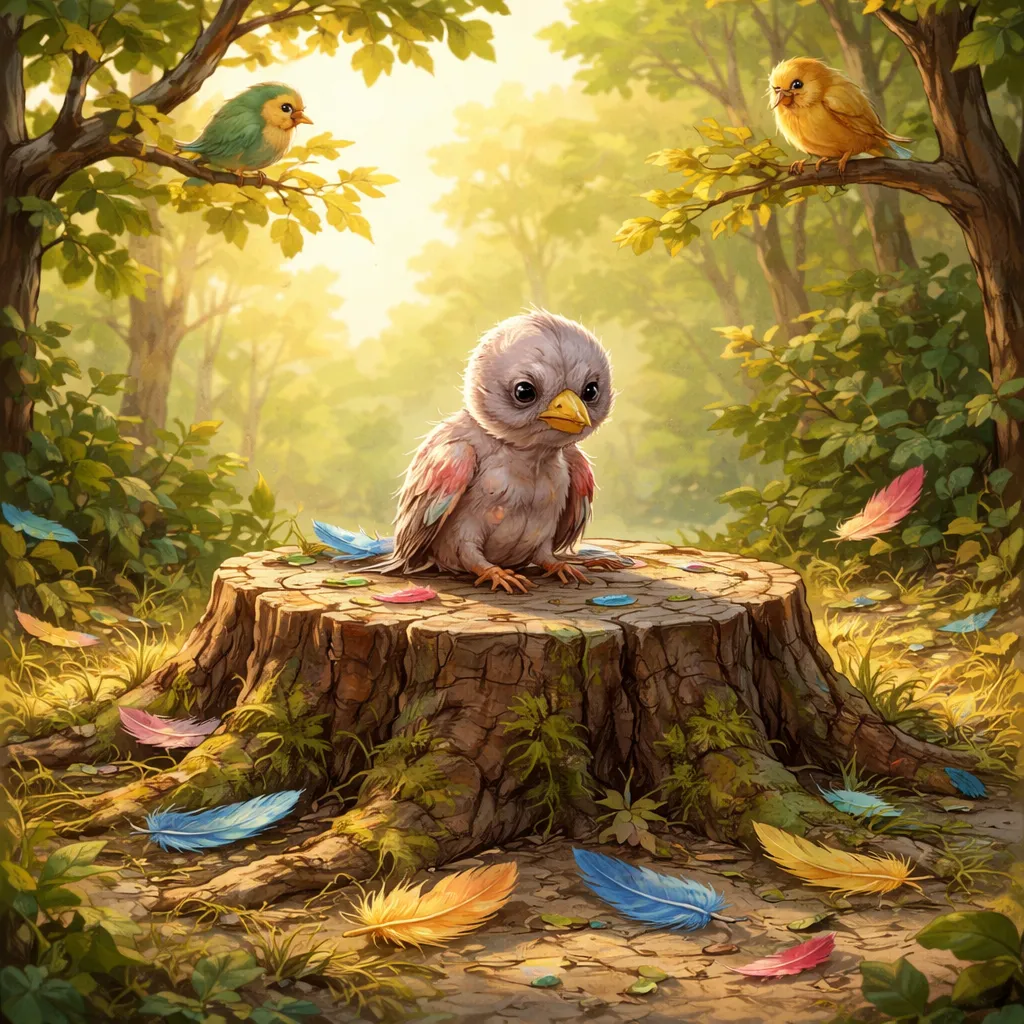

Have you ever found a pretty feather on the ground? It might be blue, or red, or speckled. Where did it come from? Did a bird lose it? There is a gentle and very popular French song that tells a story about a little bird and its feather. It is a song about a small loss, a little sadness, and a kind act. Let’s listen to the sweet and caring story of “The Little Bird (Le petit oiseau).”
About the Song
Here are the gentle and storytelling lyrics of this classic French children’s song:
Il était un petit oiseau
Tout bleu, tout bleu, tout bleu
Il était un petit oiseau
Tout bleu, tout joyeux.
Il avait une jolie plume
Tout bleue, tout bleue, tout bleue
Il avait une jolie plume
Tout bleue sur le côté.
Un jour, un méchant petit chat
Tout gris, tout gris, tout gris
Un jour, un méchant petit chat
Lui a pris sa jolie plume.
Le petit oiseau a pleuré
Très fort, très fort, très fort
Le petit oiseau a pleuré
Et puis il a chanté.
Alors moi, je lui ai donné
Une plume de chapeau
Alors moi, je lui ai donné
Pour qu'il soit à nouveau
Tout bleu, tout bleu, tout bleu
Tout bleu, tout joyeux.
English Translation:
There was a little bird
All blue, all blue, all blue
There was a little bird
All blue, all joyful.
He had a pretty feather
All blue, all blue, all blue
He had a pretty feather
All blue on his side.
One day, a mean little cat
All grey, all grey, all grey
One day, a mean little cat
Took his pretty feather from him.
The little bird cried
Very hard, very hard, very hard
The little bird cried
And then he sang.
So then, I gave to him
A feather from a hat
So then, I gave to him
So that he would be again
All blue, all blue, all blue
All blue, all joyful.
This is a beloved and narrative French folk song for children. The song tells a complete short story about a little blue bird. “Il était un petit oiseau tout bleu,” it begins, painting a picture of a happy, blue bird with a beautiful feather. The story takes a turn when a “méchant petit chat” (a mean little cat) takes the feather. The bird cries, but then he sings. Finally, the singer of the song, “moi” (me), steps in to help. The singer gives the bird a new feather from a hat so he can be blue and joyful again. It is a song about empathy, sadness, and kindness.
What the Song is About
The song is a little story with a beginning, a problem, and a happy ending. First, picture a happy little bird. He is completely blue. “Tout bleu, tout joyeux.” He is so blue and so happy. He has one special feather on his side that is especially pretty and blue.
One day, a little grey cat sees the shiny feather. The cat, being playful and a little mean, sneaks up. The cat reaches out a paw and snatches the bird’s pretty blue feather! “Lui a pris sa jolie plume.” The bird is so surprised and sad. He did nothing wrong, but now his beautiful feather is gone.
The little bird feels very sad. He starts to cry. “Le petit oiseau a pleuré.” He cries big, sad tears. But then, something beautiful happens. Even though he is sad, the little bird begins to sing. His song is soft and maybe a little lonely.
The person telling the story hears the bird’s sad song. They want to help. They look around and see a feather on their own hat. They gently take that feather and give it to the little bird. “Je lui ai donné une plume de chapeau.” The bird takes the new feather. Now he is all blue and joyful again. The kindness of a friend has fixed the problem.
Who Made It & Its Story
“Le petit oiseau” is a traditional French folk song. Its specific creator is unknown. It is a staple in French preschools and family music time, cherished for its simple, clear narrative that teaches emotional recognition and empathy. The song is often sung in a circle, with gentle hand motions to act out the bird, the cat, and the giving of the feather.
This tender narrative song is loved for three important reasons. First, it presents a complete, easy-to-follow mini-story with a clear emotional arc (happiness, loss, sadness, kindness, restored happiness), helping children understand and talk about simple story structure and feelings. Second, it beautifully models empathy and pro-social behavior, as the singer notices the bird’s sadness and performs a concrete, kind act to help, providing a clear example of compassion for young listeners. Third, it uses powerful, descriptive repetition (“tout bleu, tout bleu, tout bleu”) and contrasting colors (the blue bird vs. the grey cat) to create strong mental images and make the vocabulary and story elements memorable.
When to Sing It
This song is perfect for quiet, thoughtful moments and for teaching about kindness. You can sing it on a quiet afternoon, using a soft toy bird and cat to act out the story together. You can sing it as a comfort when a friend is sad, showing how we can help each other feel better, just like giving a new feather. You can also sing it outside while watching real birds, imagining their own little stories.
What Children Can Learn
This emotional little story is a wonderful teacher of colors, emotions, past tense narrative, and the act of giving.
Vocabulary
The song teaches us descriptive French words for animals, colors, objects, and feelings. “There was” (Il était). “A” (un). “Little bird” (petit oiseau). “All” (tout). “Blue” (bleu). “Joyful” (joyeux). “He had” (Il avait). “A pretty feather” (une jolie plume). “On the side” (sur le côté). “One day” (Un jour). “Mean” (méchant). “Little cat” (petit chat). “Grey” (gris). “Took from him” (Lui a pris). “Cried” (a pleuré). “Very strong/loud” (très fort). “And then” (Et puis). “Sang” (a chanté). “So then” (Alors). “I” (moi, je). “Gave to him” (lui ai donné). “From a hat” (de chapeau). “So that he would be” (Pour qu’il soit). “Again” (à nouveau).
Let’s use these words! You can describe things: “Mon sac est tout rouge.” (My bag is all red.) “Le chat est tout noir.” (The cat is all black.) New word: Donner. This means “to give.” You can say, “Je donne le livre à mon ami.” (I give the book to my friend.)
Language Skills
This song is excellent for hearing and learning about talking about something that happened in the past. Many of the actions in the song are in a common past tense called the “passé composé,” which is like saying “has done” or “did.”
Concept Definition: We are learning about special word pairs that tell us an action is finished. In the song, the bird cried (“a pleuré”), and the singer gave (“ai donné”). These are not happening now; they happened in the story. Think of it as the “Finished Action” team. The first word (like “a” or “ai”) is the helper, and the second word (like “pleuré” or “donné”) is the main action word in a special form.
Features and Types: This “Finished Action” team often has the helper “a” (for he/she/it) or “ai” (for I). The main action word often ends with the sound “-é” for many verbs. The pattern is: “[Person] + [helper ‘a’ or ‘ai’] + [action word ending often in ‘-é’].” From the song: “Le chat… a pris” (The cat… took/has taken). “L’oiseau a pleuré” (The bird cried/has cried). “Je… ai donné” (I… gave/have given).
How to Spot Them: Here is the “Storytime Action” trick. Listen for a two-word team where the first word is “a” or “ai” and the second word sounds like it ends with “-ay” (like “donné” sounds like “don-ay”). Ask yourself: “Is this telling me what someone did one time in the past?” If yes, it is probably this “Finished Action” team. It helps tell the story.
How to Use Them: A great way to tell a friend what you did is the “My Story” formula. The pattern is: “Je + ai + [action word ending often in -é].” For he/she/it: “Il/Elle + a + [action word ending often in -é].”
Example from the song: “Je lui ai donné une plume.” (I gave him a feather.)
Example you can make: “J’ai mangé une pomme.” (I ate an apple.) “Il a joué au parc.” (He played at the park.)
Sounds & Rhythm Fun
Listen to the gentle, storytelling rhythm of the melody. The tune for “Il était un petit oiseau” is calm and moves up and down like a bird softly flying. The repetition of descriptive phrases makes it easy to remember and very beautiful to sing. “Tout bleu, tout bleu, tout bleu” is repeated, painting a strong picture.
The song uses contrasting sounds for the bird (“tout bleu,” joyful) and the cat (“tout gris,” méchant). The “ou” sound in “tout” and “eu” sound in “bleu” and “joyeux” are soft French sounds. The melody has a sadder part when the bird cries, and a hopeful, rising part when the singer helps. This musical storytelling is perfect for creating your own animal story song. Try a squirrel song: “Il était un petit écureuil tout brun, tout brun, tout brun… Un jour, il a perdu sa noix… Alors moi, je lui ai donné une amande…” (There was a little squirrel all brown, all brown, all brown… One day, he lost his nut… So then, I gave him an almond…).
Culture & Big Ideas
“Le petit oiseau” connects to the French cultural value of “bienveillance” (kindness) and emotional literacy, often nurtured through stories and songs. The act of the singer (“moi”) intervening to help reflects the importance of individual responsibility and compassion, common themes in French children’s literature and education.
The song conveys three gentle and crucial ideas. First, it validates feelings of sadness and loss (the bird cries “très fort”), showing children that it is okay to feel and express sadness when something bad happens. Second, it demonstrates active empathy and problem-solving, as the singer not only feels bad for the bird but takes a concrete, creative step (giving a hat feather) to help, modeling proactive kindness. Third, it builds narrative understanding by presenting a classic story sequence: introduction of a happy character, a disruptive event, an emotional reaction, a helping action, and a positive resolution, which is the foundation of storytelling.
Values & Imagination
Imagine you are the little blue bird. Your blue feathers are soft and bright. You have one special feather that shines in the sun. You feel “tout joyeux.” You sing a morning song. Then, a shadow moves. A little grey cat with bright eyes jumps and grabs your pretty feather! You feel a surprise, then a sadness. Your special thing is gone. You cannot help it; you start to cry. “Je pleure.”
But then, from your heart, a song comes out. It is a soft song about your blue feather. A person hears your song. They look at you with kind eyes. They see your sadness. They think for a moment. Then, they smile. They carefully take a long, beautiful feather from their hat. They hold it out to you. You take it gently. You put it in the empty spot. Now you feel blue and joyful again. How does it feel to receive a gift when you are sad? Draw the story. Draw three pictures. First, the blue bird with its feather. Second, the grey cat taking the feather and the bird crying. Third, a hand giving a new feather to the now-happy bird. This shows the song’s emotional journey.
The song encourages us to notice when others are sad, to use our imagination to find ways to help (even with something simple like a hat feather), and to understand that kindness can fix a problem and bring back joy. A wonderful activity is the “Plume de la Gentillesse” (Feather of Kindness) game. Cut out paper feathers. When you or a friend does a kind act, write or draw it on a feather. Stick all the feathers together to make a kind “bird” or a “hat of kindness.” This connects the song’s core theme of giving and helping.
So, from the blue joy to the grey trouble and back to happiness, this song is a lesson in feelings and friendship. It is a vocabulary lesson in colors, animals, and actions. It is a language lesson in talking about past actions with “a” and “ai.” It is a music lesson in a melodic tune that tells a story. “The Little Bird (Le petit oiseau)” teaches us about empathy, kindness, and how stories can have happy endings.
Your Core Takeaways
You are now an expert on the song “The Little Bird (Le petit oiseau).” You know it is a French story-song about a little blue bird who loses his pretty feather to a grey cat, cries, but then receives a new feather from a kind person. You’ve learned French words like “oiseau,” “plume,” “bleu,” “chat,” “pleuré,” “donné,” and “joyeux,” and you’ve practiced the “Finished Action” team (“a pleuré,” “ai donné”) for talking about the past. You’ve felt its gentle, storytelling rhythm and created your own animal help verse. You’ve also discovered the song’s message about recognizing sadness, showing empathy, and performing acts of kindness to help others.
Your Practice Missions
First, play the “Où est la plume?” (Where is the feather?) feeling game. Take a small object like a pretty stone or a toy. Pretend it is your “jolie plume” (pretty feather). Have a friend pretend to be the “méchant petit chat” and hide it. You act sad (“Je suis triste”) and then sing a little song. Your friend then gives it back, and you say, “Merci! Je suis joyeux!” (Thank you! I am joyful!). This mission helps you act out the song’s story and practice the emotions.
Second, be a “Détective de la Gentillesse” (Kindness Detective). For one day, watch for a moment when a friend, family member, or even a pet seems a little sad or needs help. Think of one small, kind thing you could do for them, like sharing a toy, giving a hug, or helping with a task. It is your “plume de chapeau” (feather from a hat). This mission lets you use the song’s core idea of noticing and helping in real life.