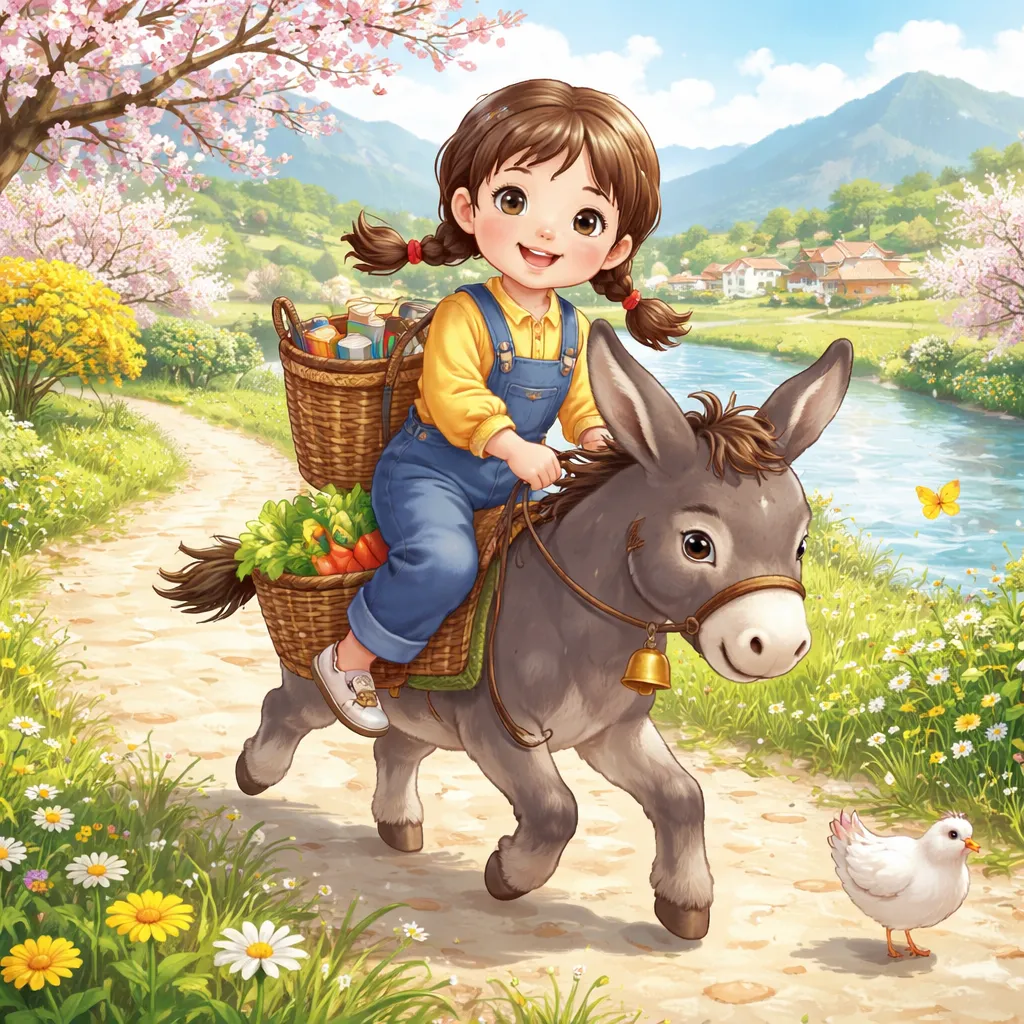

Have you ever pretended a pillow was a horse, or a broom was a pony, and gone on a wild ride around your room? Now, imagine riding a real, furry, stubborn donkey. A long time ago in China, someone made a very funny, bouncy song about a child who does just that—and the ride does not go exactly as planned! Let’s trot along with the playful tune “Little Donkey” (小毛驴, Xiǎo máolǘ).
About the Song
Let’s read the short, funny words of this famous song.
我有一只小毛驴我从来也不骑。
有一天我心血来潮骑着去赶集。
我手里拿着小皮鞭我心里正得意。
不知怎么哗啦啦啦我摔了一身泥。
English Translation:
I have a little donkey that I never ride.
One day, on a sudden impulse, I rode it to the fair.
In my hand, I held a little whip, and in my heart, I felt so proud.
But somehow, with a crash and a splash, I fell right into the mud.
This song is a classic Chinese children’s song. It is a humorous, first-person story told in a simple, repetitive melody. The singer tells us about owning a little donkey that they usually never ride. Then, on a whim, they decide to ride it to the local fair or market. They feel very proud and confident, even holding a little whip. But then, a sudden, funny disaster strikes! The donkey bucks or slips, and the singer tumbles off into a puddle of mud with a great onomatopoeic splash. The song is loved for its catchy rhythm, its funny twist, and the relatable feeling of a plan going comically wrong.
What the Song is About
The song paints a silly picture of overconfidence and a muddy surprise. The singer starts by telling us they own a little donkey. But they have a strange habit—they never actually ride it! Then, one day, they get a sudden idea. They feel excited and decide to ride the donkey to the busy village fair.
The singer climbs on, holding a tiny whip, feeling very pleased and proud. They imagine they look very important riding to the market. But then, something goes wrong! We don’t know exactly what the donkey did—maybe it stopped, maybe it jumped. The only thing we hear is the sound “哗啦啦啦” (crash, splash!) and the result: the singer is no longer on the donkey. They are sitting in the mud, covered from head to toe! The song is a mini-comedy about pride coming before a fall, literally. It’s about laughing at life’s little accidents and not taking yourself too seriously.
Who Made It & Its Story
“Little Donkey” is a traditional Chinese children’s song, so its original author is unknown. It has been passed down through generations and became a staple in Chinese kindergartens and primary schools in the 20th century. The song’s simple, repetitive structure and humorous story made it perfect for young children. It reflects a time when donkeys were common working animals in rural China, so the scenario was familiar. The song’s enduring popularity comes from its universal theme of a silly mishap, which every child can understand and find funny. It is often performed with hand motions and exaggerated expressions, making it a favorite for performances.
This song has remained a favorite for three hilarious reasons. First, its melody is incredibly catchy, bouncy, and easy to remember, with a rhythm that mimics the trotting of a donkey. Second, it tells a complete, funny story with a clear beginning, middle, and end in just four lines, which is very satisfying. Third, it has a perfect, dramatic punchline—the sudden fall into the mud—that always makes children giggle, teaching them to laugh at life’s little surprises.
When to Sing It
This song is perfect for active, silly play. You can sing it while bouncing on a couch or a bed, pretending it’s your little donkey, and then tumble off onto pillows for the “fall into the mud.” You can chant it with friends, taking turns acting out the proud ride and the muddy splat. You can also sing it on a walk, hopping over puddles and pretending to avoid the mud!
What Children Can Learn
This funny, story-song is a great teacher about narrative, sound, and humor.
Vocabulary
The song teaches us specific nouns and action words. A “donkey” (毛驴, máolǘ) is a sturdy animal related to a horse, known for being sometimes stubborn. A “whip” (皮鞭, píbiān) is a long, thin piece of leather used to guide an animal. A “fair” or “market” (集, jí) is a place where people buy and sell goods. “Proud” (得意, déyì) means feeling very pleased with yourself. “Mud” (泥, ní) is wet, soft dirt. “Crash/Splash” (哗啦啦, huālālā) is an onomatopoeic word for a loud, wet sound.
Let’s use these words! You can say, “The farmer took his donkey to the market.” Or, “I felt so proud after finishing my puzzle.” New word: Onomatopoeia. This is a word that sounds like the noise it describes, like “哗啦啦” for a crash or “meow” for a cat.
Language Skills
This song is a wonderful lesson in telling a story in the past tense and using time sequencers. The entire song is a story about something that happened in the past. It uses past time markers: “有一天” (one day) and “有一天…骑着去” (one day… rode to…).
The song uses the past tense in Chinese to show completed actions: “我骑了” (I rode), “我摔了” (I fell). The word “了” (le) is often added to a verb to show that the action is finished. The song also uses a contrast between the usual habit (“从来也不骑” - never ride) and the one-time action (“有一天我骑着” - one day I rode).
Sounds & Rhythm Fun
Listen to the bouncy, trotting, clip-clop rhythm of the melody. The song is in a lively 2/4 time, which feels like the steady pace of a donkey walking. The most fun part is the onomatopoeic “哗啦啦啦” which breaks the rhythm with a crash! The melody is simple and repetitive, making it very easy to learn. The Chinese lyrics have a clear, sing-song rhyme: “骑” (qí) and “集” (jí), “意” (yì) and “泥” (ní).
The rhythm is steady and jaunty. Try bouncing your knees: 我 有 一 只 小 毛 驴 (wǒ yǒu yī zhǐ xiǎo máo lǘ). The tune encourages movement and dramatic expression, especially on the crashing fall. This simple, narrative, and playful musical pattern is what makes the song so engaging. You can write your own funny accident song! Use the same bouncy rhythm. Try: “I have a red balloon that I never let go. One day I took it outside, and the wind began to blow. I held the string so tight, I thought it was just right. But somehow, with a pop and a whoosh, it flew right out of sight!”
Culture & Big Ideas
“Little Donkey” offers a glimpse into traditional Chinese rural life, where donkeys were common beasts of burden for transportation and farm work. The “fair” or market is a central part of community life, a place of trade and social gathering. The song’s humor is very Chinese in its gentle, self-deprecating style—laughing at one’s own misfortune is a common theme in folk tales. The song doesn’t blame the donkey; it blames the rider’s overconfidence. This connects to the value of humility. While not tied to a specific festival, the scene could happen on any market day, which were often lively weekly events in villages.
The song conveys three simple but important ideas. First, it’s about the humor in everyday mishaps. Life doesn’t always go as planned, and sometimes the best thing to do is laugh about it. Second, it expresses a light lesson about overconfidence. Feeling too proud or sure of yourself (“心里正得意”) can sometimes lead to a tumble! Third, it highlights storytelling through song. The song shows how a complete, funny story with a clear lesson can be packed into just a few lines of music, teaching the power of narrative.
Values & Imagination
Imagine you are the rider. What does your little donkey look like? Is it gray? Brown? How does it feel to sit on its back? Now, imagine the moment of the fall. Do you fly through the air? Do you land with a squelch? How does the mud feel? Cold? Slimy? Now, imagine you are the donkey. Why did you stop? Were you scared? Tired? Or just being a silly donkey? Draw a three-panel comic of the song. Panel 1: The rider looking proud on the donkey. Panel 2: The donkey stopping suddenly. Panel 3: The rider sitting in a mud puddle, looking surprised, with the donkey looking calmly back. Add the sound effect “哗啦啦!” in big letters.
The song encourages resilience, the ability to laugh at oneself, and empathy for animals (maybe the donkey had its own reasons!). A fun family activity is to have a “Silly Story Circle.” Sit in a circle. Start a story: “I have a [silly thing] I never use…” The next person adds a line, and so on, until the story ends with a funny disaster. This builds on the song’s structure and encourages creative, collaborative storytelling.
So, as the last note about the mud fades, think about the joyful lesson in this silly tune. It is a vocabulary lesson in animals and mishaps. It is a grammar lesson in telling a past story. It is a music lesson in a bouncy, trotting rhythm. From the first line about the donkey to the final muddy splash, it wraps lessons in humor, humility, and storytelling in a melody that makes you want to bounce, act, and laugh. “Little Donkey” teaches us that it’s okay to try new things, that accidents can be funny stories, and that sometimes, the ride is more memorable than the destination—especially if you end up in the mud!
Your Core Takeaways
You are now an expert on the song “Little Donkey” (小毛驴). You know it is a traditional Chinese song about a proud rider who falls into the mud. You’ve learned words like “donkey,” “whip,” and “mud,” and you’ve practiced telling a story in the past tense. You’ve felt its bouncy, trotting rhythm and created your own funny verse. You’ve also discovered the song’s reflection of rural life and its messages about finding humor in accidents, avoiding overconfidence, and the fun of musical storytelling.
Your Practice Missions
First, stage a “Donkey Drama.” With your family, act out the song. One person is the narrator/singer. One person is the rider (maybe on a parent’s back or a pillow “donkey”). Act out the proud ride, then the dramatic fall into a “mud puddle” made of blankets or pillows. Everyone says “哗啦啦啦!” together. This brings the song’s story to life.
Second, create a “Muddy Masterpiece.” The singer falls into the mud. Use brown paint or chocolate pudding (with permission!) on paper. Finger-paint a muddy scene. Then, use a different color to draw the clean rider and donkey before the fall. Or, draw the surprised rider in the mud. Write the onomatopoeic word “哗啦啦” on your artwork. This mission combines art, sensory play, and a key element from the song.