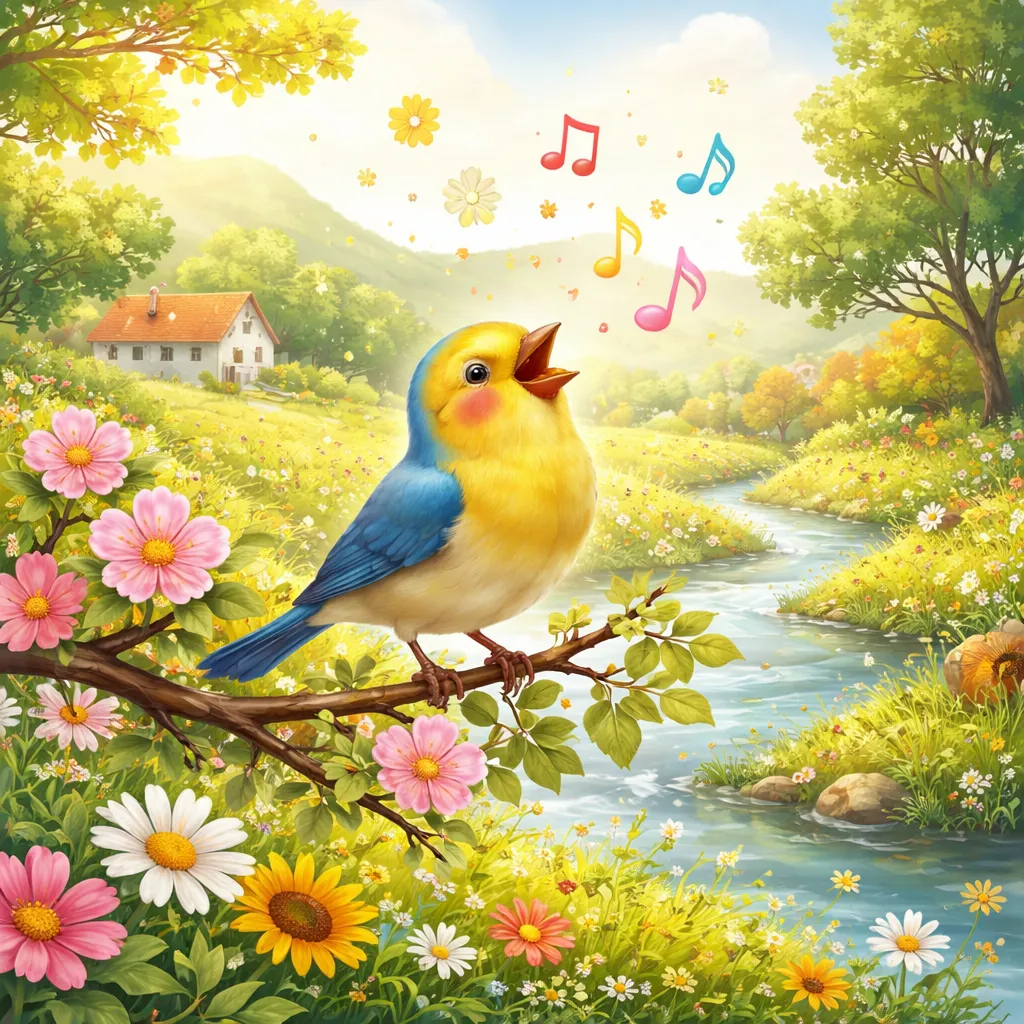

Do you love waking up to the sound of birds singing outside your window? Have you ever wondered what their happy songs might mean? Birds fill our world with beautiful music. In Portugal, there is a cheerful, simple song that imagines the life of a little singing bird. Let’s look up at the trees and learn the happy song “The Little Bird (O Passarinho).”
About the Song
Here are the joyful, melodic lyrics of a beloved traditional Portuguese children’s song. This version celebrates the bird’s simple gift:
O passarinho, o passarinho
Canta, canta, na árvore.
O passarinho, o passarinho
Faz piu piu piu, de manhã.
O passarinho, o passarinho
Tem uma voz, tão feliz.
O passarinho, o passarinho
Enche o ar de alegria, assim.
English Translation:
The little bird, the little bird
Sings, sings, in the tree.
The little bird, the little bird
Makes piu piu piu, in the morning.
The little bird, the little bird
Has a voice, so happy.
The little bird, the little bird
Fills the air with happiness, like this.
This is a classic Portuguese-language children’s song from Portugal that celebrates the simple joy of a bird’s song. The word “passarinho” is a sweet way to say “little bird.” The song is a happy observation. It pictures a little bird sitting on a tree branch. What is it doing? It is singing its heart out! Its song is a cheerful “piu piu piu,” especially in the morning. The song tells us the bird has a very happy voice. This happy voice does something wonderful—it fills the whole air with joy. The song helps us see and hear the everyday music that nature gives us for free.
What the Song is About
The song is a snapshot of a bird’s happy moment. Imagine a small bird with soft feathers. It is perched on a green branch of a tall tree. The song begins, and the bird opens its tiny beak. “The little bird sings, sings, in the tree,” the song says. You can almost hear the tune.
The bird’s song is not words, but a sweet sound: “piu piu piu!” It loves to sing this song in the fresh morning air. “The little bird makes piu piu piu, in the morning.” The song then describes the bird’s voice. It is not just any voice. It is a voice full of happiness. “The little bird has a voice, so happy.” This happy voice is so powerful. It does not stay just with the bird. It spreads out and fills the sky, the garden, the whole world around it with a feeling of joy. “The little bird fills the air with happiness, like this.” The song shows us how one small creature’s song can make the whole world brighter.
Who Made It & Its Story
“O Passarinho” is a traditional Portuguese folk song, part of a vast collection of tunes that celebrate nature and simple daily life. Its specific creator is lost to time, as it has been sung by Portuguese families and in schools for many, many years. The song reflects the deep appreciation for nature’s sounds in Portuguese culture, where gardens, parks, and the countryside are filled with birdsong. It is commonly used in early childhood settings to develop listening skills, an appreciation for music, and to connect children with the natural sounds of their environment in a positive, uplifting way.
This bright song is loved for three beautiful reasons. First, it is a wonderful, positive introduction to onomatopoeia and animal sounds in Portuguese with the classic bird call “piu piu piu.” Second, its melody is often light, upbeat, and easy to sing, encouraging children to join in and mimic the bird’s happy tune. Third, it carries a powerful emotional message about happiness, how it starts within us (a happy voice) and can spread to fill the world around us (the air), teaching about emotional expression in a simple, natural way.
When to Sing It
This song is perfect for happy, observant moments. You can sing it first thing in the morning when you hear the real birds chirping outside your window. You can hum it during a walk in the park, looking for birds in the trees and singing to them. You can also chant it when you feel especially happy yourself, sharing your own “piu piu piu” with the world.
What Children Can Learn
This joyful song is a wonderful teacher about nature, sounds, and expressing feelings in Portuguese.
Vocabulary
The song teaches us words for animals, actions, feelings, and nature in Portuguese. “The little bird” (O passarinho). “Sings” (Canta). “In the tree” (na árvore). “Makes” or “does” (Faz). “Piu piu piu” is the sound of a bird chirping. “In the morning” (de manhã). “Has” (Tem). “A voice” (uma voz). “So happy” (tão feliz). “Fills” (Enche). “The air” (o ar). “With happiness” (de alegria). “Like this” (assim).
Let’s use these words! You can say, “O passarinho canta.” (The little bird sings.) Or, “Eu estou feliz.” (I am happy.) New word: Melody. This is a sequence of musical notes that makes a tune, like the bird’s “piu piu piu” or the song you are singing right now.
Language Skills
This song beautifully shows us how to use the simple present tense to talk about habits and regular actions, and how to use the word “tão” (so) to make descriptions stronger.
Concept Definition: The simple present tense is how we talk about things that happen regularly, habits, or general truths. The word “tão” is a word we use to make an adjective (a describing word) much stronger. It means “so” or “very.”
Features and Types: Look at the bird’s actions in the song. The bird “canta” (sings). This is something it does often, maybe every day. It is a habit. The song also describes the bird’s voice: “tão feliz” (so happy). Here, “tão” makes the word “feliz” (happy) stronger. It is not just a little happy; it is so happy.
How to Spot Them: Here is a simple “habit detective” trick. Ask: “What does this person or animal do often or usually?” The answer is often in the simple present tense. In the song, the bird often sings. To find “tão,” look for it right before a describing word like happy, big, or small. It is a sign that the description is being emphasized.
How to Use Them: A great way to talk about habits and strong feelings is the “Habit and Feeling Formula”. The patterns are: “[Who/What] + [Present Tense Action].” and “[Who/What] + is/are + tão + [Describing Word].”
Example from the song: “O passarinho canta.” (The little bird sings.) “O passarinho tem uma voz tão feliz.” (The little bird has a voice so happy.)
Example you can make: “O sol nasce de manhã.” (The sun rises in the morning.) “A bola é tão redonda!” (The ball is so round!)
Sounds & Rhythm Fun
Listen to the light, chirping rhythm of the melody. The song often has a cheerful, bouncing pace that feels like a bird hopping from branch to branch. The repetition of “canta, canta” sounds like the bird singing the same sweet note twice. The best part is the sound effect: “piu piu piu!” This is the classic Portuguese way to write a bird’s chirp, and it is fun and easy to say. The melody is usually simple and rises up, like a bird’s song lifting into the sky.
The rhythm is happy and makes you want to sway or bounce gently. The repeating structure of the lines makes it very easy to learn and remember. The “piu piu piu” is a playful part that everyone can sing. This musical pattern is perfect for creating your own happy animal song. You can write your own “O Cachorrinho” (The Little Dog) song! Use the same tune. Try: “O cachorrinho, o cachorrinho, late, late, no jardim. O cachorrinho, o cachorrinho, faz au au au, com amor…” (The little dog, the little dog, barks, barks, in the garden. The little dog, the little dog, makes woof woof woof, with love…)
Culture & Big Ideas
“O Passarinho” connects to the love for simple pleasures and nature in Portuguese culture, where enjoying a sunny morning, listening to birds in a garden, or spending time outdoors is a cherished part of life. The song reflects a common theme in Portuguese folk music: finding beauty and happiness in everyday moments. It also connects to the idea of “alegria” (happiness or joy) as something to be shared openly, like a bird shares its song.
The song conveys three lovely, important ideas. First, it encourages active listening and appreciation for the natural sounds around us, like birdsong. Second, it explores the connection between inner feeling (happiness) and outward expression (singing), showing that what we feel inside can come out and affect the world. Third, it teaches that small, simple actions (like a bird’s chirp) can have a big, positive effect (filling the air with joy), promoting the idea that everyone can spread happiness.
Values & Imagination
Imagine you are the “passarinho.” You are a tiny, feathered bird waking up as the sun rises. You stretch your wings on a comfortable branch. You take a deep breath of the cool morning air. You feel a bubble of happiness inside you. You open your beak and let the feeling out as a song. “I sing, sing, in the tree,” you think. Your song is “piu piu piu!” You sing it to the sun, to the leaves, to the world. Your voice feels light and happy. “I have a voice, so happy,” you know. As you sing, you see the other birds wake up and start to sing too. Your happy sound mixes with theirs. Together, you fill the whole sky with music. “I fill the air with happiness, like this.” How does the song feel in your throat? How does the air feel when it is full of music? Draw the little bird’s world. Draw a tree with a happy bird on a branch. Draw musical notes or the word “PIU PIU PIU” coming from its beak. Draw a sun and a bright sky, and maybe show little waves of happiness or color filling the air around the tree. This shows the song’s main idea.
The song encourages us to find our own “happy voice,” to share our joy with others, and to appreciate the free music that nature gives us every day. A wonderful activity is a “Happiness Ripples” game. Think of one small thing that makes you happy. It could be a smile, a kind word, or a drawing. Share it with someone. Notice how your happy action might make them smile too. Your happiness, like the bird’s song, can fill the air around you. This connects you to the song’s spirit of sharing joy.
So, from the first chirp to the feeling of a sky full of joy, this song paints a picture of simple, shared happiness. It is a vocabulary lesson in nature, sounds, and feelings. It is a language lesson in talking about habits and using “tão” for emphasis. It is a music lesson in a light, chirping, uplifting melody. “The Little Bird (O Passarinho)” teaches us to listen to nature, to express our own happiness, and to see how our joyful sounds and actions can make the world a brighter place.
Your Core Takeaways
You are now an expert on the song “The Little Bird (O Passarinho).” You know it is a Portuguese song about a bird whose happy morning song fills the air with joy. You’ve learned Portuguese words like “passarinho,” “canta,” “árvore,” “piu,” “feliz,” and “alegria,” and you’ve practiced using the simple present tense and the emphasizing word “tão.” You’ve felt its cheerful, chirping rhythm and created your own animal sound verse. You’ve also discovered the song’s message about appreciating nature’s music, expressing happiness, and spreading joy to the world around you.
Your Practice Missions
First, be a “Bird Song Detective.” Find a quiet moment, maybe in your garden or by an open window. Listen carefully for real birds. When you hear one, try to copy its sound with your own “piu piu” or “tweet tweet.” Then, say a sentence in Portuguese about it: “O passarinho canta.” This mission connects you to the song’s real-life inspiration.
Second, do a “Tão Happy” challenge. Look around your room and find three things. For each thing, say one sentence in Portuguese using “tão” and a describing word. For example, “O cobertor é tão macio!” (The blanket is so soft!) or “O lápis é tão colorido!” (The pencil is so colorful!). This mission helps you practice using “tão” to make your descriptions stronger, just like the song described the bird’s voice.