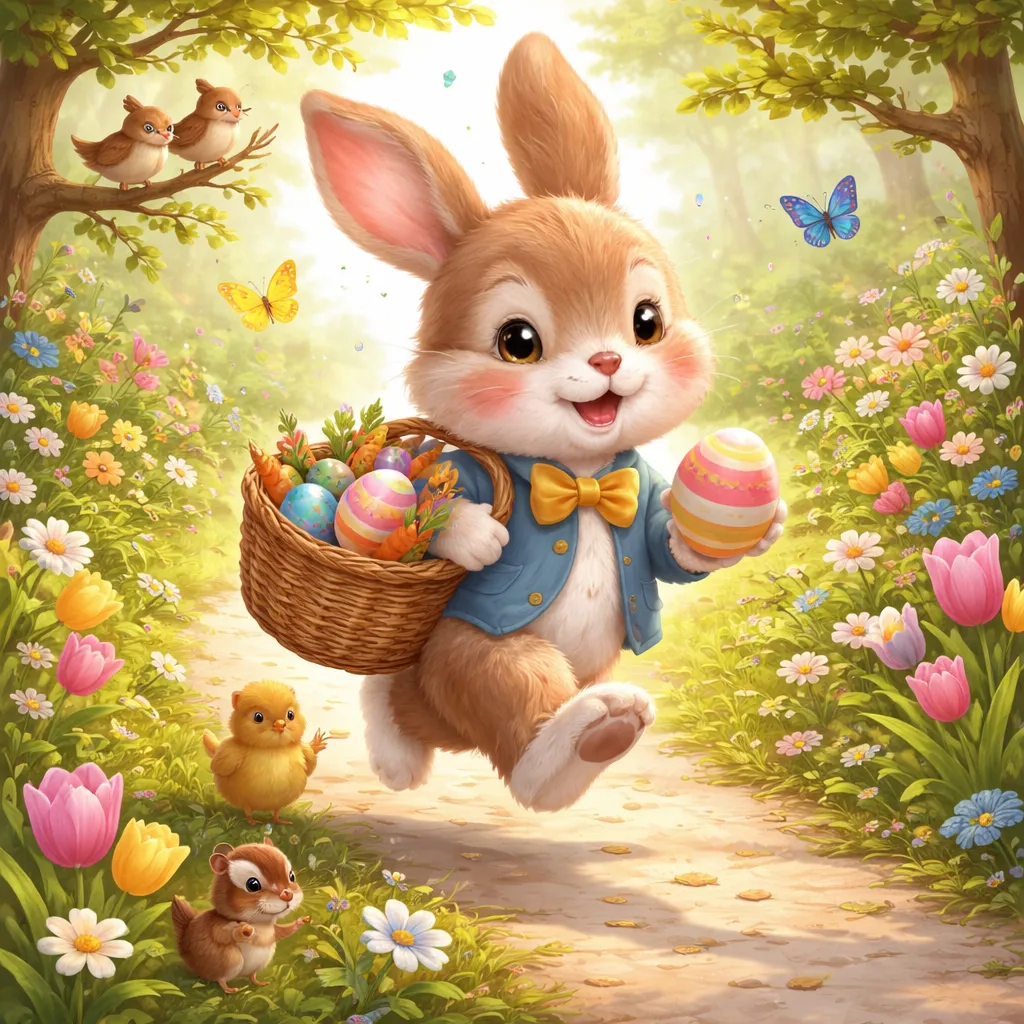

Can you imagine a rabbit that delivers colorful eggs and treats? In the spring, when flowers bloom, a special bunny becomes the star of a happy song. This bunny doesn’t just hop; he brings a basket full of joy. Let’s learn about the cheerful song “Here Comes Peter Cottontail.”
About the Song
Let’s read the happy, bouncy words of this classic song.
Here comes Peter Cottontail,
Hoppin' down the bunny trail,
Hippity, hoppity, Easter’s on its way.
Bringin' every girl and boy
A basketful of Easter joy,
Things to make your Easter bright and gay.
He’s got jelly beans for Tommy,
Colored eggs for sister Sue,
There’s an orchid for your Mommy
And an Easter bonnet, too.
Oh! Here comes Peter Cottontail,
Hoppin' down the bunny trail,
Hippity, hoppity, Happy Easter Day.
Look at him hop and listen to him say,
"Try to do the things you should."
Maybe if you’re extra good,
He’ll roll lots of Easter eggs your way.
You’ll wake up on Easter morning
And you’ll know that he was there
When you find those chocolate bunnies
And the colored eggs everywhere.
This song is a classic American Easter song. It is a lively, joyful tune that describes the approach of the Easter Bunny, named Peter Cottontail. The song was written by Steve Nelson and Jack Rollins and was first recorded by the famous “singing cowboy” Gene Autry in 1950, just a year after his huge hit “Rudolph the Red-Nosed Reindeer.” The song paints a picture of a friendly rabbit who hops down a trail, delivering baskets of treats, colored eggs, and flowers to children, encouraging them to be good. It is a musical celebration of the fun and sweetness of the Easter holiday.
What the Song is About
The song paints a bright, springtime picture. First, we see Peter Cottontail in the distance. He is hopping happily down a special path called the “bunny trail.” His hop has a rhythm: “Hippity, hoppity.” He is a sign that the Easter holiday is coming soon.
He is carrying a big basket. This basket is full of “Easter joy” for every boy and girl. Then, the song lists some of the specific treats in his basket. He has jelly beans for a boy named Tommy. He has beautifully colored eggs for a girl named Sue. He even has a beautiful flower (an orchid) for Mommy and a pretty Easter hat (a bonnet) for someone else.
The song reminds children to try to be good. Peter Cottontail suggests that if you are “extra good,” he might leave even more Easter eggs for you! The song ends by describing the magic of Easter morning. You wake up and know Peter was there because you find chocolate bunnies and brightly colored eggs hidden all around your home or yard.
Who Made It & Its Story
The songwriters who created Peter Cottontail are Steve Nelson (music) and Jack Rollins (lyrics). They were the same team that wrote “Frosty the Snowman.” Inspired by the success of holiday character songs, they wrote this song for Easter in 1950. They offered it to Gene Autry, who had a giant hit with “Rudolph.” Autry recorded it, and it became an instant Easter favorite. The character’s full name, Peter Cottontail, helps distinguish him as a specific, friendly character, much like Santa Claus or Frosty.
This song became a springtime classic for three happy reasons. First, its melody is incredibly catchy, bouncy, and full of energy, just like a hopping bunny. Second, it created a vivid and playful story around the Easter Bunny, giving him a name, a personality, and a specific mission, which made the tradition even more fun for children. Third, it is full of concrete, delightful images—jelly beans, colored eggs, bonnets—that capture the sweet, colorful joy of an Easter basket.
When to Sing It
This song is perfect for festive spring moments. You can sing it loudly while on an Easter egg hunt, hopping from one hiding spot to the next. You can sing it while helping to dye or decorate eggs, making the activity even more musical. You can also sing it as a family in the car on the way to a grandparent’s house for an Easter meal, building excitement for the day.
What Children Can Learn
This hopping, happy song is a basket full of wonderful lessons. Let’s explore all the treats inside.
Vocabulary
The song teaches us delightful words about Easter and spring. A “cottontail” is a common rabbit with a fluffy, white tail that looks like cotton. A “trail” is a path, often through woods or fields. “Hippity, hoppity” are fun, made-up words that sound like the rhythm of a rabbit hopping. A “basketful” means a basket that is completely full. “Easter joy” means the happiness of the Easter holiday. “Jelly beans” are small, bean-shaped candies. “Colored eggs” are eggs that are dyed or painted in bright colors. An “orchid” is a type of beautiful flower. An “Easter bonnet” is a fancy hat traditionally worn for Easter.
Let’s use these words! You can say, “I saw a cottontail in the garden.” Or, “We filled a basketful of toys for donation.” New word: Tradition. A tradition is a custom or belief passed down in a family or culture. The Easter Bunny is a fun holiday tradition.
Language Skills
This song is a great lesson in using the present continuous tense to describe an action happening right now and to talk about the near future. The present continuous is formed with “am/is/are” + verb-ing. It is used for actions in progress.
Look at the first line: “Here comes Peter Cottontail.” This is a present simple exclamation for an event happening as we speak. But the next line uses the -ing form: “Hoppin' down the bunny trail.” This describes the action he is doing at this moment. The song also uses the present continuous for future meaning: “Easter is on its way.” This tells us the holiday is coming soon. We use this tense a lot: “I am going to the park later.” The song also uses the future simple tense (“You’ll wake up… and you’ll know…”) to make a prediction about Easter morning.
Sounds & Rhythm Fun
Listen to the bouncy, upbeat rhythm of the song. The lyrics use wonderful, playful rhymes: “trail” and “gay,” “Sue” and “too,” “should” and “good,” “there” and “everywhere.” The best part is the onomatopoeic refrain “Hippity, hoppity,” which sounds like the bouncing steps of a rabbit.
The rhythm is light, quick, and full of energy, like a happy hop. Try bouncing lightly on your toes: Here COMES PEter COTtonTAIL. The melody is simple, repetitive, and very easy to sing, with a little jump on “Happy Easter Day!” that makes it fun to shout. This bouncy, cheerful rhythm is what makes the song so memorable and easy to dance to. You can write your own delivery song! Use the same hopping rhythm. Try: “Here comes Terry the Tooth Fairy, flitting through the air, sprinkle-ity, twinkle-ity, flying here and there. Bringing every girl and boy a shiny coin so new, for every little tooth that they carefully outgrew!”
Culture & Big Ideas
“Here Comes Peter Cottontail” is a classic example of 20th-century American holiday pop culture. It helped standardize the modern image of the Easter Bunny in the United States, much like songs did for Santa and Frosty. The song reflects the secular, commercial traditions of Easter that focus on candy, gifts, and family fun, which are celebrated alongside the religious observances of the holiday.
The song shares three cheerful ideas. First, it’s about anticipation and celebration. The song builds excitement for the coming holiday and the joy of discovering treats. Second, it connects good behavior with reward, in a gentle, non-scary way. The idea that being “extra good” might lead to more eggs is a playful encouragement. Third, it celebrates kindness and giving. Peter Cottontail is a generous figure who brings happiness to others, teaching the value of sharing joy with friends and family.
Values & Imagination
Imagine you are Peter Cottontail. What does the “bunny trail” look like? Is it a winding path through a flower-filled meadow? What does your basket feel like? Is it heavy with treats? How do you decide where to hide the eggs? Imagine hopping from house to house in the moonlight. What do you see? Quiet streets, lit windows, sleeping pets? Draw a map of Peter’s route through your neighborhood. Where would he hop? Where would he hide the eggs in your yard?
The song inspires us to be cheerful givers and to appreciate the simple joys of the season. A lovely idea is to have a “Basketful of Joy” activity. With your family, fill a small basket with little treats or drawings. Instead of keeping it, give it to a neighbor, a friend, or a family member as a surprise, just like Peter Cottontail delivers baskets. This turns the song’s message into an act of real kindness.
So, as we reach the end of Peter’s trail, think about the happiness he brings. This song is a vocabulary lesson in springtime treats. It is a grammar lesson in describing present action and future events. It is a music lesson in bouncy, joyful rhythm. From the first “hippity hop” to the final discovery of chocolate bunnies, it wraps the excitement of a holiday in a melody that makes you want to move. “Here Comes Peter Cottontail” teaches us that holidays are more fun with a story, that a little kindness hops a long way, and that the best mornings are the ones where you wake up to a world made just a little brighter and sweeter by magic—or by someone who cares.
Your Core Takeaways
You are now an expert on the song “Here Comes Peter Cottontail.” You know it was written in 1950 by Steve Nelson and Jack Rollins and made famous by Gene Autry. You’ve learned words like “cottontail,” “basketful,” and “bonnet,” and you’ve practiced using the -ing form to describe action happening now. You’ve felt its hopping, happy rhythm and created your own delivery song. You’ve also discovered how the song builds Easter excitement, gently encourages good behavior, and celebrates the joy of giving.
Your Practice Missions
First, have a “Hippity Hoppity” egg hunt. Hide a few plastic eggs or drawings of eggs around your room or yard. As you search, sing the song. Every time you find an egg, do a “hippity hoppity” dance move. This combines the song with the traditional Easter activity it describes.
Second, design Peter Cottontail’s basket. The song lists what’s in his basket. Draw or create a collage of your own perfect Easter basket. Include at least five items: some from the song (like jelly beans, colored eggs) and some of your own ideas (maybe a book, a seed packet, a toy). Present your basket drawing to your family, explaining what each item is and why Peter might bring it. This lets you use the song’s vocabulary and expand on its theme of joyful giving.