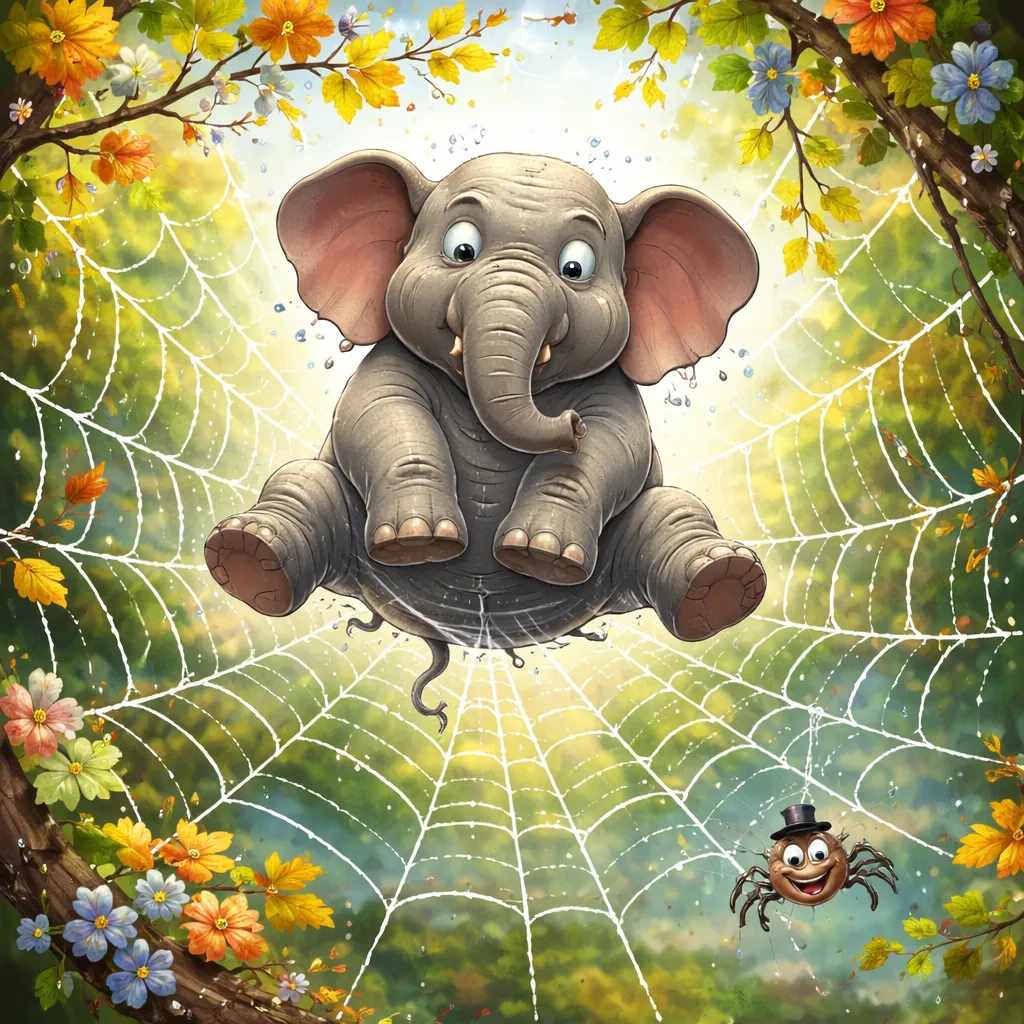

Have you ever seen a spiderweb? It is so thin and delicate. Now, think of an elephant. It is huge and heavy. What would happen if an elephant tried to play on a spiderweb? It sounds impossible and silly. There is a very funny French song that imagines exactly that. It is a song about a giant animal doing something very small. Let’s discover the playful and surprising song “The Elephant (L'éléphant).”
About the Song
Here are the funny and imaginative lyrics of this classic French children’s song:
Un éléphant, ça trompe, ça trompe,
Un éléphant, ça trompe énormément.
Deux éléphants, ça trompe, ça trompe,
Deux éléphants, ça trompe énormément.
Trois éléphants...
(Song continues counting up, often with added playful verses. A very common and beloved version is:)
Un éléphant qui se balançait
Sur une toile, toile, toile,
Une toile d'araignée.
Il trouva ça tellement rigolo
Qu'il alla chercher un autre éléphant.
Deux éléphants qui se balançaient
Sur une toile, toile, toile,
Une toile d'araignée.
Ils trouvèrent ça tellement rigolo
Qu'ils allèrent chercher un autre éléphant.
(And so on, adding one elephant each verse!)
English Translation:
An elephant, it deceives, it deceives, (Note: "Tromper" means to deceive, but sounds like "trunk" = "trompe". It's a wordplay.)
An elephant, it deceives enormously.
Two elephants...
(The swinging version:)
One elephant who was swinging
On a web, web, web,
A spiderweb.
He found it so very funny
That he went to fetch another elephant.
Two elephants who were swinging
On a web, web, web,
A spiderweb.
They found it so very funny
That they went to fetch another elephant.
This is a hugely popular and silly French counting song and playful rhyme. The most famous version for children is the one about the swinging elephant. The song starts with a single, enormous elephant doing something impossible: swinging on a tiny spiderweb. “Un éléphant qui se balançait sur une toile d'araignée.” The picture is so silly. Then, that elephant finds it so funny that he calls a friend. Now two elephants are swinging on the same fragile web. The song continues, adding more and more elephants to the web in each verse. It is a song about a funny, impossible idea that makes us laugh and count.
What the Song is About
The song is a funny, impossible story that grows with each verse. Picture a quiet garden. A single, huge gray elephant is standing there. He sees a spiderweb shining between two flowers. Instead of walking around it, he has a funny idea. He carefully puts his foot on it. Then, he sits on it! The thin, delicate web holds him. He starts to swing. “Qui se balançait.” He swings back and forth on the tiny spiderweb.
He loves it. It feels silly and fun. He thinks, “This is so funny! I need a friend to see this.” So the elephant carefully gets off and walks away. He finds another elephant. He says, “Come see what I found!” Now, two giant elephants tiptoe to the spiderweb. They both carefully sit on it. The web stretches, but it holds. Two elephants are now swinging together. They laugh and laugh.
They find it so hilarious that they go get a third elephant. Then a fourth. The song keeps adding more and more elephants to the same tiny, strong spiderweb. In your mind, you see a big pile of happy, swinging elephants on a web that should break but somehow does not. It is a wonderful, impossible joke.
Who Made It & Its Story
“L'éléphant” is a traditional French children’s song with many variations. Its specific creator is unknown. The most famous version for children is the cumulative counting song about the elephants on the spiderweb. It is a staple of French playgroups, schoolyards, and family car trips, loved for its repetitive, building structure that is perfect for group singing and memory games.
This brilliantly simple song is loved for three wonderful reasons. First, it is built on a hilarious and impossible image (elephants on a spiderweb) that immediately captures children’s imaginations and makes them laugh, showing the power of playful, illogical thinking. Second, it is a perfect, natural counting song that adds one more element with each repetition, helping children practice numbers in a fun and meaningful context without feeling like a math lesson. Third, it uses a catchy, repetitive, and cumulative melody and sentence structure that builds anticipation, makes the song easy to learn, and encourages everyone to join in as the numbers get bigger.
When to Sing It
This song is perfect for group fun and counting practice. You can sing it on a long car ride, taking turns to sing the next number and seeing how high you can count the elephants before everyone laughs too much. You can sing it on the playground, swinging on the swings and pretending to be the elephants on a spiderweb. You can also sing it as a quiet, silly song before bed, imagining the growing pile of sleepy elephants swinging gently.
What Children Can Learn
This joyful counting song is a fantastic teacher of numbers, the concept of adding on, and using imagination to create funny stories.
Vocabulary
The song teaches us clear French words for animals, actions, and counting. “An” (Un). “Elephant” (éléphant). “Who/That” (qui). “Was swinging” (se balançait). “On a” (sur une). “Web” (toile). “Spiderweb” (toile d’araignée). “He found that” (Il trouva ça). “So” (tellement). “Funny” (rigolo). “That he went” (qu’il alla). “To fetch/to look for” (chercher). “Another” (un autre). “Two” (Deux). “They” (Ils). The numbers continue: trois (3), quatre (4), cinq (5), etc.
Let’s use these words! You can count anything: “Un, deux, trois éléphants!” New word: Araignée. This means “spider.” The web is “la toile d’araignée” (the spider’s web). You can say, “Je vois une araignée.” (I see a spider.)
Language Skills
This song is excellent for learning about adding more to a group, one by one, and changing the words that go with the number. We see how the word for the animal and the action word change when we go from one elephant to two or more. This is about singular and plural forms.
Concept Definition: We are learning about how words change when we talk about one thing versus more than one thing. In the song, we start with one elephant (“un éléphant”). He does an action: “il se balançait” (he was swinging). When we add another, we have two elephants (“deux éléphants”). Now the word changes: “ils se balançaient” (they were swinging). The “s” at the end of “éléphants” and the change from “il” to “ils” and “balançait” to “balançaient” show us it is now a group.
Features and Types: In French, we often add a silent “s” to the end of a noun to make it mean more than one, like “éléphant” becomes “éléphants.” The little word in front (the article) changes too: “un” (a) for one, “des” for some. The pronoun (he/she/it) changes from “il” or “elle” to “ils” or “elles” (they). The verb (the action word) also often changes its ending. The pattern is: “[Number/Word] + [Noun with ‘s’] + [Verb for ‘they’] + [rest of sentence].”
How to Spot Them: Here is the “Counting Friends” trick. Look for the number word or a word like “des” (some) before the main person, place, or thing. Then, look for the little word for “they” (“ils” or “elles”). This tells you the sentence is about a group. Ask yourself: “Is the singer talking about one or many?” If it’s many, the noun will often have an “s” and the verb will sound different.
How to Use Them: A great way to describe a group is the “Group Action” formula. The pattern is: “[Number] + [Noun with ‘s’] + [qui] + [verb for ‘they’]…”
Example from the song: “Deux éléphants qui se balançaient…” (Two elephants who were swinging…)
Example you can make: “Trois chats qui dorment.” (Three cats who sleep.) “Cinq enfants qui jouent.” (Five children who play.)
Sounds & Rhythm Fun
Listen to the bouncy, climbing rhythm of the melody. The tune for “Un éléphant qui se balançait” is cheerful and has a swing to it, just like the elephants. The repetition is the magic of this song. Each verse is almost the same, just changing the number and a few words (“Un” to “Deux,” “il” to “ils,” “trouva” to “trouvèrent”).
This makes the song incredibly easy to remember and sing. The words “toile, toile, toile” are repeated three times, sounding like the web is swinging back and forth. The “-ait” sound in “balançait” and “rigolo” are fun to say. The melody climbs a little with each new elephant, adding to the feeling of building up. This musical pattern is perfect for creating your own cumulative songs. Try a monkey song: “Un singe qui mangeait une banane, trouva ça tellement bon, qu’il alla chercher un autre singe…” (A monkey who was eating a banana, found it so good, that he went to find another monkey…).
Culture & Big Ideas
“L'éléphant” connects to the French love for witty wordplay (“jeux de mots”) and playful, absurd humor in children’s culture. The adult version plays on the word “trompe” (which means both “trunk” and “deceives”), while the children’s version enjoys pure, illogical fantasy. It reflects how French “comptines” (nursery rhymes) often use silly scenarios to engage young minds.
The song conveys three clever and important ideas. First, it celebrates absurdity and imagination, giving children permission to imagine impossible, funny scenarios (like elephants on a spiderweb) and find joy in that silliness, which is a key part of creative thinking. Second, it is a brilliant, painless introduction to counting and addition, as each verse adds one more item to a group, helping children visualize and anticipate the growing number. Third, it teaches about sequence and consequence in a simple chain reaction (one action leads to the same action repeated), helping to understand simple narrative patterns and cause-and-effect in a playful way.
Values & Imagination
Imagine you are the first elephant. You are big and gray. You see a sparkling spiderweb in the morning sun. It looks so delicate. You have a funny, tickly feeling in your trunk. What if you tried to swing on it? You carefully put your big foot on it. The web stretches… but it holds! You sit down. It is like a tiny, bouncy hammock. You start to swing. “C’est rigolo!” (This is funny!). It feels so silly that a big animal like you is on such a small thing.
You must show a friend. You find another elephant. “Viens voir!” (Come see!). Now two of you are on the web, swinging and giggling. It is even funnier with a friend. So you get a third. And a fourth. Soon, there is a big, happy, wobbly pile of elephant friends all swinging together on one strong little web, laughing their heads off. How does the web not break? In the song, it just does not. It is magic. Draw the elephant pile. Start with one elephant on a web. Then draw two. Then three. See how many you can fit on your paper, all smiling and swinging. This shows the song’s growing, funny story.
The song encourages us to use our imagination to create impossible, happy pictures, to share fun with friends, and to see the joy in counting and adding more friends to the game. A wonderful activity is the “Château d’Animaux Impossibles” (Impossible Animal Castle) game. Think of an animal and put it in a silly place. Draw it or act it out. “Un hippopotame sur une balançoire!” (A hippo on a swing!). “Cinq girafes dans une petite voiture!” (Five giraffes in a tiny car!). This connects the song’s core idea of playful, impossible combinations.
So, from the first swinging elephant to the giant, wobbly pile, this song is a celebration of silly imagination. It is a vocabulary lesson in animals, counting, and actions. It is a language lesson in how words change from talking about one thing (singular) to many things (plural). It is a music lesson in a cumulative, building tune perfect for group singing. “The Elephant (L'éléphant)” teaches us about absurd humor, counting friends, and the strength of a shared, funny idea.
Your Core Takeaways
You are now an expert on the song “The Elephant (L'éléphant).” You know it is a funny French counting song about elephants who swing on a spiderweb and call more friends to join, making the silly picture bigger and bigger. You’ve learned French words like “éléphant,” “toile d’araignée,” “se balançait,” “rigolo,” and numbers like “un, deux, trois,” and you’ve practiced how words change from singular (“un éléphant… il”) to plural (“deux éléphants… ils”). You’ve felt its repetitive, building rhythm that makes counting fun and created your own cumulative animal verse. You’ve also discovered the song’s message about absurd humor, growing groups, and joyful imagination.
Your Practice Missions
First, play the “De plus en plus” (More and More) counting game. Take a basket and some toys. Start with “un ours” (one bear) in the basket. Sing: “Un ours dans le panier, trouve ça tellement bien, qu’il va chercher un autre ours!” Put in a second bear. Then sing for “deux ours,” and so on. Count how many you can add. This mission helps you practice the song’s core structure of adding one more each time.
Second, have an “Histoire Impossibe” (Impossible Story) drawing time. Fold a paper into four boxes. In the first, draw one animal in a silly place (like a fish riding a bicycle). In the next box, draw two of that animal doing it. In the third, draw three. Make the scene get more and more crowded and funny. Tell the story in French: “Un poisson fait du vélo…” This mission lets you use the song’s key ideas of absurdity and growing groups to create your own visual story.