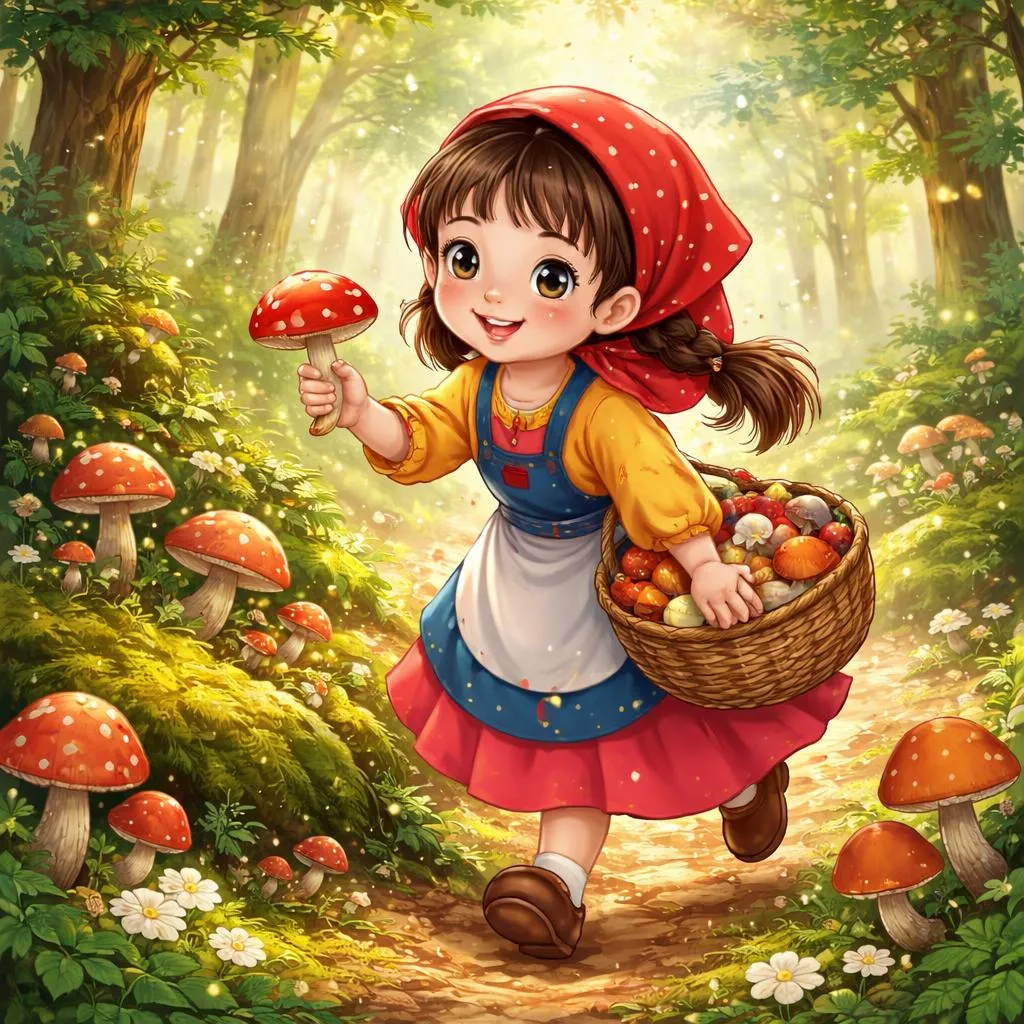

Have you ever gone on a treasure hunt, not for gold, but for things growing right out of the ground? Maybe berries in a bush or flowers in a field. A long time ago in China, a song was made about a cheerful girl who goes into the forest to look for a very special kind of treasure. Let’s follow the melody of the popular song “Picking Stars” (采蘑菇的小姑娘, Cǎi mógu de xiǎo gūniang).
About the Song
Let’s read the cheerful, descriptive words of this famous song.
采蘑菇的小姑娘,
背着一个大竹筐。
清早光着小脚丫,
走遍树林和山冈。
她采的蘑菇最多,
多得像那星星数不清。
她采的蘑菇最大,
大得像那小伞装满筐。
English Translation:
The little girl who picks mushrooms,
Carries a big bamboo basket on her back.
Early in the morning, barefoot,
She walks all through the woods and hills.
The mushrooms she picks are the most,
So many they’re like countless stars.
The mushrooms she picks are the biggest,
So big they’re like little umbrellas filling her basket.
This song is a popular Chinese children’s song from the 1980s. The lyrics were written by Chen Xiaofan (陈晓帆) and the music was composed by the famous Gu Jianfen (谷建芬). It is a bright, rhythmic, and lively tune that describes a young girl from a rural village going into the forest to pick mushrooms. The song paints a vivid picture of her hard work, her skill, and the abundant results of her labor, comparing the mushrooms to stars and little umbrellas. The melody is upbeat and catchy, making it a favorite for children to sing and dance to. It celebrates the joy of productive work and the simple pleasures of rural life.
What the Song is About
The song paints a clear picture of a hardworking, capable girl. The singer introduces us to a little girl whose job is to pick mushrooms. She carries a large bamboo basket on her back. She starts her work very early in the morning, and she doesn’t even wear shoes—she goes barefoot, which shows she is used to the natural path.
She walks through the woods and over the hills, searching everywhere. She is very good at her task. The mushrooms she gathers are the “most”—so many that they are compared to stars in the sky, which are too many to count. The mushrooms are also the “biggest,” and they are described as being like little umbrellas that fill up her basket. The song is a celebration of her effort, her success, and the wonderful, natural reward she collects from the forest. It’s about the pride and happiness that comes from doing a job well.
Who Made It & Its Story
“Picking Stars” (采蘑菇的小姑娘) was created in 1984. The lyricist, Chen Xiaofan, and the composer, Gu Jianfen, were renowned figures in Chinese children’s music. Gu Jianfen is particularly famous for composing many classic Chinese children’s songs. The song was written during a period when Chinese music was embracing folk styles and themes of everyday life. It quickly became a nationwide hit, beloved for its catchy tune and its positive portrayal of a diligent, happy child. The song is often performed in schools and on children’s television, and it remains a standard piece in the repertoire of Chinese childhood, teaching values of hard work and appreciation for nature’s gifts.
This song has remained a favorite for three joyful reasons. First, its melody is incredibly upbeat, catchy, and easy to sing along to, with a rhythm that makes you want to tap your feet. Second, it presents a positive and empowering image of a child as capable and hardworking, which is inspiring for young listeners. Third, it uses delightful and memorable comparisons (mushrooms like stars and umbrellas) that spark the imagination and make the description of work feel magical and fun.
When to Sing It
This song is perfect for active, playful moments. You can sing it while on a nature walk or hike, pretending to look for treasures on the ground. You can chant it while helping with chores at home, turning work into a game by imagining you are gathering “mushrooms” (like picking up toys). You can also sing it in a group, doing simple dance moves that mimic picking things up and putting them in a basket.
What Children Can Learn
This lively, descriptive song is a wonderful teacher about work, nature, and language.
Vocabulary
The song teaches us words about nature, work, and description. To “pick” (采, cǎi) means to gather or pluck. A “mushroom” (蘑菇, mógu) is a type of fungus that grows in forests. A “bamboo basket” (竹筐, zhúkuāng) is a container made from woven bamboo strips. “Early morning” (清早, qīngzǎo) is the time just after sunrise. “Barefoot” (光着小脚丫, guāngzhe xiǎo jiǎoyā) means without wearing any shoes or socks. “Woods” (树林, shùlín) and “hills” (山冈, shāngāng) are natural landscapes. “Countless” (数不清, shǔ bù qīng) means too many to count.
Let’s use these words! You can say, “We went to pick apples in the orchard.” Or, “The countless grains of sand on the beach.” New word: Abundant. This means existing in large quantities; plentiful. The girl finds an abundant harvest of mushrooms.
Language Skills
This song is a great lesson in using descriptive comparisons and the structure for superlatives. The song makes two vivid comparisons using “像” (xiàng, like): the mushrooms are as many as stars, and as big as little umbrellas. This helps listeners visualize the scene.
The song uses the superlative form to show she is the best: “她采的蘑菇最多… 最大” (The mushrooms she picks are the most… the biggest). In Chinese, “最” (zuì) is used before an adjective to form the superlative. The song also uses the present simple tense to describe her habitual actions: she picks, carries, walks.
Sounds & Rhythm Fun
Listen to the bouncy, cheerful, folk-like rhythm of the melody. The song is in a lively 2/4 time, which gives it a marching or dancing feel. The melody is very repetitive and easy to remember, with a catchy refrain. The Chinese lyrics have a clear, song-like rhyme: “筐” (kuāng) and “冈” (gāng), “清” (qīng) and “星” (xīng), and the repeated sounds in “蘑菇” (mógu).
The rhythm is peppy and light. Try a happy, stepping pace: 采 蘑 菇 的 小 姑 娘 (cǎi mógu de xiǎo gūniang). The tune encourages movement and is often accompanied by simple dance steps in performances. This repetitive, rhythmic, and joyful musical pattern is what makes the song so infectious and fun to sing. You can write your own “picking” song! Use the same bouncy rhythm. Try: “The little boy picking up toys, moving quickly, full of joys. The toys he picks are the neatest, making his room the completest.”
Culture & Big Ideas
“Picking Stars” is a product of the modern Chinese folk-inspired children’s music of the 1980s. It reflects the cultural value of hard work (勤劳, qínláo) and the appreciation of rural life and nature’s bounty. The song connects to the activity of foraging, which is a common practice in many cultures, especially around the time of the Qingming Festival when people go outdoors. The image of the barefoot girl is one of simplicity and closeness to the earth. The song also subtly teaches about economic contribution, as the girl likely sells or uses the mushrooms to help her family. It presents an idealized, happy vision of childhood labor, where work is not a burden but a source of joy, skill, and natural reward.
The song conveys three important ideas. First, it’s about the joy and pride found in hard work and skill. The girl is celebrated for being the best at her task, showing that effort leads to accomplishment and happiness. Second, it expresses appreciation for nature’s gifts. The forest provides abundantly, and the song encourages a sense of gratitude and connection to the natural world. Third, it highlights the value of simplicity and resourcefulness. The girl needs only her basket and her own two feet to achieve her goal, showing that great things can be done with simple tools and determination.
Values & Imagination
Imagine you are the little girl. The morning air is cool on your bare feet. What does the forest floor feel like? Soft moss? Crunchy leaves? Now, imagine finding a patch of mushrooms. How do they look? Like little buttons? Like tiny umbrellas? How do you feel when your basket gets heavier and fuller? Draw a picture of the song’s scene. Draw the girl with a big basket on her back, walking through a forest. On the ground, draw lots of big mushrooms, and in the sky above, draw stars. Draw a line connecting a mushroom to a star, with the words “as many as” written on it. This shows the song’s central comparison.
The song encourages a strong work ethic, appreciation for nature, and finding joy in simple, productive tasks. A lovely idea is to have a “Harvest Hunt” at home. With your family, choose a small chore that involves “gathering” or “picking up” (like organizing books, pairing socks, or tidying toys). Set a timer and see how much you can “harvest” in 5 minutes. Celebrate your “abundant” collection! This turns a routine task into a fun, song-inspired game.
So, as the last note about the full basket fades, think about the cheerful lesson in this catchy tune. It is a vocabulary lesson in nature and work. It is a grammar lesson in making comparisons and using superlatives. It is a music lesson in a bouncy, folk rhythm. From the first image of the girl with her basket to the final comparison of mushrooms to stars, it wraps lessons in hard work, natural abundance, and simple joy in a melody that makes you want to move and sing along. “Picking Stars” teaches us that work can be a happy adventure, that nature rewards the diligent, and that even the smallest hands can gather a harvest as plentiful as the stars.
Your Core Takeaways
You are now an expert on the song “Picking Stars” (采蘑菇的小姑娘). You know it is a 1980s Chinese children’s song about a girl skillfully picking mushrooms in the forest. You’ve learned words like “mushroom,” “bamboo basket,” and “countless,” and you’ve practiced making comparisons and using superlatives. You’ve felt its bouncy, cheerful rhythm and created your own picking verse. You’ve also discovered the song’s cultural background and its messages about the joy of hard work, appreciation for nature’s gifts, and the value of simplicity and skill.
Your Practice Missions
First, stage a “Mushroom Hunt” drama. With your family, pretend your living room is a forest. Scatter small pillows or balls as “mushrooms.” One person is the little girl, carrying a bag or box as a basket. Sing the song while she “picks” all the mushrooms. Time how fast she can do it! Then switch roles. This active play brings the song to life.
Second, create a “Comparison Collage.” The song compares mushrooms to stars and umbrellas. Make a collage that shows other fun comparisons. Find pictures in magazines or draw them. For example, a cloud like cotton candy, a tree like a giant broccoli. Write the comparison sentence under each. This activity encourages creative thinking and use of similes, just like the song.