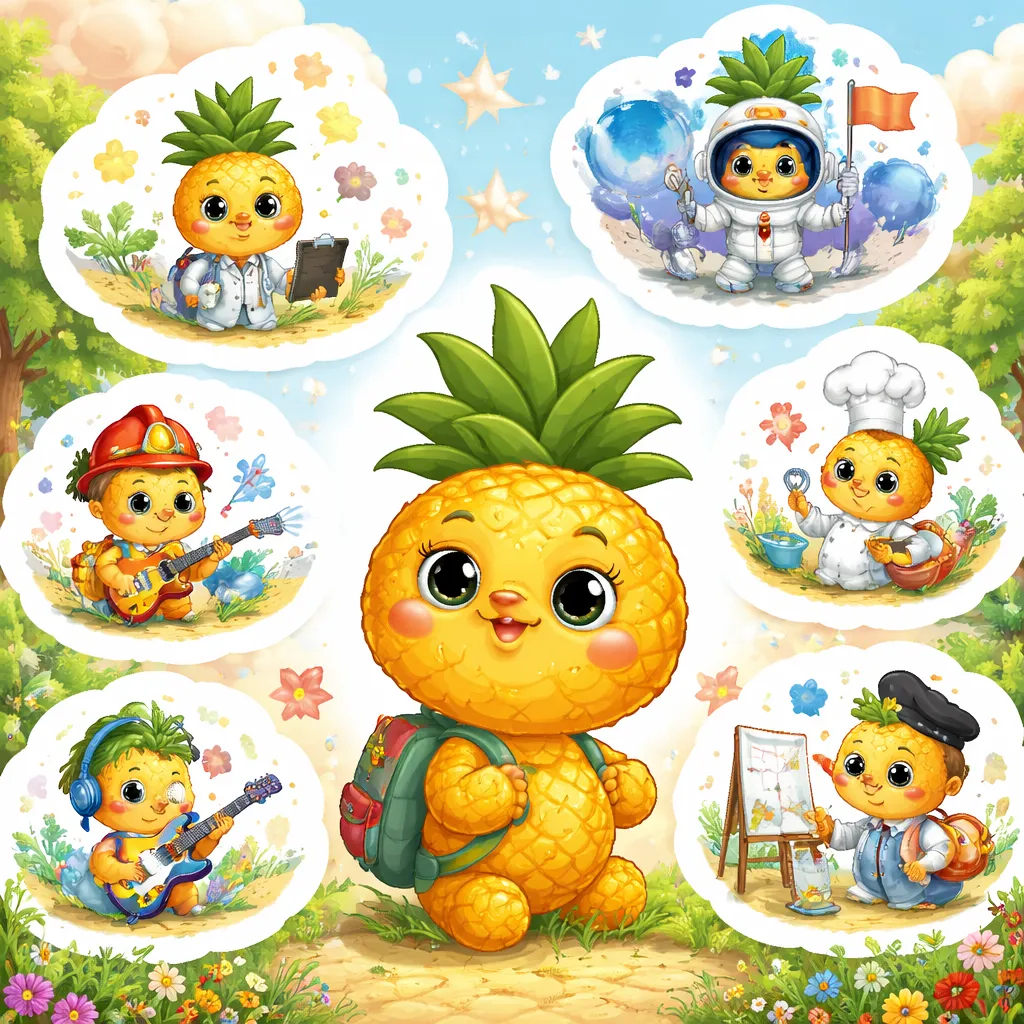

Have you ever eaten a sweet, juicy pineapple? Did you know it grows on a special plant right in the ground? In Spanish-speaking countries, there is a happy song that tells the story of a tiny pineapple growing big and strong. Let’s dig into the cheerful song “The Little Pineapple (La piñita).”
About the Song
Let’s read the sunny, growing words of this traditional song. Here is a common and beloved version:
(Verse 1)
Piñita, piñita, piñita, piñón,
tú que estás en el campo como un campeón.
Piñita, piñita, yo te voy a cortar
para llevarte a la feria para disfrutar.
(Chorus)
Ay, piñita, ay, piñón,
tú serás mi corazón.
Ay, piñita, ay, piñón,
llena de dulce sabor.
(Verse 2)
Verdes son tus hojas, amarillo tu interior,
creces con el sol y la lluvia con amor.
Piñita, piñita, pronto vas a crecer
y en la mesa familiar te vamos a comer.
(Chorus)
Ay, piñita, ay, piñón,
tú serás mi corazón.
Ay, piñita, ay, piñón,
llena de dulce sabor.
English Translation:
(Verse 1)
Little pineapple, little pineapple, little pineapple, little pine cone,
you who are in the field like a champion.
Little pineapple, little pineapple, I am going to cut you
to take you to the fair to enjoy.
(Chorus)
Oh, little pineapple, oh, little pine cone,
you will be my heart.
Oh, little pineapple, oh, little pine cone,
full of sweet flavor.
(Verse 2)
Green are your leaves, yellow your inside,
you grow with the sun and the rain with love.
Little pineapple, little pineapple, soon you will grow
and at the family table we are going to eat you.
(Chorus)
Oh, little pineapple, oh, little pine cone,
you will be my heart.
Oh, little pineapple, oh, little pine cone,
full of sweet flavor.
This is a traditional Spanish folk song and children’s song popular in many Latin American countries, especially in tropical regions where pineapples grow. The sweet name “piñita” uses the friendly, small ending “-ita” to mean “dear little pineapple.” The song is a celebration of nature’s gifts. It sings directly to the pineapple plant, praising its strength and sweetness. The song describes the pineapple growing in the field, nurtured by the sun and rain, and finally being harvested to be shared with the family. The melody is usually bright, rhythmic, and full of affection, like a cheerful compliment to a favorite fruit.
What the Song is About
The song paints a picture of the life of a pineapple plant, from the field to the family table. Imagine a big, sunny tropical field. In the middle, a strong pineapple plant stands proudly. It has long, pointy green leaves that look like a spiky crown. A small, green pineapple fruit is growing right in the center. The song starts by talking to this little fruit, calling it a “champion” for growing so well in the open field.
The singer makes a happy plan to pick the pineapple when it is ripe. The plan is to take the pineapple to a lively, colorful fair where people celebrate and have fun. The chorus sings lovingly to the fruit, calling it “my heart” and saying it is full of sweet flavor. Next, the song describes the pineapple with beautiful colors: green on the outside and yellow on the inside. It explains how the plant grows tall and strong thanks to the warm sun and the gentle, loving rain. The song promises that the little fruit will grow up soon. Finally, it shows a happy scene: the ripe, sweet pineapple is cut and placed on the family table, ready for everyone to share and enjoy as a delicious treat. The song is about growth, patience, and the joy of sharing nature’s sweet rewards.
Who Made It & Its Story
“The Little Pineapple (La piñita)” is a cherished Spanish folk song with no single known author. It grew from the agricultural traditions and daily life in tropical areas of Latin America, like Central America, the Caribbean, and parts of South America, where pineapples are an important and delicious crop. The song reflects a close connection to farming and the land. It personifies the pineapple, singing to it as if it were a friend, which shows a deep appreciation and love for the food that the earth provides. It is often sung in schools and homes to teach children about where food comes from in a joyful, musical way. The “feria” (fair) mentioned might refer to local markets or festivals where people sell and celebrate their harvest.
This song is loved for three joyful reasons. First, it is a sweet and simple introduction to where food comes from, teaching children about plants, growth, and harvest in a happy way. Second, it is full of affectionate, descriptive words that help children learn colors, nature elements, and feelings. Third, it celebrates family, sharing, and gratitude for nature’s gifts, turning a simple fruit into a symbol of love and togetherness.
When to Sing It
This song is perfect for happy, communal moments. You can sing it loudly while helping to prepare fruit in the kitchen, pretending the pineapple is the star of the show. You can chant it during a walk in a garden or park, celebrating all the growing plants you see. You can also sing it as a thankful song before a family meal, especially if pineapple is on the table, to appreciate the delicious food.
What Children Can Learn
This sunny, loving song is a wonderful teacher about nature, Spanish language, and gratitude.
Vocabulary
The song teaches us words for a tropical fruit, its parts, and its growth in Spanish. A “little pineapple” (piñita) is a small or young pineapple, a sweet tropical fruit. A “field” or “countryside” (campo) is open land where plants grow. A “champion” (campeón) is a winner, someone very strong and good. A “fair” (feria) is a fun outdoor event with games, food, and music. “Leaves” (hojas) are the green, flat parts of a plant. Your “inside” or “interior” (interior) is the part that is not the outside. To “grow” (crecer) means to get bigger. To “cut” or “harvest” (cortar) means to remove a fruit from its plant. “Flavor” or “taste” (sabor) is how something tastes, like sweet or sour.
Let’s use these words! You can say, “The sunflower is a tall champion in the garden.” Or, “The orange has a bright orange interior and a sweet flavor.” New word: Tropical. This describes a warm, humid climate near the equator where fruits like pineapples, bananas, and mangoes grow best.
Language Skills
This song is a great lesson in using adjectives to describe things and talking about the future with “going to.”
Concept Definition: An adjective is a word that describes a person, place, animal, or thing. It tells us more about it, like its color, size, or how it feels. In the song, we use adjectives to paint a picture of the pineapple. Think of it as a “describing word.” We also use a special way to talk about things that will happen later, like plans or sure things in the future.
Features and Types: In the song, we see many types of describing words. Color adjectives like “verdes” (green) and “amarillo” (yellow). Descriptive adjectives like “dulce” (sweet). We also see phrases for the future: “yo te voy a cortar” (I am going to cut you) and “vas a crecer” (you are going to grow). This is a common and easy way to talk about what will happen next.
How to Spot Them: Here is a simple “finding secret.” For adjectives, ask yourself: “Does this word tell me what something is like? Does it tell me the color, size, or taste?” If yes, it is probably an adjective! Look for words that come before nouns, like “dulce sabor” (sweet flavor). For the “going to” future, look for the words “voy a” (I am going to) or “vas a” (you are going to) right before an action word.
How to Use Them: A great way to use adjectives is with a simple “description recipe”. The pattern is: [Thing] + [Verb ‘to be’] + [Adjective].
Example from the song: “Verdes son tus hojas.” (Green are your leaves.) Thing=hojas, Verb=son, Adjective=Verdes.
Example from the song: “Llena de dulce sabor.” (Full of sweet flavor.) Thing=sabor, Adjective=dulce.
You can make your own descriptions! “The apple is red.” Or, “The cake has a chocolate flavor.” Just follow the recipe: Thing + is/are + Adjective.
Sounds & Rhythm Fun
Listen to the bright, bouncy, and affectionate rhythm of the melody. The song has a lively, folk music rhythm that makes you want to sway. The playful repetition of the affectionate name “Piñita, piñita, piñita, piñón” is super fun to say and helps you remember the song’s star. The chorus with “Ay, piñita, ay, piñón” has a sweet, sighing sound of love and excitement. The melody is often catchy and moves up and down like a happy little hill, especially on the lines describing growth and sweetness.
The rhythm is steady and cheerful. Try clapping along: Pi-ñi-ta, pi-ñi-ta, pi-ñi-ta, pi-ñón, tú que es-tás en el cam-po co-mo un cam-pe-ón. The repetition of the structure in the verses and chorus makes the song easy to learn and sing together. This bright, repetitive, and loving musical pattern is perfect for celebrating something you love. You can write your own “celebration of food” song! Use the same cheerful rhythm. Try: “Manzanita, manzanita, red and very sweet, you who are so crunchy and a perfect treat. Ay, manzanita, ay, red delight, you are such a yummy, shiny sight.”
Culture & Big Ideas
“La piñita” connects us directly to the tropical agriculture and vibrant market culture of Latin America. Pineapples are a beloved fruit in these regions, and songs like this one show a deep respect and affection for the foods the land provides. The mention of the “feria” (fair) reflects the importance of community markets and festivals where people gather to sell, buy, and celebrate local harvests with music and joy. This song embodies the value of seeing food not just as something to eat, but as a gift from nature that involves hard work, patience, and deserves celebration.
The song conveys three important themes. First, it’s about observing and appreciating nature’s process. The song follows the pineapple’s journey from a plant in the field to a sweet fruit on the table, teaching us to notice and value how our food grows. Second, it expresses patience and care. The pineapple grows with “sun and rain with love,” reminding us that good things take time and need nurturing. Third, it highlights gratitude and sharing. The final goal of the pineapple is to be enjoyed “en la mesa familiar” (at the family table), showing that the best part of food is sharing it with loved ones.
Values & Imagination
Imagine you are the little pineapple growing in the big field. The warm sun shines on your spiky green leaves all day. How does the sunlight feel? Warm and golden? Then, a gentle rain falls. How do the cool raindrops feel on your leaves? You drink the water and feel yourself growing bigger and stronger from the inside. You can feel your color changing from green to golden yellow, and your sweet flavor getting stronger every day. Now, imagine you are the farmer or child singing the song. You walk through the field and see the little pineapple. How do you feel when you see it growing so well? Excited? Proud? You can almost taste its future sweetness. Draw the pineapple’s story in three pictures. First, draw it as a small, green fruit in the middle of a big plant in a sunny field. Second, draw it bigger, with yellow showing, as the sun and rain fall on it. Third, draw it cut open on a family table, with everyone smiling. This shows the journey from the field to your home.
The song encourages a love for nature, patience for growth, and gratitude for shared food. A wonderful activity is a “Thank You, Fruit!” drawing. Choose your favorite fruit. Draw it in its natural home (on a tree, on a vine, in the ground). Then, draw it on your table. Write or say two thank-you notes: one to the sun and rain for helping it grow, and one to the people who helped bring it to you. This connects the song’s message to your own meals and thankfulness.
So, as the last note about sweet flavor fades, think about the journey in this sunny tune. It is a vocabulary lesson in fruits, colors, and growth. It is a language lesson in using describing words and talking about future plans. It is a music lesson in a cheerful, affectionate rhythm. From the first call to the little pineapple to the final celebration at the family table, it wraps lessons in observation, patience, and joyful gratitude in a melody that makes you appreciate every bite. “The Little Pineapple (La piñita)” teaches us that our food has a story, that growth takes love and time, and that the sweetest things are even better when we share them together.
Your Core Takeaways
You are now an expert on the song “The Little Pineapple (La piñita).” You know it is a traditional Spanish folk song that celebrates the growth of a pineapple, from the field to the family table. You’ve learned Spanish words like “piñita,” “campo,” and “dulce sabor,” and you’ve practiced using adjectives to describe things and the “going to” form to talk about the future. You’ve felt its bright, affectionate rhythm and created your own fruit celebration verse. You’ve also learned the song’s connection to tropical farming and its messages about appreciating nature’s gifts, being patient, and sharing with family.
Your Practice Missions
First, play “Guess the Fruit with Adjectives.” With a friend or family member, take turns choosing a fruit. Describe it using three adjectives (like “yellow,” “sweet,” “spiky”). The other person must guess the fruit! Use Spanish words if you can, like “dulce” for sweet. This mission turns the song’s vocabulary into a fun guessing game.
Second, grow your own “piñita” gratitude. The next time you eat a pineapple (or any fruit with a top, like a pineapple or green onions), save the leafy top. Place it in a small jar with water at the bottom and put it on a sunny windowsill. Watch the roots grow over the next few weeks! As you care for it, sing a line from the song: “creces con el sol y la lluvia con amor” (you grow with the sun and the rain with love). This activity connects the song’s theme of growth to a real, hands-on experience.