
Have you ever woken up to the sound of a bird singing outside your window? In the countryside, there is a very special bird whose job is to wake everyone up at dawn. In Germany, there is a cheerful, important song all about this feathered alarm clock. It is a song about starting the day. Let’s listen for the morning call and learn the song “The Little Rooster (Der kleine Hahn).”
About the Song
Here are the bright and clear lyrics of a beloved traditional German children’s song:
Der kleine Hahn, der kleine Hahn,
der kräht auf dem Zaun, kikeriki!
Kikeriki, kikerikah,
der kleine Hahn ist schon wieder da.
Er kräht, damit es alle seh'n,
der Morgen kann nicht schlafen geh'n.
Der kleine Hahn, der kleine Hahn,
der kräht uns allen einen schönen guten Tag.
English Translation:
The little rooster, the little rooster,
he crows on the fence, cock-a-doodle-doo!
Cock-a-doodle-doo, cock-a-doodle-dah,
the little rooster is here again.
He crows, so that everyone can see,
the morning cannot go back to sleep.
The little rooster, the little rooster,
he crows us all a beautiful good day.
This is a classic and lively German-language song for children that celebrates the start of a new day. The song is all about the rooster’s important morning duty. “The little rooster, the little rooster, he crows on the fence, cock-a-doodle-doo!” it announces with his famous call. The song repeats his cheerful sound, “Cock-a-doodle-doo, cock-a-doodle-dah,” and tells us he is back again. He has a very important job. “He crows, so that everyone can see, the morning cannot go back to sleep.” His call tells the world that the night is over and the day has begun. Finally, he crows a friendly greeting to all. “The little rooster, the little rooster, he crows us all a beautiful good day.” The song turns the rooster’s call into a happy wish for a good morning.
What the Song is About
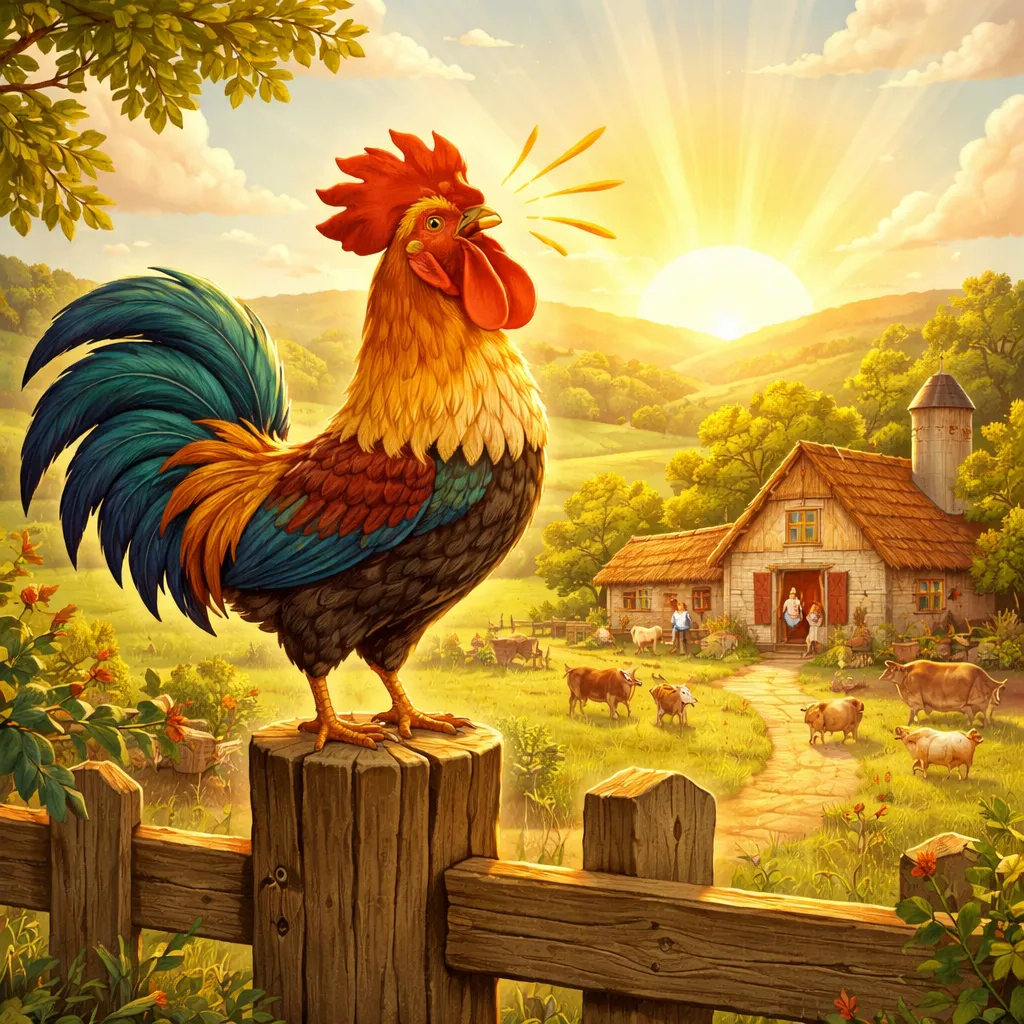
The song is a picture of a rooster’s important morning work. Imagine a quiet farm just as the sun starts to rise. The sky is light pink and orange. A little rooster with bright red comb and shiny feathers flies up onto the wooden fence. “The little rooster, the little rooster, he crows on the fence, cock-a-doodle-doo!” He takes a deep breath and lets out his loud, clear call.
His call echoes, “Kikeriki, kikerikah, the little rooster is here again.” He is the sign that a new day has started. “He crows, so that everyone can see, the morning cannot go back to sleep.” His call is like an announcement. It tells the sleeping cows, the chickens, the farmer, and the whole world that it is time to wake up. He is not just making noise; he is doing his job. “The little rooster, the little rooster, he crows us all a beautiful good day.” With his final call, he sends a friendly “good morning” wish to everyone on the farm. The song is about routines, responsibility, and the cheerful beginning of a new day.
Who Made It & Its Story
“Der kleine Hahn” is a traditional German folk song deeply rooted in rural and farm life. Its specific writer is unknown, as it comes from the long tradition of songs that explain the world to children through animals. The rooster (“Hahn”) is a classic symbol of the morning, punctuality, and a new beginning in German-speaking cultures, much like a living alarm clock. This song connects children to the natural rhythms of the day that were once essential for farm life.
This bright, welcoming song is loved for three important reasons. First, it is a fantastic and fun way to learn the iconic German animal sound for a rooster (“Kikeriki”) and action verbs like “kräht” (crows). Second, it has a very catchy, repeating melody and a clear, strong rhythm that mimics the rooster’s confident call, making it easy and satisfying to sing. Third, it teaches about daily rhythms, responsibility, and the idea of greeting a new day with a positive wish, which are comforting and important concepts for children.
When to Sing It
This song is the perfect morning anthem. You can sing it loudly when you wake up, stretching your arms like wings and crowing “Kikeriki!” to greet the day. You can chant it during a playtime about farms, pretending to be the rooster waking up all the other toy animals. You can also sing it as a cheerful “good morning” greeting to your family, just like the rooster crows a good day to everyone.
What Children Can Learn
This rhythmic, purposeful song is a wonderful teacher about animals, time, and friendly greetings in German.
Vocabulary
The song teaches us clear words for animals, actions, places, and time in German. “The” (Der). “Little” (kleine). “Rooster” (Hahn). “He” (der / er). “Crows” (kräht). “On the” (auf dem). “Fence” (Zaun). “Cock-a-doodle-doo” (Kikeriki). “Is” (ist). “Already” (schon). “Again” (wieder). “Here / there” (da). “So that” (damit). “It” (es). “All” (alle). “Can see” (seh’n – short for sehen). “The morning” (der Morgen). “Cannot” (kann nicht). “Sleep go” (schlafen geh’n). “Us” (uns). “All” (allen). “A” (einen). “Beautiful” (schönen). “Good” (guten). “Day” (Tag).
Let’s use these words! You can give a greeting: “Guten Tag!” (Good day!) You can describe an action: “Der Vogel singt.” (The bird sings.) New word: Wecken. This is the German verb for “to wake someone up,” which is exactly what the little rooster does!
Language Skills
This song is excellent for learning about saying why something happens, using the word “damit” (so that). The key line is “Er kräht, damit es alle seh’n” (He crows, so that everyone can see). It also introduces the idea of something being for someone, as in “er kräht uns allen einen Tag” (he crows us all a day).
Concept Definition: The word “damit” is a special word that explains the reason or purpose for doing something. It connects an action (the crowing) to its goal (everyone seeing). It answers the question “Why?”. In the song, why does the rooster crow? He crows so that everyone can see the morning has come.
Features and Types: “Damit” is a word that links two parts of a sentence: the action and the purpose. The word order after “damit” is special: the verb (like “seh’n” or “gehen”) often goes to the end of that part. Another way to give a reason is “weil” (because), which explains a cause. “Damit” is about the goal for the future.
How to Spot Them: Here is a simple “goal finder” trick. Ask: “What is the goal? What does the person/animal want to happen by doing this action?” If you can answer with “so that…”, then you can use “damit.” The rooster crows. What is his goal? His goal is: so that everyone sees the morning. So we use “Er kräht, damit es alle seh’n.”
How to Use Them: A great way to explain why you do things is the “Action-Goal Formula”. The pattern is: “[Action Sentence], damit [Goal Sentence].”
Example from the song: “Der Hahn kräht, damit alle aufwachen.” (The rooster crows, so that everyone wakes up.)
Example you can make: “Ich singe, damit ich fröhlich bin.” (I sing, so that I am happy.) or “Ich rufe, damit du mich hörst.” (I call, so that you hear me.)
Sounds & Rhythm Fun
Listen to the proud, clear rhythm of the melody. The song has a strong, announcing tune that sounds like a rooster’s call. The most fun part is singing the famous rooster sound: “Kikeriki, kikerikah!” It is a tongue-twister and so much fun to say. The repeated line “Der kleine Hahn” starts each important announcement, like a drumroll.
The rhythm is steady and strong, perfect for marching or pretending to be a proud rooster strutting. The sounds are bright and open, like a morning yawn. The line “kräht uns allen einen schönen guten Tag” is a lovely, long, friendly wish that flows like a melody. This musical pattern is perfect for creating your own morning announcer song. You can write your own “Die kleine Glocke” (The Little Bell) song! Try: “Die kleine Glocke, die kleine Glocke, die läutet hell, bim-bam-bom! Bim-bam-bom, bim-bam-bei, die kleine Glocke läutet frei. Sie läutet, damit alle geh’n, zur Schule oder auf die Zeh’n…” (The little bell… rings brightly… it rings, so that everyone goes, to school or on their toes…)
Culture & Big Ideas
“Der kleine Hahn” connects to the German cultural appreciation for punctuality, order, and the structured beginning of the day. The rooster as a natural alarm clock is a strong symbol in folklore. The song also reflects traditional farm life, where the rooster’s call was an important timekeeper for starting chores. The friendly wish for a “schönen guten Tag” (beautiful good day) is a very common and warm German greeting.
The song conveys three important, structured ideas. First, it teaches about natural cycles and routines, showing how the rooster’s call marks the transition from night to day. Second, it models responsibility and helpfulness, as the rooster performs his important job for the whole community. Third, it promotes positive social interaction and friendliness by turning a simple animal sound into a cheerful greeting for everyone.
Values & Imagination
Imagine you are the important “kleine Hahn” on a cool, quiet morning. You stand on the highest fence post, feeling the first warm rays of the sun. “The little rooster, the little rooster, he crows on the fence, cock-a-doodle-doo!” You fill your lungs and let out your powerful call. The sound breaks the silence. “Kikeriki, kikerikah, the little rooster is here again.” You are the sign that night is over.
You crow with purpose. “He crows, so that everyone can see, the morning cannot go back to sleep.” You see a light turn on in the farmhouse. You hear the cows begin to move. Your job is working. You take one more breath, this time to send kindness. “The little rooster, the little rooster, he crows us all a beautiful good day.” How does the morning air feel? How does it feel to know your call helps everyone start their day? Draw the rooster’s morning. Draw a fence post with a rooster on top, its beak open. Draw the sun rising. Draw speech bubbles with “Kikeriki!” and “Guten Tag!” floating over the farm to a house, a barn, and some animals. This shows the song’s message of announcement and greeting.
The song encourages us to appreciate daily routines, to understand how even small roles (like a morning call) are important, and to start our own days with a positive wish for others. A wonderful activity is the “Guten-Tag-Ruf” (Good-Day Call). In the morning, find a spot, stand up tall like a rooster, and say (or crow!) “Guten Tag!” to your room, your family, or the day outside. You can even say “Einen schönen guten Tag!” like in the song. This connects you to the rooster’s spirit of cheerful announcement.
So, from the first “Kikeriki” to the final friendly wish, this song is a morning celebration. It is a vocabulary lesson in animals, time, and greetings. It is a language lesson in using “damit” (so that) to explain a purpose. It is a music lesson in a strong, announcing melody with a fun animal sound. “The Little Rooster (Der kleine Hahn)” teaches us about nature’s routines, about having a helpful job, and about greeting each new day with a friendly voice.
Your Core Takeaways
You are now an expert on the song “The Little Rooster (Der kleine Hahn).” You know it is a cheerful German song about a rooster who crows on a fence to announce the morning and wish everyone a good day. You’ve learned German words like “Hahn,” “kräht,” “Zaun,” “Kikeriki,” “Morgen,” and “guten Tag,” and you’ve practiced using “damit” (so that) to explain why someone does something. You’ve felt its proud, rhythmic melody and created your own morning announcer verse. You’ve also discovered the song’s message about daily routines, responsibility, and starting the day with a positive greeting.
Your Practice Missions
First, play the “Warum?” (Why?) game. Think of a simple action, like turning on a light. Say a sentence in German using the “damit” pattern from the song: “Ich mache das Licht an, damit ich sehen kann.” (I turn on the light, so that I can see.) You can do this for other actions, like “Ich rufe, damit du kommst.” (I call, so that you come.) This mission helps you practice the song’s language skill of explaining a purpose.
Second, be the “Morgen-Hahn” (Morning Rooster) for one day. In the morning, find a safe place to stand tall. Announce the day by saying the rooster’s line loudly: “Kikeriki! Einen schönen guten Tag!” Then, go and wish at least one person a real “Guten Morgen!” (Good morning!). This mission lets you act out the song’s core action of giving a cheerful morning greeting.