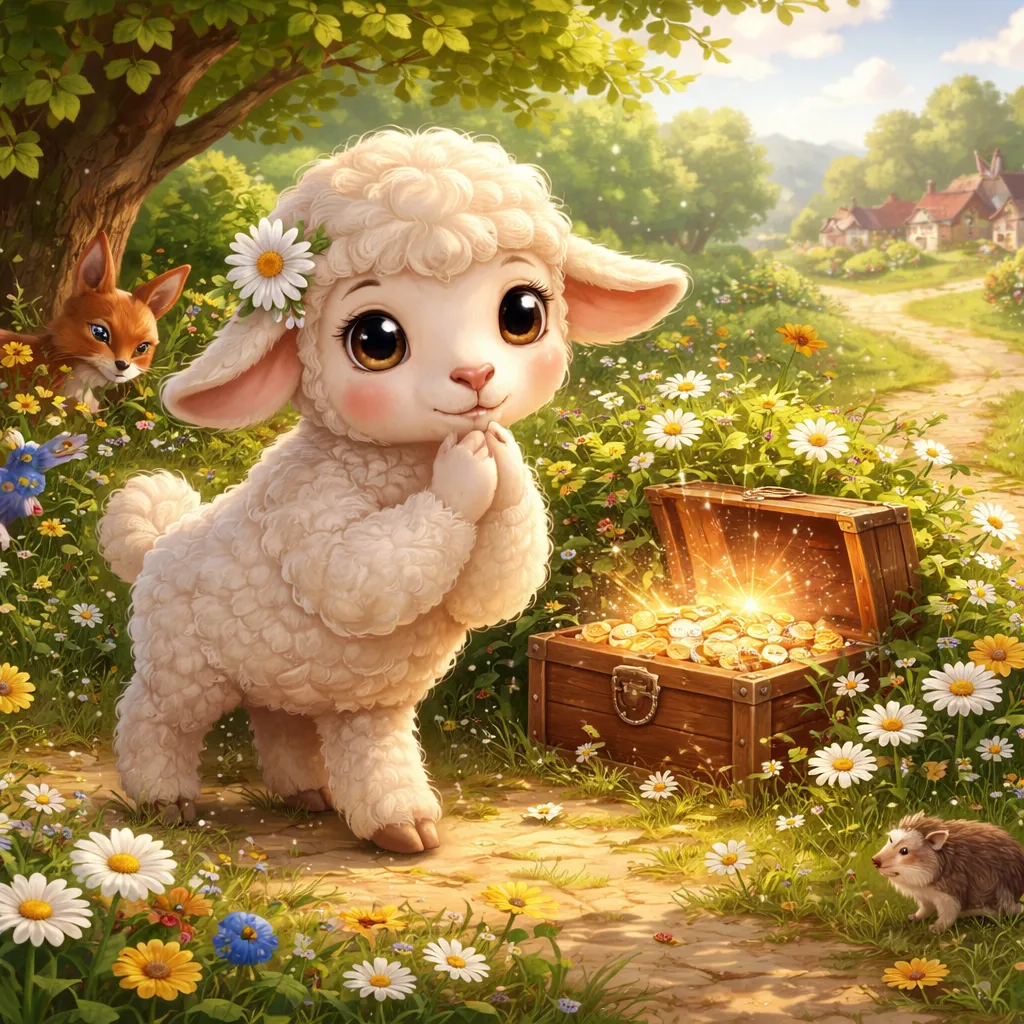

Have you ever touched a soft, woolly sweater and wondered where the wool comes from? It comes from a fluffy, gentle animal. In Germany, there is a sweet, curious song that asks a little sheep all about itself. It is a song full of simple, friendly questions. Let’s discover the cozy song “The Little Sheep (Das kleine Schaf).”
About the Song
Here are the gentle, questioning lyrics of a beloved traditional German children’s song:
Das kleine Schaf, das kleine Schaf,
das hat ein weißes, weißes Fell.
Das kleine Schaf, das kleine Schaf,
das hat vier Beine, stampf, stampf, stampf!
Das kleine Schaf, das kleine Schaf,
das frisst das grüne, grüne Gras.
Das kleine Schaf, das kleine Schaf,
das macht mäh, mäh, mäh!
English Translation:
The little sheep, the little sheep,
it has a white, white coat.
The little sheep, the little sheep,
it has four legs, stomp, stomp, stomp!
The little sheep, the little sheep,
it eats the green, green grass.
The little sheep, the little sheep,
it says baa, baa, baa!
This is a classic German-language folk and farm song for children. The song is a friendly chat with a sheep. “The little sheep, the little sheep, it has a white, white coat,” it starts, describing the sheep’s most famous feature. Each line tells us something new about the sheep. “It has four legs, stomp, stomp, stomp!” “It eats the green, green grass.” Finally, we hear its voice. “It says baa, baa, baa!” The song builds a full, cute picture of a sheep using simple, repeated sentences. It feels like getting to know a new, fluffy friend.
What the Song is About
The song is a list of wonderful facts about a little sheep. Imagine a sunny green meadow. A small, fluffy sheep stands quietly. “The little sheep, the little sheep, it has a white, white coat.” Its wool is as white and puffy as a cloud.
Look closer. “The little sheep, the little sheep, it has four legs, stomp, stomp, stomf!” It stomps its hoof on the ground three times. It is hungry. “The little sheep, the little sheep, it eats the green, green grass.” It lowers its head and munches on the delicious, green blades. Then, it looks up. “The little sheep, the little sheep, it says baa, baa, baa!” It calls out to its friends with its soft, gentle voice. The song is about observing an animal closely, noticing its parts, its food, and its sound.
Who Made It & Its Story
“Das kleine Schaf” is a traditional German folk song that belongs to the rich collection of German “Kinderlieder” about animals and farm life. Its specific writer is unknown, passed down through families, kindergartens, and farm visits. The song connects children to the traditional German countryside (“Landleben”), where sheep farming has a long history. It reflects a cultural appreciation for simple, rural life and for knowing where things like wool and milk come from.
This descriptive song is loved for three clear reasons. First, it is a perfect, repetitive way to learn the essential German verb “haben” (to have) and simple descriptive sentences, building a strong foundation for describing anything. Second, it engages multiple senses by describing looks (“weißes Fell”), actions (“stampf”), food (“Gras”), and sound (“mäh”), creating a complete, multisensory learning experience. Third, it uses a calm, cumulative structure that is easy to remember and expand upon, encouraging children to observe and describe other animals in the same way.
When to Sing It
This song is perfect for calm, observational moments. You can sing it softly while visiting a farm, petting zoo, or looking at pictures of sheep in a book. You can chant it as a gentle action song, stomping your feet on “stampf” and making eating motions on “frisst.” You can also sing it as a cozy lullaby to a stuffed animal sheep, gently describing it before sleep.
What Children Can Learn
This gentle, descriptive song is a wonderful teacher about farm animals, simple facts, and the verb “to have” in German.
Vocabulary
The song teaches us clear words for animals, body parts, colors, actions, and sounds in German. “The” (Das). “Little” (kleine). “Sheep” (Schaf). “It” (das / es). “Has” (hat). “A” (ein). “White” (weißes). “Coat” or fur/wool (Fell). “Four” (vier). “Legs” (Beine). “Stomp” (stampf). “Eats” (frisst). “The” (das). “Green” (grüne). “Grass” (Gras). “Makes” / says (macht). “Baa” (mäh).
Let’s use these words! You can describe any animal: “Die Katze hat weiches Fell.” (The cat has soft fur.) You can talk about what you eat: “Ich esse Brot.” (I eat bread.) New word: Wiese. This is the German word for “meadow,” the green, grassy home of the little sheep in the song.
Language Skills
This song is excellent for learning about describing what something has or owns, using the verb “haben” (to have). The key sentence pattern is “Das kleine Schaf hat…” (The little sheep has…). It also introduces the verb “fressen” (to eat, for animals).
Concept Definition: The verb “haben” means to have or to own. It tells us what someone or something possesses. In the song, the sheep has a white coat. The sheep has four legs. “Haben” is one of the most important verbs for describing things.
Features and Types: “Haben” is an irregular verb. Its form changes with the subject. For “it” (das Schaf) or “he/she,” we use “hat”. For “I,” we use “habe.” For “you,” we use “hast.” For “we/they,” we use “haben.” The song uses “hat” because it’s talking about the sheep (it).
How to Spot Them: Here is a simple “possession check” trick. Ask: “What does the subject have?” The word that answers is often connected to “haben.” In the song: What does the sheep have? It has a white coat. It has four legs. The word “hat” is the key.
How to Use Them: A great way to describe anything is the “Possession Formula”. The pattern is: “[Thing] + hat + [what it has].”
Example from the song: “Das Schaf hat ein weißes Fell.” (The sheep has a white coat.)
Example you can make: “Ich habe ein Buch.” (I have a book.) “Der Baum hat grüne Blätter.” (The tree has green leaves.)
Sounds & Rhythm Fun
Listen to the steady, gentle rhythm of the melody. The song has a simple, marching tune that feels like a calm walk through a field. The repetition of the line “Das kleine Schaf” starts each new fact, like a friendly reminder of who we are talking about. The repeated words “weißes, weißes” and “grüne, grüne” are fun to say and emphasize the color. The sound effect “stampf, stampf, stampf!” is a great stomping sound, and the final “mäh, mäh, mäh!” is the classic German sheep sound, different from the English “baa.”
The rhythm is clear and steady, perfect for a gentle, clapping game or for doing actions: patting your own “coat” on “weißes Fell,” stomping feet on “stampf,” pretending to eat grass on “frisst Gras,” and making sheep sounds on “mäh.” The repetitive structure makes each new fact easy to remember. This musical pattern is perfect for creating your own animal fact song. You can write your own “Die kleine Kuh” (The Little Cow) song! Try: “Die kleine Kuh, die kleine Kuh, die hat schwarz-weiße Flecken. Die kleine Kuh, die kleine Kuh, die hat vier Beine, steckt, steckt, steckt! Die kleine Kuh, die kleine Kuh, die frisst das frische Heu. Die kleine Kuh, die kleine Kuh, die macht muh, muh, muh!” (The little cow… has black and white spots… has four legs, stands, stands, stands!… eats the fresh hay… says moo, moo, moo!)
Culture & Big Ideas
“Das kleine Schaf” connects to the German traditions of farming (“Landwirtschaft”), hiking in the countryside (“Wandern”), and regional festivals. Seeing sheep in meadows is a common sight in many German regions. The song reflects a straightforward, observational approach to nature, teaching children to identify animals by their features, food, and sounds. It connects to the practical knowledge of where wool comes from, celebrated in festivals and markets.
The song conveys three clear, educational ideas. First, it promotes close observation and categorization, breaking down an animal into its key attributes: appearance, body parts, diet, and sound. Second, it celebrates the simplicity and beauty of nature and farm animals, fostering a connection to the source of everyday materials like wool. Third, it uses repetition and accumulation to build knowledge, a common and effective method in early childhood learning.
Values & Imagination
Imagine you are in a wide, green meadow. You see a fluffy, white shape. It is “das kleine Schaf.” You walk closer. “The little sheep, the little sheep, it has a white, white coat,” you whisper, touching the soft wool in your mind. You look at its strong legs. “The little sheep, the little sheep, it has four legs, stomp, stomp, stomp!” It stomps its foot, maybe shaking off a fly. You watch it eat. “The little sheep, the little sheep, it eats the green, green grass.” It munches happily. Then it looks at you. “The little sheep, the little sheep, it says baa, baa, baa!” It calls to you with its gentle voice. How does the wool feel? How does the fresh grass smell? Draw the little sheep’s world. Draw a big, green meadow. Draw a fluffy white sheep in the middle. Around the sheep, draw four small pictures: a patch of white wool, four legs, some green grass, and a speech bubble that says “MÄH!”. This shows all the facts from the song.
The song encourages us to look at animals closely, to learn the simple facts about their lives, and to appreciate the gifts they give us, like warm wool. A wonderful activity is the “Was hat es?” (What does it have?) observation game. Look at a toy animal or a pet. Describe it using the “hat” (has) formula from the song. “Das Kaninchen hat lange Ohren.” (The rabbit has long ears.) “Der Vogel hat Federn.” (The bird has feathers.) This connects you to the song’s spirit of friendly, factual observation.
So, from the white coat to the gentle “mäh,” this song is a friendly introduction to a farm animal. It is a vocabulary lesson in animals, colors, body parts, and sounds. It is a language lesson in using “hat” (has) to describe what things possess. It is a music lesson in a steady, repetitive, descriptive melody. “The Little Sheep (Das kleine Schaf)” teaches us to observe carefully, to describe simply, and to appreciate the gentle animals around us.
Your Core Takeaways
You are now an expert on the song “The Little Sheep (Das kleine Schaf).” You know it is a gentle German song that describes a sheep’s white coat, four legs, grass diet, and “mäh” sound. You’ve learned German words like “Schaf,” “weiß,” “Fell,” “Beine,” “Gras,” and “mäh,” and you’ve practiced using the verb “hat” (has) to describe what animals possess. You’ve felt its steady, descriptive rhythm and created your own animal fact verse. You’ve also discovered the song’s message about careful observation, appreciating farm animals, and learning through repetition.
Your Practice Missions
First, play the “Was hat das Schaf?” (What does the sheep have?) game. Find a stuffed animal sheep or draw one. Point to its parts and say the German sentences from the song: “Es hat ein weißes Fell.” (It has a white coat.) “Es hat vier Beine.” (It has four legs.) Then, add one new fact about it in German, like “Es hat zwei Augen.” (It has two eyes.) This mission makes you a great observer, just like the song.
Second, be a “Beschreiber” (Describer). Choose any animal you like—a dog, a cat, a bird. Describe it in German using the song’s “hat” (has) pattern. Say: “Der [animal name] hat…” and say what it has. For example, “Der Vogel hat Flügel.” (The bird has wings.) “Die Katze hat einen Schwanz.” (The cat has a tail.) This mission lets you use the song’s most important language skill to talk about any animal you see.