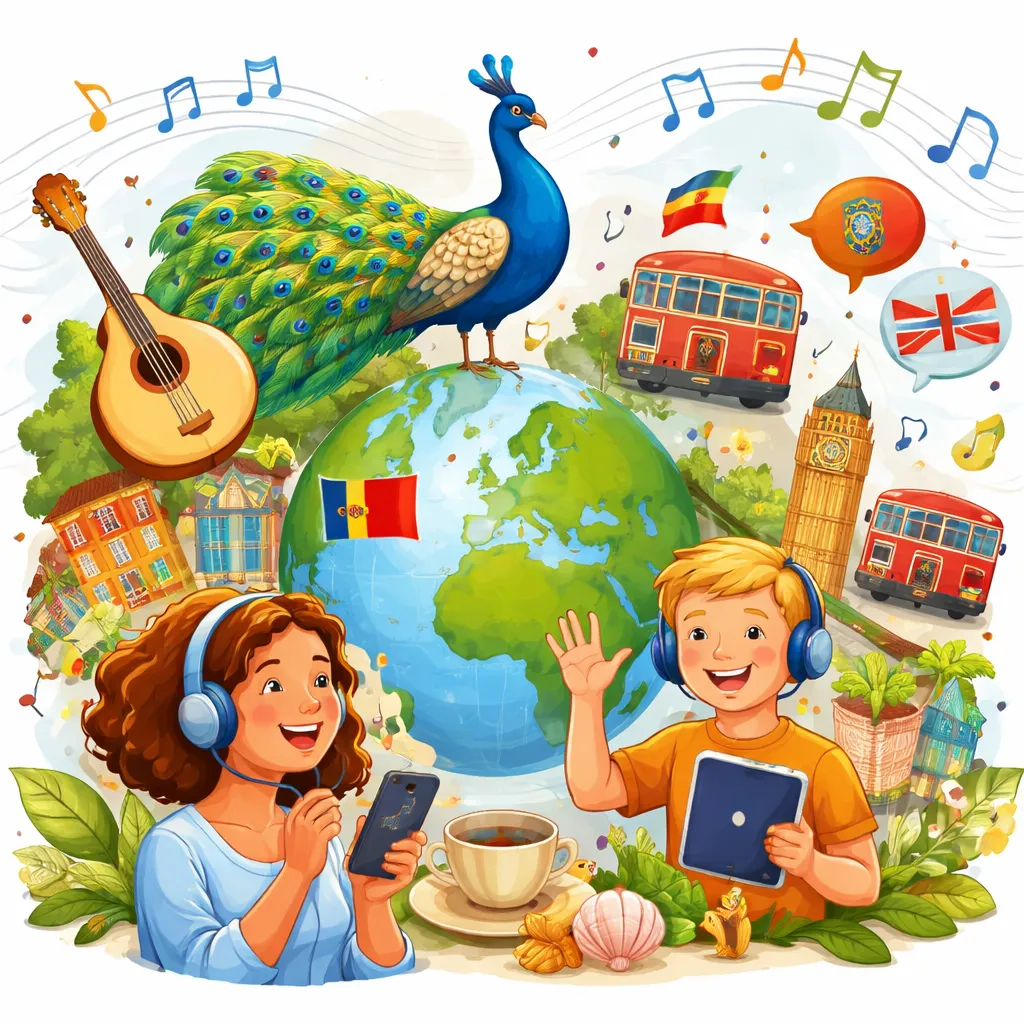

A peacock opens his feathers in a brilliant display. A children’s song can open a child’s mind to language in that same beautiful way. Today, we explore a traditional Portuguese rhyme called “O Pavão,” which means “The Little Peacock.” This elegant song celebrates the peacock’s stunning tail and graceful movements. We will use this melody as a gentle path into English. Together, we will learn new words, explore important sounds, and discover how a simple song can make language learning feel as beautiful as a peacock’s display. The peacock shows his colors with pride. Your child can show their new language skills with that same gentle confidence.
What is the rhyme? “O Pavão” is a cherished nursery rhyme in Portuguese-speaking cultures. It tells the story of a little peacock who opens his magnificent tail. The song has a slow, graceful rhythm, like the peacock’s elegant walk. Children often use hand movements. They spread their fingers wide behind them like a tail. They walk slowly and proudly. They make soft, admiring sounds. The song celebrates beauty and uniqueness. It invites children to appreciate what makes each creature special. When we bring this song to English learning, we keep its graceful spirit. We use the familiar melody to introduce English words in a way that feels like unfolding something beautiful, one feather at a time.
The lyrics of nursery rhymes To appreciate this song, we first look at the original Portuguese words. Then we see how they translate into English. This shows children that the same elegant story can be told in different languages. You do not need to know Portuguese to enjoy the slow, graceful rhythm of the words.
Original Version (Portuguese)
O pavão, o pavão Vai abrir, vai abrir Sua cauda, sua cauda Vai florir, vai florir
English Version
The little peacock, the little peacock Will open, will open His tail, his tail Will bloom, will bloom
A second verse often continues the story, describing the beautiful colors.
Original Version (Portuguese)
Que beleza, que beleza Cores mil, cores mil Verde e azul, verde e azul Que lindo, que lindo
English Version
What beauty, what beauty A thousand colors, a thousand colors Green and blue, green and blue How beautiful, how beautiful
As you read these words, notice the flowing repetition. The rhythm moves like a peacock’s gentle stride. The story is simple and elegant. A peacock opens his tail. It blooms like a flower. The colors are green and blue. It is beautiful. This narrative invites children to appreciate beauty in nature.
Vocabulary learning This song offers a beautiful set of words that connect to nature, colors, and appreciation. We can explore these words through conversation, pictures, and gentle admiration.
Start with the main character: the peacock. In Portuguese, it is pavão. In English, we say “little peacock.” The word “peacock” refers to a male bird with a spectacular tail. You can look at pictures of peacocks together. Notice the eye-like patterns on the feathers. Talk about how special this bird is.
Here are the key words to focus on from the song:
Peacock: A beautiful bird with a large, colorful tail. Explain that only the male is called a peacock. The female is a peahen.
Open: To spread out. The peacock opens his tail. Ask your child to open their hands or a book.
Tail: The feathers behind the peacock. Show pictures of peacock tails. Notice how they fan out.
Bloom: To open up like a flower. This word usually describes flowers. Using it for the peacock’s tail makes the song poetic.
Beauty: Something that is lovely to see. Point out beautiful things around you. A flower. A sunset. Your child’s smile.
Colors: The different hues we see. The song mentions a thousand colors.
Green and blue: Two specific colors. Point to green and blue things in your home. Name them together.
Beautiful: How we describe something lovely. Use this word often when you see something wonderful.
Use these words in natural moments. When you see a flower open, say “look, the flower blooms like the peacock’s tail.” When your child wears a colorful shirt, say “what beautiful colors.” These connections make the vocabulary meaningful.
Phonics points Phonics helps children understand the sounds that build English words. This song gives us several clear sounds to explore in a gentle, graceful way.
First, focus on the ‘p’ sound at the beginning of “peacock.” This is a sharp, popping sound. Put your hand in front of your mouth and say “p p p.” You will feel a puff of air. Practice with “panda,” “paint,” and “peacock.” This sound is crisp and clear.
Next, notice the long ‘e’ sound in “peacock” and “green.” The ‘ea’ in “peacock” makes the long ‘e’ sound. Say “ee” like in “see.” Then say “green.” Practice with “tree,” “bee,” and “green.” This is a common vowel sound.
The word “beauty” contains the ‘eau’ sound. This is a special spelling. It sounds like “byoo-tee.” Say “byoo” and then “tee.” Practice with “beautiful” and “beauty.” This is a fun word to say slowly.
Finally, look at the ‘bl’ blend in “blue” and “bloom.” This is two consonants together. Say “b” and then quickly add “l.” Then add “ue” or “oom.” Practice with “black,” “blow,” and “blue.” This blend appears in many color words. The song also has “colors,” which contains the ‘or’ sound. Say “more,” “door,” and “colors.”
Grammar patterns Even a simple song contains grammar that we can introduce gently. We do not need to use technical terms. Instead, we show how words work together through examples and play.
The song uses the future tense with the word “will.” “Will open” means the peacock plans to open his tail. You can explain this simply. “Will” is a helper word that tells us something is going to happen. Practice by talking about your day. “You will see beautiful colors.” “We will look at pictures.” This gives children a tool to talk about future events.
The second verse introduces exclamations. “What beauty!” and “How beautiful!” are exclamations. They express strong feeling. You can practice by using exclamations in your day. “What a big tree!” “How tall you are!” This teaches children how to express admiration and excitement.
Notice the repetition of phrases. “The little peacock, the little peacock” repeats the noun. This repetition adds rhythm and elegance. Children can use this pattern themselves. They might say “the colors, the colors” when looking at something beautiful.
Also, look at the question form used indirectly. The song expresses admiration without asking a question. But you can introduce questions about beauty. “What colors do you see?” “Is this beautiful?” This builds conversational skills.
Learning activities Activities bring the song into the body and the imagination. They transform listening into active participation. These ideas are simple and require little preparation.
Peacock Dance Play the song and pretend to be the peacock. Walk slowly and gracefully. When the song says “will open his tail,” spread your fingers wide behind you. When it says “will bloom,” open your arms slowly. When it describes the colors, point to green and blue things around you. This activity builds listening skills and graceful movement.
Color Hunt Go on a color hunt around your home or outside. Look for green and blue things. Name them together. “Green leaf.” “Blue sky.” Then sing the part of the song about green and blue. This connects the song to the real world.
Beauty Appreciation Take a few moments each day to notice something beautiful. A flower. A cloud. A drawing your child made. Say “what beauty!” or “how beautiful!” Use the language from the song. This builds appreciation and vocabulary together.
Printable materials Printable resources offer a quiet way to reinforce the song’s vocabulary. They are perfect for moments when children want to create or focus calmly.
Flashcards Create a set of flashcards. One card shows the peacock. One shows a fan opening for “open.” One shows a peacock tail. One shows a flower blooming for “bloom.” One shows a rainbow for “colors.” One shows green and blue swatches. Use these cards for a matching game. Sing a line from the song and ask your child to find the matching card. This builds word recognition.
Coloring Page Draw a simple scene from the song. Show the little peacock with his tail open like a fan. Draw the tail with spaces for many colors. Children can color the tail in green, blue, and other beautiful colors. As they color, talk about the scene. “What colors are you using?” “Is the peacock beautiful?” This keeps the language flowing naturally.
Feather Pattern Page Create a page with an outline of a peacock tail feather. Provide small paper pieces in green and blue. Your child can glue the pieces onto the feather to create patterns. While working, sing the song together. This combines fine motor skills with language practice.
Educational games Games encourage repetition without boredom. They invite children to use the language in new and creative ways.
Peacock Says Play a game similar to “Simon Says.” Give commands using the song’s vocabulary. “The peacock says open your tail.” “The peacock says walk gracefully.” “The peacock says find something green.” If you give a command without saying “the peacock says,” the child does not move. This game builds listening skills.
Color Memory Place green and blue objects on a tray. Let your child look at them. Then cover the tray. Ask “what colors did you see?” Add other colors to make it more challenging. This builds memory and color vocabulary.
Beautiful Things Take turns naming beautiful things you see. “I see a beautiful flower.” “I see a beautiful blue sky.” Use the word “beautiful” each time. This extends the vocabulary from the song into everyday conversation.
As you share “O Pavão” with your child, remember that you are nurturing an appreciation for beauty and language together. The little peacock opens his tail slowly. He shows his colors with patience and pride. Learning a new language unfolds in that same gentle way. Each new word is like a feather in the tail. Each new sound is a new color to admire. Let the elegant peacock be your guide. Sing the song when you want to slow down and appreciate something lovely. Let the beauty of the peacock remind you both that language learning is not about rushing. It is about unfolding, one beautiful moment at a time.