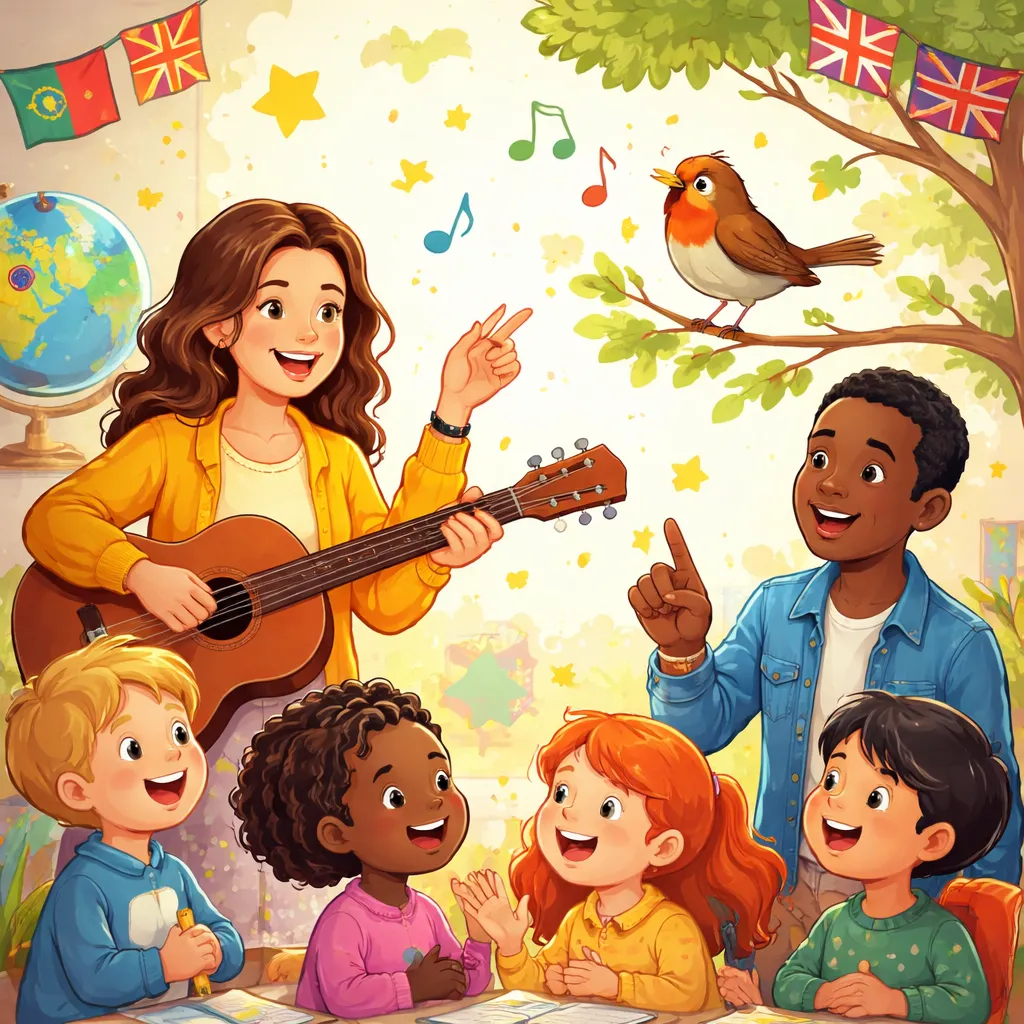

A robin is often one of the first birds a child notices. Its bright chest and cheerful song make it memorable. A children’s song can have that same effect on language learning. It can make new words stand out and stay in the mind. Today, we explore a traditional Portuguese rhyme called “O Tordo,” which means “The Little Robin.” This warm song follows a small robin who sings and explores. We will use this melody as a gentle, colorful path into English. Together, we will learn new words, explore important sounds, and discover how a simple song can make language learning feel as friendly as a robin perched on a branch. The robin is small but noticeable. Your child’s new words can be that noticeable too.
What is the rhyme?
“O Tordo” is a gentle nursery rhyme in Portuguese-speaking cultures. It tells the story of a little robin who sings in the garden and looks for food. The song has a warm, cheerful rhythm. Children often use hand movements. They cup their hands to make a bird’s nest. They flap their arms gently. They make soft chirping sounds. The song celebrates the beauty of birds in the garden. It invites children to appreciate the small wonders in nature. When we bring this song to English learning, we keep its warm spirit. We use the familiar melody to introduce English words in a way that feels like spending a peaceful moment in the garden.
The lyrics of nursery rhymes
To appreciate this song, we first look at the original Portuguese words. Then we see how they translate into English. This shows children that the same warm story can be told in different languages. You do not need to know Portuguese to enjoy the cheerful, gentle rhythm of the words.
Original Version (Portuguese)
O tordo, o tordo
Vai cantar, vai cantar
No jardim, no jardim
Voa sem parar, voa sem parar
English Version
The little robin, the little robin
Will sing, will sing
In the garden, in the garden
Flies without stopping, flies without stopping
A second verse often continues the story, describing the robin’s bright colors.
Original Version (Portuguese)
Peito vermelho, peito vermelho
Tão bonito, tão bonito
A procurar, a procurar
Um amiguinho, um amiguinho
English Version
Red breast, red breast
So pretty, so pretty
Searching, searching
For a little friend, for a little friend
As you read these words, notice the warm repetition. The rhythm moves like a bird flitting from branch to branch. The story is simple and sweet. A robin sings in the garden and flies without stopping. He has a red breast that is so pretty. He searches for a little friend. This narrative invites children to look for beauty and friendship in nature.
Vocabulary learning
This song offers a lovely set of words that connect to nature, colors, and friendship. We can explore these words through conversation, pictures, and gentle observation.
Start with the main character: the robin. In Portuguese, it is tordo. In English, we say “little robin.” Robins are birds with orange-red chests. They are common in gardens. You can look at pictures of robins together. Notice the bright red breast. Listen for robin songs.
Here are the key words to focus on from the song:
Robin: A bird with a red chest. Explain that robins often appear in spring and summer.
Sing: What birds do. Listen for bird songs outside. Make your own singing sounds.
Garden: A place where flowers and plants grow. If you have a garden, visit it. If not, look at pictures of gardens.
Flies: Moves through the air. Make flying motions with your arms.
Without stopping: Continuously. The robin flies without stopping. This phrase shows persistence.
Red breast: The red feathers on the robin’s chest. Point to red things around you.
Pretty: Nice to look at. The robin is pretty. Use this word to describe beautiful things.
Searching: Looking for something. The robin searches for a friend.
Friend: Someone you like to be with. This is a special word. Talk about your child’s friends.
Use these words in natural moments. When you see a bird, say “look, a robin! He has a red breast.” When you go outside, say “we are in the garden, like the little robin.” These connections make the vocabulary meaningful.
Phonics points
Phonics helps children understand the sounds that build English words. This song gives us several clear sounds to explore in a warm, gentle way.
First, focus on the ‘r’ sound at the beginning of “robin” and “red.” This is a voiced sound made with the tongue. Say “rrrr” like a rolling sound. Practice with “run,” “rain,” and “robin.” This sound appears in many English words.
Next, notice the short ‘o’ sound in “robin.” Say “o” like in “hot.” Then say “robin” slowly. Practice with “top,” “hop,” and “robin.” The short ‘o’ is a common vowel sound.
The word “breast” contains the ‘ea’ sound. This is a short ‘e’ sound. Say “e” like in “bed.” Then say “breast.” Practice with “bread,” “head,” and “breast.” This sound is clear and short.
Finally, look at the ‘fr’ blend in “friend.” Say “f” and then quickly add “r.” Then add “end.” Practice with “frog,” “free,” and “friend.” This blend appears in many friendly words. The song also has “garden,” which contains the ‘ar’ sound. Say “ar” like in “car.”
Grammar patterns
Even a simple song contains grammar that we can introduce gently. We do not need to use technical terms. Instead, we show how words work together through examples and play.
The song uses the future tense with the word “will.” “Will sing” means the robin plans to sing. You can explain this simply. “Will” is a helper word that tells us something is going to happen. Practice by talking about what you will do. “We will look for robins.” “You will sing a song.” This gives children a tool to talk about future events.
The second verse uses descriptive phrases. “Red breast” and “so pretty” describe the robin. You can practice describing things. “The robin is pretty.” “The flower is red.” This builds vocabulary for description.
Notice the phrase “without stopping.” This uses “without” to show absence. You can practice with other “without” phrases. “He sings without stopping.” “She plays without resting.” This introduces a more advanced structure.
Also, look at the repetition of “searching, searching.” This repetition shows emphasis. Children can use repetition to show importance. “Looking, looking for my toy.” “Waiting, waiting for you.”
Learning activities
Activities bring the song into the body and the imagination. They transform listening into active participation. These ideas are simple and require little preparation.
Robin Flight
Play the song and pretend to be the robin. Flap your arms gently. Fly around the room. When the song says “sings,” stop and make a chirping sound. When it says “flies without stopping,” flap your arms quickly. When it says “searching for a friend,” look around. This activity builds listening skills and physical expression.
Red Breast Craft
Cut out a robin shape from paper. Let your child color the body brown and glue a red circle on the chest for the red breast. Talk about the song while creating. “The little robin has a red breast. So pretty!” This connects the song to a craft activity.
Friend Search
Go on a walk together. Look for birds, flowers, or other friends. Say “we are searching for a little friend, like the robin.” When you find something, point and name it. This builds observation skills and vocabulary.
Printable materials
Printable resources offer a quiet way to reinforce the song’s vocabulary. They are perfect for moments when children want to create or focus calmly.
Flashcards
Create a set of flashcards. One card shows the robin. One shows musical notes for “sing.” One shows a garden scene. One shows wings for “flies.” One shows a red circle for “red breast.” One shows two figures holding hands for “friend.” Use these cards for a matching game. Sing a line from the song and ask your child to find the matching card. This builds word recognition.
Coloring Page
Draw a simple scene from the song. Show the little robin in a garden. Color his breast red. Draw flowers around him. Children can color the garden with bright colors. As they color, talk about the scene. “What is the robin doing?” “What color is his breast?” This keeps the language flowing naturally.
Bird Feeder Craft
Create a simple bird feeder using a toilet paper roll, peanut butter, and birdseed. While making it, talk about the robin searching for food. Hang it outside and watch for visitors. This combines fine motor skills with language practice.
Educational games
Games encourage repetition without boredom. They invite children to use the language in new and creative ways.
Robin Says
Play a game similar to “Simon Says.” Give commands using the song’s vocabulary. “The robin says sing a song.” “The robin says fly without stopping.” “The robin says search for something red.” If you give a command without saying “the robin says,” the child does not move. This game builds listening skills.
Color Hunt
Go on a color hunt. Look for something red, like the robin’s breast. Look for something green, like the garden. When you find each color, say the word. This builds color vocabulary and observation skills.
Friend Match
Create cards with pictures of animal friends. A robin and another robin. A dog and a dog. A child and a child. Match the pairs. Say “friends together.” This builds understanding of friendship concepts.
As you share “O Tordo” with your child, remember that you are creating moments of warmth and connection. The little robin sings in the garden. He has a bright red breast. He searches for a friend. Learning a new language can be like that too. It is about singing new sounds. It is about noticing what is bright and beautiful in words. It is about finding connection with someone who shares the journey. Let the warm robin be your guide. Sing the song when you spend time in nature. Hum it when you do crafts together. Let the friendly spirit of the robin remind you both that language learning is not just about words. It is about the beauty you notice and the friends you make along the way.