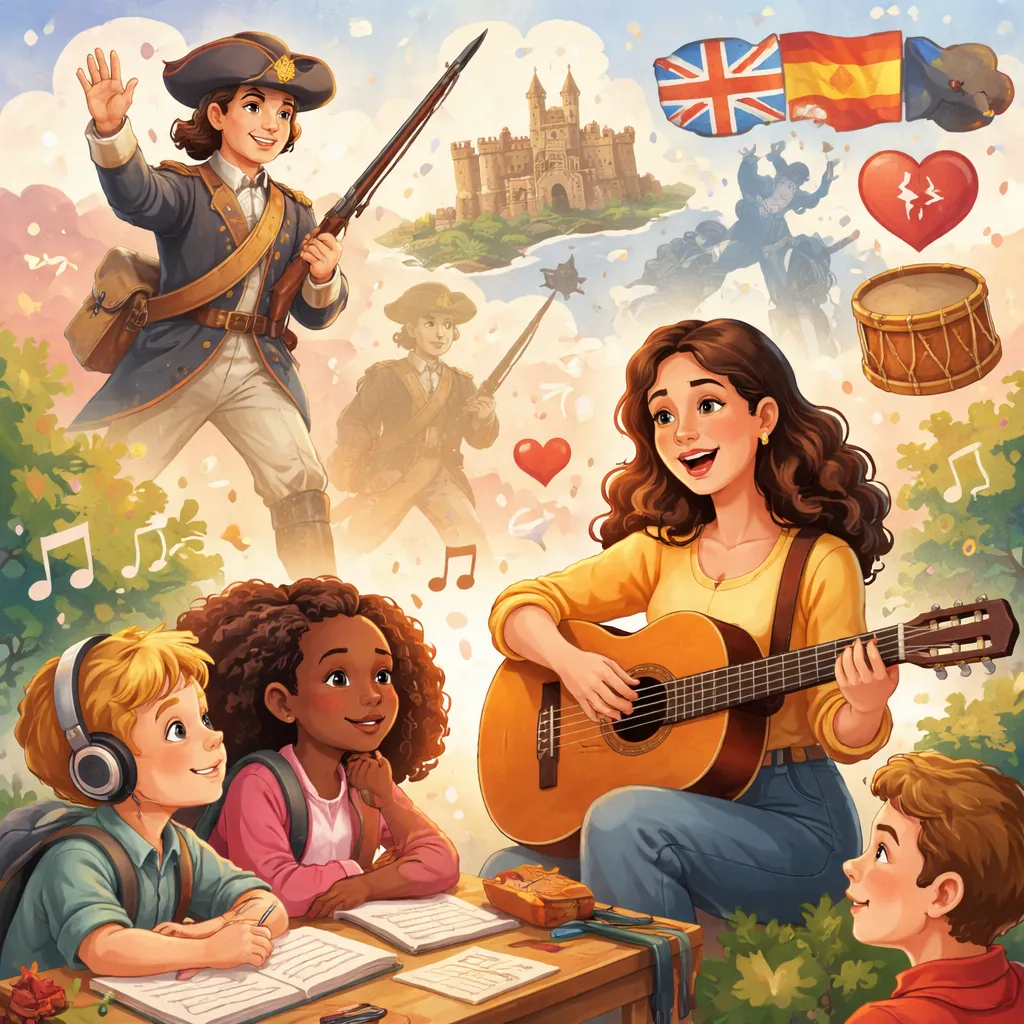

A soldier goes to war. He does not return. A children’s song can capture that story of loss and remembrance. Today, we explore a traditional Spanish children’s song called “Mambrú se fue a la guerra,” which translates to “Mambrú Went to War.” This gentle, melancholic song tells the story of a soldier who leaves for war and never comes back. We will use this melody as a thoughtful, reflective path into English. Together, we will learn new words, explore important sounds, and discover how a simple song can make language learning feel like listening to a story from long ago. Mambrú went to war. Your child can learn English with that same sense of story and reflection.
What is the rhyme?
“Mambrú se fue a la guerra” is a traditional Spanish children’s song that has been sung for centuries. It tells the story of a soldier named Mambrú who goes to war. The song describes how he does not return, and how his loved ones wait for him. The song has a slow, mournful rhythm. Children often use hand movements. They march in place. They put their hands over their hearts. They look sad. The song creates a thoughtful, reflective atmosphere. It teaches about loss, remembrance, and the cost of war. When we bring this song to English learning, we keep its thoughtful, reflective spirit. We use the familiar melody to introduce English words in a way that feels like hearing an old story.
The lyrics of nursery rhymes
To appreciate this song, we first look at the original Spanish words. Then we see how they translate into English. This shows children that the same sad story can be told in different languages. You do not need to know Spanish to enjoy the slow, mournful rhythm of the words.
Original Version (Spanish)
Mambrú se fue a la guerra
Qué dolor, qué dolor, qué pena
Mambrú se fue a la guerra
No sé cuándo vendrá
Do, re, mi, fa
Do, re, mi, fa
Mambrú se fue a la guerra
No sé cuándo vendrá
English Version
Mambrú went off to war
What sorrow, what sorrow, what pain
Mambrú went off to war
I don’t know when he’ll come back
Do, re, mi, fa
Do, re, mi, fa
Mambrú went off to war
I don’t know when he’ll come back
A longer version adds more verses about waiting and mourning:
Por la plaza pasa un coche
Qué dolor, qué dolor, qué pena
Por la plaza pasa un coche
Trae flores para él
English Version
Through the square a carriage passes
What sorrow, what sorrow, what pain
Through the square a carriage passes
It brings flowers for him
As you read these words, notice the slow, mournful repetition. The rhythm moves like a sad march. The story is simple and emotional. Mambrú went to war. What sorrow. I don’t know when he’ll come back. A carriage passes with flowers for him. This narrative invites children to feel empathy and reflect.
Vocabulary learning
This song offers a lovely set of words that connect to war, emotions, and waiting. We can explore these words through conversation, pictures, and thoughtful reflection.
Start with the main character: Mambrú. In Spanish, it is Mambrú. In English, we say “Mambrú.” It is a soldier’s name.
Here are the key words to focus on from the song:
War: Fighting between countries. Mambrú went to war.
Sorrow: Great sadness. What sorrow.
Pain: Hurt, suffering. What pain.
Come back: Return. I don’t know when he’ll come back.
Square: An open area in a town. Through the square.
Carriage: A vehicle pulled by horses. A carriage passes.
Flowers: Pretty plants that bloom. It brings flowers for him.
Wait: To stay for someone. They wait for him.
Use these words in natural moments. When someone is sad, say “what sorrow.” When you wait for someone, say “I wait.” These connections make the vocabulary meaningful.
Phonics points
Phonics helps children understand the sounds that build English words. This song gives us several clear sounds to explore in a thoughtful, reflective way.
First, focus on the ‘w’ sound at the beginning of “war.” This is a voiced sound made with rounded lips. Say “w w w.” Practice with “water,” “wind,” and “war.” This sound is strong and serious.
Next, notice the ‘o’ sound in “sorrow.” Say “o” like in “hot.” Practice with “top,” “hop,” and “sorrow.” This sound is short and open.
The word “pain” contains the long ‘a’ sound. Say “ay” like in “day.” Practice with “say,” “play,” and “pain.” This sound is bright but sad.
Finally, look at the ‘fl’ blend in “flowers.” Say “f,” then quickly add “l.” Then add “owers.” Practice with “flap,” “flip,” and “flowers.” The song also has “square,” which contains the ‘sq’ blend. Say “sk” quickly, then add “ware.”
Grammar patterns
Even a simple song contains grammar that we can introduce gently. We do not need to use technical terms. Instead, we show how words work together through examples and play.
The song uses the past tense to tell the story. “Went,” “passed,” and “brought” describe what already happened. You can practice telling simple stories in the past tense. “He went to war.” “He did not come back.” This builds understanding of past tense.
Notice the repetition of “what sorrow, what sorrow, what pain.” Repetition adds emphasis and emotion. You can practice repeating for effect. “What sadness.” “What waiting.” “What longing.” This adds expressive language.
The phrase “I don’t know when” shows uncertainty. You can practice with other “don’t know” phrases. “I don’t know when.” “I don’t know where.” “I don’t know why.” This builds understanding of uncertainty.
Also, look at the musical notes “do, re, mi, fa.” These are the first notes of the scale. You can practice singing them. This builds musical awareness.
Learning activities
Activities bring the song into the body and the imagination. They transform listening into active participation. These ideas are simple and require little preparation.
Soldier March
Play the song and pretend to be a soldier. March slowly. When the song says “what sorrow,” put your hand on your heart. When it says “I don’t know when,” look into the distance. This activity builds listening skills and reflective movement.
Flower Craft
Create paper flowers. Talk about how the carriage brought flowers. Place them on a picture of a square. This combines fine motor skills with language practice.
Waiting Game
Talk about waiting. Have you ever waited for someone? How did you feel? Say “I wait for you.” This builds emotional vocabulary.
Printable materials
Printable resources offer a quiet way to reinforce the song’s vocabulary. They are perfect for moments when children want to create or focus calmly.
Flashcards
Create a set of flashcards. One card shows a soldier for “war.” One shows a sad face for “sorrow.” One shows a carriage for “carriage.” One shows flowers for “flowers.” One shows a clock for “wait.” One shows musical notes for “do re mi fa.” Use these cards for a matching game. Sing a line from the song and ask your child to find the matching card. This builds word recognition.
Coloring Page
Draw a simple scene. Show a soldier marching away. Show a square with a carriage and flowers. Children can color the soldier, the carriage, the flowers, and the square. As they color, talk about the story. “Where is Mambrú going?” “What do the flowers mean?” This keeps the language flowing naturally.
Memory Box
Create a memory box for someone you miss. Put pictures or small objects inside. Talk about them. This builds emotional vocabulary and connection.
Educational games
Games encourage repetition without boredom. They invite children to use the language in new and creative ways.
Soldier Says
Play a game similar to “Simon Says.” Give commands using the song’s vocabulary. “Soldier says march to war.” “Soldier says feel sorrow.” “Soldier says wait.” “Soldier says bring flowers.” If you give a command without saying “soldier says,” the child does not move. This game builds listening skills.
Flower Hunt
Find flowers. Count them. Give them to someone you love. Say “flowers for you.” This builds social and emotional language.
Waiting Game
Set a timer. Wait quietly for one minute. Talk about how it feels to wait. This builds patience and emotional vocabulary.
As you share “Mambrú se fue a la guerra” with your child, remember that you are sharing a story of love, loss, and remembrance. Mambrú went to war. What sorrow. I don’t know when he’ll come back. A carriage passes with flowers for him. Learning a new language can also be about understanding stories. It can be about feeling what others feel. Let this thoughtful song be your guide. Feel the story. Let the reflective spirit of the song remind you both that every word you learn carries emotion, and every story you tell connects you to others.