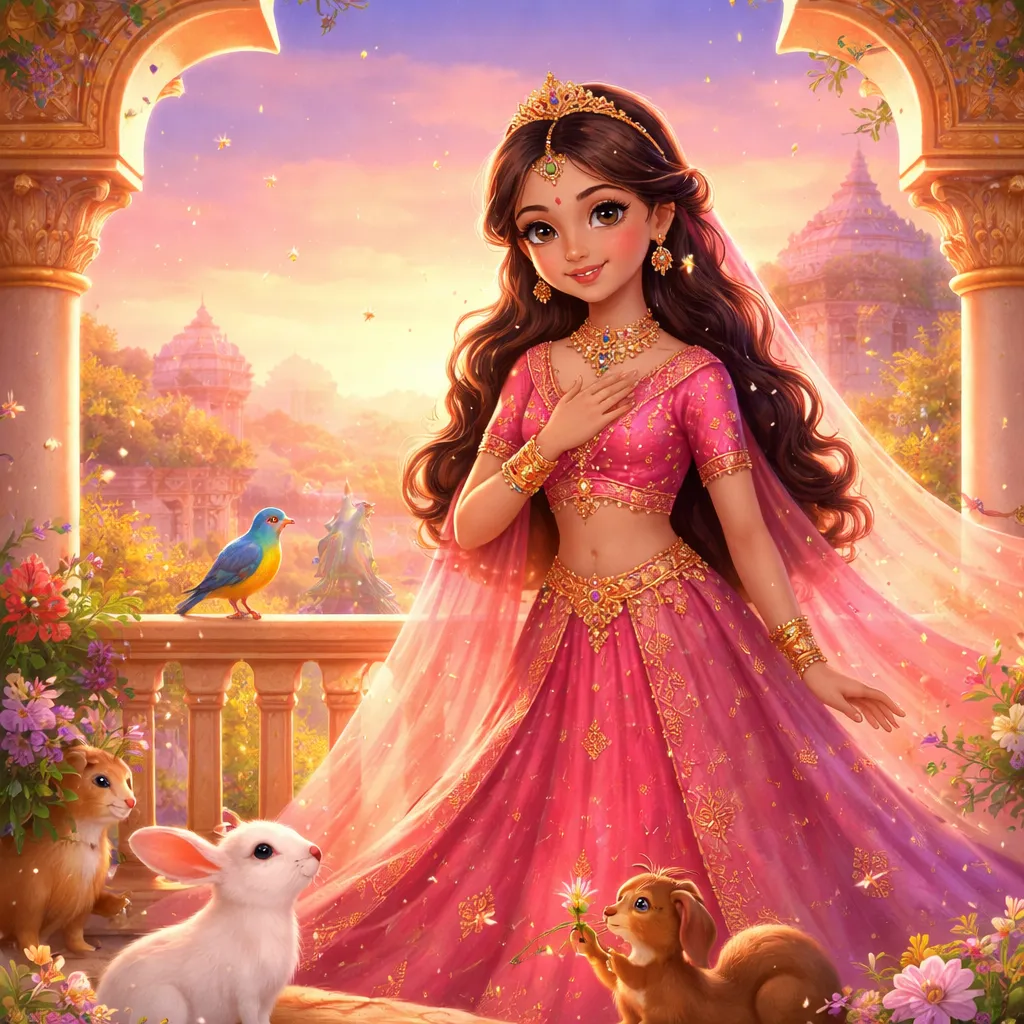

Have you ever played dress-up? Maybe you’ve put on a shiny necklace or a pretend crown and felt… royal? It’s fun to imagine being a princess in a grand palace. But what makes a true princess? Is it the sparkly dress, or is it something else? In India, a land of ancient kingdoms and modern stories, there’s a lovely song that answers this question. Let’s discover the Hindi Song: The Little Princess (राजकुमारी).
About the Song Here is a gentle and wise verse from this popular song in Hindi and English: मैं एक छोटी सी राजकुमारी (Main ek chhoti si rajkumari) I am a little princess मेरा ताज है मेरी अच्छाई (Mera taj hai meri achchai) My crown is my goodness मैं सबसे प्यार से बात करूँगी (Main sabse pyar se baat karungi) I will speak to everyone with love यही है मेरी खास बात (Yahi hai meri khaas baat) This is my special thing
This song’s original name is “राजकुमारी” (Rajkumari), the Hindi word for “princess.” It is a popular modern Indian children’s song. The song isn’t about living in a castle. It is about a girl declaring her own royal identity. Her crown isn’t made of gold and jewels; it is made of her own “goodness.” The song redefines what it means to be royal, showing that true princess qualities come from a kind heart and gentle actions. The Hindi Song: The Little Princess (राजकumārī) teaches that nobility is a choice you make every day.
What the Song is About The song is a confident and gentle promise. First, the singer simply states, “I am a little princess.” She claims the title for herself. Then, she shows us her special crown. We look closely, and we see it is not a physical object. “My crown is my goodness.” This means her kindness, honesty, and good choices are what make her royal. Her royal duty is clear: “I will speak to everyone with love.” The song pictures her using soft, respectful words with her friends, her family, and even strangers. She says this loving way of speaking is her “special thing”—her true superpower. The song paints a picture of a princess whose palace is her community and whose treasure is the happiness she brings to others.
Who Made It & Its Story This song comes from the world of contemporary Indian children’s media, which often focuses on positive values and modern role models. While specific creators aren’t widely listed, the song beautifully reflects a shift in storytelling. It moves away from old tales where princesses wait to be rescued, towards stories where they are defined by their character. In a country with a rich history of royal figures and epics, this song offers a new, empowering definition. The Hindi Song: The Little Princess (राजकुमारी) is beloved for three reasons. First, it empowers every child, especially girls, to see themselves as the heroes of their own stories. Second, it defines beauty and status through internal qualities like kindness, which every child can develop. Third, its melody is sweet, graceful, and easy to sing, making its positive message feel natural and lovely to repeat.
When to Sing It Sing this song quietly to yourself in the morning while brushing your hair, to remember that your “crown” is your kind heart for the day. It’s perfect to hum with friends when you are playing together, to remind everyone to use “love” in their words. You could also sing it as a family before a gathering, as a promise to be gracious and welcoming hosts to your guests.
The Hindi Song: The Little Princess (राजकुमारी) gives us a beautiful new definition of royalty. But this song is also a quiet teacher. It holds lessons about new words, how to talk about our identity and qualities, and the graceful patterns of music. Let’s explore the wisdom hidden in its melody.
What Children Can Learn
Vocabulary This song enriches our vocabulary for describing character and grace. Grace: Moving or behaving in a smooth, relaxed, and attractive way, especially under pressure. A dancer moves with grace. Speaking calmly when upset shows grace.
Dignity: A calm, serious, and respectful manner that makes people feel valued and in control. You show dignity by listening carefully when someone speaks.
Compassion: A strong feeling of understanding and caring for someone who is hurt or in trouble, and wanting to help. Giving your seat to someone tired is an act of compassion.
Integrity: Doing the right thing even when no one is watching. Returning a lost toy shows integrity.
Gentility: Kind, polite, and calm manners. Saying “please” and “thank you” is part of gentility.
Nobility: The quality of being honorable, generous, and courageous. Sharing your last piece of candy shows a nobility of spirit.
Language Skills This song is a perfect example of using the verb “To Be” to link a subject with its identity or quality. It’s the “equals” verb. What Is It?: The verb “to be” (am, is, are) is like an equals sign (=) in a sentence. It doesn’t describe an action like “run” or “jump.” Instead, it links the subject to who they are or what they are like. “I am a princess.” “My crown is goodness.”
Finding the Secret: Look for “am,” “is,” or “are.” Ask yourself: “Is this word connecting a person or thing to a name, a place, or a description?” If yes, it’s the verb “to be.”
Using It:
◦   Formula: [Subject] + am/is/are + [Rest of the sentence].

◦   I am happy. She is smart. We are friends. The sky is blue.

◦   In the song: “I am a little princess.” “My crown is my goodness.” “This is my special thing.” It defines her identity and her qualities.
Sounds & Rhythm Fun Listen to the graceful music. The Hindi Song: The Little Princess (राजकुमारी) has a sweet, flowing, and gentle rhythm. It doesn’t make you jump; it makes you sway softly. The melody is smooth and elegant, like a graceful dance. Words are sung clearly and lovingly, emphasizing the positive message. This gentle, flowing rhythm is calming and helps the important words about character (“goodness,” “love”) sink deeply into your memory. You can use this same smooth, graceful rhythm to make up a song about any gentle quality, like being a good listener or a peaceful friend.
Culture & Big Ideas This song connects to a modern reimagining of traditional ideals. India has ancient stories of wise and powerful queens and goddesses, like Devi Saraswati, the goddess of knowledge, music, and art, who is celebrated for her wisdom and grace, not just her appearance. A festival like Vasant Panchami, dedicated to her, is about honoring learning and culture. This song aligns with that value, focusing on inner wealth. The Hindi Song: The Little Princess (राजकुमारी) teaches three core ideas. First, Inner Kingdom: True royalty is not about what you own or where you live, but about the kingdom of your own good character. Second, Communication is Power: How you speak to others—with love and respect—is a true royal power that builds bridges. Third, Self-Definition: You get to define what makes you special. Your “crown” is what you choose it to be.
Values & Imagination Imagine your “crown of goodness.” What is it made of? Is it made of shiny moments when you told the truth? Is it decorated with gems of every time you shared? This song teaches you that the most beautiful things about you are invisible: your kindness, your honesty, your gentle words. A simple idea: For one day, wear a hairband or a ring as a reminder of your invisible crown. Every time you see or feel it, try to do one small thing that adds a “jewel” to it—like giving a sincere compliment or finishing a chore without being asked.
Your Core Takeaways The Hindi Song: The Little Princess (राजकुमारी) beautifully redefines royalty for the modern child. You learned words like “dignity” and “compassion” that describe true inner nobility. You discovered how to use the verb “to be” (am, is, are) to state who you are and describe your qualities. You felt the song’s gentle, flowing rhythm that carries its message of grace. You also connected its theme to the cultural appreciation for wisdom and art, embodied by figures like Devi Saraswati. Most importantly, the song teaches that your character is your crown, your words have power, and you hold the pen to write your own special story.
Your Practice Missions
- Your “Crown of Goodness” List. Sit quietly for a few minutes. Draw a simple crown on a paper. Inside or around it, write or draw three things that are your “goodness.” They can be words like “I share,” “I listen,” or “I try hard.” This is a map of your real crown.
- Host a “Royal Words” Tea Party. Invite a stuffed animal or a family member for a pretend tea party. Your mission is to speak only “royal” words for five minutes—words that are kind, polite, and loving. Use phrases like “Please,” “Thank you,” “I like your idea,” and “Can I help you?” Practice making your speech your “special thing,” just like the princess in the song.