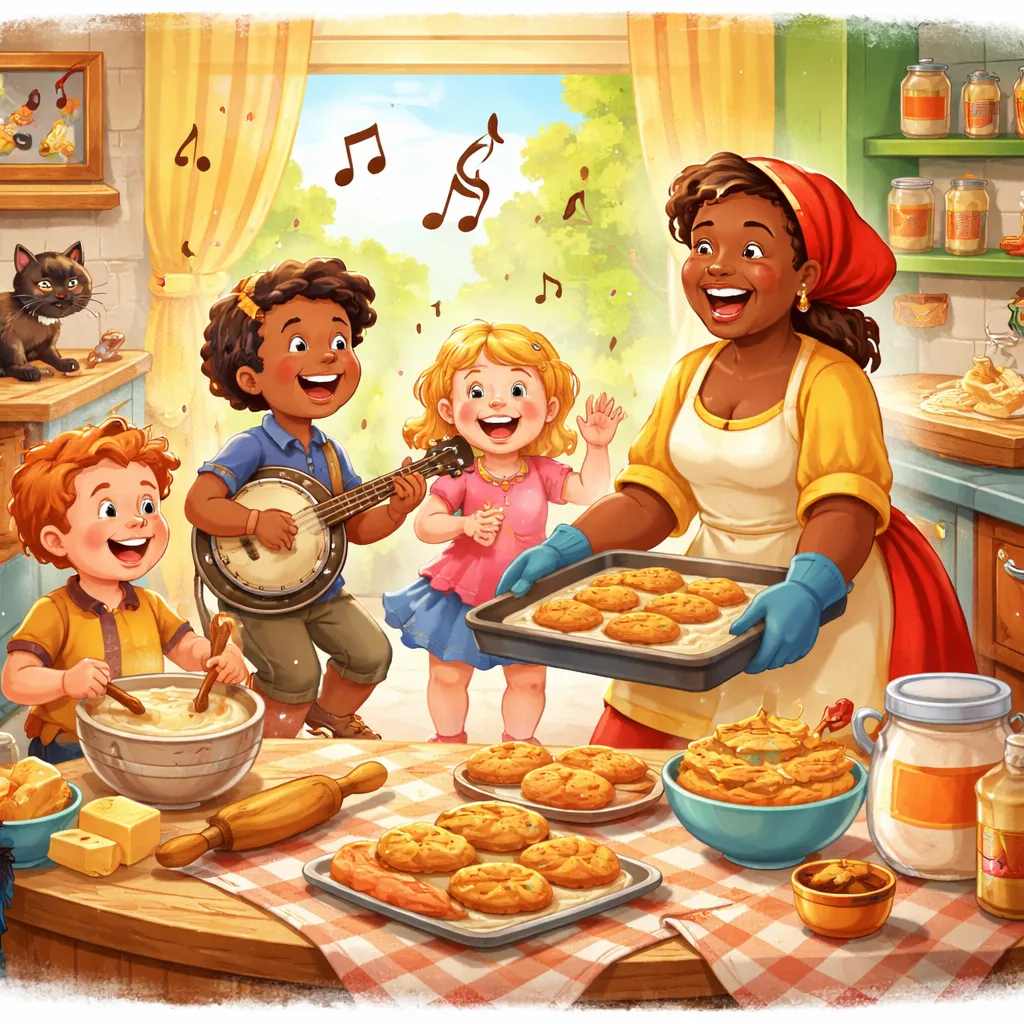

What is your favorite food that makes you smile just thinking about it? Is it cookies? Pancakes? Long ago, families sang a cheerful, clapping song about a special, simple treat that made everyone happy. It’s a song about cooking, mischief, and joy. Let’s learn about the folk song “Shortnin’ Bread.”
About the Song
Let’s read the playful, repeating words of this classic tune.
Two little children, lyin’ in bed,
One of them sick and the other ’most dead.
Call for the doctor, the doctor said,
"Feed those children on shortnin’ bread."
Mammy’s little baby loves shortnin’, shortnin’,
Mammy’s little baby loves shortnin’ bread.
Mammy’s little baby loves shortnin’, shortnin’,
Mammy’s little baby loves shortnin’ bread.
Put on the skillet, put on the led,
Mammy’s gonna make a little shortnin’ bread.
That ain’t all she’s gonna do,
Mammy’s gonna make a little coffee, too.
This song is a traditional African American folk song and children’s rhyme. It is a lively, rhythmic song about a simple food called “shortnin’ bread” (shortening bread), a type of biscuit or cake made with pan drippings or butter. The song’s origins are in the 19th century, and it is part of the rich tradition of Black American music. The lyrics tell a funny little story about children pretending to be sick to get this treat, and about their mother making it. The song is famous for its catchy, clapping rhythm and its celebration of family, food, and a playful trick.
What the Song is About
The song paints a funny, warm picture of family life. First, we see two children in bed. They are not really very sick; they are pretending! One is “sick” and the other is “’most dead,” which is a silly exaggeration. They call for the doctor, who isn’t fooled. He knows just what they want and prescribes the perfect medicine: “Feed those children on shortnin’ bread.”
The chorus is the heart of the song. It is a happy, proud declaration: “Mammy’s little baby loves shortnin’ bread.” Everyone sings it with a smile. Then, the scene moves to the kitchen. The mother (“Mammy”) gets busy. She puts the skillet (a frying pan) on the fire and the lid (“led”) on top. She is going to make the wonderful shortnin’ bread. And as a special treat, she’s going to make coffee too, probably for the adults. The song is all about the love of a special food and the cleverness of children trying to get it.
Who Made It & Its Story
“Shortnin’ Bread” is a traditional folk song, so its original author is unknown. It comes from African American communities in the southern United States in the 1800s. The song likely has roots in the harsh times of slavery, where making a simple, tasty treat from basic ingredients was an act of love and creating joy. The song was passed down orally through generations. It was first published in sheet music in 1900, with lyrics adapted by the poet James Whitcomb Riley. The song’s upbeat, clapping rhythm made it a favorite in both Black communities and later in mainstream American culture as a children’s song.
This song has remained a favorite for three wonderful reasons. First, its rhythm is incredibly catchy and perfect for clapping, tapping, and moving, making it an active song. Second, it tells a tiny, funny story that children understand and find amusing—the idea of pretending to be sick for a treat. Third, it celebrates a universal joy: the love of a special food made by a loved one, which is a feeling everyone, everywhere, can understand.
When to Sing It
This song is perfect for cozy, happy times. You can sing it with your family while helping to bake cookies or biscuits, clapping along as you mix the dough. You can sing it as a playful clapping game with friends, seeing how fast you can clap the rhythm. You can also sing it softly as a silly lullaby, pretending to be the children in bed.
What Children Can Learn
This joyful, rhythmic song is full of interesting lessons. Let’s explore what’s cooking.
Vocabulary
The song teaches us wonderful words about food and family. “Shortnin’” is a short way of saying “shortening,” which is a fat like butter or lard used in baking. “Bread” here means a baked good like a biscuit or simple cake. “Lyin’” is a short way of saying “lying,” meaning resting in bed. “’Most” is a short way of saying “almost.” A “skillet” is a frying pan. A “led” is an old, informal way of saying “lid,” the top of a pot or pan. “Mammy” is an old-fashioned, informal word for mother.
Let’s use these words! You can say, “We need shortening to make the pie crust.” Or, “Put the lid on the pot of soup.” New word: Nourishment. This is food that helps you grow and stay healthy. The shortnin’ bread is nourishment for the children.
Language Skills
This song is a great lesson in using contractions and understanding cause and effect. Contractions are short forms of words. The song uses “lyin’” (lying), “’most” (almost), and “ain’t” (isn’t). These make the language sound casual and how people might really talk.
The song also shows a clear cause and effect. The cause is the children pretending to be sick. The effect is the doctor telling their mother to feed them shortnin’ bread. This is a simple story sequence. The line “That ain’t all she’s gonna do” uses informal grammar to add more information, which is common in storytelling songs.
Sounds & Rhythm Fun
Listen to the strong, clapping, bouncing rhythm of the melody. The song has a fantastic call-and-response feel. The chorus is the most famous part, with its happy repetition. The verses have a clear rhyme scheme: “bed” and “dead,” “said” and “bread,” “led” and “bread,” “do” and “too.”
The rhythm is a steady, syncopated 4/4 time, perfect for patting your knees or clapping. Try a simple clap pattern: clap on “lit-” and “-tle” in “Mammy’s little baby.” The melody is simple, repetitive, and very easy to learn. This strong, rhythmic, and repetitive musical pattern is what makes the song so fun and easy to remember. You can write your own food song! Use the same clapping rhythm. Try: “Daddy’s little helper loves pizza, pizza, Daddy’s little helper loves pizza pie. Put on the oven, wait for the cheese, Daddy’s gonna make a pizza that will please!”
Culture & Big Ideas
“Shortnin’ Bread” is an important part of African American folk culture. It comes from a history of making the most of simple ingredients and finding joy and comfort in family and food, even in difficult times. The song reflects values of resourcefulness, love, and the small, sweet pleasures of life. It is a celebration of the mother’s role as a nourisher and the clever, playful spirit of children.
The song shares three wonderful ideas. First, it’s about the comfort of home and family. The song makes us think of a warm kitchen, a caring mother, and the safety of home. Second, it celebrates playfulness and cleverness. The children aren’t really sick; they’re just being smart to get a treat, which is a funny, harmless trick. Third, it highlights the joy of simple things. Happiness doesn’t need to be complicated; it can be as simple as a piece of warm, sweet bread made with love.
Values & Imagination
Imagine you are one of the children in the bed. How do you pretend to be sick? Do you cough? Moan? What does the doctor look like? Does he have a bag? Imagine the smell of the shortnin’ bread cooking in the skillet. Buttery and sweet? What does it taste like? Warm and crumbly? Now, imagine you are the mother. How do you feel knowing the children are playing a trick? Are you amused? Draw a picture of the kitchen scene. Show the mother at the stove, the skillet, and the two children peeking out from another room, smiling because their plan worked.
The song inspires us to appreciate simple treats and the love of our family. A lovely idea is to have a “Family Comfort Food” talk. With your family, talk about a simple food that makes you all feel happy and loved. Is it toast with jam? A special soup? Then, if you can, make it or draw a picture of it together. This connects the song’s theme to your own family’s traditions.
So, as the last clap fades, think about the warmth of this simple song. It is a vocabulary lesson in old-fashioned cooking. It is a grammar lesson in contractions and story sequences. It is a music lesson in a clapping, joyful rhythm. From the first line about the children in bed to the final promise of coffee, it wraps a lesson in love, cleverness, and the joy of simple comforts in a tune that makes your hands want to clap. “Shortnin’ Bread” teaches us that home is where the heart is, that a little playfulness is fun, and that some of the best memories are made in the kitchen, with a song.
Your Core Takeaways
You are now an expert on the song “Shortnin’ Bread.” You know it is a traditional African American folk song about a favorite treat. You’ve learned words like “shortnin’,” “skillet,” and “led,” and you’ve seen how contractions and cause-and-effect work in a story. You’ve felt its clapping, bouncing rhythm and created your own food verse. You’ve also discovered the song’s roots in family and resourcefulness, and its messages about home, playfulness, and the joy of simple things.
Your Practice Missions
First, have a “Shortnin’ Bread” baking playtime. With a grown-up’s help, make a simple baked treat together, like biscuits or muffins. While you mix and wait, sing the song. Clap the rhythm. When your treat is done, enjoy it as your own “shortnin’ bread.” This connects the song to a real, tasty activity.
Second, create a “Modern Comfort Food” song verse. Think of a simple food your family loves today. Write a new verse for “Shortnin’ Bread” about that food. For example: “Two little children, lookin’ so sad, until they saw the treat that they had. Called for their parent, who simply said, ‘Let’s share a plate of tacos instead!’” Sing your new verse to your family.